A low murmur moved through the hall. Conrad’s hand closed into a fist. Evelyn looked straight at him. “And to begin that work, I am announcing a fifty-million-dollar founding endowment, transferred this afternoon from Hale Trust assets that were never part of Whitmore Capital, never controlled by my husband, and never available for corporate image laundering.” The room burst open. Not with applause at first. With astonishment. Then applause followed, sharp at first, then swelling. Conrad shoved his way through the crowd toward the edge of the stage. “Turn off the microphone,” he hissed at a technician. The technician remained still. Evelyn went on. “As part of that endowment, we have commissioned an independent audit of all prior charitable activity associated with this gala. Any misdirected funds will be recovered. Any fraudulent authorizations will be referred to the appropriate authorities.” Several board members lost color in their faces. Marissa whispered, “Conrad, what is she talking about?” He gave no answer. Because his phone had started buzzing. Then buzzing again. Then again. Across the hall, other screens began lighting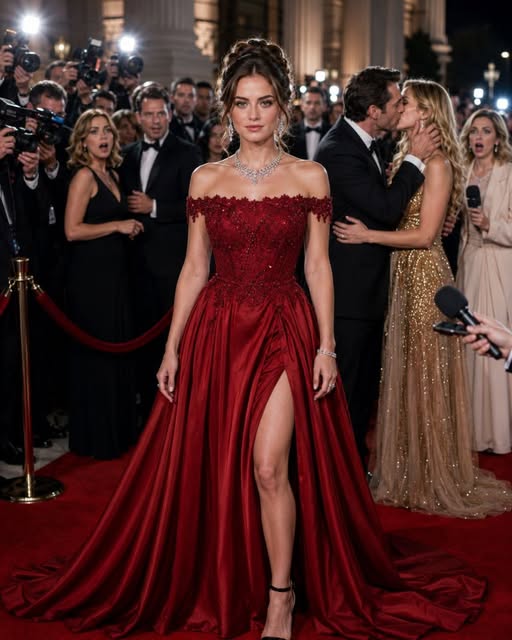
up too. A financial alert flashed across them. WHITMORE CAPITAL SHARES FALL AFTER CEO RED-CARPET SCANDAL AND FOUNDATION AUDIT ANNOUNCEMENT. A second headline appeared right after it. UNKNOWN INVESTOR GROUP SEEKS EMERGENCY REVIEW OF CONRAD WHITMORE’S LEADERSHIP. Conrad stared down at his phone as if the device itself had betrayed him. Evelyn descended from the podium to roaring applause. Lydia Cross met her near the side exit. “Stock dropped eighteen percent in seven minutes,” Lydia murmured. “Not
enough.” “The first article is live. The flight records, Marissa’s contract, the foundation transfers.” Evelyn’s expression remained unchanged. “Good.” Conrad stepped into her path, his eyes wild. “You leaked company records?” “I protected foundation records.” “You’ll go to prison.” “No,” Lydia
said pleasantly, moving beside Evelyn. “But someone might.” Marissa suddenly looked very young. “Conrad?” He snapped, “Be quiet.” The cruelty in his tone made Evelyn look at Marissa once more. For one fleeting second, she did not see a rival. She saw a woman realizing the door had
locked behind her as well.
Then Conrad seized Evelyn’s wrist.
The room witnessed it.
So did the cameras.
So did Judge Marian Ellis, standing six feet away with an untouched glass of champagne and the expression of a woman already composing an affidavit in her mind.
“Let go of my client,” Lydia said.
Conrad did not.
Evelyn glanced down at his hand, then lifted her eyes to his face.
“This,” she said calmly, “is your second mistake tonight.”
He dropped her wrist as though it had burned him.
At 9:17 p.m., the museum’s enormous screens switched from donor slides to a live news broadcast. Someone on the production team had misunderstood—or perhaps understood perfectly—the order to monitor coverage.
Conrad’s kiss appeared across the screen.
Then Evelyn’s arrival.
Then the newscaster’s voice echoed through the gala hall.
“Sources confirm that Evelyn Whitmore, long believed to be merely the wife of billionaire Conrad Whitmore, is in fact the controlling figure behind tonight’s gala and the Hale Trust, raising urgent questions about Whitmore’s use of charitable assets…”
Every face turned toward Conrad.
For the first time in his public life, Conrad had no prepared line.
Evelyn passed him and walked toward the private donor room, where the true meeting was about to begin. At the door, she stopped and glanced back.
“You wanted the world to know who she was,” Evelyn said, glancing once at Marissa. “Now they’re about to know who you are.”
Then she vanished inside.
The donor room held no cameras, no orchestra, and no flowers. Only a long walnut table, twelve leather chairs, and a wall of windows facing Central Park.
It was the only truthful room in the entire building.
Evelyn took the seat at the head of the table, even though Conrad’s name had been printed on the place card there. Lydia sat on her right. On her left was Helen Voss, chairwoman of the museum board and one of the rare women in New York capable of making a billionaire feel like an underdressed intern.
The Whitmore Capital board arrived in pieces.
Robert Keane, Conrad’s CFO, looked as if he had grown ten years older in a single hour. Malcolm Price, the general counsel, kept polishing his glasses even though they were already spotless. Two outside directors avoided Evelyn’s gaze. They had known enough to feel ashamed, but not enough to be ready.
Conrad came in last.
He had left Marissa outside in the hallway.
That told Evelyn everything she needed to know.
“This is absurd,” he said, slamming the door. “A marital disagreement has been turned into a corporate ambush.”
Helen Voss folded her hands together. “You kissed your mistress on a charity red carpet sponsored by your wife’s foundation while under audit for improper charitable transactions. That is not a marital disagreement. That is governance failure wearing a tuxedo.”
Conrad jabbed a finger toward Evelyn. “She planned this.”
“Yes,” Evelyn said.
The room went still.
She let the single word settle over them.
“I planned to protect my mother’s foundation from a man using philanthropy as stage lighting.”
“You set me up.”
“No. I set the table. You chose what to serve.”
Lydia opened a folder. “At 8:41 this morning, Mr. Whitmore signed updated conduct acknowledgments connected to tonight’s event. At 8:52, those documents were filed with the Hale Trust. At 9:04, Mr. Whitmore engaged in public behavior that triggered reputational liability provisions tied to both the foundation agreement and his marital settlement terms.”
Conrad gave a sharp, ugly laugh. “You expect a court to destroy a marriage contract over a kiss?”
“No,” Lydia said. “We expect the court to examine the kiss, the stock decline, the improper transfers, the concealed contract awarded to Ms. Vale’s company, the private jet usage, and your attempt to pressure museum staff into suppressing my client’s speech.”
Robert Keane shut his eyes.
Conrad noticed.
“You knew?” he demanded.
Robert’s reply was almost too quiet to hear. “I warned you about the Vale contract.”
“You warned me it was messy.”
“I warned you it was illegal.”
That was the first fracture that sounded like the beginning of a collapse.
Conrad swung back toward Evelyn. “You think you can run my company?”
Evelyn nearly smiled. “Conrad, I have been running your company for twelve years. You’ve been attending interviews.”
The blow landed harder because everyone at the table knew it was true.
Every major acquisition had passed through Evelyn’s private review. Every successful retreat from dangerous debt had followed one of her quiet cautions. Every time Conrad appeared visionary, it was because Evelyn had handed him the map before he stepped onstage.
“You were useful,” Conrad said, his voice shaking with rage. “Don’t confuse that with being powerful.”
Evelyn rose.
She was not especially tall, but the atmosphere of the room altered when she stood.
“My mother used to say powerful men make one fatal mistake,” she said. “They assume the women taking notes are secretaries.”
She placed a second folder on the table.
“These are voting proxies from investors representing thirty-one percent of Whitmore Capital. These are letters from three institutional shareholders demanding an emergency leadership review. This is confirmation that Hale Trust partners acquired additional shares through legal market purchases over the last quarter.”
Malcolm Price went pale.
Conrad stared at her. “How much?”
Evelyn held his gaze.
“Enough.”
At that exact moment, the door opened.
Marissa stood there, mascara smeared beneath one eye, gripping her silver purse as if it were a shield.
Conrad erupted. “Get out.”
But Marissa stayed where she was.
“I signed something too,” she said.
Everyone in the room turned.
Conrad’s expression hardened into a warning. “Marissa.”
Her voice shook, but she continued. “You told me it was a publicity agreement. You said after tonight you’d announce the separation and I’d get a foundation ambassador role.”
Evelyn watched her closely.
Marissa pulled several folded papers from her purse and passed them to Lydia.
“He made me sign a nondisclosure agreement this afternoon. But there’s another page. He promised me a payment if I appeared with him tonight and if Evelyn reacted badly in public.”
The silence turned deadly.
Lydia read the page once.
Then again.
A slow, ruinous smile appeared on her face.
“Mr. Whitmore,” she said, “did you pay your mistress to provoke your wife into a public breakdown?”
Conrad lunged toward Marissa. “You stupid little—”
Security moved before he could finish.
This time, two guards restrained him.
Marissa began to cry, but not prettily. Not like a starlet. She cried like a woman who had finally understood she had been led onto a battlefield dressed as decoration.
“He said she was unstable,” Marissa whispered. “He said if she made a scene, he could prove she wasn’t fit to control the trust. He said everyone would believe him because she was cold and strange and no one liked her anyway.”
For the first time that night, Evelyn felt real pain.
Not because Conrad had betrayed her. That wound had long since scarred over.
Because suddenly, she understood the full design of his plan.
He had not simply wanted to shame her.
He had wanted to erase her.
The kiss had been meant as a weapon. Marissa had been meant as bait. Evelyn had been meant to break on camera, to scream, to slap him, to collapse into the image he had spent years constructing around her: brittle wife, emotional woman, unstable heiress, unfit trustee.
Instead, she had entered like winter.
Conrad stared at Evelyn, breathing hard.
For the first time, she saw fear in him that had nothing to do with losing money.
He was afraid because she finally knew the whole truth.
Evelyn turned toward Lydia. “Add the attempted trust interference to the filing.”
“With pleasure,” Lydia said.
Then Evelyn looked at Marissa.
“Do you have somewhere safe to go tonight?”
Marissa blinked, stunned.
Conrad let out a bitter laugh. “You’re helping her now?”
Evelyn’s gaze cut back to him.
“No,” she said. “I’m proving the difference between us.”
By sunrise, Conrad Whitmore’s empire was losing blood from every visible wound.
The kiss had turned into a cultural spectacle. The contract had turned into a legal crisis. The financial filings had turned into a market disaster. Together, they created the kind of flawless storm no crisis manager could rebrand as ordinary rain.
At 6:00 a.m., Whitmore Capital’s communications department issued a statement describing the situation as “a private family matter.”
At 6:07, three major newspapers released documents proving foundation money had been funneled through consulting vendors tied to Conrad’s personal circle.
At 6:22, footage appeared showing Conrad grabbing Evelyn’s wrist.
At 6:41, the sentence You should have read the contract before you kissed her became the top trending phrase in America.
Evelyn was not watching the coverage from home.
She watched from her mother’s former office inside the Hale Foundation building, a modest brick townhouse on the Upper West Side that Conrad had once dismissed as “sentimental real estate.” Eleanor’s books still filled the shelves. Her walking cane still stood in the corner. On the desk sat a framed photograph of Evelyn at twelve years old, beside her mother at the opening of their first women’s shelter in Queens.
In that photograph, Evelyn was smiling.
She looked at that younger version of herself for a very long time.
Then Lydia came in carrying coffee and bad news.
“Conrad is petitioning for emergency injunctions,” Lydia said.
“On what basis?”
“He claims you manipulated a mentally vulnerable spouse into signing documents he didn’t understand.”
Evelyn let out a quiet laugh without humor. “Conrad claiming helplessness. How historic.”
“There’s more. He’s also alleging the Hale Trust was secretly controlled through marital assets.”
“He can allege sunrise is a conspiracy. Can he prove it?”
“No.”
“Then proceed.”
Lydia sat down across from her. “Evelyn, Marissa Vale’s attorney called.”
Evelyn lifted her eyes.
“She wants immunity in exchange for testimony.”
“Give her protection if she tells the truth.”
“You don’t owe her that.”
“No,” Evelyn said. “I owe Conrad nothing. That’s different.”
The emergency hearing took place forty-eight hours later.
The courtroom was full.
Conrad came through the front entrance because he still believed being seen was the same as having power. He wore a navy suit and an injured expression carefully practiced for the cameras. His attorneys surrounded him like a flock of costly birds. He attempted to appear dignified, but his eyes were red, and his jaw carried the swollen stiffness of a man who had not slept.
Evelyn entered through the side door with Lydia.
She wore gray.
Not white. Not triumph. Gray, like stone.
Judge Marian Ellis was presiding. The same Judge Ellis who had seen Conrad seize Evelyn’s wrist at the gala. She listened for three hours while Conrad’s lawyers argued that Evelyn had designed a malicious scheme meant to ruin him emotionally, financially, and socially.
When they were finished, Judge Ellis looked nearly bored.
Then Lydia rose.
She did not raise her voice. She did not dramatize. She simply connected fact to fact until Conrad found himself stranded on the wrong side of the river.
Signed paperwork. Audit trails. Investor letters. Foundation ownership records. Emails in which Conrad called Evelyn “the ice queen” and discussed “forcing a public reaction.” A message to Marissa that said: If she loses control on camera, the trust fight becomes easy.
After that, the courtroom shifted.
Even Conrad’s lead attorney stopped writing notes.
Then Marissa gave testimony.
She entered in a simple black dress, her hair pulled back, without diamonds or glamour. She seemed smaller than she had on the red carpet, but steadier as well. When Conrad saw her, his mouth twisted with contempt.
Marissa told the truth.
Not all of it made her look innocent. She admitted she had wanted Conrad’s money, influence, and promises. She admitted she had ignored the obvious cruelty of being involved with a married man. She admitted she had enjoyed the thought of being publicly chosen.
“But he told me Mrs. Whitmore was dangerous,” Marissa said, voice shaking. “He said she needed to be exposed. He said if she acted crazy, everyone would finally see what he had lived with.”
Lydia asked, “Did Mrs. Whitmore ever threaten you?”
“No.”
“Did she ever contact you before the gala?”
“No.”
“What did she do after you gave her the agreement?”
Marissa swallowed.
“She asked if I had somewhere safe to go.”
For the first time that morning, Evelyn lowered her gaze.
Conrad stared down at the table.
By the end of the hearing, Judge Ellis rejected his injunction, protected Evelyn’s authority over the Hale Trust, and referred multiple financial issues for further investigation. She also issued a temporary order barring Conrad from contacting Evelyn, Marissa, or foundation employees.
When the gavel fell, Conrad flinched.
Outside the courthouse, reporters packed the steps.
Conrad tried to speak first. “This is a coordinated attack by a bitter woman—”
A journalist cut him off.
“Mr. Whitmore, did you plan to provoke your wife into a public breakdown?”
Another called out, “Did you misuse charity funds?”
Another followed: “Is Marissa Vale cooperating with prosecutors?”
Conrad’s face twisted.
For years, questions had been soft cushions tossed gently at his ego. Now they were stones.
Evelyn walked past him without slowing.
One reporter called, “Mrs. Whitmore, do you feel vindicated?”
She stopped.
The cameras moved closer.
“No,” Evelyn said. “Vindication suggests this was about feelings. It was about facts.”
“Do you have anything to say to your husband?”
Evelyn turned slightly.
Conrad looked at her then—not with love, not even with hatred, but with the stunned disbelief of a man watching a mirror refuse to reflect him.
“Yes,” she said.
The steps fell silent.
“You wanted me to fall apart in public,” Evelyn said. “I’m sorry you had to settle for the truth.”
Then she went to her car.
That evening, Conrad returned not to the Whitmore penthouse, but to a rented hotel suite under legal supervision. His corporate cards had been frozen. The board had suspended him while the review continued. Investors demanded leadership changes before the markets opened on Monday.
At midnight, alone in a room smelling of generic soap and failure, Conrad called Evelyn from a blocked number.
She answered because she wanted to know what a collapsing empire sounded like.
“You destroyed me,” he said.
Evelyn stood by the window of her mother’s office, looking down at the streetlights.
“No,” she replied. “I stopped protecting you from yourself.”
For once, Conrad had nothing to say.
She ended the call.
Three months later, the Whitmore name was removed from the tower.
It happened on a cold Monday morning beneath a pale New York sky. Workers in orange harnesses lowered the silver letters one at a time while pedestrians paused to record. WHITMORE CAPITAL had once sat atop the building like a threat. By noon, the first word had vanished. By sunset, only pale outlines remained against the stone.
Two weeks later, new letters were installed.
HALE PARTNERS.
Evelyn did not become CEO.
That surprised the business press, which had anticipated a coronation. They wanted the obvious ending: betrayed wife claims the throne, ruined husband disappears, applause rises. But Evelyn had never trusted obvious endings. Obvious endings belonged to men like Conrad, men who confused attention with control.
Instead, she appointed a respected operations chief, broadened the board, separated the foundation from the company, and built a legal firewall so solid that Lydia Cross called it “emotionally satisfying architecture.”
Evelyn became chairwoman.
Quiet power fit her.
Conrad fought for some time. Men like Conrad always did. He hired louder lawyers, gave wounded interviews, and insisted he had been trapped by a cold, calculating wife. But discovery was merciless. More emails appeared. More transfers. More witnesses.
The divorce settlement took from him the penthouse, the Hamptons estate, his voting rights in the company, and the fantasy that money made him untouchable. He kept enough wealth to remain comfortable, which offended him more deeply than poverty would have. Comfort was not power. Comfort did not make rooms fall silent when he entered.
Marissa left New York.
Evelyn heard that she went back to Ohio for a time, then relocated to Chicago using the relocation assistance Evelyn had arranged through the foundation’s legal partners. Six months after the gala, a handwritten letter arrived at Evelyn’s office.
I don’t expect forgiveness, it said. I’m not even sure I deserve peace yet. But I wanted you to know I started over. Not as Marissa Vale. As myself. Thank you for not letting him make me disappear too.
The letter was signed: Anna Vail.
Evelyn placed it inside her desk drawer and did not cry.
She almost never cried anymore. Sometimes that worried her.
One year after the gala, the Evelyn Hale Foundation opened its largest shelter in Brooklyn. The building held legal offices on the first floor, childcare on the second, temporary apartments above, and a rooftop garden where residents could sit without being visible from the street.
Evelyn attended the opening in a navy coat, standing beside women who had escaped men with less money than Conrad but the same appetite for control.
After the ribbon-cutting, one woman approached her. She was young, carrying a toddler on her hip, with a bruise fading beneath makeup.
“I saw you on TV,” the woman said. “That night. The red carpet.”
Evelyn’s expression softened. “I’m sorry.”
“No,” the woman said. “I mean, I saw you not break. I thought maybe I didn’t have to either.”
Those words stayed with Evelyn longer than any magazine cover ever did.
That evening, Evelyn went to her mother’s grave.
The Boston cemetery was quiet, the grass silvered by frost. Evelyn stood before Eleanor Hale’s headstone with her hands tucked into her coat pockets while the wind lifted loose strands of hair around her face.
“I carried out the deed,” she said softly.
For a long while, she listened to the bare trees creaking.
Then she added, “But I don’t know what to do with the house now that the fire is out.”
The truth was that victory had not made her whole.
It had made her free.
And those were not the same thing.
Freedom was an open door. Wholeness was learning to step through it without looking back for the person who had locked you inside. Some nights, Evelyn still woke expecting Conrad’s voice in the hallway, telling her she was dramatic, difficult, cold. Some mornings, she still reached for her phone to check the markets before remembering she no longer needed catastrophe to justify her existence.
Healing, she learned, came without applause.
There were no cameras when she slept eight hours for the first time. No headlines when she laughed over dinner with Lydia and felt no guilt. No standing ovation when she removed her wedding ring and placed it, not in anger, but inside a small blue box beside her mother’s pearls.
Two years after the red carpet, Evelyn hosted the gala again.
This time, it was not held at the Harrington Arts Museum. It took place at the Brooklyn shelter, beneath strings of warm lights in the rooftop garden. Donors stood beside attorneys, social workers, survivors, and children eating cupcakes piled with too much frosting. There was no velvet rope. No celebrity mistress. No billionaire waiting to crown himself king of the room.
Evelyn gave a brief speech.
“My mother believed safety should not depend on whether someone powerful decides to be kind,” she said. “It should be built, funded, defended, and protected.”
Her voice caught only once.
No one laughed at her for it.
After the speech, she stepped away from the crowd and looked out over the city. It glittered just as it had on the night Conrad kissed Anna beneath the cameras. But Evelyn no longer saw a battlefield. She saw windows. Thousands of them. Lives stacked above one another. Secrets. Exits. Beginnings.
Lydia came to stand beside her at the railing.
“You know,” Lydia said, handing her a glass of sparkling water, “people still ask me whether you planned every single detail.”
Evelyn smiled faintly. “What do you tell them?”
“I tell them your husband planned the kiss. You planned the consequences.”
Then Evelyn laughed.
A real laugh.
It startled her enough that she touched her throat.
Across the rooftop, a little girl from the shelter chased bubbles beneath the lights. Her mother watched from a bench, smiling with tired eyes. For a moment, Evelyn thought of Eleanor. Of the strawberry receipt. Of the red carpet. Of Conrad’s stunned expression when he finally understood that ownership and power were not the same thing.
Her phone buzzed.
A news alert appeared.
CONRAD WHITMORE SETTLES FINAL FRAUD CASE, BARRED FROM EXECUTIVE ROLE FOR TEN YEARS.
Evelyn read it once.
Then she deleted it.
Lydia noticed. “No victory lap?”
Evelyn looked at the women laughing beneath the rooftop lights, at the children safe behind locked doors, at the foundation her mother had imagined into being long before Conrad ever learned to use charity as camouflage.
“No,” Evelyn said.
Below them, New York roared. Above them, the lights swayed softly in the wind.
Evelyn Hale Whitmore—who would soon ask the court to become simply Evelyn Hale again—stood inside the life she had reclaimed piece by piece. Not as a wife. Not as a victim. Not as a woman defined by the kiss meant to destroy her.
As herself.
And for the first time in years, the silence surrounding her did not feel like a cage.
It felt like peace.