Chapter 1: The Geometry of Erasure: I am Captain Tori Meyers, and I was thirty-two years old on the damp, overcast morning my mother finally looked me in the eye and begged me to eradicate my own existence. She stood framed in the doorway of my childhood bedroom, her knuckles white as she gripped a wooden hanger. Draped across it was a Powder Blue Dress—a cascade of expensive, formless silk designed to render the wearer entirely unremarkable. The air between us smelled faintly of her signature gardenia perfume and the mothballs that haunted the hallway closet. “The military is an embarrassment, Victoria,” she murmured, her voice a hushed, frantic thing, as if the walls might report her indiscretion. “Just this once. Blend in.” I had traversed continents for this weekend. I had swallowed my pride and kept my jaw wired shut for the better part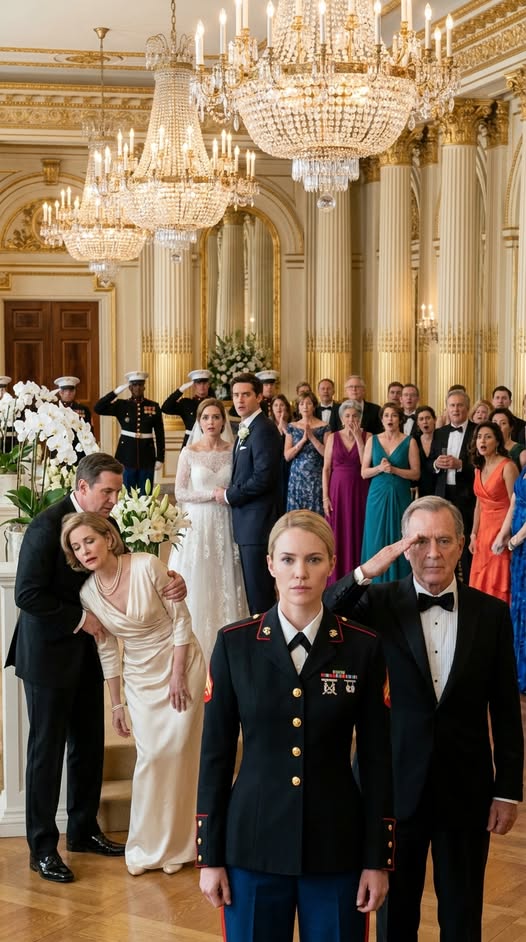
of a decade. Yet, standing barefoot on the faded floral rug of my youth, I recognized a corrosive truth I had spent years desperately avoiding. My mother had absolutely no inkling of the titans who would be populating that reception ballroom later tonight. And, to be brutally honest, neither
did I. What transpired when I finally pushed through those heavy oak doors is a sequence of events I will carry in my marrow until the day they put me in the ground. But to comprehend the gravity of that doorway, you must understand the architecture of my life before I reached it.
My current apartment, a sterile box positioned just off base, can essentially be packed into a single, olive-drab duffel bag. I prefer the impermanence. My combat boots stand at attention by the threshold, my coffee is brewed black enough to strip paint, and I am usually unconscious by twenty-one hundred hours. The Marines I command know the contours of my soul far better than the blood relatives who share my surname. We have scraped cold rations from the same aluminum tins under hostile skies. We have shivered through the same unforgiving midnight watches. When the ghosts come calling for one of us, the rest stay awake to keep the perimeter secure. That brotherhood is the closest approximation of a family I have ever dared to trust.
My biological family, the Meyers, operates like a sovereign nation whose customs I never managed to decipher. I am the eldest, the rebellious anomaly who marched out the door at eighteen and returned forged in a fire they refused to acknowledge. I play my part. I dispatch punctual birthday cards. I appear stoically at funerals. I hoist the heaviest luggage so no one else has to strain their delicate wrists. For as long as I can recall, my sole function has been utility: Keep the peace. Absorb the shock. Above all, do not make it awkward.
So, when my mother phoned to summon me for my younger brother Wes‘s nuptials, I issued my standard affirmative before she could even complete her sentence. I booked the red-eye. I meticulously pressed my uniform out of ingrained discipline. I assured myself this operation was low-risk: deliver a bland toast, endure a single dance, and extract myself by dawn.
I am an expert at orchestrating complex logistical maneuvers in hostile territories. I am, however, catastrophically inept at anticipating the emotional landmines planted by my own kin.
The most baffling paradox of my existence is this: I can maintain a glacial calm while coordinates are called in under heavy artillery fire. I can issue directives with the weight of human lives suspended in the balance. But place my mother two feet in front of me, arm her with a subtle sigh of disappointment, and I instantly regress, shrinking to a fraction of my stature.
The insidious nature of being overlooked is that it is never a singular assassination. It is a death by a thousand microscopic cuts. When I first enlisted, my mother informed the local country club that I was taking a “gap year to find my footing.” When I earned my commission, she bypassed the ceremony, citing an unmovable charity luncheon. When I pinned on Captain, she skillfully pivoted the dinner conversation to my cousin’s imported Italian countertops.
Eventually, I learned to sever my tongue. I would test the waters with a brief anecdote about a deployment, only to watch her painted smile pull taut, her eyes darting desperately for an exit. Oh, Tori’s in the service. It’s a phase. She’ll land somewhere sensible eventually. I heard her whisper those exact words to my father through the floor vents when I was twenty-four. I heard variations of it at twenty-eight. By thirty, I had simply stopped flinching.
My brother Wes was the golden child. Not intellectually superior, merely effortless to showcase. He secured a lucrative finance position, drove a leased luxury sedan, and wore the kind of timepiece that telegraphed generational wealth he didn’t actually possess. When he announced his engagement to Sloan Whitfield, my mother wept for an hour—the triumphant, theatrical kind of weeping.
The Whitfield Estate represented old money. Not the loud, flashing kind, but the quiet, ancestral variety where names are etched into university libraries. To my mother, this union wasn’t a marriage; it was an ascension. “We’re finally going to be the kind of family people respect,” she had breathed into the receiver.
I was assigned a walk-on role: appear, grin, and fade into the upholstery. I was intimately familiar with the script. What I hadn’t prepared for was Sloan herself. During our sole telephone conversation, she bypassed the pleasantries and interrogated me about my actual deployments. She listened with an intensity that unsettled me.
“I’m so profoundly glad Wes has a sister like you,” she had said, her voice lacking any trace of irony.
I didn’t know how to process the compliment. Now, standing in my bedroom, weighing my military dress against the pastel silk my mother was pushing into my hands, the cognitive dissonance was suffocating. I told her I needed time to think. She squeezed my wrist, a gesture devoid of warmth, and vanished down the hall.
I sat on the edge of the mattress, my hand drifting instinctively to the inner breast pocket of my jacket. My fingers traced the smooth, worn edges of a bronze Challenge Coin. A talisman. A debt.
I closed my eyes, seeking the quiet stoicism that usually anchored me. But as my phone vibrated aggressively on the nightstand, fracturing the silence, a cold dread coiled in my gut. I didn’t know it yet, but the notification waiting on that glowing screen was about to detonate the fragile foundation of my entire familial existence.
Chapter 2: The Silence of the Chat
I picked up the device. It was a message from Aunt Diane, my mother’s notoriously cynical younger sister. There was no accompanying text, no pleasantries—just a stark, high-resolution screenshot.
The image was a capture of a group thread titled Wedding Logistics. A thread that included my mother, my father, Wes, the extended gaggle of aunts and cousins. Every single person who shared my blood. Every person except me.
My eyes dragged across the pixels, the words burning themselves into my retinas. It was a frantic dispatch from my mother, sent earlier that morning:
Please make sure no one encourages Tori to wear the uniform. The Whitfields are extremely refined and it would be humiliating. Seat her at Table Nine, near the kitchen doors, away from the head table. The military is an embarrassment and I will not have her turning Wes’s wedding into a parade.
Beneath her digital decree sat a row of agonizing responses. A cousin had reacted with a laughing emoji. Wes, the brother I had taught to ride a bicycle, had replied with a single, cowardly word: Fine.
But the most devastating blow wasn’t the text itself. It was the timestamps. My mother had fired off the message at 11:40 AM. The read receipts indicated my father had viewed it at 11:42.
He had read the words The military is an embarrassment regarding his own daughter. And he had said absolutely nothing.
I sat utterly paralyzed. People often assume that betrayal on this scale manifests as blinding, cinematic rage. It doesn’t. What washed over me was a glacial, terrifying clarity. It felt like stepping out of a suffocatingly warm house into the biting, sub-zero air of a winter midnight.
For a decade, I had anesthetized myself with a fairy tale. I told myself they were just ignorant, that my mother’s neurotic social climbing was a trauma response to her own impoverished childhood. I had cast my father as the silent, suffering mediator.
That narrative fractured into dust on my childhood bedspread. They didn’t misunderstand me. They had accurately assessed who I was, deemed it defective, and actively conspired to hide the evidence. My father’s silence wasn’t diplomacy; it was complicity. He chose his own domestic comfort over my dignity, time and time again.
My hand tightened around the heavy bronze coin still resting in my palm.
The coin had belonged to Lance Corporal Danny Brennan. Nineteen years old. A kid from a dust-choked town in Ohio who kept stale hard candies in his cargo pockets to distribute to local children. A week before the world ended, he had shoved this coin into my palm. “For luck, ma’am. You carry it.”
Three days later, an improvised explosive device tore through our convoy. Three of my Marines returned to base breathing. Danny was not among them. I have replayed the brutal calculus of those ninety seconds every day for six years. The coin was how I carried him. It rested over my heart, precisely beneath the spot where a heavy chunk of metal and ribbon now resided.
When my mother called my life an embarrassment, she wasn’t just insulting my career. She was, in her staggering ignorance, spitting on Danny Brennan’s grave.
I stood up. The air in the room felt different now—thinner, highly combustible. I picked up the Powder Blue Dress, smoothed its delicate seams with a terrifying gentleness, and draped it over the back of my desk chair. I wasn’t angry anymore. Anger is chaotic. I was purely, lethally focused. I was done evaporating for their comfort. The only question remaining was the tactical execution of my refusal.
I zipped my garment bag, the heavy wool of my true skin sealed inside, and headed toward the estate. I had no grand scheme, no desire to ruin Wes’s vows. I merely intended to exist. But as I arrived at the venue and began my preliminary sweep of the perimeter, my eyes caught a glint of polished brass near the coat check. A plaque I hadn’t noticed before. As I read the inscription, the blood roared in my ears, and I realized my mother hadn’t just misread me—she had marched our entire family straight into a devastating trap.
Chapter 3: The Fabric of Truth
The ceremony itself was agonizingly beautiful. Out of respect for the sanctity of the vows, I had adhered to my own strict moral perimeter: I wore a muted, civilian sheath dress and slipped into the very back pew. This hour belonged to Wes and Sloan. I refused to let my family’s treachery bleed onto the altar.
Watching my brother stammer through his vows, his hands trembling as he slipped the ring onto Sloan’s finger, I felt a genuine tear trace its way down my cheek. That is the cruel, illogical arithmetic of blood. You can possess empirical evidence of a person’s utter failure to defend you, yet still love them with an intensity that aches. I allowed myself those ten minutes of vulnerable humanity.


