Then, the chaplain pronounced them husband and wife, the applause thundered, and the ceasefire expired. While the 150 guests migrated across the manicured lawns toward the grand reception hall, a sprawling architectural marvel of vaulted ceilings and crystal chandeliers, I veered off course. I found a secluded anteroom adjacent to the main ballroom, where I had stashed my garment bag. I locked the door. The air smelled of old dust and lemon polish. Slowly, with the deliberate reverence of a priest preparing for mass, I stripped off the civilian camouflage. I pulled on the midnight-blue trousers with the blood stripe running down the seam. I slid my arms into the dark, heavy wool of the coat. I secured the standing collar, high and unforgiving against my throat. I snapped the stark white gloves onto my hands. Finally, I meticulously pinned my medals to the left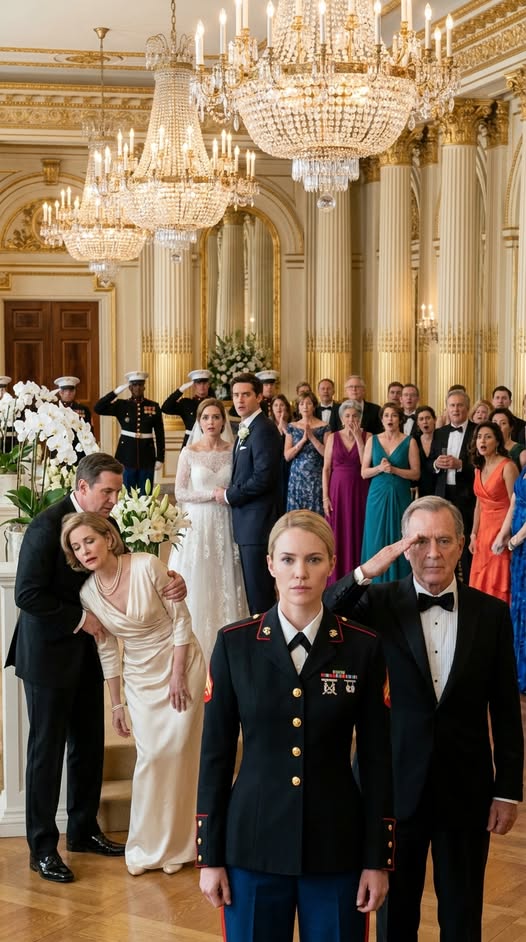
breast, ensuring the rows were perfectly aligned. The highest honor sat at the apex: a golden star with a miniature silver star resting at its center, suspended from a ribbon of red, white, and blue. I checked my reflection in the tarnished mirror. The woman staring back had no soft edges. She
was an absolute truth, inscribed in brass and wool. I reached for the brass doorknob, my pulse a slow, steady drumbeat. But before I could turn it, the door violently wrenched open from the other side. My mother stumbled into the small room, her eyes wide, a champagne flute trembling
precariously in her hand. The moment her gaze locked onto the Eagle, Globe, and Anchor catching the ambient light, the color rapidly drained from her face, leaving her a sickly, translucent white. She slammed the door shut behind her, plunging us back into the dimness.
“What in God’s name are you doing?” she hissed, the venom returning to her tone, sharper now, laced with raw panic. “Victoria, we discussed this. I specifically laid out the dress for you!”
I maintained my posture, my hands clasped loosely behind my back. “I told you I needed to think about it, Mom. I thought about it. I am attending my brother’s reception in my dress blues. I will not cause a scene. I will quietly take my seat.”
She didn’t absorb a single syllable. She closed the distance between us, her manicured fingers clawing at the empty air between us as if she could physically un-dress me.
“These are not our kind of people!” she spat, her voice vibrating with a terrifying desperation. “The Whitfields are refined. You do not get to turn this evening into a gaudy parade. Just for once in your miserable life, camouflage yourself!”
I looked down at her. Beneath the layers of expensive cosmetics and the desperate social climbing, I saw the terrified, impoverished little girl she had once been—a girl who had spent a lifetime running from the shame of a broken, chaotic home. I felt a profound, tragic pity for her. But pity was no longer a currency I accepted.
“Mom,” I said, my voice dropping an octave, ringing with the authority I usually reserved for the briefing room. “I am not the embarrassing one.”
I stepped around her rigid form, ignoring her broken, gasping intake of breath. I placed my white-gloved hand on the heavy brass handle of the ballroom doors, and with a single, fluid motion, I pushed them wide open, stepping out of the shadows and directly into the blinding, golden light of the lion’s den.
Chapter 4: The Geometry of the Room
The ballroom was a labyrinth of opulence. Massive arched windows allowed the dying amber light of dusk to spill across the polished parquet floor. The string quartet was navigating a bright Vivaldi piece, their notes weaving through the low, sophisticated hum of wealth and privilege.
I mapped the geometry of the room instantly. The head table sat elevated at the far north end. Table Nine—my assigned exile—was positioned in the deep south corner, practically flush against the swinging doors of the catering kitchen. To reach it, I didn’t need to bisect the dance floor. I could simply hug the western wall, dissolve into the periphery, and vanish.
For a fleeting, cowardly fraction of a second, muscle memory hijacked my brain. Keep the peace. Shrink. I took a half-step toward the wall.
But the weight of the silver on my chest anchored me. I squared my shoulders, adjusted my cover, and began to walk. Not a march, but a deliberate, measured stride.
You learn to read the atmosphere of a space in a combat zone. You feel the subtle shift in barometric pressure right before an ambush. That is precisely how the silence began.
It didn’t happen all at once. First, a woman holding a crystal coupe near the ice sculpture stopped speaking mid-sentence, her eyes locking onto the striking contrast of my uniform against the sea of tuxedos and pastel gowns. She tapped the elbow of her husband. He turned, his jaw slackening.
The silence rippled outward, contagious and swift. The clinking of silverware ceased. The low murmur of conversation evaporated into the high, vaulted ceiling. Even the string quartet, sensing the massive gravitational shift on the floor, faltered. The cellist dragged a harsh, discordant note across his strings before the music died completely.
One hundred and fifty heads turned to face the back of the room.
I kept my eyes locked straight ahead, focusing on the intricate molding above the kitchen doors. I caught a peripheral glimpse of my mother, who had slipped in behind me. She was frozen near a pillar, her hand clamped over her mouth, watching her ultimate nightmare manifest in real-time. Wes, seated beside his glowing bride, had half-risen from his chair, his face a mask of utter confusion.
The tension in the room was a physical weight, suffocating and heavy. It hung on a knife’s edge, teetering dangerously close to the exact awkwardness my mother had predicted. I could feel the whispers gathering in the throats of the elite.
But then, the anomaly occurred.
Near the head table, an elderly gentleman set his scotch glass down with a sharp, definitive clack that echoed like a gunshot. He was tall, remarkably straight-backed, with hair the color of polished steel. I didn’t know his name yet—I would later learn he was Sergeant Major Frank Holloway, a thirty-year veteran of the Corps and a dear friend of the late Whitfield patriarch.
He didn’t just stand up. He snapped to attention. The fabric of his bespoke tuxedo seemed to rearrange itself, mimicking a uniform he hadn’t worn in decades. His eyes, sharp and predatory, bypassed the crisp lines of my jacket and locked with laser precision onto the small, multi-colored ribbon pinned above my heart.
He knew. You do not spend three decades bleeding for your country without developing a visceral, cellular recognition of what a Silver Star looks like from fifty paces away.
His napkin fluttered unheeded to the floor. He took a deep, commanding breath that expanded his barrel chest, and as I took my twelfth step across the parquet, the Sergeant Major prepared to shatter the silence, ready to drag my family’s darkest secret directly into the light.
Chapter 5: Silver Star in the Room
“Silver Star on the deck!“
The Sergeant Major’s voice did not crack. It boomed, carrying the unmistakable, gravelly cadence of a man accustomed to shouting over the deafening roar of rotor blades. Five words, delivered with absolute, bone-rattling authority.
He brought his right hand up in a slow, razor-sharp arc, his fingertips grazing his brow. A civilian rendering a perfect military salute in the middle of a high-society wedding.
The words struck the room like a concussive blast. I watched the realization bloom across the faces of the guests. Those who understood military honors immediately turned to their neighbors, furiously whispering translations. Silver Star. The third-highest award for valor in combat. Not a phase. Not a costume. I stopped dead in my tracks. I am conditioned to withstand mortar fire and tactical betrayals, but I possessed zero armor for this. The sudden, overwhelming surge of respect from a stranger threatened to crack the dam I had spent a decade fortifying. My throat burned. I swallowed the lump of emotion, snapped my heels together with a sharp crack, and returned his salute, holding it with rigid, trembling perfection.
In the breathless void that followed, the true architecture of the Whitfield guest list revealed itself.
To my left, a heavy-set man in his sixties pushed his chair back with a loud screech. He leaned heavily on a wooden cane, favoring a ruined knee, but he stood, his posture stiffening.
Across the dance floor, a severe-looking woman with her gray hair pulled into a tight chignon rose smoothly to her feet, her chin lifting in silent solidarity.
One by one, the sound of scraping chairs echoed through the cavernous hall. A young man my age. An elderly gentleman with a trembling hand. Twelve people in total, scattered like hidden sentinels among the silk and chiffon, rose to their feet. Twelve veterans. They didn’t all salute—some merely stood at the position of attention—but the message was deafeningly clear: We see you. We know the cost. You are among your own.
I stood perfectly still, enveloped in a profound, vibrating silence, while the ghosts of my family’s shame disintegrated around me.
From the periphery of my vision, I heard a strangled, pathetic gasp. It was my mother. The crushing irony of her grand strategy was finally collapsing upon her. She had spent the entire weekend desperately trying to hide the one thing this elite, “refined” family actually revered.
Gerald Whitfield, Sloan’s father and the intimidating patriarch of the estate, broke away from the head table. He bypassed the terrified catering staff and strode purposefully across the dance floor. He did not look embarrassed. His eyes were swimming with unshed tears.
He stopped two feet in front of me and did something that entirely short-circuited my training. He reached out and enveloped my white-gloved hand in both of his.
“Captain Meyers,” Gerald said, his voice echoing in the pin-drop quiet. “We are profoundly honored to have you under this roof.” He turned to face the stunned crowd, keeping me anchored by his side. “My father,” he projected, gesturing toward the brass plaque near the entrance, “served two brutal tours in the infantry. He built this family, and our wealth, on a singular, unbreakable rule: We never, ever forget the blood spilled by people like the Captain, so the rest of us can stand around drinking champagne in rooms like this.”
My mother, witnessing her social capital vaporizing, activated her final, desperate survival mechanism. She pushed her way to the front of the crowd, her face stretched into a grotesque, panicked mask of maternal pride.
“Oh, we are just so incredibly proud of her!” she announced, her voice pitching an octave too high, shrill and grating. She reached out, attempting to loop her arm through mine, to claim me as her trophy now that the room had deemed me valuable. “Our Tori, always making us proud.”
I did not let her touch me.
I took a deliberate half-step back, my eyes locking onto hers. The silence returned, thicker this time. “You spent this entire weekend terrified I would humiliate you,” I said softly, yet the acoustics of the room carried the indictment to every corner. “You banished me to Table Nine. You called my life an embarrassment. And these people—the people you were so desperate to impress—just stood up for the exact thing you tried to bury.”
Her mouth opened and closed like a suffocating fish. She looked wildly toward Gerald, toward Wes, begging for a lifeline. She found only cold, judgmental stares. The trap had sprung, and she was entirely alone inside it.
I turned away from her, shifting my gaze back to the Sergeant Major, the 12 standing veterans, and the heavy burden of the truth I still had to deliver. I reached into the breast pocket of my jacket, my fingers closing around the cold, familiar bronze, ready to speak the only name that actually mattered tonight.
Chapter 6: The Wreckage of a Story
I withdrew my hand from the pocket and held the bronze coin aloft. The chandelier light caught the worn, dulled edges, making it gleam like a piece of captured sunlight.
“I did not earn this metal alone,” I addressed the room, my voice steady, stripped of any familial venom. I wasn’t speaking to my mother anymore; I was speaking to the men and women still standing at attention. “There were four of us in an armored vehicle on a Tuesday morning. Three of us came home. This coin belongs to the one who didn’t.”
I paused, letting the reality of the statement settle over the silk-clad crowd. “His name was Danny Brennan. He was nineteen years old. He pressed this into my hand for luck, and he made me swear to carry it. So, I carry it. The ribbon on my chest isn’t mine. It is his. I stand in this room today purely because he no longer has the privilege.”
I lowered my arm, pressing the coin back against my chest, right over my furiously beating heart. I offered one final, crisp nod to the Sergeant Major. “Thank you. You have no idea what it means that you stood.”
Slowly, the tension evaporated. The veterans lowered themselves back into their seats. The string quartet, finding their courage, struck up a soft, melancholic melody. The guests subtly returned to their conversations, though the timber of their voices was irrevocably altered.
Before the sea of people could fully swallow me, Wes vaulted down from the raised dais. He abandoned his bride, his groomsmen, and the illusion of his perfect day, marching straight toward me. When he stopped, he looked at my face as if decoding a foreign language he had just realized he needed to speak.
“I didn’t know,” Wes stammered, his voice fracturing on the final syllable. “I never asked you, Tori. My God, I never even asked what you did.”
He wasn’t performing for the Whitfields. His golden-boy facade had shattered, revealing a man standing in the smoldering wreckage of a narrative he had blindly accepted because ignorance was comfortable.
“I’m sorry,” he whispered.
I reached out, resting my gloved hand on his shoulder, a ghost of the protective gesture I used when we were children. “It is your wedding day, Wes. Go dance with your wife. Ask me about it tomorrow.” I squeezed his shoulder. “I mean it. Ask me tomorrow.”
He nodded furiously, wiping a stray tear from his cheek with the back of his hand, and retreated to Sloan, who was watching us with a hand pressed flat to her chest in awe.
The reckoning was far from over. Ten minutes later, as I stood near the sweeping floor-to-ceiling windows watching the night consume the lawn, my father approached. He looked as though he had aged a decade in the span of an hour. His shoulders were slumped, the fight entirely drained from him.
In his trembling hands, he held a manila envelope. The paper was butter-soft, creased and re-creased countless times, the edges frayed from years of being handled in secret. He extended it toward me.
“I kept it,” he rasped, his eyes refusing to meet mine. “The official dispatch. The letter they send when… when an action like that occurs.”
I stared at the envelope. I had assumed the Marine Corps bureaucracy had failed to notify them.
“I should have spoken up,” he continued, the words tearing out of his throat. “For years, I would read this in my study, lock it in the bottom drawer, and let your mother dictate exactly who you were to the rest of the world. I was a coward, Victoria. I am so deeply ashamed.”
The lifelong instinct flared within me—the desperate urge to pat his arm, to smile softly, to say, It’s fine, Dad, let it go. I fought it down.
“It is not okay, Dad,” I replied, my tone gentle but entirely unyielding. “But I am glad you finally admitted it.”
He didn’t protest. For the first time in our shared history, we existed in a space of absolute, painful truth. It wasn’t absolution, but it was a foundation.
My mother launched one final, pathetic offensive near the end of the evening, cornering me near the coat check. She had painstakingly reconstructed her mask of polite superiority. “Tori, darling, let’s just put this unpleasantness behind us,” she attempted, waving her hand dismissively. “You made your little point. Let’s not let it ruin the family.”
“I am not ruining anything, Mom,” I said, zipping my garment bag over my civilian clothes. “I am simply no longer hiding. If you want a relationship with me, it comes with the uniform, the history, and the truth. I will never sit at the back of the room for you again. That is the perimeter. Breach it, and I’m gone.”
She offered no rebuttal, and her silence was all the confirmation I needed.
The ensuing months played out exactly as one might expect. The social fallout was quiet but lethal. Gerald Whitfield invited me to deliver the keynote address at his veteran’s foundation gala; I accepted. Sloan began phoning me on Sunday afternoons, asking piercing, genuine questions. The cousins who had mocked me suddenly found my career trajectory fascinating.
As for my mother, her meticulously curated status within the Whitfield orbit never fully recovered. She had exposed her own shallowness to a room full of people who valued depth, and you cannot un-ring a bell of that magnitude.
If there is a tactical takeaway from this operation, it is this: The individuals truly worth impressing already comprehend the weight of your armor. It is only the cowards who demand you shrink to make them feel larger. I carried the burden of their shame for ten years. I left it on the parquet floor of that ballroom, and I have never once looked back.


