The black plastic handle of my landline receiver was slick against my ear, and the coffee in my mug had gone completely cold. Thomas Kelly did not pause to let me speak between his sentences. “I just need a little more time to submit the paperwork, Mr. Kelly,” I said, reaching back to rub the small of my spine where the dull ache of thirty-four weeks had settled. “We have rigid guidelines for these accounts, Ms. Miller, and exceptions are rare,” Kelly said. The rhythmic, sharp tapping of a silver pen against his leather folder stopped for a brief second, then resumed. “I understand
that, but my hours at the clinic were cut when my pregnancy became high-risk,” I said, keeping my voice as quiet and level as I could. “Once the baby is born, I have a remote bookkeeping position lined up. I can catch up if I just have a small window.” “The legal department does not work on windows,” Kelly replied, his tone flat and administrative. “Your mortgage is now three full months past due. The quarterly reports are being finalized, and non-performing loans must be cleared.” “How much would it take to halt the process today?” I asked, my throat dry. “I do not have
the final ledger sheet with the legal fees in front of me,” he said, and I heard the rustle of papers on his end of the line. “But you are looking at well over seven thousand dollars to bring the loan current. Without that, the property will be scheduled for public auction.” “Seven thousand,” I whispered, looking at the faded yellow wallpaper with its pattern of small blue teacups.
“We will be sending the official notice to your address,” Kelly said, his voice already moving on to the next task on his desk. “Have a good day, Ms. Miller.”
The line clicked, leaving me with the low, steady hum of the old refrigerator and the silence of the empty kitchen.
I stood on the front porch, trying to draw a deep breath of the damp morning air, but the Indiana heat was already rising from the gravel road. The August humidity had made the wooden screen door swell and stick in its frame, requiring a hard tug to open.
At exactly half past eight, Jeffrey, our local mail carrier, came walking down the sidewalk under the shade of the old maples. He was a young man with a quick smile, carrying a heavy canvas bag slung over his shoulder.
“Morning, Nora,” Jeffrey said, stepping onto the bottom step of my porch. “They say the humidity is going to hit ninety percent before noon.”
“It feels like it already, Jeffrey,” I said, reaching out to take the mail.
He sorted through the envelopes, sliding a long, heavy one from the middle of the stack. The window in the center was framed by a bright, solid red border that seemed to burn right through the paper.
“Got this one from Oak Valley Bank,” Jeffrey said, his eyes dropping briefly to my round belly before he turned back toward the sidewalk. “Looks like some of it is official.”
“Thank you, Jeffrey,” I said, slipping the red-bordered envelope to the bottom of the stack so I would not have to look at those bold black letters.
I watched him walk down the block, his boots crunching on the loose gravel, before I stepped back inside the house.
By one o’clock, the heat in the living room had become almost unbearable, but I kept the windows shut to keep the dust from the road out of the clean baby clothes. I sat on the edge of the old floral sofa, a plastic basket of tiny cotton sleepers resting on the floor by my knees.
I pulled out my phone and tapped the screen to open my banking application, though I already knew what the screen would tell me.
The balance in my checking account was three hundred forty dollars.
A gallon of milk at the corner store was four dollars and ten cents now, and the utility bill was due by the end of the week. I set the phone face down on the cushion beside me, my chest tightening with a cold, hollow panic.
Just then, a small, distinct movement rippled across my stomach, a quiet nudge from the baby as if she were trying to find a comfortable spot to rest. I placed my hand over the fabric of my dress, holding my breath as I felt the steady, gentle pressure against my palm.
This house was the only home she had waiting for her, the same bungalow where my grandmother had lived for forty years.
I stood up, my joints stiff, and walked toward the front window to look out at the quiet street.
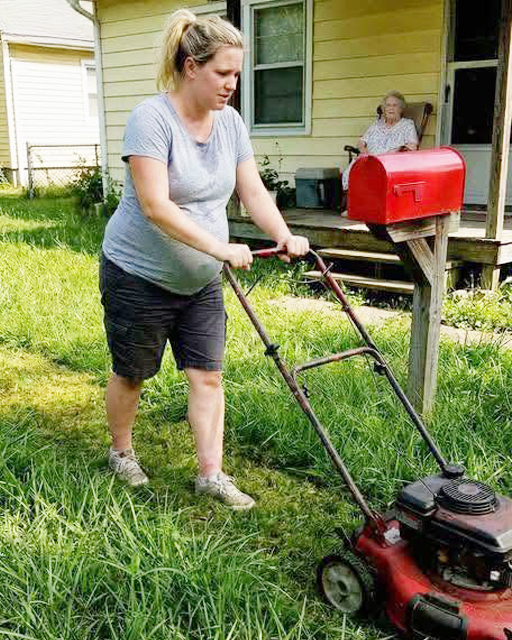
Through the glass, the sunlight was so bright it made the gravel driveway next door look white. My neighbor, Clara Higgins, was standing near her side porch, her yellow straw sun hat tilted forward as she looked down at her old green lawnmower.
She was eighty-two, and since her husband Arthur had passed, she had kept her small white house in perfect order, but the grass had gotten away from her over the last few weeks.
I watched her bend over, her thin arms shaking slightly as she took hold of the black starter handle. She gave the rope a sharp pull, but the heavy engine only sputtered once, a loose blue gas cap rattling against the metal tank as the vibration died out.
Clara stopped, her shoulders rising and falling rapidly under her faded blue cotton blouse. She leaned her forehead against the mower’s handlebar, her pale face turning slightly toward my house as she tried to catch her breath.
Even from fifty yards away, I could see the strain in her posture, the way she clung to the metal frame just to stay upright.
I left the baby clothes on the sofa and opened the heavy wooden screen door, the swollen wood groaning against the frame as I pushed it open. I stepped onto the hot porch and began walking down the steps toward Clara’s yard, leaving my own unpaid bills on the kitchen counter.
The humidity hung thick over the dandelion heads as I crossed the property line, carrying a blue plastic pitcher and a single plastic cup.
Clara was leaning over the green machine, her yellow straw sun hat tilted forward so I could only see the pale, lined skin of her neck. She gave the starter rope another short, weak tug that ended in a dry cough.
“Clara, let me,” I said, stepping onto the dry grass.
She looked up, her breathing shallow and fast, her cheeks carrying a faint, dusky flush instead of their usual healthy pink. She tried to wave her hand, gesturing toward my stomach, but she did not have the breath to speak right away.
“I have plenty of water,” I said, pouring a cup and holding it out to her. “Drink this first.”
She took the cup, her knuckles white against the plastic, and drank in small, hesitant sips. I did not wait for her permission before I reached down and took the black rubber grip of the handlebar.
When my hand brushed hers, her skin felt surprisingly cool despite the heat, dry as parchment paper. She let her arm drop to her side, exhaling a long, trembling breath that sounded like dry leaves scraping across concrete.
“You should not be doing this in this heat, dear heart,” she murmured, her voice thin.
“Neither should you,” I said.
I looked down at the ancient mower and noticed the blue gas cap was sitting crooked, rattling against the metal tank with every slight vibration of my hand on the frame. I gave the cap a quick twist to secure it, but the plastic threads were stripped, leaving it loose and wobbling under my thumb.
Clara nodded slowly, her eyes tracking the movement of my hand before she turned and walked toward her porch steps. She sat down on the second step, resting her elbows on her knees, looking smaller than she had just yesterday.
The grass in her front yard was nearly five inches high, thick with clover and crabgrass that had gone to seed. I set my feet, gripped the pull cord, and gave it a hard, steady yank.
The old engine coughed twice, spat a thin blue cloud of exhaust, and then roared into a rattling, uneven idle. The blue gas cap danced against the tank, vibrating so fast it became a blur.
I leaned my weight into the handle and pushed the machine forward into the first thick patch of green.
My lower back flared with a dull, familiar ache almost immediately, a heavy pull that made me slow my pace to a crawl. The baby remained quiet, a heavy warmth centered low in my belly, while I focused on keeping the machine straight along the edge of the gravel driveway.
Every few yards, I had to stop and tilt the deck to clear the wet grass that clogged the chute.
Clara did not move from the wooden steps, her yellow hat casting a wide shadow over her face, but I could feel her eyes following me. Every time I turned the mower near the maple tree, I caught her watching with an expression that was not just tired, but deeply sorrowful, as if she were looking at something already gone.
The air under the trees was completely still, trapping the heat and the sharp smell of gasoline close to the dirt. I worked in concentric squares, moving inward, the physical effort forcing the image of the red-bordered letter out of my mind for a few minutes.
By the time I reached the last narrow strip of grass near her porch, the front of my shirt was damp with sweat, and my thighs felt like lead.
I released the safety lever, and the sudden silence of the dead engine felt heavy, filled only by the distant hum of the highway.
Clara was already standing by the screen door when I pushed the quiet mower toward the side of the house. She held a metal tray with a tall glass of lemonade, the ice cubes clinking against the glass with a rapid, frantic rhythm.
As I walked up the three porch steps, I realized the clinking was not from her movement, but from the violent trembling of her fingers.
“Sit down, Nora,” she said, her voice dropping to a whisper as she set the tray on the small wicker table. “Please.”
I took the glass, the condensation instantly cooling my palm, and sat on the wicker bench while she sank back onto her cushioned chair. Her hands remained in her lap, tucked under her white cotton apron as if she were trying to hide the shaking.
“You did a beautiful job,” she said, looking out at the neat, pale green rows. “Arthur always said a manicured lawn keeps the world at bay.”
“It was overdue,” I said, taking a long drink of the cold, tart liquid. “I did not mind the work.”
“A young woman in your position should not have to carry the heavy end of the rope,” Clara said, her blue eyes fixing on my face with a quiet, unsettling intensity. “Where is that boy, Nora?”
The question hung in the hot air between us, landing with a weight that made me set the glass down on the metal tray.
I looked down at my lap, my thumbs tracing the seam of my maternity shorts, wishing I could find a convenient lie. The truth felt like a physical weight in my throat, dry and hard to swallow.
“He is not coming back, Clara,” I said, my voice barely louder than the hum of the cicadas in the maples.
Clara did not look surprised, nor did she offer the usual empty reassurances that people use when they do not know what else to say. She simply nodded once, her gaze drifting toward the empty driveway where her husband’s old sedan used to sit.
“He left three months ago,” I added, the words spilling out before I could stop them. “He does not answer my calls anymore.”
“And the bank?” she asked quietly.
My hand went instantly to my lower back, my fingers pressing into the muscle as a sharp wave of anxiety hit me. I had not told anyone about the missed payments, not even the mail carrier who had delivered the red-bordered envelope.
“I am handling it,” I said, though my voice lacked any real conviction.
Clara reached out from under her apron, her hand still trembling, and placed her fingers over mine. Despite the frailty of her wrist, her grip was surprisingly firm, her fingers locking onto my hand with a strength that startled me.
“Some burdens are too heavy for one pair of shoulders, dear heart,” she said.
I looked at her, wanting to ask what she meant, but she was already releasing my hand and pulling her yellow hat lower over her brow. She stood up slowly, her knees making a dry clicking sound, and turned toward her front door without another word.
The screen door clicked shut behind her, leaving me alone on the porch with the melting ice.
The porch door clicked shut behind me. I walked back into my own quiet house, the heat of the afternoon pressing against the windowpanes.
I sat down at the kitchen table with a yellow legal pad and a sharpened pencil. The mortgage statements were piled in three neat rows, each white envelope marked with those bright red borders that seemed to glow under the yellow ceiling bulb.
I wrote down the numbers one by one. The principal, the late fees for June, the late fees for July, and the additional penalty interest the bank had tacked on for August. My hand hovered over the paper, my pencil lead lingering on the bottom line.
The total was seven thousand four hundred twenty dollars.
My phone screen lit up on the counter, showing my bank balance of three hundred forty dollars. If I did not find a way to pay the full seven thousand four hundred twenty dollars, the house would go to the county auction on October twelve.
The kitchen wall clock read half past six when the landline finally rang. I picked up the receiver and held it close, listening to the static of the local housing assistance office.
“Nora, it is Sarah,” the voice on the other end said. “I went over the county registry files you mentioned. Oak Valley Bank is clearing their books fast this quarter.”
“Can we ask for a delay?” I asked, my fingers tracing the edge of the yellow notepad. “Just until after the baby comes.”
“They are pushing every default straight to the courthouse,” Sarah said. “Without a steady household income, a standard mortgage refinance is going to be nearly impossible to get approved.”
“There has to be another program,” I said.
“Unless you have a co-signer with significant assets, you are looking at a hard wall,” Sarah said. “They want the property, Nora, not a new payment plan.”
I set the receiver back on its cradle. The house felt too small, the silence too heavy, so I picked up Clara’s empty lemonade glass and the silver thermostatic cup from the counter.
The air outside had begun to cool, but the humidity still clung to the screen door as I pushed it open. Clara was sitting on her porch glider in the graying light, a small leather ledger open on her lap.
“I brought these back, Clara,” I said, setting the glass and the silver cup on the small wicker table beside her.
Clara looked up, her fingers resting on the open page of her ledger. “Thank you, dear heart. Sit down for a moment.”
“I should get back inside,” I said, though I did not move toward the steps.
“Nora, let me ask you something,” Clara said, her voice dropping to a quiet, steady tone. “Do you have a good local attorney, or someone you trust with your financial affairs?”
I looked at her, my hand instinctively reaching for my lower back. It was a strange question for a neighbor to ask on a Tuesday evening.
“I never really needed one,” I said. “My father handled everything before he passed.”
“A good advisor is like a strong roof,” Clara said, closing the small leather book with a soft snap. “You do not think about them until the weather turns.”
She stood up slowly, her hand resting on the porch railing for support, and gestured toward her front door. “Come inside for a minute. I want to show you something Arthur left behind.”
The parlor was cool and smelled of beeswax and old paper. Clara walked over to the mahogany desk in the corner and picked up a framed black-and-white photograph of a young man in a dark suit.
“Arthur made sure that our savings could always be used for what mattered most,” Clara said, her thumb tracing the edge of the silver frame. “He spent three months working with our attorney, George Sterling, to set up our estate plan.”
I looked at the photograph, then at the neat stacks of legal documents resting on the desk. “It sounds like he took care of everything.”
“He did,” Clara said, turning to look at me with a soft, serious expression. “George knows every loophole in the county. A good plan can solve problems even after a person is gone.”
I nodded, but my mind was still on the seven thousand four hundred twenty dollars I owed the bank. Clara turned back to her desk and opened her leather ledger again, her pen poised over a column of figures.
I stood near the door, looking at the old ledger on Clara desk, wondering why the older woman is organizing her papers so late at night.
The double glass doors of Oak Valley Bank did not keep out the heavy August humidity, but the lobby air conditioning was high enough to make my collar feel damp. I walked toward the cubicles at the back of the room, the clicking of my flat shoes against the polished tile sounding far too loud in the quiet, carpeted space.
Thomas Kelly did not look up from his computer screen when I approached his desk, though he must have heard me coming. He tapped his silver pen against his leather folder, the rhythm fast and steady, while he finished typing a long line of numbers on his keyboard.
“Sit down, Ms. Miller,” he said, his voice flat as he finally clicked his mouse and turned his attention to me.
I took the chair across from him, adjusting my position to ease the dull ache in my lower back before placing my manila folder on the desk. The yellowed mortgage notice with its bright red border was folded neatly underneath my budget page, its edges slightly frayed from how many times I had smoothed them out on my kitchen table.
“This is the hardship application we discussed on the telephone,” I said, keeping my tone as measured as I could manage. “I have included the full ledger of my seasonal bookkeeping clients and the expected payment dates.”
Thomas picked up the papers with a detached look, his eyes scanning the columns of numbers without lingering on any of them. He did not look at my face, nor did his eyes drift to the heavy, unmistakable silhouette of my thirty-four weeks of pregnancy.
“We have rigid guidelines for these accounts, Ms. Miller, and exceptions are rare,” he said, his thumb flicking the corner of my handwritten budget sheet. “The bank expects accounts to be brought current, not merely documented.”
“I have outlined every monthly expense,” I said, pointing to the line where I had noted the cost of groceries and basic utilities. “If you look at the second page, you will see my projected income for the autumn, which will allow me to make double payments.”
“A projection is not a payment,” Thomas said, setting the papers back down on the desk with a neat, dismissive slide. “Our mortgage department cannot accept a payment plan that relies on unsecured future earnings.”
“I can pay twelve hundred dollars by Friday afternoon,” I said, leaning forward slightly and resting my hands on the edge of his desk.
He tapped the silver pen against his leather folder again, the metal clicking against the dark cowhide in a sharp, impatient rhythm.
“The bank cannot accept a partial payment plan under these circumstances,” he said. “The system is automated, and it does not allow us to hold a foreclosure file once the sixty-day default window has closed.”
I looked at the neat stack of files on his desk, wondering how many other families in Oakhaven were represented by those identical blue tabs. “I just need a small window to get my footing before the baby arrives.”
Thomas did not look up from the folder he was now opening. “The bank requires seven thousand four hundred twenty dollars to clear this file and remove it from the default registry.”
“That amount is the total of three full payments plus late fees,” I said, my fingers pressing into my lap. “I told you on the phone that the seasonal bookkeeping contracts do not pay out until the first week of September.”
“The contract terms are between you and your clients, Ms. Miller,” Thomas replied, his tone as level and dry as dust. “Our concern is the security of the loan, and the terms of your deed of trust are very clear.”
“But the house has been in my family for forty years,” I said, the wood of his desk cool under my hand. “My grandfather built the back porch, and I have never missed a payment until this summer.”
Thomas clicked his pen once, the sharp sound echoing in the small cubicle. “The bank holds the deed, and our investors expect their scheduled returns regardless of the property’s history.”
“Surely there is some sort of grace period for long-term customers,” I whispered, looking around the quiet lobby to see if any of the tellers were watching us.
“Your grace period expired thirty days after the first missed payment in June,” he said, his eyes scanning a spreadsheet on his screen. “We have already delayed the initial filing by two weeks as a professional courtesy.”
“We are already in the middle of August,” I said, my hands resting on my knees to keep them from shaking. “If you can give me a thirty-day extension to consult a financial planner, I know we can find a way to restructure the remaining debt.”
Thomas stopped typing and leaned back in his mesh chair, his expression perfectly blank. “The foreclosure sale is set for October twelve, Ms. Miller, and the bank is moving forward with the auction preparations.”
“But October is two months away,” I said, the words catching in my throat. “Thirty days would still leave you plenty of time to proceed if we cannot reach an agreement.”
“The system does not have a button for sentiment,” he said, his voice carrying the practiced weight of someone who delivered this news several times a week. “The system has deadlines.”
“Is there no one else I can speak with?” I asked, looking toward the closed doors of the offices at the side of the lobby. “Perhaps the branch manager?”
“Mr. Finch is out of the office today,” Thomas said, his hand already reaching for the next file in his inbox. “And even if he were here, he does not have the authority to override a corporate default directive.”
He pulled a blue folder toward him, effectively closing the space between us. “So my application is simply denied?” I asked, wanting him to say the words plainly.
“The file has been processed, and the decision is final,” he said, not looking up. “We will notify you of the auction details by certified mail.”
“What about the hardship assistance program listed on your website?” I asked, my voice rising slightly before I caught myself. “The one that mentions temporary forbearance for local residents?”
Thomas did not look up. “That program is for active-duty military and victims of federally declared natural disasters.”
“I am an expectant mother with no family support,” I said, the words slipping out before I could stop them.
He stopped typing for a brief second, his gaze flickering down to my midsection before returning to the screen. “That is a personal circumstance, Ms. Miller, not a regulatory exemption.”
The heavy glass doors of the bank felt twice as heavy when I pushed them open to walk back out into the glare of the morning sun. The August heat hit me like a physical weight, thick with the scent of hot asphalt and exhaust from the main street.
I unlocked my old sedan and climbed inside, the vinyl seat burning the backs of my legs through my thin cotton skirt. My hands gripped the steering wheel so hard my knuckles turned white, but I did not turn the key.
The air inside the car built quickly to a stifling temperature, yet I sat there, staring at the brick facade of the bank while my baby stirred restlessly against my ribs. The realization that my home, the place where my mother had lived and where I planned to bring my daughter, was merely a line item on a computer screen made me feel incredibly small.
I looked at my bank app on my phone, the screen showing three hundred forty dollars. The gap between that number and seven thousand four hundred twenty dollars felt like an ocean I had no way to cross.
A freight train blew its horn in the distance, the low, rumbling sound vibrating through the car frame. I finally turned the key, the old engine catching with a rough, uneven rumble before I backed out of the space.
The dashboard clock read ten past eleven as I turned onto the county road, the cornfields on either side looking yellowed and dry from the lack of rain. I drove slowly, my foot heavy on the pedal, feeling every bump in the road in my lower back.
The thought of returning to that empty house, with the unpaid bills still sitting on the kitchen counter, made my stomach tighten.
The gravel crunched under my tires as I pulled into my driveway at half past eleven, the dust settling slowly around the bumper of my car. Clara Higgins was standing near my mailbox, her yellow straw sun hat shading her eyes from the high midday sun.
She was holding a small brass key in her hand, turning it over and over between her thin, spotted fingers.
“Nora, dear heart,” she said as I stepped out of the car, her voice carrying that gentle, old-fashioned cadence that always made me slow down. “You look like you’ve been chasing the wind.”
I forced a smile, my shoulder muscles tightening as I reached for my purse to hide the yellowed envelope with the red border. “Just had some errands to run in town, Clara,” I said, keeping my voice as light as possible.
“Did you see the people at the bank?” she asked, her blue eyes searching my face with a quiet intensity that made me want to look away.
I lied to her then, the shame of my failure hot and sharp in my throat. “Everything went fine, Clara,” I said. “Just some routine paperwork they needed for the file.”
Clara looked down at the brass key in her palm, her fingers trembling slightly as she adjusted the brim of her hat. “Arthur always said that a key is only useful if you know which door it belongs to,” she said softly.
“What would I need your tool shed key for, Clara?” I asked, looking past her to her quiet, neatly mowed lawn.
“A person never knows when they might need a sturdy shovel or a bit of extra twine,” she said, her smile small and patient.
“We are neighbors, Nora,” she said, her voice barely louder than the rustle of the dry leaves overhead. “That has to count for something in this world.”
I wanted to tell her the truth right then, to tell her that the bank was taking the house in October, but the words felt too heavy to lift.
“This is for the tool shed in the back, dear,” she said, reaching out to press it into my hand. “I want you to keep it.”
I took the brass key from Clara, feeling the cold metal press into my palm.
The brass key was cool and solid in my pocket as I walked downtown, the early afternoon heat rising from the cracked pavement in heavy waves. I kept my right hand tucked deep into my shorts, my fingers tracing the metal ridges while the humid August air pressed against my neck like a wet wool blanket. I had Clara’s small cream card tucked into my waistband, the raised black lettering of George Sterling, Attorney at Law, pressing against my skin. It was only three blocks to the town square, but with the baby resting low and heavy now, every step felt like a negotiation with my own lower back.
The law office sat above the old Oakhaven pharmacy on the corner of Main and Third, up a long flight of wooden stairs that smelled of floor wax and sixty years of stale tobacco.
The air at the top of the landing was thick and completely still. A frosted glass door with George’s name painted in faded gold leaf stood slightly ajar, letting out the faint, rhythmic click of a small desk fan. I tapped my knuckles against the glass, and the fan seemed to pause in its sweep before a voice called for me to enter.
George Sterling stood behind a massive walnut desk, holding a blue silk cloth in his right hand.
“Ms. Miller,” he said, his resonant courtroom voice filling the room with a quiet, measured gravity. “Clara called ahead of you. Please, sit down before the humidity gets the better of you.”
He gestured to a high-backed green leather chair that looked older than the courthouse down the street. As I sat, he took off his gold-rimmed spectacles and began polishing them with the blue silk, his movements slow and practiced.
“I understand you had a difficult meeting with Oak Valley Bank this morning,” George said, holding the glasses up to the dusty light of the window before putting them back on his nose.
“Thomas Kelly rejected the hardship paperwork,” I said, my voice sounding thin and small in the quiet office. “He said the foreclosure auction is set for October twelfth. He wouldn’t even look at my budget sheet or the utility bills.”
George nodded slowly, resting his thumbs on the edge of his desk blotter. “Oak Valley has been pushing their residential files through with unusual speed this quarter. The corporate headquarters in Indianapolis has been putting pressure on the branch managers to clear the non-performing loans from their books before the autumn audit.”
“But I told him I just needed thirty days,” I said, rubbing the small of my back where the dull ache was starting to spread. “I thought there were federal rules about pregnant women. I thought there was some kind of safety net.”
“The mortgage refinance structures have changed significantly since the bank merger last spring,” George said, leaning back in his chair. “Once the formal default notice is sent, the local branch loses most of its discretionary power. They operate on a rigid grid now, and Thomas Kelly is a man who lives by the grid.”
“Can you represent me?” I asked, looking at the rows of leather-bound legal volumes behind him. “Can you file something in court to make them stop?”
“I cannot represent you in an adversarial action against Oak Valley, Nora,” George said, his tone softening just a fraction. “My firm represents the Higgins trust, and the bank acts as the corporate trustee for several of Clara’s municipal bonds. If I filed an injunction against them, their attorneys would have me disqualified by noon tomorrow on a conflict of interest.”
“Then I have no other path,” I said, looking down at my hands. “I’ll have to pack up the bungalow.”
“I did not say that,” George replied, rising from his desk and gesturing toward a heavy wooden door that led to an inner room. “Let us look at what we actually have to work with.”
The inner room was cooler, lined with floor-to-ceiling shelves holding gray cardboard boxes. A large oak table in the center was covered in rolled blueprints and historical plat maps of Oakhaven. George spread a copy of my original home deed across the wood, his long fingers smoothing out the dry creases where the paper had been folded since the fifties.
“Your grandfather bought the bungalow in nineteen fifty-eight,” George said, pointing to a column of typed legal descriptions with his pen. “The legal description in this deed lists the eastern boundary of your lot as eighty-four degrees, twelve minutes west.”
I leaned over the table, the scent of old paper rising to meet me. “That’s the fence line between my yard and Clara’s garden.”
“Exactly,” George said, pulling a second, larger map from a shelf and unrolling it beside the first. “But when the county completed the road widening project on Third Street in nineteen eighty-four, they filed a corrected plat map. The county surveyor recorded your boundary as eighty-four degrees, twenty-one minutes.”
I looked at the numbers, my head swimming with the technical terms. “Is nine minutes a big difference?”
“On the ground, it is about three feet of land,” George said. “Normally, it is a minor discrepancy that neighbors ignore for decades. But under Indiana law, a bank cannot foreclose on a property unless the legal description in the public notice matches the county recorder’s plat map to the letter.”
“So the bank’s paperwork is wrong?” I asked, a tiny spark of hope rising.
“Their notice contains the nineteen fifty-eight description,” George said. “If we file a formal survey request and a boundary dispute notice with the county, the bank is legally required to halt the foreclosure process until a certified surveyor can physically measure the line.”
“How long does that buy me?” I asked.
“A week,” George said. “Perhaps ten days if the county surveyor’s office is busy. It is a very small shield, Nora, but sometimes a small detail in an old deed is the only shield we have.”
I swallowed, looking at the faded ink on the old map. “How much does it cost to file the dispute?”
“The county filing fee is fifty dollars, and the expedited surveyor’s bond is two hundred and fifty,” George said, polishing his spectacles again. “Three hundred dollars in total. It must be paid in certified funds to the county clerk’s office.”
I thanked him and walked back into the small, carpeted lobby of his office, the air conditioner hum suddenly sounding very loud. I sat on the low sofa near the door and pulled my phone from my bag, my fingers damp against the screen as I opened the mobile banking app.
The screen loaded slowly, the little wheel turning twice before showing my balance.
Three hundred forty dollars and cents.
If I paid the clerk three hundred dollars, I would have exactly forty dollars left to buy groceries, pay the electric bill, and keep gas in my sedan until the end of the month. The baby was due in six weeks, and the pantry at home held little more than a box of pasta and a half-gallon of milk that had cost four dollars and ten cents at the corner store.
I looked up at the wall, where a framed portrait of Arthur Higgins looked down with a stern, quiet confidence.
If I kept the three hundred dollars, Thomas Kelly would take the house on October twelfth, and forty dollars wouldn’t even cover the deposit on a storage unit for my grandfather’s furniture.
I stood up, my decision cold and flat in my mind.
I walked back to the receptionist’s desk and handed her my debit card. “Please file the survey request.”
The machine gave a sharp, double beep as the transaction went through, and the assistant handed me a small paper receipt that felt incredibly light for what it had cost me.
The walk back to Oakhaven took longer than usual, the afternoon sun beating down on the asphalt until my shoes felt sticky. When I reached the edge of my yard, I saw Clara sitting on her front porch, her yellow straw sun hat tilted slightly to shade her eyes from the glare.
She looked incredibly peaceful, her hands resting in her lap as she watched the daily freight train pass through the valley in the distance, its whistle blowing right on schedule at four o’clock.
“You look like you’ve walked a mile in a tight shoe, dear heart,” Clara said as I stopped near her bottom step.
“I went to see George Sterling,” I said, leaning against her porch railing to take the pressure off my lower back. “He found an error in my grandfather’s deed from nineteen fifty-eight.”
Clara smiled, a gentle, slow expression that made her eyes wrinkle at the corners. “George is a good man, Nora. He knows how to handle difficult transitions.”
“He filed a boundary survey request,” I said, not wanting to mention the three hundred dollars I had just spent. “He thinks it will buy us a week.”
“A week can be a very long time,” Clara said, her voice soft but steady. “Sometimes everything changes in a single night.”
I looked at her quiet house, then back at my own bungalow, the white paint peeling on the window frames where the August humidity had made the wood swell and stick.
“I just need enough time to figure out what to do next,” I said.
“You’ve done the hard part,” Clara said, adjusting the brim of her hat as she looked toward the street. “Now we let the law do its work.”
The office phone in George’s sedan must have been busy, because he drove up to the curb just as I was walking back across my own yard. He stepped out of the car, carrying a single sheet of paper with a blue notary seal at the bottom.
“I have the final authorization form,” George said, meeting me near my porch steps. “We need your signature before I can deliver this to the clerk’s office.”
I took the silver pen from his hand, the metal feeling heavy and cold against my fingers.
My hand was trembling so much the first letter of my name looked like a jagged line, but I pressed the pen down anyway, signing my future over to a three-foot strip of grass.
The cool metal of the silver thermostatic cup Clara had given me was the only pleasant thing on my front porch. I sat on the top step, cradling the cup in both hands, watching the heat shimmer rise from the asphalt of our quiet street. The morning humidity had already made my cotton shirt cling to my back, and my feet were swollen inside my canvas shoes.
A white mid-sized sedan with the green Oak Valley Bank logo on the driver-side door rounded the corner by the water tower. It slowed down as it passed Clara’s neatly mowed yard, then turned sharply into my gravel driveway. The tires crunched to a stop, kicking up a small cloud of white limestone dust that hung in the still air.
Thomas Kelly opened the door and stepped out into the heat. He was wearing a light gray summer suit that looked freshly pressed, his silver pen clipped to his breast pocket. He did not carry his heavy leather folder under his arm this time; instead, he held it loosely by his side as if he were just dropping by for a casual visit.
He looked up at the porch and smiled, a wide, friendly expression that made his eyes crinkle at the corners. It was a complete departure from the cold, hurried man who had dismissed me in the bank cubicle only days before. He walked up the gravel path with an easy, unhurried stride.
“Good morning, Nora,” he said, stopping at the bottom of the porch steps. “I hope I am not interrupting your breakfast.”
“I finished an hour ago,” I said, keeping my hands tight around the silver cup. “What brings you out here, Mr. Kelly?”
He took a step up, his leather shoes silent on the painted wood. He adjusted his collar and looked around the porch, his eyes lingering for a second on the empty wicker chair.
“May I sit?” he asked, his voice carrying an unexpected softness. “It is already turning into a scorcher today.”
I nodded toward the chair, not trustful enough to offer a warm welcome but curious enough to let him stay. He sat down, crossing one leg over the other, and placed his folder on his knee. He looked out at the lawn I had mowed the day before, then back at me.
“You did a fine job with the grass,” he said. “It looks very tidy.”
“It is a lot of work,” I said. “But it needs doing.”
“Nora, I wanted to come out here personally because I felt our meeting at the branch was a bit too formal,” he said, leaning forward slightly. “We have a lot of accounts to manage, and sometimes the personal touch gets lost in the office. I do not want you to think Oak Valley Bank is some faceless corporation that does not care about its neighbors.”
I did not answer. I waited, watching the way his thumb rubbed the edge of his leather folder.
“We reviewed your file again yesterday afternoon,” he continued, his tone remaining warm and collaborative. “Our regional underwriting department agreed that your situation deserves some special consideration. We want to help you stay in this house, Nora.”
The words felt like a sudden breeze in the middle of August. I looked down at my cup, then back at his face, trying to find the catch.
“What kind of consideration?” I asked.
“A temporary forbearance agreement,” he said, opening his folder to reveal a neat stack of blue-tinted documents. “We can lower your monthly payments for the next two months to just one hundred and fifty dollars each. That will give you time to have the baby, get settled, and then we can work out a permanent modification once you are back on your feet.”
I felt the tight band of worry around my chest loosen. For weeks, the number seven thousand four hundred twenty dollars had been a boulder sitting on my chest, threatening to crush me before the baby even arrived. Now, he was offering a way to pause the weight.
“One hundred and fifty dollars?” I asked, my voice barely above a whisper.
“Exactly,” he said, nodding. “We want to make sure you have peace of mind during your delivery. Let us take this inside where we can review the signature lines on the kitchen table.”
I stood up, my knees feeling lighter than they had in days. I led him through the front door, the screen closing softly behind us. The kitchen was cooler than the porch, though the air was still heavy with the scent of yeast from the bakery down the road.
I set my silver cup on the counter and pulled out one of the wooden chairs for him. Thomas sat down, sliding the three blue-tinted pages across the table toward me. He reached into his pocket, pulled out his silver pen, and placed it gently on top of the paperwork.
“It is a very straightforward agreement,” Thomas said, pointing his finger to three yellow highlight marks at the bottom of the third page. “You sign here, here, and here. Once I take this back to the office, the foreclosure process is put on hold.”
I looked at the lines where my signature would go. The relief was so strong it made me feel slightly dizzy. I could keep the bungalow. I could bring my daughter home to the room with the yellow wallpaper without the fear of a sheriff’s deputy knocking on the door in October.
I reached for my own ballpoint pen from the ceramic mug on the counter, my hand moving quickly.
Thomas watched me, his face relaxed, his thumbs resting on the edge of the table.
“This is a standard courtesy we offer to cooperative homeowners, Nora,” he said.
I pulled the document a few inches closer to my side of the table. I wanted to sign it immediately, to get his signature next to mine and get him out of my house so I could sit down and breathe. But my training in bookkeeping, the years spent checking ledgers for small businesses in town, made me pause. I turned to the second page.
“It is just standard legal language,” Thomas said, his voice dropping a fraction of an octave. “Mostly administrative details about the payment routing.”
My eyes traveled down the single-spaced paragraphs of the second page. The print was tiny, designed to be skipped. Near the bottom, under a section labeled Section 4, a capitalized heading caught my eye: WAIVER OF DEFENSES AND CLAIMS.
I read the words slowly, twice.
The paragraph stated that by signing the temporary forbearance agreement, the borrower unconditionally waived any and all rights to challenge, dispute, delay, or contest any pending or future foreclosure proceedings, including the scheduled sale on October twelve.
I looked up at Thomas. He was still smiling, but his eyes had gone perfectly still, fixed on my face.
“What is this section, Mr. Kelly?” I asked, pointing to the paragraph.
“As I said, it is standard legal language,” he said, his tone smooth. “It simply protects the bank from unnecessary litigation while we are helping you. It is a formality.”
“If I sign this, and the bank decides not to give me a permanent modification in two months, I cannot stop the auction,” I said. “I would be giving up my right to use the boundary survey George Sterling is filing.”
“Nora, you are overthinking the legalities,” he said, leaning closer, his warmth beginning to feel like a heavy coat in the summer heat. “The survey is a minor issue. This agreement is your actual safety net. If you do not sign it, the auction moves forward on October twelve regardless. This is the only option that keeps you in this kitchen next month.”
I looked back down at the blue paper. The trap was laid out in clean, elegant typeface. He had not come here out of kindness. He had come because George Sterling’s survey request had created a legal snag for the bank, a delay they wanted to bypass by tricking me into signing away my rights.
“No,” I said, my voice steady. “I am not signing this.”
I slid the papers back across the table, along with his silver pen.
Thomas did not move for a long moment. Then, the warmth vanished from his eyes, leaving them as hard and grey as river stones. He picked up the pen and slid it back into his pocket with a sharp click.
“You are being incredibly foolish,” he said, his voice cold and flat. “You are choosing a boundary dispute over a direct offer of assistance from your lender.”
“You did not offer assistance,” I said, standing up and holding the kitchen chair. “You offered to take away my only defense.”
He gathered the blue papers, tapping them against the wooden table to align the edges, and stuffed them back into his leather folder. He stood up, his chair scraping loudly against the linoleum.
“We tried to work with you,” Thomas said, looking down at me. “But you have chosen to listen to an old town attorney who does not understand modern banking. The bank will not make another offer.”
I walked him to the front door, my hand resting on the wooden frame as he stepped out onto the porch. The heat hit us both again, thick and suffocating.
“I would like you to leave my property, Mr. Kelly,” I said.
He walked down the porch steps and stopped on the gravel driveway, turning back to face me with his folder tucked tightly under his arm.
“You just sealed your own eviction,” he said.
Thomas slammed his leather folder shut and walked briskly to his car.
The grey light of six in the morning was barely pushing through the thin cotton curtains of my bedroom when the sound woke me.
It was not the sharp, metallic rattle of the daily freight train that usually shook the windowpanes at four in the afternoon.
Instead, it was a low, rhythmic murmur of male voices out on the gravel driveway, their tones hushed and urgent.
I lay still for a moment under the heavy patchwork quilt, my hand resting against the curve of my stomach where the baby was quiet and still.
The air in the room had turned surprisingly cool overnight, a sudden break in the stifling August humidity that had hung over the valley for weeks.
The wooden floorboards felt like slabs of cold creek stone beneath my bare feet as I finally swung my legs out of bed.
A soft, deliberate double knock sounded at the front door, the wood vibrating slightly through the quiet of the small bungalow.
I pulled my faded blue chenille robe from the brass hook behind the door, wrapping it tightly around my waist.
I tied the heavy belt twice to secure it over my pregnancy, my fingers cold and clumsy in the dim light.
The wooden screen door outside was swollen from the weeks of damp heat, but the inner door felt solid under my palm as I reached the entryway.
Through the textured yellow glass of the door’s oval pane, I could see the dark, square outline of a man standing on the porch.
I turned the deadbolt and pulled the heavy door inward, the hinges letting out a dry, high-pitched squeak that echoed down the narrow hallway.
Sheriff Robert Gentry stood on the top concrete step, his tan uniform pressed and neat.
His face looked lined with a deep, grey exhaustion that went far beyond the early hour.
He was holding his campaign hat in both hands, slowly running his thumb along the stitched edge of the brown leather band.
“Nora,” he said, his voice carrying that slow, comforting Midwestern drawl that had quieted many disturbances in this county over the years.
“I am sorry to disturb you before the sun is fully up, dear,” he added, looking down at his boots.
“Sheriff,” I said, my hand instinctively moving to the small of my back to rub the dull, aching pressure that had started there three weeks ago.
“Is there something wrong next door?” I asked, my heart catching on the silence of the morning.
He looked up, his eyes meeting mine with a quiet gravity that made my throat go dry.
“May I step inside for a brief moment?” he asked.
I stepped back into the living room, leaving the door wide to let the pale morning light spill onto the worn carpet.
The room was cool, the sudden draft from the porch carrying the scent of damp earth and river fog from the valley below.
Robert Gentry entered with a quiet, careful step, his heavy utility belt creaking slightly with each movement.
He did not sit in the armchair I pointed toward, choosing instead to stand near the edge of the small dining table.
My yellowed mortgage notices and the bright red-bordered envelopes still lay in a neat, stressful stack right where I had left them.
“I just came from next door,” the sheriff said, his voice dropping into a quiet, reverent tone.
“Clara’s niece, Martha, called the station about forty minutes ago when she went in to drop off the morning groceries,” he said.
He paused, his eyes resting on the stack of mail on my table before returning to my face.
“Clara passed away in her sleep last night, Nora,” he said, the words falling heavily into the quiet of the room.
“The county doctor has already been there, and he says her heart simply ran out of time.”
I sat down slowly on the edge of the sofa, my hands dropping into my lap as the room seemed to tilt.
The image of Clara on Tuesday afternoon, pale and gasping for breath as she pulled at the starter cord of that ancient green mower, flashed through my mind.
“She was out there in the heat,” I whispered, looking toward the window that faced her empty driveway.
“She was trying to do the yard herself, and I didn’t even realize how sick she was.”
“You couldn’t have known,” Gentry said, resting his thumbs on his leather utility belt, his face showing the compassion that made him so respected in Oakhaven.
“Clara had been dealing with congestive heart failure for over a year now, but she was a proud woman.”
“She didn’t want this town watching her fade away, and she certainly didn’t want people worrying over her,” he added.
The small details of our last conversation on her porch came back to me, her trembling fingers holding the lemonade tray, her quiet insistence that some storms must be weathered with quiet help.
She had been settling her affairs right under my nose, preparing for the end while I was busy hiding my own financial ruin from her out of foolish pride.
“Martha found her ledger on the desk,” the sheriff continued, his drawl softening even further.
“But there was something else, Nora, and that is the real reason I came over here before the funeral home arrived.”
I looked up, my hand rubbing my lower back again as the baby shifted slightly inside me, a gentle reminder of the world that was still turning.
“What is it?” I asked, my voice barely louder than a whisper.
“The Miller family down the road installed one of those security cameras on their garage last month,” Gentry said, pointing a finger toward the east corner of the street.
“It captures the sidewalk and the front yards along this side of the block.”
He cleared his throat, a low, gravelly sound in the quiet room.
“My deputy was reviewing the footage from last night just to make sure everything was quiet around her house,” he said.
“Around three o’clock this morning, the camera caught Clara walking across her lawn.”
“She was moving very slowly, holding onto the willow branches for support, but she made it all the way to your mailbox,” he said.
My heart gave a strange, uneven thud against my ribs.
“My mailbox?” I repeated, my mind racing.
“She put something inside it and walked back,” Gentry said, nodding toward the front door.
“She wanted to make sure this was in your hands first thing this morning, Nora.”
He stepped back toward the door, holding it open for me.
I stood up, my legs feeling strangely heavy, and followed him out onto the wooden porch.
The morning air was crisp, the temperature having dropped into the low sixties, carrying none of the thick, heavy humidity that had choked the valley for the past month.
We walked down the steps and across the damp grass of the front yard, the cold dew instantly soaking through the slippers on my feet.
The black mailbox stood at the edge of the gravel driveway, its red flag down, looking completely ordinary under the shadow of the old maple tree.
Sheriff Gentry stood back a few feet, giving me space, his thumbs resting gently on his utility belt as he watched the road.
“Go on,” he said quietly.
I reached out and pulled the metal door of the mailbox open, the rusty latch resisting for a second before giving way with a soft click.
Inside, lying flat against the black metal bottom, was a thick cream-colored envelope.
My name was written across the center in Clara’s elegant, old-fashioned cursive, the letters perfectly formed despite the tremulous line of her handwriting.
I slid my fingers inside and lifted the envelope, the paper feeling heavy and expensive, completely dry despite the morning dew that clung to the grass around my ankles.
“I’m going to head back over to her house now,” Sheriff Gentry said, his voice gentle as he adjusted his hat.
“The family is going to need some help organizing things, and the truck should be arriving shortly,” he added.
“Thank you, Robert,” I said, my throat so tight the words felt like sand.
“You take care of yourself, Nora,” he said, turning to walk down the gravel.
“And that little one.”
I watched his quiet steps as he crossed the driveway toward Clara’s yard, his large shoulders slightly hunched against the morning air.
I walked back up to the porch and sat down on the top wooden step, the cold wood pressing through my robe.
My hands were cold as I slid my index finger under the thick seal of the envelope, tearing the cream paper with a clean, sharp hiss.
Inside, there was a folded sheet of lined paper from Clara’s ledger book, and beneath it, a stiff, formal document with the blue-and-gold letterhead of Oak Valley Bank.
My eyes skipped past the legal jargon on the bank document to the center of the page, where a dark purple ink stamp stood out against the white paper.
PAID IN FULL.
Beside the stamp, a handwritten signature from the trust department was dated yesterday afternoon, alongside a series of figures that matched the exact amount of my mortgage arrears.
I unfolded the lined paper from Clara, her familiar script filling the page.
I stared down at Clara’s handwriting on the thick cream envelope, tears blurring my vision.
The clock above the teller counter read exactly one in the afternoon when Thomas Kelly finally looked up from his computer screen. I stood by the mahogany partition in the lobby of Oak Valley Bank, holding the thick cream envelope in my left hand. The air conditioning was humming a steady, low note that did not quite cut the damp heat of the late August day, and the smell of floor wax and stale coffee hung thick in the air.
Thomas did not offer me a seat or greet me by name. He simply looked at my shadow on his desk blotter, then back at his monitor as if he were waiting for a file to load, his fingers resting lightly on his keyboard.
“Ms. Miller,” he said, his voice carrying that rapid, flat efficiency that always made me feel like an unwelcome interruption to his afternoon. “I have a scheduled phone conference with our regional supervisor in ten minutes.”
“This was in my mailbox this morning,” I said, placing the document from Clara’s envelope directly on top of his black keyboard.
The paper was crisp and heavy, bearing the deep purple stamp of a paid mortgage release at the bottom, signed by a senior trustee from the county estate office. It was a formal document, the ink still smelling faintly of vinegar and old rollers.
Thomas picked up his silver pen, tapping it three times against the edge of his leather folder before he even touched the page. He used the plastic tip of the pen to slide the paper closer to him, his eyes scanning the lines with a slow, skeptical squint that made my stomach tighten.
“This is an estate voucher,” he said, setting the pen down with a dull click that sounded far too loud in the quiet lobby. “Our ledger does not reflect any such transaction on your loan account as of noon today.”
“The transfer was authorized yesterday,” I said, my hand instinctively finding my lower back to press against the rising ache of my thirty-four weeks. “The funds came from Clara Higgins’s trust. The mortgage is paid in full, Mr. Kelly.”
Thomas leaned back in his swivel chair, crossing his arms over his chest while his eyes remained fixed on the purple stamp. “Ms. Miller, we discussed your options on Tuesday. Your account is ninety days past due, and the foreclosure process has already been formalized by our legal department.”
“But you have the receipt right there in front of you,” I said, pointing to the purple ink where Clara’s delicate signature sat next to the trustee’s mark. “The balance was seven thousand four hundred twenty dollars. It clears the entire debt, including the late fees.”
“An unverified slip from a private trust does not change our active files,” Thomas said, his tone remaining perfectly level, though I noticed his fingers twitching toward his leather folder. “The foreclosure auction is scheduled for October twelve, and we are moving forward with the public notices in the county paper.”
He stood up, taking the document with him as he gestured toward the back hallway where the executive offices were located.
“Let us speak with the branch manager,” he said.
The office of Harold Finch sat behind a heavy oak door with a frosted glass pane that kept the bank’s internal politics hidden from the public. The room inside was cool and smelled of old paper and leather furniture polish, with a large window that looked out over the bank’s drive-through lanes and the dusty sycamore trees beyond.
Harold Finch adjusted his gold-rimmed spectacles and studied the document Thomas laid before him on the wide glass blotter. He was a small, neat man who did not look up immediately when Thomas explained the situation in rapid, financial terms that sounded like a foreign language to me.
“This voucher was drawn on the Higgins estate trust,” Mr. Finch said, his voice dry and slow as he tilted the paper to catch the overhead light. “We received formal notice of Mrs. Higgins’s passing from the county coroner’s office at nine this morning.”
“The paperwork was signed yesterday afternoon while she was still alive,” I said, sitting on the very edge of the low leather chair. “She went to her attorney specifically to make sure this was done.”
Mr. Finch laid the document flat on his desk, smoothing the crease with his thumb with a slow, deliberate motion. “An unverified payment from a deceased account cannot halt an active foreclosure, Ms. Miller.”
“The money was already cleared by her attorney,” I said, my fingers tightening around the strap of my purse. “It was her final wish to settle this.”
“When an account holder passes, the trust is frozen automatically,” Mr. Finch said, looking over the top of his spectacles at me. “We cannot verify the validity of a discretionary disbursement without a certified probate clearance from the executor.”
“But that could take weeks,” I said. “And the auction is only two months away.”
“The bank cannot accept a pending voucher that might be contested by the Higgins heirs,” Thomas added from his position by the door, his leather folder tucked firmly under his arm. “If we halt the auction now, we risk missing our quarterly clearance target for non-performing assets.”
Mr. Finch nodded in agreement, sliding the paper back toward me with a polite but firm gesture of his hand. “The auction on October twelve remains on the calendar, Ms. Miller. Until the funds are cleared and verified by our own legal department, the default stands.”
“So you are going to take my house because she died before your system updated?” I asked, my voice barely above a whisper as the reality of his words began to sink in.
“We are following standard regulatory procedure,” Mr. Finch said, standing up to signal the end of our meeting. “We must protect the bank’s assets.”
I took the document back, folding it carefully along its original creases before sliding it into my purse, my fingers numb against the leather.
The drive back to Oakhaven was a blur of gravel dust and heavy humidity that made the wooden frame of my car door squeak. I sat on my front porch steps at three o’clock, looking at Clara’s quiet house next door.
The yellow sun hat she always wore was gone from her porch peg, and the small green watering can sat lonely on her top step. On my own porch table, the silver thermostatic cup she had returned to me yesterday sat in the heat, its metal surface reflecting the gray Indiana sky.
It felt as though the entire neighborhood had gone silent, the empty windows of Clara’s house staring back at me like closed eyes that would never open again. The default notice with its bright red border was still sitting on my kitchen counter inside, its threat renewed and heavier than before.
The bank had not even hesitated to use Clara’s death as a legal shield, turning her act of kindness into a pending transaction that they could ignore. I pressed my palm against my stomach, feeling the slow, heavy weight of the future pulling at my energy.
At four o’clock, a dark blue sedan pulled into Clara’s driveway, its tires crunching slowly over the dry grass near the property line.
George Sterling climbed out of the car, carrying his tan leather briefcase and a small yellow legal pad. He did not walk toward Clara’s porch, but instead walked slowly around the perimeter of her lawn, inspecting the flowerbeds and the overgrown edges of the grass.
I walked down my steps and met him near the old wire fence that separated our yards.
“I went to the bank, Mr. Sterling,” I said.
George stopped and looked at me, his face carrying a solemn, tired expression that made him look older than sixty. He reached into his pocket and pulled out his blue silk cloth, using it to polish his gold-rimmed spectacles with slow, circular movements.
“I expected as much,” George said, his deep voice carrying clearly in the still afternoon air. “Harold Finch is a stickler for corporate protocol when it serves the bank’s interest.”
“He said the trust is frozen,” I said. “He said they are going ahead with the auction on the twelfth.”
George put his glasses back on, tucking the blue cloth into his vest pocket. “They are acting in bad faith, Nora. They know a clean title on a vacant house is worth more to their investors than a resolved mortgage.”
“Is there nothing we can do?” I asked, looking at the quiet house.
“I will contact the probate court and request an expedited certification of the trust release,” George said, tapping his legal pad against his briefcase. “But you must understand that the bank will use every legal technicality to keep the property on the auction block.”
“Clara wanted me to have this house,” I said.
“Clara made her arrangements with absolute precision,” George said, his voice softening. “But the bank has a team of corporate lawyers whose only job is to find the cracks in those arrangements.”
“I don’t have the money to fight them in court,” I said.
George looked at me, his eyes steady behind his clean lenses. “We are not finished yet, Nora. Go inside, try to get some rest, and let me handle the probate filings.”
He turned back toward his car, his shoes leaving dark footprints in the dry grass. I stood by the wire fence, watching the dust settle behind his sedan as he drove away, feeling more alone than I ever had before.
The kitchen clock showed five minutes past eight when I turned back from the window.
I wiped my face with a paper towel and threw it into the yellow plastic bin under the sink.
There was a dry, crusty ring of dried coffee at the bottom of my mug, and I let the tap run hot until the porcelain cleared.
The wooden kitchen table was covered in envelopes, yellowed notices, and scribbled legal pads that had kept me awake for three nights.
I sat down and pulled the piles toward me, sorting them by date.
Near the corner of the sugar bowl sat the loose blue gas cap I had taken off Clara old lawnmower to keep it from rattling into the weeds.
I picked up the plastic cap, rubbing the dirt from its threaded underside with my thumb.
Clara had kept that machine running for twenty years by paying attention to the smallest loose screws.
I took the blue cap and set it directly on top of the foreclosure notice with the red border.
I was not going to let them take the house my father had built.
My phone screen lit up with a reminder for my ten o’clock appointment in town.
I folded the letters into my canvas bag, placed the blue gas cap inside my pocket, and went out to the car.
The drive to the courthouse square took twelve minutes.
George Sterling, the trust attorney, was already waiting by his front door when I pulled up to the curb.
His office smelled of old paper and the lemon oil he used on his dark oak desks.
He did not ask me how I was sleeping.
He polished his gold-rimmed spectacles with a blue silk cloth, then gestured toward the two green leather chairs facing his desk.
“Did you bring the file, Nora?” he asked.
I unzipped the canvas bag and laid out every piece of paper in chronological order.
I had three separate pages of lined paper detailing my phone calls with Thomas Kelly, complete with the exact times and dates.
At the very top, I placed the copy of the temporary forbearance agreement Thomas had tried to get me to sign on my porch.
George picked up the agreement first, his eyes moving quickly down the page until they stopped at the bottom paragraph.
He tapped his finger against the paper, right over the clause that waived my legal right to contest a foreclosure sale.
“He told me this was a standard courtesy,” I said.
“This is not a courtesy,” George said, his formal, resonant voice filling the quiet room.
He set his spectacles back on his nose and looked at me for several seconds without speaking.
“You kept the original envelope this arrived in?” he asked.
“I kept everything,” I said, pulling the postmarked envelope from the bottom of my bag.
George nodded slowly, a small change in his expression that looked almost like a smile.
“Most people in your position simply stop opening the mail,” he said.
“I had a baby to think about,” I said.
He leaned back in his leather chair and picked up a black fountain pen.
“Let us look at the timeline Clara left behind,” he said.
We moved into the small parlor room behind his main office, where three large cardboard boxes of Clara’s estate files were stacked on a long table.
George opened the top box and drew out a thick blue binder containing the Higgins family trust agreement.
“Arthur Higgins was a cautious man,” George said, turning the heavy cream pages.
“He wanted to be sure Clara could make decisions without a bank trustee blocking her path,” he said.
“Does the trust allow her to pay off someone else’s mortgage?” I asked.
“Section four, paragraph B,” George said, pointing his pen at a line of clean, typewritten text.
The clause allowed the sole trustee to make discretionary distributions for the welfare of the Oakhaven community.
“She signed the authorization check on Monday afternoon,” George said.
“That was twelve hours before her heart stopped,” I said.
“Exactly,” George said, “which means the funds were legally cleared and committed while she was alive.”
He stood up and walked to a steel filing cabinet in the corner.
“The bank manager, Harold Finch, is a stickler for procedure, but he is also terrified of the county board,” George said.
He pulled out a blank sheet of legal stationery with his firm’s gold crest at the top.
“We are going to file an emergency petition for an injunction against the foreclosure sale,” he said.
“Will that stop the auction on October twelve?” I asked.
“It will do more than stop it,” George said, sitting back down to write.
“We are going to hold them to the letter of the law, Nora.”
He wrote three quick paragraphs, his pen scratching loudly against the heavy paper.
“I am going to demand an emergency hearing before the bank’s board of directors tomorrow morning,” he said.
“Can they refuse to meet with us?” I asked.
“Not when we present evidence of a fraudulent forbearance agreement,” George said.
He signed his name at the bottom with a thick, black flourish.
“Go home and rest for the afternoon,” he said, handing me a copy of the petition.
“I have one more place to go first,” I said.
The sun was high and hot when I got back to our gravel driveway at one o’clock.
Clara’s house next door looked smaller without her sitting on the front porch.
The brass key she had given me felt heavy in my jeans pocket as I walked across the dry grass.
The tool shed sat behind her kitchen, hidden by three tall lilac bushes that had finished blooming weeks ago.
I fitted the key into the padlock, which was rusty and stiff from the summer humidity.
It turned with a sharp click, and the heavy iron lock fell open in my hand.
I pulled the wooden door toward me, the hinges creaking in the afternoon quiet.
Inside, the air was cool and smelled of dry earth, motor oil, and old cedar shingles.
Clara’s garden tools hung from wooden pegs along the wall, each one clean and in its proper place.
The green spade was wiped free of dirt, and the heavy iron rake was suspended by its handle near the window.
On the small workbench sat a row of clean glass jars filled with sorted nails, screws, and copper washers.
In the corner, the green lawnmower sat with its empty tank, its metal deck wiped clean of grass clippings.
I reached into my pocket and took out the blue gas cap.
I twisted it onto the brass neck of the fuel tank until it clicked, locking it tight.
A lifetime of quiet order was gathered in this small wooden shed, built by two people who had cared for their home.
I looked at the neat rows of tools and felt the cold resolve settle deep into my shoulders.
I was not going to let Thomas Kelly take the bungalow my father had built, nor was I going to let them ignore Clara’s final gift.
I stepped back out into the bright Indiana sunshine and pulled the heavy shed door closed behind me.
I snapped the brass padlock back into place and tested it with a firm tug to make sure it was secure.
The walnut table in the Oak Valley Bank boardroom was polished to a high shine, reflecting the square fluorescent light panels overhead.
George Sterling, Clara Higgins’s trust attorney, adjusted his gold-rimmed spectacles and opened a thick leather folder. He did not look at Thomas Kelly, who sat across from us, tapping a silver pen against his own leather folder.
Harold Finch, the branch manager, sat at the head of the table with his hands clasped on a clean green blotter.
“We are here to resolve the matter of the mortgage on the Miller property,” George said, his formal courtroom voice filling the quiet room.
He slid a certified document across the dark wood toward Harold Finch.
“This is the pre-cleared trust authorization from the late Clara Higgins,” George said. “The funds were transferred and fully cleared before her passing, under a specific discretionary clause in her late husband’s estate.”
Thomas Kelly leaned forward, his silver pen suddenly still.
“The bank’s position remains unchanged,” Thomas said, his voice rising slightly. “An unverified payment from a deceased donor’s account cannot halt an active foreclosure. The trust accounts are frozen for probate.”
Harold Finch picked up the document, his eyes scanning the signatures.
“The funds were not frozen at the time of the transfer, Thomas,” George said quietly. “I personally executed the transaction at nine o’clock last Monday morning, four days before Clara passed. The certified release was generated by your own automated clearinghouse.”
“Our ledger didn’t show it,” Thomas said, looking at Harold. “We had no formal record of the transaction in the active loan file when the foreclosure auction was processed.”
George did not argue. He reached into his leather folder and pulled out a second sheet of paper.
“Perhaps your ledger was incomplete because of other activities,” George said.
He placed a neatly typed log on the table, alongside a copy of the forbearance agreement Thomas had brought to my porch.
“This is a detailed record of every communication between Mr. Kelly and Ms. Miller,” George said. “Including the dates, the times, and the specific terms of a document Mr. Kelly attempted to have my client sign under false pretenses.”
Harold Finch leaned forward, his brow furrowed as he looked at the typed log.
“What forbearance agreement?” Harold asked.
“It was a document presented as a temporary relief measure,” George said, pointing to a highlighted section on the second page. “But as you can see, clause four explicitly waives the homeowner’s right to contest the foreclosure sale scheduled for October twelve.”
Thomas Kelly cleared his throat, his face turning a dull red.
“That is a standard courtesy we offer to cooperative homeowners, Harold,” Thomas said quickly. “It simplifies the transition process when a modification is unlikely to succeed.”
“You told her she had thirty days to submit her hardship application,” George said, his voice dropping an octave. “Yet you initiated the expedited foreclosure file forty-eight hours after her initial call. You lied to her, Mr. Kelly, to prevent her from seeking legal counsel.”
Harold Finch picked up the forbearance copy, his fingers pressing into the paper.
“Is this the actual agreement you presented, Thomas?” Harold asked.
“It was a draft,” Thomas said, his voice dropping. “We were trying to find a resolution before the quarter ended. The ledger pressure is high, Harold.”
“There is also the matter of the legal description,” George said.
He drew a blue-ribboned document from his folder and laid it flat on the walnut table.
“This is the certified boundary survey we filed with the county recorder on Wednesday,” George said. “It shows a twelve-foot discrepancy along the western property line, dating back to nineteen seventy-four. The bank’s foreclosure notice describes a parcel that does not legally match the current deed.”
Harold Finch stared at the survey, his face turning pale in the bright light of the boardroom.
“A faulty legal description invalidates the public notice,” George said. “If you proceed with the auction on October twelve, you will be selling a property you do not have the clear title to foreclose upon. The bank will accept this payment today, or we will file the lawsuit by noon.”
The air conditioner hummed in the wall, the only sound in the large room.
Harold Finch looked from the survey to Thomas Kelly, then down at the cashier’s check that had been slid across the table. The check was for seven thousand four hundred twenty dollars, the exact amount of the arrears, drawn from Clara’s trust.
“The bank does not desire a protracted legal dispute over a boundary line, George,” Harold said.
“Then sign the release,” George said.
Thomas Kelly stood up, his leather folder gripped tightly in his left hand.
“Harold, we have rigid guidelines for these accounts,” Thomas said, his voice strained. “If we make exceptions for every private trust arrangement, our quarterly ledger—”
“Sit down, Thomas,” Harold said, his voice flat.
Thomas remained standing for three seconds, his jaw tight, before he sat back down and stared at the polished wood.
Harold Finch reached into his breast pocket and pulled out a heavy black fountain pen. He unscrewed the cap with a deliberate twist and signed his name at the bottom of the certified mortgage release.
He pulled a red ink pad from the center drawer of the table. With a firm, heavy press, he applied the official paid-in-full stamp to the red-bordered default notice that had arrived in my mailbox six weeks ago.
“The mortgage is satisfied, Ms. Miller,” Harold said, sliding the papers across to me.
“Thank you, Mr. Finch,” I said, my voice barely above a whisper.
“Thomas, please return to your desk and prepare the formal dismissal of the foreclosure action,” Harold said. “We will discuss your account management procedures in my office at one o’clock.”
Thomas did not look at me. He gathered his silver pen and his empty folder, his movements quick and silent, and walked out the heavy oak door.
I looked down at the stamped mortgage release paper in my hands, the black ink of Harold’s signature still fresh and dark.
“We should verify one more detail before we close this file,” George said, turning to me.
“What is it, George?” I asked.
“Clara’s family has been notified of the trust disbursement,” George said, looking at the door through which Thomas had just departed. “They will need to sign off on the final estate administration papers this afternoon.”
I felt a sudden tightness in my chest.
“Will Clara’s family contest the trust payment now that the bank has accepted it?” I asked.
The legal release was folded inside my coat pocket as I sat on Clara’s green wicker bench at two that afternoon. The August air was thick and heavy, but the shadow of the porch awning offered a small pocket of cool relief. George Sterling sat in the matching chair opposite me, his leather briefcase resting flat across his knees.
He unclasped the brass buckles with two distinct clicks that sounded sharp in the quiet neighborhood.
He pulled a thin stack of papers from the cream-colored folder inside. He did not rush, taking his time to align the edges of the pages against the leather of his case.
From his breast pocket, he withdrew his blue silk cloth and began to polish his gold-rimmed spectacles, holding them up to the light of the yard.
“These are the final administration documents for Clara’s estate,” George said, his formal voice carrying clearly across the porch. “I wanted you to have your copy as soon as the court registry stamped them.”
I reached out and took the papers, my thumb resting on the blue ink of the clerk’s seal. My name was typed clearly near the top, right below the name of Clara Higgins.
“Is there any chance the family will object to this?” I asked, my voice barely louder than a whisper.
George placed his glasses back on his nose, adjusting them behind his ears before looking at me. “I spoke with Clara’s nephew, Edward, yesterday evening. He lives over in Columbus, Ohio, and works in school administration.”
“Did he have questions about the trust?” I asked, my voice barely louder than a whisper.
“None at all,” George said, shaking his head. “He was the sole remaining beneficiary listed in the original estate plan Arthur drew up. He told me Clara had written to him back in July, mentioning how you took over the mowing when her breath started getting short.”
He paused, looking out toward the driveway where a yellow butterfly fluttered near the gravel.
“What else did he say?” I asked, holding the papers tighter against my side.
“He said his aunt was a sensible woman who knew her own mind,” George said. “He was glad she had someone nearby who treated her with respect. He had no desire to contest her final wishes, Nora.”
He leaned forward, placing his hands on his knees, his expression softening.
“There will be no challenges,” George said. “The trust is legally closed regarding this matter, and the bank has already processed the payment in full. Your mortgage arrears are entirely cleared.”
I looked down at the paper, the letters blurring slightly before my eyes. The threat that had kept me awake for six weeks, the quiet terror of the red-bordered envelopes, had simply dissolved into three pages of neat legal text.
“She left this world knowing she made your corner of it safe,” George said, his voice quiet and steady.
I nodded, unable to find the words to answer him right away. The weight of the relief was so vast it felt almost heavy, pressing into my chest like a physical hand.
“We have one more detail to settle regarding the estate’s physical property,” George said, reaching back into his briefcase. He retrieved a small white receipt book and a black ballpoint pen. “Edward requested that the remaining household items be liquidated or donated, but he specifically asked about the green lawnmower.”
He tapped the pen against the receipt book, looking at me over his spectacles.
“He wants to know if you have any use for it,” George said.
I looked toward the side of Clara’s house, where the wooden latch on the tool shed sat silent in the shade. The old machine with the loose blue gas cap was still resting inside, exactly where I had locked it the day before.
“I do,” I said. “But I cannot afford to pay what it is worth, George.”
George smiled, a brief, genuine movement of his lips that quickly returned to his usual professional line. “The estate has valued the item at one dollar. If you have a single bill on you, we can conclude the transaction right now.”
I reached into my canvas purse, my fingers brushing past the cold metal of the silver thermostatic cup Clara had given me on the porch. I had brought it with me to return to her kitchen, but now it felt like an anchor in my hand.
I found a single dollar bill folded in the small side pocket, crumpled from weeks of neglect. I smoothed it out on my knee and handed it to George.
He took the bill, slipped it into his pocket, and wrote out a formal receipt in his neat, looping script. He tore the yellow carbon copy from the book and handed it to me.
“The mower is officially yours, Nora,” George said, closing his briefcase with another sharp click. “Along with whatever else remains in that tool shed.”
He stood up, smoothing his trousers, and offered me his hand. I shook it, feeling the dry, papery warmth of his palm.
“Take care of yourself, dear heart,” George said, using Clara’s favorite phrase so naturally that it made my breath hitch.
He walked down the porch steps, his shoes crunching on the gravel driveway as he made his way to his sedan parked by the curb. I watched him pull away into the quiet afternoon, the sound of his engine fading until the street was entirely silent again.
I sat on the wicker bench for another ten minutes, the papers lying flat in my lap. A soft breeze rustled the leaves of the big walnut tree near the fence line, dropping a single brown leaf onto the grass.
Next door, Clara’s house stood silent, its white siding reflecting the harsh glare of the mid-afternoon sun. The porch chairs were empty, the small wooden side table bare of the yellow straw sun hat she always kept there.
I picked up the silver thermostatic cup from the bench beside me, its metal surface warm from the heat of the air. It felt heavier than it should have, a tangible piece of the quiet afternoons we had shared on this very porch.
I stood up, holding the papers and the cup tightly against my chest, and walked back across the lawn to my own porch.
My screen door opened with its familiar scrape against the frame, a sound that usually made my stomach tighten with anticipation of another past-due notice. This time, the silence that greeted me inside was different.
I walked into the kitchen and set the silver cup on the counter next to the sink. The light from the window caught the polished steel, casting a small bright reflection onto the plaster wall.
I carried the estate papers into the living room and sat down on the sofa, letting the documents rest on the cushion beside me. The room was cool, the heavy curtains drawn against the worst of the afternoon heat.
On the writing desk in the corner, the old ledger and the yellow legal pad still sat under the dim light of the desk lamp. I looked at the numbers I had written there just days ago, the columns of figures that had seemed like an impossible wall.
The number seven thousand four hundred twenty dollars was circled in red ink at the top of the page. I reached out and drew a single clean line through it with a black pen, then closed the pad.
The relief was a quiet thing, settling into my shoulders with a slow, steady weight. But as the minutes ticked by, the silence of the house began to feel heavier, empty of the comforting knowledge that Clara was just a few yards away.
I looked at the telephone on the side table, half expecting it to ring with another cold demand from Thomas Kelly at Oak Valley Bank. The black plastic sat quiet and still, its screen dark in the shade of the room.
I touched my stomach, feeling the round curve beneath my linen shirt. The baby was quiet, resting in the stillness of the afternoon as if she too were waiting for the storm to fully pass.
I thought of Clara pulling the starter cord on that heavy lawnmower, her face pale under her straw hat as she struggled in the heat. She had known her own heart was failing, yet her primary concern had been the grass that grew between our homes.
She had spent her remaining strength ensuring that my home would be safe before her own light went out.
At four o’clock, the daily freight train passed through the valley, its low rumble vibrating through the floorboards of the living room. I listened to the steady rhythm of the steel wheels, a sound that had marked the passage of my days in this valley for as long as I could remember.
When the sound finally faded into the distance, the house felt even quieter than before, the silence stretching from the kitchen to the empty nursery upstairs.
I stood up and walked to the window, pulling the curtain back just enough to look out at the driveway. The gravel was dry, dusty from the weeks without rain, holding the heat of the day.
I decided to go outside, unable to remain in the stillness of the living room any longer.
The air in the front yard had begun to shift, the stifling humidity of the afternoon giving way to a lighter breeze from the west. I walked down the porch steps and stood near the property line, looking at the two lawns.
The grass on Clara’s side was neat and even, the green blades standing straight in the sunlight. It looked cared for, a testament to the work we had done together under the August sun.
I walked toward the boundary line, my shoes sinking slightly into the soft earth. The property dispute that the bank had tried to use against me was gone, resolved by a simple survey and the quiet generosity of a neighbor who had seen my need.
I realized then that Clara’s gift was not just the money that had saved my home. It was the reminder that we are not meant to weather the storms of this life in isolation, hiding our struggles behind locked doors.
She had reached across the property line when I was too proud and too frightened to ask for help, offering a glass of lemonade and a hand to hold.
I stood there for a long time, looking at the quiet street and the houses that lined it. The sun was beginning to touch the tops of the maple trees, casting long, cool shadows across the grass.
A yellow butterfly, the same one I had seen from Clara’s porch, fluttered near the boundary line before disappearing into the shadow of the hedge.
A car turned onto the street, its tires humming against the asphalt as it slowed down near the corner.
I did not turn to look, keeping my eyes on the quiet green of Clara’s yard.
I placed my hand flat against my stomach, feeling a gentle kick of agreement from my baby.
The morning sun filtered through the mature maple trees, casting long, quiet shadows across the gravel driveway. The street was still, free of the delivery trucks and county cars that had occupied it over the last six weeks.
I sat on the top step of the porch, holding the thick cream envelope in both hands. The heavy bank documents and the stamped mortgage release were safely stored in the metal file box inside, but Clara’s handwritten letter remained in the envelope.
The ink was slightly faded, written in her small, precise cursive. She had penned it on her kitchen table only hours before her heart finally gave out.
“A home is not just four walls to keep out the wind, dear heart,” the letter read. “It is where we gather the strength to face the next morning.”
I folded the paper carefully along its original creases and slid it back into the cream paper.
A large orange moving truck turned the corner at ten past ten, its brakes squealing slightly as it slowed down. It backed into Clara’s driveway, the engine roaring before it died with a loud hiss of air.
A young woman with her dark hair pulled back in a messy bun climbed down from the passenger side, wiping her forehead with the back of her wrist. She looked at the two-story house, then at the stack of cardboard boxes visible through the open back of the truck.
I went inside, took a cold bottle of water from the refrigerator, and walked across the grass boundary line.
“The August humidity doesn’t make moving any easier,” I said, holding out the bottle.
The young woman turned, startled for a second, before her face softened into a grateful smile. She took the water, her fingers cool against mine.
“Thank you,” she said, twisting the plastic cap off. “I’m Megan. My uncle said Oakhaven was quiet, but I didn’t realize the air would feel like warm soup.”
“It gets better by September,” I said. “I’m Nora. If you need a place to store a few of those smaller boxes while you clear the rooms, my porch is dry.”
landlord said the house was empty, but there are still a few old pieces of furniture in the parlor.”
“Clara’s family left those for the estate sale,” I said. “They are good people. They wanted to make sure the right person ended up here.”
We stood by the rear bumper of the truck, watching the driver lift the first heavy wooden dresser onto the ramp.
“The yard looks like it grows an inch a day,” Megan said, gesturing to the thick blades of grass around the porch steps. “I don’t even own a rake yet.”
I reached into my pocket and felt the cold, notched shape of the brass key Clara had given me.
“Follow me,” I said, leading her toward the small wooden structure at the back of Clara’s property.
The padlock on the shed door was stiff, but the brass key turned with a solid, familiar click. I pulled the door open, letting the smell of dry earth and old oil drift out into the humid air.
The green lawnmower sat in the center of the small room, its loose blue gas cap catching a sliver of sunlight from the dusty window.
“This belonged to Clara,” I said, pointing to the handle. “I bought it from her estate last week. It has a little rattle, but it starts on the second pull.”
Megan leaned against the doorframe, looking at the neat rows of hand tools hanging on the pegboard. “I wouldn’t even know how to gas it up.”
“I can show you,” I said. “The fuel can is right behind the door. You’re welcome to use any of this whenever you need.”
“That’s incredibly kind of you, Nora,” Megan said, her voice dropping to a quieter, softer tone. “I was worried about moving to a place where I didn’t know a soul.”
I placed the brass key in her hand, wrapping her fingers around the metal.
“Let me know if you ever need a hand with that yard,” I said.
She squeezed the key, her shoulders dropping as she let out a long, slow breath.
I walked back to my own side of the lawn, the grass soft under my sneakers. The heat was still heavy, but the air felt clearer now, stripped of the pressure that had kept my shoulders tight for months.
By eleven o’clock, the sun was directly overhead, baking the wooden steps of my porch.
I carried the wicker bassinet out from the living room, setting it down gently in the shade of the blue porch overhang.
My baby daughter lay inside, her small fingers curling and uncurlying against the yellow flannel blanket. She had arrived exactly two weeks after the bank manager signed the mortgage release, healthy and quiet, as if she knew the house was finally safe.
I sat in the wicker rocker beside her, letting the gentle back-and-forth motion soothe the remaining ache in my lower back.
My financial ledger was no longer a source of secret terror. With the house secure, I had found a steady, part-time bookkeeping job for a local lumber yard, working from the kitchen table while the baby slept.
Clara’s relatives had offered me several pieces of her furniture before the estate sale, including the grand mahogany clock that had kept time in her parlor for fifty years. I had thanked them, but asked instead for her yellow straw sun hat, which now hung on the peg by my front door.
The anger I had carried toward the bank and the cold face of Thomas Kelly had simply faded away, replaced by the daily, practical rhythms of caring for my daughter. There was no room left in the bungalow for bitterness.
Megan was back in her driveway now, carrying a stack of empty cardboard boxes toward the paper recycling bin. She waved, her face bright in the midday light.
I waved back, then looked down at the bassinet.
My daughter opened her eyes, dark and clear, reflecting the green of the maple leaves above us.
I reached down and let her tiny hand wrap around my index finger, her grip surprisingly warm and firm.
“We are home, little one, and we are going to be just fine.”