The hum of the heavy black fan in the hallway always vibrated through the floorboards of our bedroom, but this morning it sounded like a low, warning whistle. I dragged my yellow dust cloth across the top of the mahogany dresser, moving carefully around the small wooden jewelry box Olivia had given me for my forty-fifth birthday. Brian stood in the doorway, his shoulder leaning against the pine frame. He adjusted his silver wristwatch, the metal strap clicking against his skin in the quiet room. “You have been dusting that dresser for twenty minutes, Evelyn,” he said.
“There is dust in the corners, you see,” I said, smoothing my floral skirt with my free hand. He did not answer, but his eyes drifted down to the floor molding. His hands were rough from forty years of carpentry, the knuckles slightly swollen. He checked his watch again, the silver face catching the pale morning light that filtered through the blinds. The room smelled of lavender sachet and old carpet. Through the window, the morning light showed every tiny speck of dust floating in the air, drifting like miniature stars that had nowhere to land. Brian took a step into the room, his
heavy boots squeaking on the wood. He was fifty-five, but lately he walked with the caution of a much older man. “We should think about getting the oil changed in the Buick,” he said, looking at his watch again. “It has been five months since the last service.” “The Buick is fine,” I said. “It only has eighty-two thousand miles on it.” “I like to keep the maintenance on a schedule,” he said. “You cannot let the engine build up grime, or the whole system starts to wear down from the inside.” I lifted the wooden jewelry box to wipe beneath its heavy feet. A small piece of blue paper, folded twice into a tight square, slid out from the gap between the box and the mirror. It was the distinct shade of sky-blue paper Olivia used for her school stationery. I picked it up, my thumb catching on the sharp fold, and felt a quiet chill.
“What is that?” Brian asked, his voice flat.
“Just a scrap behind the mirror,” I said, slipping it into my pocket before he could step closer.
He looked at his watch once more, then turned toward the stairs without another word.
I waited until his slow, heavy footsteps faded on the wooden steps before I pulled the paper back out. My fingers felt stiff as I unfolded the first crease.
The writing inside was definitely hers, written in her neat, rounded print, but the ink was slightly faded. I read the first three lines, and my breath went quiet in the empty bedroom.
She had hidden it there, tucked away behind the mahogany jewelry box while the dust settled over our lives. I could hear the hum of the heavy black fan in the hallway, its steady rhythm matching the slow beat of my own chest.
The note was short, but every word felt like a small, sharp stone. She had written it on a Tuesday, the week before she went into the hospital for the last time.
The kitchen clock was ticking loud and steady when I finally went downstairs at nine. Brian was standing by the counter, pouring black coffee from the glass pot into two heavy ceramic mugs.
The kitchen smelled of fresh floor wax and coffee, a combination that always reminded me of Saturday mornings before the house grew so quiet. I sat at the laminate table and laid the blue note between our cups.
“She hid it behind my jewelry box,” I said.
Brian set the coffee pot down with a hard, metallic clink. He did not look at the paper, keeping his eyes on the steam rising from his mug.
“We do not need to go digging up things that are already settled, Evelyn,” he said.
“It is not settled,” I said, pointing to the rounded blue ink. “She wrote this before she went into the hospital, you see.”
He picked up his mug, but his hand stayed hovering over the table, his knuckles white.
“The graduation is at ten o’clock,” I said.
“We talked about this,” Brian said, his voice dropping. “We agreed we were staying home where it is quiet.”
“I want you to come with me,” I said.
He shook his head slowly, looking out the kitchen window at the gravel driveway.
“We need to sand down the rough edges of this thing before we go jumping into a crowd of people,” he said, using his thumb to trace the grain of the wooden table.
“I need to do this for her, Brian, even if I have to walk in there alone,” I said.
He set his cup down, the dark liquid sloshing over the brim, and walked out to the back porch without looking back.
I watched him through the window as he stood near his workbench, his back to the house. He picked up a piece of pine and turned it over in his hands, his fingers tracing the rough edges as if searching for a flaw he could fix.
The coffee in my mug grew cold, a dark skin forming over the surface. I looked down at the note again, the paper soft from being handled.
The forty-one thousand dollars in savings bonds we had set aside for her college fund were still sitting in the safe deposit box at the bank, completely untouched. Now, those bonds felt like paper weights holding down a past we could not change.
By ten o’clock, the house had grown entirely still, save for the hum of the fan upstairs. I went to the hallway closet and reached for the top shelf, where the cardboard boxes were stacked.
My fingers found the stiff, square edge of the black mortarboard cap.
I brought it down into the light, brushing a stray speck of lint from the gold tassel that hung limp over the side. It smelled of plastic packaging and drawer liner, untouched and brand new.
If I stayed in this hallway, the silence of the house would eventually press me into the mattress. I smooth my skirt again, feeling the weight of the decision settle in my shoulders.
I was going to sit in that assembly hall, even if every eye in Oakhaven turned to look at the woman who had no business being there.
The blue paper was safe in my brass-latched purse now, tucked deep beside my house keys.
I held the black cap against my ribs, the stiff polyester pressing against my skin. It felt like a shield, or perhaps a weight that would keep me from floating away.
I looked at the hallway mirror, the glass slightly silvered with age. My face looked thin, the lines around my eyes deeper than they had been in the spring.
There was no sound from the backyard now, and I wondered if Brian had gone down to the cellar to organize his tools.
He always organized when he could not build, shifting the heavy plastic bins from one shelf to another until the labels were perfectly aligned.
At eleven, the bright Ohio sun was high enough to bake the gravel in the driveway. Through the screen door, I could see Brian standing beside our gray Buick, the car we had bought second-hand with eighty-two thousand miles on it.
He had already opened the passenger door for me, his silver watch catching the glare of the light as he rested his arm on the warm metal roof.
I stood in the dim entry of the hallway, holding Olivia’s graduation cap against my floral skirt.
The black polyester felt surprisingly light, almost weightless, like a shadow I could carry in my hands.
From here, I could see the heat rising off the hood of the car, distorting the green leaves of the maples across the street.
I knew what lay beyond that threshold: the pitying looks from neighbors, the empty seat in the front row, the loud celebration of families who still had their children.
I smoothed my skirt one last time, my fingers lingering on the pattern of faded blue roses.
The kitchen clock gave a heavy, metallic click behind me, marking the hour.
I stood there, staring at the brass handle, with the sudden, heavy realization that I had to open the front door and step out into the bright Ohio sun.
My hand stayed on the brass knob for three long ticks of the hallway clock before I pulled. The heat from the porch hit me like a physical weight, thick with the scent of dry clover from the front yard.
The hallway floor was slick under my shoes, smelling faintly of the fresh floor wax I had applied the previous Tuesday to keep my mind busy. Down the corridor, the heavy black fan sat on its metal stand, humming on its lowest speed and shaking the floorboards with a dull, rhythmic vibration.
Brian was already at the kitchen table, his shoulders hunched over a half-empty mug of black coffee that sat on a folded paper napkin. A small plate with three vanilla wafer crumbs lay near his elbow, the yellow laminate of the table reflecting the bright afternoon light.
I walked over and sat opposite him, my floral skirt whispering against the wood of the chair as I pulled myself close to the table. Between us, I laid the small slip of paper I had found under the velvet tray of Olivia’s wooden jewelry box.
“Look at this,” I said, pushing the paper across the yellow surface until it rested against the side of his mug.
Brian did not look up immediately. He reached down and adjusted his silver wristwatch, turning the face of it so it lined up perfectly with his wrist bone, then tapped his fingers against the table.
“What is it?” he asked, his voice low and raspy from hours of silence.
“A receipt from the Jo-Ann Fabrics over in Elyria,” I said, smoothing my skirt down over my knees. “Forty-one dollars. It is for colorful fabric ribbon, bought six weeks ago.”
He finally picked up the slip of paper, holding it near the kitchen window where the bright Ohio sun illuminated the faded purple ink. “Forty-one dollars of ribbon is a lot of fabric, Evelyn. Maybe she was making something for her hair.”
“She didn’t wear ribbon in her hair, Brian. Not since she was nine years old, you see.”
He set the receipt down on his napkin, his thick thumb rubbing the corner of the paper as if he could smooth out the ink. “Sometimes you have to sand down the rough edges of a project before you understand what the piece is supposed to be.”
“She bought it on the second Tuesday of April,” I said, looking at his hands. “Three weeks before she went into the hospital. Why would she need forty-one dollars of ribbon?”
“She was eighteen,” he said, looking out the kitchen window at the gray Buick parked in the driveway. “They have their own plans. Maybe it was for some art project at the school.”
“She didn’t take art this semester,” I said. “And she didn’t ask for the keys to the Buick that day. The odometer only has eighty-two thousand miles on it, and I write down the mileage every time I go to the grocery store.”
“Someone else must have driven her then,” Brian said, his fingers returning to his watch.
“Who would drive her all the way to Elyria without telling me?” I asked, leaning forward.
“Why Elyria?” I added, before he could answer. “The local dime store has ribbon.”
“Maybe they didn’t have the colors she wanted,” Brian said.
“What colors did she want?”
“I don’t know, Evelyn. I was in the workshop most of that Tuesday.”
“And look at the bottom of the receipt,” I said, pointing to the smaller line items. “Six rolls of grosgrain ribbon. Three yellow, three green. And twelve packs of small safety pins.”
“Safety pins,” Brian repeated, his brow furrowing for a split second before he smoothed his face back into its usual blank expression. “Maybe she was fixing something on her graduation gown.”
“They don’t pin things to their gowns, Brian. The gowns are zip-up polyester. You know that as well as I do.”
Brian stood up, his chair scraping loud against the linoleum. “The garden hose is leaking at the brass connection. I need to go find some plumber’s tape in the garage.”
He left the kitchen before I could ask him anything else, the screen door letting out a long creak before it clicked shut behind him.
I sat alone for a long time, the heavy black fan in the hallway continuing its slow, rhythmic hum.
At four in the afternoon, the heat had moved into the small study at the back of the house.
Olivia’s desk was exactly as she had left it, the wooden surface smelling faintly of lemon polish and old paper. Her high school planner, a black spiral notebook with her name written on the cover in silver marker, sat near the base of the brass lamp.
Beside the planner sat her favorite blue ink pen, the one with the silver clip she always used for exams. I picked it up and held it, the plastic still carrying the tiny scratches from her fingernails.
I sat in her vinyl desk chair and opened the cover, the plastic pages sticking together slightly in June’s heavy humidity.
The calendar was filled with the ordinary details of a senior year that had been cut short. There were calculus assignments, reminders to return library books, and dental appointments marked with small red checkmarks.
On the page for the third Monday in April, there was a circle drawn in bright green ink. Inside the circle, Olivia had written “project joy” in her neat, rounded cursive.
Below those words, she had drawn a tiny sketch of a balloon, but the string of the balloon was left hanging, unfinished.
On the Tuesday she bought the ribbon, her planner had a single word written under the homework section: Kayla’s.
I remembered that afternoon now. Olivia had come home late, her cheeks slightly flushed, saying she had been studying at the library.
She had carried a large paper shopping bag up to her bedroom, but when I asked her what was inside, she said it was only some old posters for the school hallway.
I had believed her, you see. I had no reason to think a simple paper bag held anything more than cardboard and tape.
The desk drawers were neatly organized, containing her rubber bands, three rolls of scotch tape, and a small wooden ruler with her initials carved into the back. I opened the bottom drawer and found a stack of college brochures, their covers bright with pictures of brick buildings and smiling students.
She had looked at them so often, yet she never filled out a single application. I had assumed she was too tired, too overwhelmed by the diagnosis to think about a future she might not see.
But now, looking at the planner and the receipts, I wondered if she had been busy with something else entirely.
I turned the page to see if there was another note, but the remaining weeks of May were completely blank, the white paper clean and untouched.
A small slip of blue paper fell from between the pages and landed on my lap.
It was a handwritten receipt for three dollars from the school office, signed by the secretary.
I picked it up, my thumb brushing the blue ink.
The front door clicked open down the hall, and the sound of Brian’s work boots on the linoleum broke the quiet of the house.
At seven in the evening, we sat in the living room while the sun began to slip behind the oak trees outside. Brian was flipping through a hardware catalog, his eyes scanning the pages but his hands remaining perfectly still.
“Did Olivia ever talk to you about Kayla toward the end?” I asked, holding the black planner against my chest. “About anything they were working on together?”
Brian did not look up from the catalog. “They talked about normal things, I suppose. Prom dresses. College dorms.”
“But she didn’t go to prom, Brian. She was in bed by then.”
He turned a page, the paper rustling loud in the still room. “They still talked about it. It made her feel like she was part of things.”
“Brian, you’re not going to the graduation tomorrow, are you?” I asked.
He stared at his catalog, his eyes staying on a picture of a brass drill bit. “We already talked about this.”
“But she was your daughter too, Brian. Even if she was my girl first.”
“I have a lot of orders to finish in the shop,” he said, his hand moving to his silver wristwatch again. “I can’t just walk away from the workbench.”
“It’s only two hours,” I said.
“Two hours is enough to ruin a joint-cut if you’re not paying attention,” he said.
“I keep thinking she felt so isolated,” I said, the old fear rising in my throat. “I keep thinking she didn’t want us to see how scared she was, so she kept us on the outside.”
He closed the catalog and set it on the side table, his fingers immediately dropping to his silver watch. “There are things about her last month that we simply did not see, Evelyn.”
The words hung in the warm room, heavier than the summer air.
“What things?” I asked, leaning forward.
Brian stood up, his boots heavy on the rug as he walked toward the hallway. “I need to check the oil in the Buick before dark. The oil light has been flickering.”
He did not look back as he went through the door, leaving me alone in the dimming light.
At eight, I walked out to the backyard patio, the concrete still radiating the afternoon’s heat. The sky was a pale purple, the color of the wild phlox that grew along the ditch at the edge of our property.
I sat on the green metal bench, placing the black planner on my lap alongside the small receipt for the colorful ribbon.
The neighborhood was quiet, the only sound the distant hum of a lawnmower three streets over. I watched the last orange light disappear behind the trees, wondering how much of her life she had kept hidden in this very yard.
You see, I had spent her final weeks counting her medications and adjusting her pillows, believing I was the only one who saw her clearly.
Now, the green ink circles and the rolls of ribbon felt like a secret language she had spoken with someone else.
I looked down at the open page on my knees, the white paper almost glowing in the twilight.
My fingers traced the mysterious entry in the school planner.
Kayla stood on the concrete porch holding a glass dish wrapped in a red kitchen towel. She was nineteen days away from graduation, wearing a green cardigan that looked too warm for the late May morning.
“My mom made a squash casserole,” Kayla said, her voice rushing out in one of her usual rapid, earnest bursts. “She said you shouldn’t have to think about dinner this week, and she wanted me to bring it by before the rehearsal.”
“That is very kind of her,” I said. I smoothed my floral skirt, pressing the fabric flat against my thighs.
We stood by the screen door, which still had the gray wire patch Brian had put over the lower corner. Kayla did not step inside right away, and her thumb worked furiously, twirling the small silver ring she always wore.
“How are things at Oakhaven High?” I asked, trying to keep my voice light. “Are you all ready for June first?”
“We are ready,” she said, her eyes shifting toward the gray Buick parked in our driveway. “Most of us, anyway. It is going to be different than people think.”
I waited for her to explain, but she only shifted the heavy dish in her arms.
“The principal is keeping everyone on a very tight schedule,” she added, her eyes darting down to her sneakers.
“Mr. Davis has always preferred things done by the book, you see,” I said.
“Well, he doesn’t know everything,” Kayla said.
She looked down at the red towel, her fingers resuming their rapid twisting of the silver band.
“Is there something going on with the senior class, Kayla?” I asked.
“No,” she said quickly, her eyes snapping back up. “Nothing bad. I promise.”
I opened the screen door wider to let her pass, the hinges giving their familiar high whine.
We moved into the living room, where the heavy black fan in the hallway hummed its low, steady song. Kayla set the casserole on the side table and sat on the edge of the armchair, her knees pressed tight together.
“I found Olivia’s school planner yesterday,” I said, sitting across from her. “There was a note left behind her wooden jewelry box, too. She wanted me to go to the ceremony, Kayla. She wrote it down in blue ink, asking me to sit in her place.”
Kayla stopped twirling her silver ring for a fraction of a second. “I knew she wrote you something. She told me she was going to hide it where you would find it when the time was right.”
“She asked me to be there,” I said, the words feeling heavy in my mouth. “But Brian is not coming with me. I have to go alone.”
Kayla leaned forward, her face turning remarkably serious for an eighteen-year-old.
“Just promise me you will be there, Mrs. Miller, right in the audience,” Kayla said.
“I promised her in my mind,” I said. “But what is this project joy she wrote down in her calendar?”
Kayla’s fingers went straight back to the silver ring on her thumb, twisting it around and around until her skin turned pink.
“It is just a class project,” Kayla said quickly, her words running into each other. “We wanted to do something to make sure the day is beautiful. You just have to be there to see it.”
“Is it a memorial?” I asked. “Did the teachers help you plan it?”
“No teachers,” Kayla said. “And it isn’t a sad thing. Olivia hated when people got quiet and sad around her, you know that.”
“She did,” I said. “She always tried to clear the air, you see.”
“Exactly,” Kayla said, standing up suddenly. “So don’t expect a normal, quiet graduation. It is going to be exactly what she wanted.”
She did not offer any more details, even when I asked if she wanted a glass of iced tea. She excused herself, saying she had to help with the decorations in the assembly hall before the afternoon rehearsals started.
After Kayla left, the house felt larger and much too quiet. I carried the squash casserole into the kitchen and set it on the counter near the ticking wall clock.
The blue note was still resting on the kitchen table next to the salt shaker. I picked it up, unfolding the small square of paper to read Olivia’s neat, slanted handwriting one more time.
She had written only three sentences, asking me to wear something bright and to sit near the front if I could. The final line was the one that made my chest tighten: Please do this for me, Mom, so I can feel like I made it to the end of the line.
My black purse sat on the chair by the door. It was the leather one I only used for church and funerals, its brass latch slightly tarnished from sitting in the back of the closet.
I opened the main compartment and cleared out the old receipts and loose pennies. I placed the folded blue note inside, slide-clicking it into the zippered side pocket where it would stay safe.
The graduation cap remained on the counter, its dark blue fabric catching the midday light. I reached out and smoothed the tassel, letting the yellow threads slide through my fingers.
There was no changing my mind now. Even if Brian chose to stay behind in the silence of his workshop, I would have to find a way to walk through those school doors by myself.
We sat at the dining room table at five o’clock. The sun was still high enough to cast long, pale bars of light across the wallpaper, but the room felt cold.
Brian kept his eyes on his plate, carefully cutting his meat into perfect, uniform squares. He checked his silver wristwatch twice before he even took a bite.
“Kayla brought over a casserole this morning,” I said, passing him the salt.
“That was nice of her,” Brian said. He cleared his throat and adjusted his fork. “She is a good kid. Just trying to sand down the rough edges of the week, I suppose.”
“She wants me to be there tomorrow,” I said. “She was very insistent about it.”
Brian did not look up from his plate, but his hand tensed around the handle of his knife.
“I cannot do it, Evelyn,” he said, his voice flat and quiet. “You know I cannot.”
The dining room clock ticked against the wall, each second sounding like a small hammer hitting a nail.
“I am not asking you to do anything you cannot bear, Brian,” I said. I smoothed my floral skirt under the table, the fabric rustling slightly in the quiet room.
“There are too many people,” he said, staring at the salt shaker. “Too many eyes. It is better if you go.”
He checked his watch again, though only four minutes had passed since the last time.
I reached into my pocket and touched the outline of my purse keys. Tomorrow morning at ten o’clock, the music would start playing in the assembly hall, and the front row would be filled with families who still had their children.
I stood up from the table, leaving my plate half-full, and walked back into the kitchen. My black purse sat on the counter, heavy with the weight of the promise I was about to keep.
I took the folded note from the zippered pocket one last time, looking at the blue ink before folding it back into my purse and clicking the brass latch shut.
The metal latch of my purse remained cold against my fingers as I turned the ignition key of the grey Buick and let the engine die.
The odometer showed eighty-two thousand miles, the numbers slightly dusty behind the clear plastic screen.
Outside, the gravel parking lot hummed with the sounds of a Friday morning in June.
Parents in light summer suits and floral dresses stood in small clusters, their laughter carrying through the open window of my car.
A young man in a blue gown adjusted his mortarboard while his father leaned against a shiny red truck, holding a camera ready.
I sat still, the heavy black mortarboard cap resting on my lap, my thumbs smoothing the fabric of my printed skirt.
You see, the fabric of the skirt was too thin for the morning breeze, but I did not want to go back home to the quiet kitchen.
The blue note Olivia had written was folded tight inside my purse, a small square of hope that felt too heavy for the leather bag.
I looked at the families posing by the brick sign of Oakhaven High School.
A mother was straightening her son’s collar, her hands moving with a quick, practiced tenderness.
I gripped the steering wheel, my knuckles turning white against the grey plastic.
There was a silver balloon shaped like an eight bouncing against the side of a minivan, its string tied to the door handle.
I wondered if Brian was still sitting at the kitchen table with his cold coffee, staring at the empty space where the wooden jewelry box had been.
He had looked so small when I left, his silver wristwatch catching the light as he checked the time for the third time in ten minutes.
My fingers drifted back to Olivia’s cap, tracing the yellow tassel that lay flat against the cardboard.
A family of five walked past the hood of my car, their voices rising as they debated who would hold the program.
The mother looked directly at me through the windshield, her smile fading into a quick, polite nod before she looked away.
I knew what she saw: a woman alone in an old car, holding a black cap that belonged to nobody who would walk across that stage today.
I opened the car door and stepped out into the humid June air.
The gravel crunching under my low heels sounded incredibly loud in the space between the parked cars.
A young girl in a yellow dress ran past me, nearly tripping over her own patent leather shoes before her father caught her.
“Slow down, sweetie,” he said, laughing as he swung her up into his arms.
I pulled the strap of my purse tighter over my shoulder and walked toward the brick entrance.
The double doors of the main entrance were propped open with heavy rubber wedges.
The smell of fresh floor wax met me at the threshold, thick and chemically sweet.
Principal Davis stood just inside the lobby, his tall frame slightly stooped as he greeted the arriving families.
He wore a dark blue suit that looked slightly too large for him, and his gold-rimmed glasses caught the fluorescent light.
“Good morning, Evelyn,” he said, his voice measured and deep.
He pulled the wide end of his silk tie loose and began polishing his lenses with it, his eyes squinting in the bright room.
“Thank you for coming,” he added.
“I had to be here,” I said, holding the graduation cap tight against my side.
“Of course,” he said, replacing his glasses and adjusting the temples behind his ears. “We have a seat reserved for the family near the front, if you would prefer.”
“The back will be fine, Principal Davis.”
He looked at me, his gaze lingering on the black cap under my arm, and for a second his formal posture softened.
“We want today to go smoothly,” he said, his voice dropping to a quieter register. “The students have been very quiet this week.”
“Have they?” I asked.
“Unusually so,” he said, turning to greet another family with a practiced nod.
I moved past him into the hallway, my low heels clicking against the polished tile.
A glass display case behind Principal Davis held dozens of silver trophies, their wooden bases dark with age.
The school’s brass emblem was mounted on the wall above them, polished but slightly tarnished at the edges.
A teacher I did not recognize was directing people toward the double doors of the assembly hall, her hand waving toward the crowd.
The rows of folding chairs stretched across the polished floor, divided by a wide center aisle.
I found a seat in the very last row, close to the exit sign that glowed red above the door.
The metal chair was cold through my skirt.
“Evelyn? Is that really you?”
Sarah, who lived three streets over and always kept her hedges trimmed to exactly four feet, slid into the seat next to me.
She smelled of heavy lavender perfume and peppermint.
“Oh, you poor thing,” Sarah said, her voice carrying over the murmur of the crowd. “I told my husband just this morning that I could not imagine how you would get through today.”
Several people in the row in front of us turned their heads to look.
“I am doing just fine, Sarah,” I said, smoothing my floral skirt over my knees.
“We are all praying for you,” she said, leaning closer so her shoulder pressed against mine. “It must be absolute torture sitting here seeing all these happy children.”
I kept my eyes fixed on the empty stage.
“Olivia wanted me to come,” I said.
“Well, it is brave of you,” Sarah said, her voice still loud enough to compete with the hum of the crowd. “Most people would have stayed behind closed doors.”
Sarah leaned over, her gold charm bracelet clinking against the metal armrest of her chair.
“Is Brian coming?” she whispered, her eyes wide with a sort of urgent curiosity.
“No,” I said. “He had some things to finish at the house.”
“Oh, of course,” she said, her voice dropping to a theatrical whisper. “Men handle these things so differently.”
A man two rows ahead turned completely around, his eyes scanning my face with a look of soft, painful pity.
I felt the heat rising in my neck, my skin tightening under their stares.
I wanted to slip out of the row and find a dark corner, but the weight of the cap on my lap kept me pinned to the metal seat.
“I think the ceremony is about to start,” I said, keeping my voice as flat as possible.
Sarah patted my arm once, her palm dry and warm, before she finally turned her attention to her own program.
She began pointing out various names in the pamphlet, whispering about who was going to which college.
I did not look at the program in my own lap.
The printed names on the white paper would only have one entry missing, and I did not need to see the blank space to know it was there.
Instead, I kept my eyes on the wooden podium at the center of the stage, where a microphone stood waiting.
The low rumble of the crowd quieted as the side doors opened.
The graduating class began to file in, two by two, their black gowns rustling as they walked down the center aisle.
I searched the line of teenagers, looking for Kayla.
She walked near the middle of the line, her silver thumb ring catching the light as she clutched her rolled diploma holder.
As she passed my row, her eyes darted toward me for a fraction of a second, but she did not smile.
Then I noticed something strange about the way some of the boys in the back of the line were walking.
Their black gowns seemed bulkier than they should have been, bulging slightly at the sides as if they were carrying large objects underneath.
One of the girls near Kayla had a bright flash of pink silk peeking out from the bottom of her sleeve.
Another boy had a thick, cylindrical shape tucked under his arm, hidden beneath the dark fabric.
I leaned forward, trying to see what they were holding, but they kept their arms pressed tight to their sides.
The whispering among the parents in the rows ahead of me started up again, a low murmur of curiosity.
I held Olivia’s cap tight against my ribs, my fingers digging into the cardboard.
I am here, Olivia, but I feel so incredibly small.
The students took their places in the front rows, the black gowns settling into a sea of dark fabric.
In the very front row, right in the center, sat a single chair that remained empty.
On the seat of that chair, resting on the polished wood, was a single white rose.
I looked at the rose, its petals bright against the dark wood of the chair.
The silence in the room stretched out, heavy and expectant, as the principal stepped up to the microphone.
My eyes remained fixed on that single white rose across the room.
The wooden seat felt hard against my back as the brass band in the corner finished the prelude, their instruments giving one last low rumble before the silence took over. Down in the third row of the graduating class, a tall boy shifted in his seat, and his black gown parted just enough to show a bright stripe of yellow ribbon pinned to his trousers.
A few chairs to his left, a girl with braided hair reached down to adjust her ankle, revealing a thick band of emerald green satin tied around her calf.
I smoothed my floral skirt, pressing the fabric flat against my knees to keep my hands busy, you see.
More colors winked from beneath the dark polyester hemlines as the students settled. A flash of orange here, a strip of sky blue there, completely out of place against the navy and black dress code Principal Davis had insisted upon in his spring newsletter.
I leaned forward, trying to see if Kayla was among them, but her row was too far down.
The boy with the yellow ribbon turned his head to whisper to his neighbor, his thumb flicking against the satin stripe.
The girl next to him nodded, her hand sliding into her pocket and pulling out a small square of purple fabric that she quickly tucked back under her sleeve.
The air in the room was warm, smelling of damp wool and the lavender perfume the woman next to me had sprayed too heavily.
At ten-thirty, the line of students began to shift as the late arrivals filed toward the back rows before the speeches started.
Kayla walked past my aisle, her steps quick and silent on the worn wooden floorboards, her silver thumb ring catching the light from the high windows.
She did not look at me directly, but as she brushed past my shoulder, her hand darted out and dropped a heavy blue pen onto my lap.
It was Olivia’s favorite pen, the one with the tiny plastic star cracked at the clip, the one she used for her biology diagrams, you see.
Before I could call out to her, Kayla was already ten paces down the aisle, her black gown billowing slightly as she took her place near the front.
I picked up the pen, my thumb finding the rough edge of the cracked plastic clip where Olivia had chewed on it during her finals.
Why Kayla had it, or why she had chosen this exact moment to hand it back to me, was a knot I could not untangle.
The principal stepped up to the wooden podium, his gold-rimmed glasses catching the glare of the overhead stage lights.
He polished them with the wide end of his blue tie, his movements slow and practiced, before resting his hands on the edges of the dark wood.
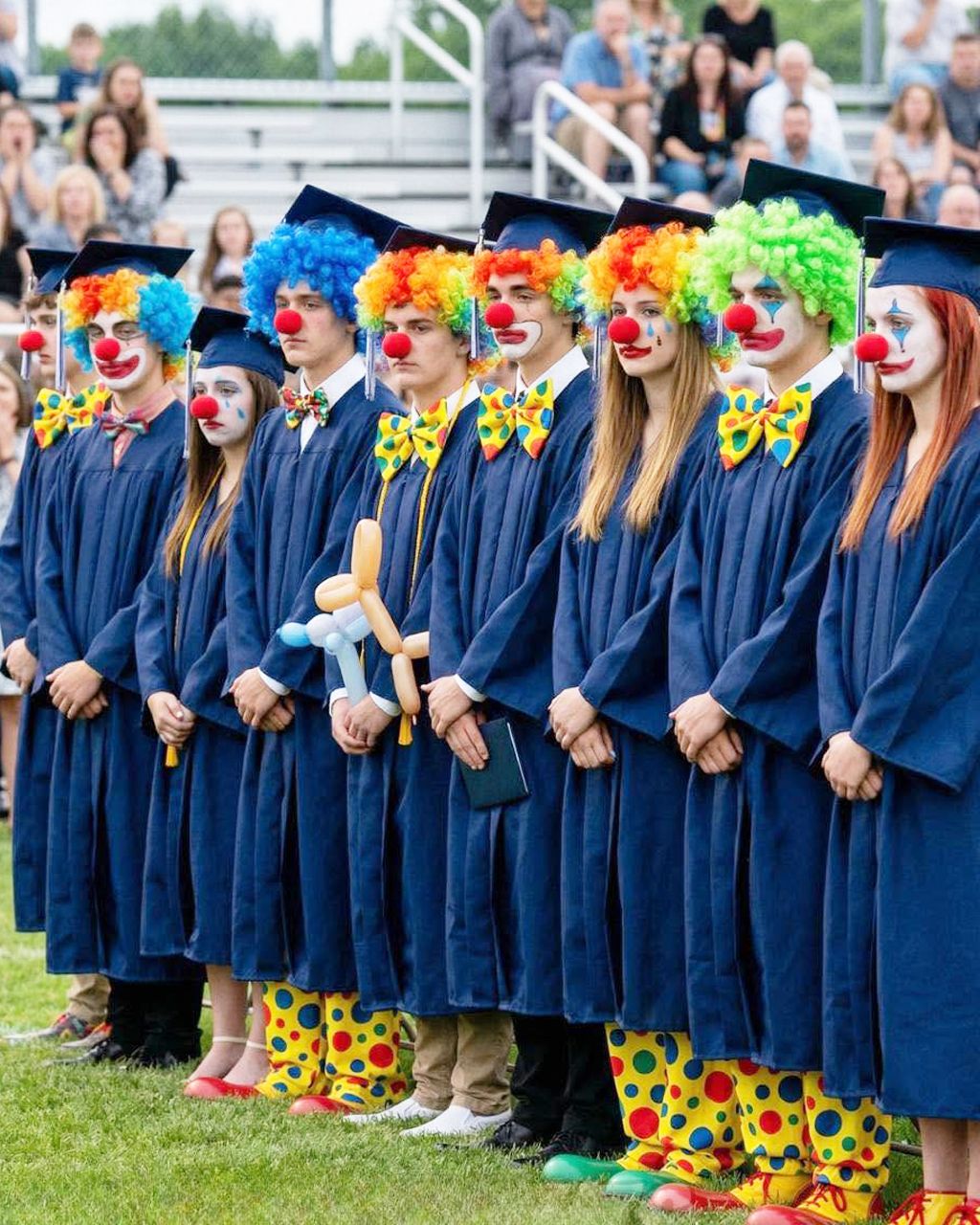
To his right, a short boy in the second row reached into his gown and pulled out a bright orange wig, slipping it over his hair with a single, swift motion.
A soft murmur rippled through the row behind him, a quick rustle of programs and shifting feet.
Principal Davis cleared his throat into the microphone, the high-pitched squeal of the feedback making several parents in the front row flinch.
“Welcome, families, faculty, and distinguished guests, to the sixty-fourth commencement,” he began, his voice flat and measured.
Beside the boy in the orange wig, two more students reached into their pockets and pulled out mismatched neon green socks, pulling them over their dress shoes.
The whispers in the rows around me grew louder, a low hum of confusion passing from row to row like a draft.
“This is not what I expected, but it feels like her,” I whispered to myself, my fingers tightening around the cracked blue pen.
On my left, an older man in a gray suit leaned toward his wife, pointing a thick finger toward the middle aisle.
“What in the world are those kids wearing?” he muttered, his voice carrying over the principal’s words.
Two girls in the front row unzipped their gowns halfway, revealing bright pink suspenders crossed over their white shirts.
from the wide sleeves of the black robes.
The sight of dozens of mismatched ribbons waving in the crowd was all I could see.
The principal cleared his throat, the sound sharp and scraping through the overhead speakers. He adjusted his grip on the edges of the wooden podium, his gold-rimmed glasses slipping slightly down his nose as he peered over the assembly. I sat in the very back row, the hard plastic of the folding chair pressing into my spine while I smoothed my floral skirt.
Principal Davis took off his glasses and began polishing them with the wide end of his blue silk tie. In the hallway behind me, the heavy black fan hummed, sending a rhythmic, warm draft across the back of my neck. The smell of fresh floor wax was strong, thick enough to make my head headache if I breathed it in too deeply.
“Every class leaves its own particular mark on Oakhaven,” Principal Davis said, his voice dropping into that formal, measured cadence he always used when addressing the public. “But this year, we have been tested in ways that require a different kind of strength.”
He paused, his eyes scanning the rows of graduates who were still rustling under their blue polyester gowns. A yellow ribbon peeked out from beneath one boy’s collar, bright and defiant against the dark fabric. Another girl in the third row seemed to be hiding something bulky under her knees.
“Resilience is not merely surviving the winter,” the principal continued, replacing his glasses and leaning forward. “It is the decision to rebuild the structure when the storm has passed.”
He spoke of long-term growth and structural integrity, using the sort of language Marcus often used when we talked about our retirement accounts. It was dry, safe language designed to keep everyone in their seats, you see. But the graduates were not listening to the words.
that made me stiffen. It was the sound of seventy people trying to decide if they should laugh or complain.
Principal Davis stopped mid-sentence, his gaze landing on the middle row of graduates.
Kayla stood up from her seat near the center aisle, her movement sudden enough to draw every eye in the back rows. Her thumb was already at work, twirling the small silver ring around her thumb with a rapid, frantic motion that I could see even from thirty yards away.
She began walking toward the stage steps, her chin held high and her shoulders square.
“Kayla,” Principal Davis said, his microphone catching the warning tone in his voice before he could turn it off.
She did not pause, her sneakers squeaking softly against the polished floor wax as she reached the bottom of the wooden steps. Two other students in her row stood up as if on cue, their hands tucked behind their backs.
I leaned forward, my fingers tightening on the edge of Olivia’s graduation cap resting in my lap. The cardboard inside the cap bent slightly under my thumb, and I quickly let go, smoothing the dark blue fabric back into place.
Kayla climbed the steps and stood beside the podium, her hand reaching out toward the thin neck of the microphone.
Principal Davis stepped back, his tie still slightly crooked from where he had used it to clean his lenses. He looked down at his printed program, then back at Kayla, his face tightening into a pale, anxious mask.
“The program allows for student reflections at the conclusion of the roll call,” the principal said, his voice carrying only to the first few rows.
“We need to do this now, sir,” Kayla said, her voice clear even without the microphone.
The silence that followed was thin and brittle, like winter ice on the driveway.
Principal Davis looked at the crowd, then at the school board members seated in a neat row behind him, before he finally took three steps back. He left the podium entirely to her.
Kayla adjusted the height of the microphone, the metal pole sliding down with a harsh, metallic screech that made several people in the front row flinch.
She looked out over the sea of parents, her eyes searching the rows of folding chairs. I knew she was looking for me, but in the back row, surrounded by tall winter coats and wide shoulders, I was hard to find, you see.
She cleared her throat, the sound booming through the black speakers mounted on the brick walls.
“Before we hand out the diplomas, we have a promise to keep,” Kayla said, her words coming in a rapid, earnest burst.
She reached down and unzipped the front of her graduation gown, letting the blue polyester fall away from her shoulders. Underneath, she was wearing a bright green t-shirt and a pair of suspenders decorated with tiny yellow rubber ducks.
A scattered round of laughter broke out from the junior varsity baseball team sitting near the exit.
I watched her from the back, my breath held so tight my chest ached. Kayla adjusted the suspenders, her fingers snapping the elastic against her chest as she tried to steady her breathing.
In the second row of students, a quiet boy named Arthur stood up to help her by holding up a hand painted sign, though his face was entirely red. He was the quiet boy who worked in the school kitchen after hours, always keeping to himself, and seeing him stand there made my throat tighten.
He held the sign high, though his hands shook so much the wooden stick rattled against his metal chair.
Kayla looked at him and nodded once, her expression softening for a brief second before she turned back to the microphone.
“We promised we would not let this day be ordinary,” Kayla said, her voice shaking slightly before she found her footing.
She looked down at her hands, her silver ring catching the overhead fluorescent lights.
The laughter from the back rows began to die down, replaced by a heavy, expectant quiet that seemed to press against the brick walls of the assembly hall. Parents who had been whispering a minute ago were now leaning forward in their seats.
Kayla looked up from the podium, her gaze cutting through the crowd of hundreds.
She looked directly at me.
Kayla kept her eyes on mine, her thumb ring catching the glare of the overhead stage lights. The silence in the assembly hall grew so heavy that I could hear the steady hum of the black fan working in the corridor behind the double doors.
“Most of you are probably wondering why we look like this,” Kayla said into the microphone. Her voice came out in a rapid, earnest burst that vibrated through the black speakers on the brick walls.
She reached down and adjusted the bright yellow suspenders stretching over her shoulders. The bright fabric stood out against the formal black of her graduation gown like a dandelion growing through a crack in the Oakhaven pavement.
“We did not plan this to be disrespectful to the school or to Principal Davis,” Kayla said, looking briefly at the side of the stage. “We did it because Olivia Miller designed these ribbons and socks in her bedroom three months ago.”
My hand froze against the floral skirt I had been smoothing over my knees. The blue graduation cap on my lap felt suddenly heavy, its stiff square corner pressing into my palm.
“She made me promise that we would carry out the plan,” Kayla said, her voice rising to reach the back row where I sat. “Every single piece of color you see on us today is for her.”
A low murmur rippled through the rows of parents sitting in front of me. I saw Mrs. Gable, who lived down the street from us, turn her head to look back in my direction, but I kept my eyes fixed on Kayla.
“She knew she would not be standing here with us,” Kayla said, her fingers twirling the silver band on her thumb. “But she did not want us to walk across this stage with only a blank space where she belonged.”
Principal Davis stood near the steps of the stage, his hands clasped behind his back. He took off his gold-rimmed glasses and began to polish the lenses with the thick end of his blue tie, his movements slow and measured.
To my left, a tall boy in the front row of the student section stood up from his folding chair. It was Tommy, who used to mow our lawn on summer afternoons when his lawnmower wasn’t broken.
Tommy pulled the hem of his black graduation gown up to his shins. He was wearing a pair of neon green and yellow striped socks that reached nearly to his knees.
Beside him, two girls stood up and reached into their wide sleeves. They pulled out bright orange plastic joke noses and slipped them over their faces, blinking through the small eye holes.
“She bought forty-one dollars of colorful fabric ribbon on the Tuesday before Easter,” Kayla said, her voice steadying as more students began to stand. “We cut them up on my kitchen table while her mother was at the grocery store.”
I remembered the yellow receipt I had found tucked inside the drawer, the one with the faded ink that I could not account for. I had spent weeks wondering what Olivia had done with forty-one dollars in cash during a brief afternoon when she had asked Brian to drive her to the craft shop near the highway.
“We spent three hours deciding which colors went to which person,” Kayla said. “Olivia had a list of every student in our class.”
More graduates stood up in the third and fourth rows, their gowns rustling like dry leaves. A girl with dark braids turned toward the audience to reveal a large, mismatched pink bow pinned to the shoulder of her gown.
The parents around me began to whisper, their voices blending into a dry rustle that rose toward the steel rafters. A man two rows ahead of me leaned over to ask his wife a question, but she only shook her head and kept her eyes on the stage.
“She wanted us to laugh today, especially the ones who find it hard,” Kayla said.
She looked down at the empty folding chair in the very front row where the single white rose lay on the polished wood. The rose looked small and pale against the bright yellow ribbon someone had tied around its stem while the assembly hall was filling up.
“She told me that graduation should not feel like a dry sermon,” Kayla said. “She said she did not want her mother sitting in the crowd thinking about a quiet room and a closed box.”
My thumb traced the gold embroidery on the corner of the blue cap in my lap. I thought of the folded blue note currently tucked inside the brass latch of my purse, the one she had hidden behind her wooden jewelry box.
She had asked me to come here, you see. She had written those few lines in her favorite blue ink pen because she knew the hall would be filled with these ridiculous, bright ribbons.
“She made me swear that I would not tell anyone until we were all in our seats,” Kayla said, looking back at the long row of standing students. “She did not want the school to cancel the ceremony or confiscate our socks.”
A soft, hesitant laugh came from the middle of the crowd. Principal Davis did not put his glasses back on, but he stopped polishing them and held them by the temple pieces, looking at the students.
“We promised we would not let this day be ordinary,” Kayla said, her voice dropping into a quieter, more deliberate tone. “And we promised we would show her mother that Olivia was not alone when she was planning this.”
I looked at the boy Tommy, who was still standing with his bright green socks showing. He caught my eye and gave a small, solemn nod, the kind of nod his father used to give my husband Brian when they met at the edge of the driveway.
The realization settled over me like a cold draft under a door.
For weeks, I had carried the heavy belief that Olivia had spent her last month locked in her own mind, preparing for her departure in a lonely, isolated silence that we could not reach. I had pictured her staring at the ceiling of her bedroom, holding her fears close because she did not want to burden us with them.
But she had been plotting this. She had been sitting at her small desk, using her favorite blue ink pen to write down names and coordinate ribbon lengths with her best friend.
She had accepted her path months before I had even allowed myself to admit the doctors were out of options, you see. She had looked at the future and decided that her friends should have laughter, even if she could not be there to share the joke.
“This is for you, Mrs. Miller,” Kayla said, her voice carrying clearly through the high ceiling of the hall. “She wanted you to see that she was still here.”
The girl with the dark braids who had pinned the pink bow to her gown began to clap. Her palms made a sharp, flat sound that seemed to startle the row of teachers sitting behind the podium.
Tommy joined in, his large hands creating a deeper, slower rhythm. Within seconds, the entire front row of graduates was clapping, their mismatched ribbons shaking against the black fabric of their shoulders.
I looked at Principal Davis to see if he would step to the microphone to restore the order he valued so much. He stood perfectly still by the wooden steps, his gold-rimmed glasses still hanging from his fingers as he watched the students.
The applause spread to the middle rows of parents. The woman in front of me who had been whispering to her husband stood up, her hands moving quickly, her face turned toward the stage.
I remained in my seat, my fingers pressed against the blue cap on my lap. The hum of the heavy black fan in the hallway was completely gone now, buried under the sound of hundreds of hands coming together.
The sound rose toward the rafters, warm and rhythmic, filling every corner of the large room until the walls seemed to vibrate with it.
My palms were cold against the dark blue fabric of Olivia’s graduation cap, which lay flat on my floral skirt. The applause rolled across the rows of folding chairs, a steady, thrumming beat that made the wooden floorboards vibrate under my shoes.
Principal Davis stood at the microphone, his gold-rimmed glasses catching the harsh glare of the stage lights. He reached up with one hand, unfastening his silk tie slightly so he could use the tip to polish the lenses, his movements formal and measured.
“We have one more name,” he said, his voice dropping its formal edge as the microphone hummed with a quiet static.
He looked directly toward the back row where the late arrivals and the families who preferred the shadows always sat.
“To accept the diploma for Olivia Miller, we invite her mother, Evelyn, to the stage.”
My fingers tightened on the cardboard edge of the cap, and I felt the small embroidered button in the center press into my thumb. The silence that followed was not empty; it was filled with the collective breath of three hundred people waiting to see what I would do.
I stood up, smoothing my floral skirt with a slow, deliberate stroke of my hands to make sure the fabric hung straight. The gray Buick was parked three hundred yards away in the gravel lot, its eighty-two thousand miles of road dust coating the fenders, but the short walk to the stage felt infinitely longer.
I walked down the long side aisle, my heels making a sharp, solitary sound against the polished floor. To my left, rows of young faces looked up, their bright yellow and green ribbons pinned to their blue gowns, waving slightly as I passed.
Principal Davis watched me approach, his tie still slightly crooked from his polishing. He did not look back at the crowd; his eyes stayed on my face, full of a quiet, formal pity as I reached the bottom step of the stage.
“She earned every credit, Evelyn,” he whispered, his hand extending the small leather folder bound with a gold tassel.
The leather of the folder was cool and smooth, smelling of glue and new vinyl. I took it with my left hand, keeping Olivia’s cap pressed close to my ribs with my right.
“Thank you, Arthur,” I said, my voice barely carrying past his shoulder, using his first name for the first time in the ten years we had lived in Oakhaven.
He gave a slow, measured nod and stepped back, leaving me standing in the center of the stage lights.
Before I could turn toward the steps, a sudden rustle of blue nylon came from the front row of graduates. Kayla stood up first, her silver thumb ring catching the light as she stepped onto the wooden floorboards with a quick, earnest movement.
Two other girls in blue gowns stood up behind her, their mismatched socks showing beneath their hems as they walked forward.
“We aren’t letting you go back alone, Mrs. Miller,” Kayla said, her voice carrying across the front rows in a rapid, earnest burst.
Within seconds, the entire front row was moving, their blue gowns rustling like dry leaves as they formed a tight circle around me.
The scent of peppermint gum and damp wool fabric closed in as they gathered, shutting out the rest of the room. A hand pressed gently against my shoulder blade, and another rested on my arm, holding me steady in the center of their circle.
Nobody spoke a word, but the pressure of their young shoulders was firm and real, a physical wall against the eyes of the crowd. I held Olivia’s diploma tight against my ribs, feeling the sharp edge of the leather folder sink into my skin.
“We have her blue pen,” one of the boys whispered from somewhere behind me, his voice cracking slightly on the last word.
The circle broke slowly, the students stepping back one by one with small, quiet nods that felt more like a promise than a farewell. Kayla remained the closest, her thumb ring spinning rapidly under her finger as she looked at me.
“We have to go to the lobby for the line-up,” she said, pointing toward the side exit behind the stage curtain.
I followed them through the heavy velvet drapes, the cool air of the back hallway hitting my face with the familiar scent of fresh floor wax.
The exit doors were propped open with heavy brass wedges, letting in the warm breeze from the parking lot where a few early departures were already starting their cars. Kayla stopped near the water fountain, her fingers tracing the edge of her silver ring as she looked out at the yellow school buses.
“I wanted to show you the ribbon before everyone started leaving,” Kayla said, pulling a spare strip of green satin from her gown pocket.
“It’s beautiful, Kayla,” I said, running my thumb over the smooth fabric, though I did not look at the words written on the inside. “You did all of this.”
“Olivia did,” she said, her voice rising in a rapid, earnest burst. “She sat at my kitchen table three days before she went into the clinic and wrote down the names of everyone who needed a ribbon. She told me you would be here.”
I looked down at the dark blue diploma folder in my hands, then back at the girl who had spent every Friday night of her teenage years in our living room.
“She knew I would come?” I asked.
“She knew you would find the note,” Kayla said, nodding quickly. “She wanted you to see that she wasn’t alone. She loved you so much, Mrs. Miller. She told me to make sure you knew that, especially today.”
The crowd of relatives began to push through the double doors, their loud laughter filling the narrow corridor and breaking the quiet space between us.
“I have to find my parents,” Kayla said, looking toward the gravel parking lot where her father was waving from their truck.
“Go on,” I said, squeezing her hand. “They’re waiting.”
She ran down the concrete steps, her blue gown billowing behind her like a sail in the warm June wind.
I walked toward the gray Buick, my heels clicking against the asphalt of the half-empty parking lot as I placed the diploma and the cap on the passenger seat beside me.
The driveway was quiet when I pulled in, the heavy black fan in our hallway still humming through the screen door with a low, rhythmic vibration. Brian’s dark blue sedan was parked near the garage, the engine off but the windows rolled down to let the hot air escape.
He was sitting in the driver’s seat, his hands resting on the top of the steering wheel. His silver wristwatch caught the afternoon sun as I shut the door of the Buick, the ticking of the clock in his dashboard probably the only sound he had heard for hours.
I walked over to his side of the car, carrying Olivia’s cap and the leather diploma folder in the crook of my arm. His eyes were red, his face wet as he stared straight ahead at the closed wooden garage door.
“Brian?” I said, leaning against the warm metal of the door frame.
He didn’t turn his head, but his fingers tightened on the black vinyl of the wheel. His silver watch caught the light as he checked it out of habit, his wrist moving in a quick, jerky motion.
“I tried to clean the gutters,” he said, his voice thick and rough, like sawdust caught in his throat. “But I couldn’t even get the ladder out of the shed.”
“It’s alright,” I said, placing my hand over his on the window sill.
“I wanted to go, Evelyn,” he said, a single drop tracing a path through the dust on his cheek. “I had my good shoes on. I even went out to the porch.”
He finally looked at me, his eyes full of a raw, heavy pain that I had been too angry to see in the weeks leading up to today.
“I just could not bear to look at that front row, Evelyn,” he said, his voice dropping to a whisper.
I kept my hand steady on his, feeling the heat of the afternoon sun rising from the driveway.
“I felt like I failed her,” he said, his thumb rubbing against the silver watchband. “Like I was supposed to sand down the rough edges of her life, make everything smooth for her, and I couldn’t do it. I couldn’t protect her from any of it.”
“No one could have changed it, Brian,” I said.
He looked down at the dashboard, his throat moving as he tried to swallow.
“Every time I think about that empty space in the room, it feels like a physical weight,” he said.
“She wasn’t alone,” I said, holding out the green ribbon Kayla had given me. “They had ribbons, Brian. Dozens of them. She planned the whole thing.”
He didn’t take the ribbon, but his eyes lingered on the bright green satin, his fingers twitching as if he were measuring the grain of the wood.
“I should have been there to hold your hand,” he said.
“You’re here now,” I said, opening the car door gently.
He didn’t get out, but he reached for my hand, his fingers rough and calloused from years of working with pine and oak in his workshop.
“I don’t know what to do with the college money,” he said, looking at the house where the forty-one thousand dollars in savings bonds sat in the drawer. “Every time I think about those savings bonds, it feels like we’re just keeping a box of ashes.”
“We’ll find a way to use it,” I said, thinking of the draft I would write later. “Something that fits her.”
He nodded slowly, but his hand began to tremble against mine.
The grief seemed to take him all at once then, pulling him down into his seat as he let go of my fingers.
He leaned his forehead against the steering wheel.
I touched his shoulder, the fabric of his good Sunday shirt warm from the afternoon heat, and guided him toward the back porch. He did not look back at the driveway as he stepped inside.
By seven in the evening, the heat had settled into the kitchen floorboards, thick and heavy. The black fan in the hallway kept up its steady, rhythmic drone, moving the warm air from one corner of the room to the other.
Olivia’s high school diploma lay in the center of the kitchen table, its embossed gold seal catching the light from the overhead fixture. Next to it sat the blue ink pen Kayla had dropped into my lap during the ceremony, its plastic barrel slightly scuffed.
I set the pen down right next to the gold seal.
Brian sat in the chair nearest the window, his fingers tracing the edge of the white tablecloth. He had not changed out of his dress trousers, though he had undone the top button of his collar.
“I kept thinking about the cedar chests I built last winter,” Brian said, his voice barely louder than the hum of the fan. “If you don’t sand the grain down before the lacquer goes on, every little mistake gets locked inside forever.”
I smoothed my floral skirt, pressing the fabric flat against my knees. The linen was wrinkled from hours of sitting in the assembly hall, but the physical repetition of smoothing it helped quiet the noise in my head.
I waited for him to speak first.
“She wanted us to be there, Brian,” I said.
He checked his silver wristwatch, the metal band clicking against his wrist bone. He looked at the blue pen, then back at the diploma.
“I know,” he said. “I should have been sitting right beside you, but I just kept seeing that empty space in the front row where she was supposed to be.”
I picked up the pen, unscrewing the cap and screwing it back on. The small plastic thread made a dry, clicking sound that seemed to fill the quiet space between us.
“Kayla gave me this during the recessional,” I said, holding the blue pen up to the light. “She didn’t say why Olivia wanted me to have it, but she was very particular about handing it over, almost as if it were a key to something.”
Brian reached out and touched the gold lettering on the diploma cover, his rough fingers matching the texture of the leatherette.
“It has her full name on it,” he said. “Olivia Grace Miller.”
“We should put it in the study for now,” I said, rising from the chair. “Before the grease from the stove gets to it.”
I picked up the leatherette folder and walked down the hall.
The air in the small study at the end of the hall was cooler and smelled of old paper. The green ribbon Kayla had given me sat on the corner of the rolltop desk, still tied in its neat, stiff bow.
The ribbon was the exact color of the spring grass along the creek behind our orchard. I picked it up, my fingers finding the rough texture of the grosgrain fabric.
I was almost afraid to touch the knot.
It was the same ribbon from the forty-one-dollar receipt I had found tucked inside her school planner weeks ago. I had wondered then why she needed so many yards of colorful trim, thinking perhaps she was making banners for a school dance or decorations for her bedroom walls.
Now, as I untied the small bow, the fabric uncurled under my fingers, revealing the pale, unfinished underside of the weave.
Written in Olivia’s neat, rounded print, using the same blue ink as the pen on the kitchen table, was a single word.
Kind.
I stood there for several minutes, the green ribbon draped over my palm like a small, quiet weight. Kayla had been wearing a yellow one, and the boy in the front row had a bright orange band tied around his wrist during the ceremony.
They all had words written on the inside, you see.
I remembered the way the students had stood up one by one, showing their mismatched socks and joke noses, their gowns parted to reveal the bright flashes of ribbon.
Each piece of fabric carried a different word, a tiny testament to the things Olivia had seen in them during their four years together.
I had to find out what she wrote on the others.
I carried the green ribbon back into the living room, where Brian was sitting on the edge of the sofa. He had finally taken off his dress shoes, his blue socks showing against the faded wool of our rug.
“It says kind,” I said, holding the green strip out to him. “Olivia wrote it herself on the back of the trim.”
He took the ribbon, holding it under the light of the floor lamp. He turned it over, his rough thumb passing over the blue lettering twice before he set it down on the side table.
“Kayla told me the others have them too,” I said, sitting in the armchair opposite him. “Brave on some, loved on the others. She spent the entire month of April cutting those ribbons and writing on them in her bedroom while we thought she was just resting.”
He did not ask how I knew.
Brian cleared his throat, his eyes fixing on the framed print of the Oakhaven valley that hung above the fireplace. He checked his silver wristwatch again, though only five minutes had passed since we left the kitchen.
“It is like a template,” he said, his voice tight. “When you build a cabinet, you layout the pieces before you cut the timber so you don’t waste the good oak.”
“We have forty-one thousand dollars in the savings bonds,” I said, my voice dropping an octave. “The money we set aside for her tuition at Ohio State.”
Brian did not look up, but his shoulders went rigid under his white shirt. The clock on the mantel ticked once, a sharp, metallic sound that seemed to mark the distance between us.
“That was for her future, Evelyn,” he said.
“This is her future,” I said.
I smoothed my skirt again, the floral pattern familiar under my palms. The savings bonds were sitting in the safety deposit box at the Oakhaven State Bank, forty-one thousand dollars in crisp paper that we had accumulated over fifteen years of skipping summer trips and keeping the old Buick running.
“We are going to use her college fund to keep her work going, Brian,” I said.
He looked at me then, his gray eyes searching my face for some sign of hesitation. The heavy fan in the hallway seemed to grow louder, filling the silence while he processed the words.
“A permanent scholarship,” he said, the words falling slowly. “For the kids who don’t always get the high marks, but the ones who look out for the rest.”
“The ones Olivia always noticed,” I said.
He stood up and walked to the window, looking out at the gravel driveway where the gray Buick sat in the gathering dusk. The car had eighty-two thousand miles on it, and the muffler would need replacing before the autumn rains started.
“It will take some restructuring,” Brian said, his hand resting on the window frame. “Marcus will know how to set up the foundation so the principal stays whole.”
“We will call him tomorrow morning,” I said.
He did not agree, but he did not say no.
“He will talk about tax dividends and structural growth,” Brian said, a faint smile touching the corner of his mouth. “But he will get the paperwork done right.”
I left him by the window and walked up the stairs to the bedroom. The air was cooler up here, carrying the faint scent of the lilac bushes that grew along the backyard fence.
I sat at the small writing desk in the corner of our room, turning on the brass lamp. The yellow light pooled over a pad of lined paper and Olivia’s favorite blue ink pen, which I had brought up from the kitchen.
I began to write, my handwriting shaky at first, then growing steadier as the sentences took shape on the page.
The Olivia Miller Memorial Scholarship, I wrote at the top of the sheet.
My hand was steady now.
I did not write about grades or athletic achievements, you see. I wrote about the quiet things, the small acts of decency that go unnoticed in a crowded hallway.
I specified that the recipient must be chosen by a committee of peers and teachers, based on the qualities of kindness and quiet leadership. The forty-one thousand dollars would remain untouched, the annual interest providing a thousand dollars each year for a graduating senior.
The paper felt thin under my hand, but the words carried a weight that the bank accounts never could.
There was no turning back from this.
I wondered if the school board would accept a criteria that did not rely on grade point averages or test scores. Principal Davis was a formal man, and the rules of the district were rigid, built on decades of precedent that favored the highest achievements.
I knew we would have to fight Principal Davis on this point.
But I knew Kayla would help me find the right words to convince them.
I read through the draft twice, correcting a spelling mistake in the third paragraph. The house was quiet now, the only sound the occasional hum of a passing car on the state route half a mile away.
I signed my name at the bottom of the rough scholarship draft.
Marcus tapped his blue pen against the yellow legal pad, the plastic clicking in a steady, dry rhythm that matched the hum of the air conditioner. The office smelled of old paper and leather chairs, a quiet room high above the main street of Oakhaven.
“The structure here is what secures the longevity,” Marcus said, pointing the tip of his pen at a column of figures. “A donor-advised fund allows the principal to remain untouched while we yield enough annual growth to cover the award. We are looking at a system built for structural growth, not a one-time payout.”
I smoothed my floral skirt, pressing the fabric flat against my knees. The paper on his desk showed the forty-one thousand dollars, our entire college savings for Olivia, now divided into neat, bloodless percentages.
“We want it to last,” I said. “It has to be there every year, you see.”
Brian shifted in his chair, his silver wristwatch catching the fluorescent light as he turned his arm to check the face. It was ten past ten.
“We need to sand down the rough edges of this thing before we take it to the school,” Brian said, his voice low but steady. “If we do not get the grain right from the start, the whole piece will warp later on.”
“We have to present this to the board at two,” Brian said. “Let us keep the paper in the folder until we see if Davis is on our side.”
I let go of the pen, the metal clip on my purse clicking as I tucked the unsigned draft into my folder.
The drive to the high school administration building was quiet, the gray Buick carrying us past the park where the maple trees were already heavy with summer leaves. The parking lot was mostly empty, save for a few yellow school buses parked in the far lane.
Principal Davis met us at the double doors of the board room at exactly two o’clock. He looked formal in his dark blue suit, his gold-rimmed glasses catching the light as he took them off to polish them with the wide end of his silk tie.
“The board members are already seated,” Principal Davis said, his voice measured and quiet. “They have reviewed the financial outline you sent, Mrs. Miller. They are prepared to listen.”
We followed him into the room, where seven people sat around a long oak table. The smell of fresh floor wax was strong, reminding me of the morning of the graduation ceremony.
I sat at the foot of the table, opening my folder and placing the draft on the polished wood.
“We are not offering this money for the highest grade point average,” I said, looking at the board members. “And we are not looking for the varsity captain.”
A woman near the middle of the table, her gray hair pulled back in a tight clip, leaned forward. “The district has several academic trusts already, Mrs. Miller. Our current guidelines prioritize students in the top ten percent of the graduating class.”
“This scholarship will search for the quiet ones, the ones Olivia always noticed,” I said.
Brian leaned his elbows on the table, his fingers interlaced. “If you only reward the ones who are already at the top, you leave a lot of good wood on the forest floor. We want to find the student who keeps the peace, the one who helps without asking for a trophy.”
Principal Davis finished polishing his glasses and slid them back onto his nose, the gold frames sitting perfectly straight.
“The criteria must be objective enough for our committee to evaluate,” Davis said. “How do you measure kindness?”
I reached into my purse and pulled out the small blue ink pen that Olivia had kept in her desk drawer, placing it beside the paper.
“You look at what they do when they think nobody is watching,” I said. “You ask the hall monitors, the cafeteria staff, and the librarians. They know who the kind ones are, you see.”
The board members looked at each other, the silence in the room stretching until the clock on the wall gave a loud, metallic tick.
The gray-haired woman tapped her pencil against her notebook. “We would need a separate nomination form. One that allows peer reviews and staff recommendations rather than standard transcripts.”
“We have already drafted that form,” Brian said, sliding a second sheet of paper across the table. “It is simple. No grade requirements, just a space for three people to describe how the nominee made the school a better place to be.”
Principal Davis picked up the draft, his eyes moving slowly down the page as he read the questions we had written the night before.
“This is unusual,” Davis said. “It bypasses our standard rubric.”
“That is the point,” I said.
Davis looked at the other board members, his face showing nothing of his thoughts, before he stood up and gestured toward the door.
“The board will require a private discussion to vote on the acceptance of these terms,” Davis said. “If you could step out into the hallway for a few minutes.”
Brian and I stood up, leaving the blue pen and the papers on the table.
The hallway was lined with green metal lockers, their faces reflecting the pale light from the high windows. We walked toward the display cases where the old trophies sat behind sliding glass doors.
“They might say no,” Brian said, his eyes fixed on his wristwatch as the second hand swept past the twelve. “They like things to fit into their neat little boxes.”
“If they say no, we will find another way,” I said, though my hands were cold as I smoothed my skirt again. “We do not need their permission to help a child.”
The heavy oak door of the board room opened at ten minutes past three, and Principal Davis stepped out into the corridor, holding the blue pen in his breast pocket.
“The board has concluded its vote,” Davis said, his voice carrying a slight warmth that had not been there before. “The decision was unanimous.”
A small breath escaped my lips, the tension in my shoulders finally letting go as I looked at the dark wood of the door.
“They approved it?” I asked.
“The Olivia Miller Memorial Scholarship is officially accepted under your terms,” Davis said, extending his hand. “We will begin the nomination process for the next graduating class immediately.”
I took his hand, his grip firm and dry, and for the first time in months, the weight in my chest felt like something I could carry.
“Thank you, Principal Davis,” I said.
“It is we who should thank you,” he said. “This school needs more of her spirit.”
We walked down the long corridor toward the main exit, our shoes squeaking slightly on the waxed tile. Near the glass doors of the administrative wing, Kayla was sitting on a wooden bench, her legs tucked under her.
She stood up quickly when she saw us, her silver ring spinning around her thumb as she took three rapid steps toward us.
“Did they agree?” Kayla asked, her voice rising in that earnest, hurried way of hers. “Tell me they didn’t make you change it.”
“They agreed to everything, Kayla,” I said, reaching out to touch her shoulder. “The criteria stay exactly as we wrote them.”
Kayla let out a quick, sharp laugh, her shoulders dropping as she looked from me to Brian. “I knew they would. They couldn’t say no to her.”
“We need someone to help us read the nominations next spring,” I said, looking at her bright, young face. “Someone who knows what to look for.”
Kayla stopped spinning her ring. “You want me?”
“You will be the first honorary committee member,” I said. “If you are willing.”
“I am,” Kayla said, her voice dropping to a quiet, steady tone. “I absolutely am.”
Principal Davis walked out of the office behind us, holding a leather folder containing the signed agreement. He stopped beside our small group, the gold rims of his glasses catching the afternoon sun through the main doors.
He reached out and shook my hand once more, the gesture formal and final.
The school assembly hall smelled of fresh floor wax and lavender perfume, the exact same scent that had drifted through the rows twelve months before.
My fingers worked the hem of my floral skirt, smoothing the cotton fabric over my knees.
It was a habit I could not seem to shake when the room grew too quiet, you see.
Brian sat to my right, his shoulder brushing mine in the tight row of metal folding chairs.
He adjusted his tie, his fingers lingering on the silk before he dropped his hand to check his silver wristwatch.
“Ten minutes until they start,” he whispered, his voice barely carrying over the murmur of the gathering families.
I nodded, keeping my eyes on the wooden stage where the podium stood under the bright overhead lights.
Last year, the front row had felt like an impossible ledge, but today we sat in the center of the honored guests section, our names printed on small white cards taped to the seat backs.
A heavy black fan hummed in the high corner of the room, pushing a slow, warm breeze across the crowd.
Every few seats, I saw the small flashes of color from the previous year, a stray ribbon pinned to a lapel or a bright wristband worn by one of the younger siblings.
Kayla sat three rows to our left, her silver thumb ring catching the light as she turned to wave at us.
She gave a quick, earnest nod, her lips moving as she whispered something to the girl beside her.
“We did the right thing with the fund,” Brian said, leaning in so close I could smell the peppermint on his breath. “We sanded down the rough edges, Evelyn.”
“We did,” I said.
My purse sat on my lap, heavy with the weight of the speech Principal Davis had asked me to keep in my pocket.
Inside the bag, Olivia’s graduation cap remained, folded flat, a physical anchor that I had carried into the building once again.
A woman two rows behind us dropped a heavy metal thermos, and the sudden clatter made Brian stiffen.
He looked at his watch again, then reached over and placed his hand over mine, his palm warm and dry.
“They are coming in,” he said.
The double doors at the back of the hall creaked open, and the first line of dark blue gowns appeared in the doorway.
The procession moved with a slow, rhythmic sway, the students keeping time with the recorded organ music pouring from the speakers.
I watched their faces, looking for the nervous grins and the quick searches into the crowd for proud parents.
Principal Davis stood at the podium, his gold-rimmed glasses catching the glare of the stage lamps as he polished them with the tip of his blue tie.
When he stepped back, the microphone gave a brief, sharp whine before settling into a low hum.
He spoke of dedication, of the quiet strength that keeps a community whole during its darkest seasons.
Then he cleared his throat and looked directly at our row.
“And now, we present the first annual Olivia Miller Memorial Scholarship,” Principal Davis said, his voice carrying clearly to the back wall.
The crowd went perfectly still, the rustle of program papers dying out in an instant.
“This award does not look at the highest test scores or the longest list of club memberships,” he continued, adjusting his glasses. “It looks for the student who works without expecting an audience.”
He looked down at his folder, his finger tracing a single line of print.
“This year, the committee recognizes Arthur Pendelton.”
A boy in the third row of graduates stood up slowly, his movements cautious as if he expected someone to tell him he had made a mistake.
His gown was slightly too long, the hem brushing his scuffed black shoes as he stepped into the aisle.
He did not look at his classmates, keeping his chin tucked as he walked toward the wooden steps of the stage.
Brian gave my hand a gentle squeeze, his thumb tracing the back of my knuckles.
“That is the boy,” Brian whispered.
I stood up from my seat, my floral skirt whispering against the metal chair as I made my way toward the steps to meet him.
Arthur met me near the podium, his hands clasped tightly in front of his gown.
His face was pale, his eyes darting toward the floor before he managed to look at me.
“Congratulations, Arthur,” I said, reaching out to hand him the heavy blue folder containing the scholarship certificate.
“Thank you, Mrs. Miller,” he said, his voice small but steady.
His fingers were rough, the skin around his nails red from the strong soaps used in the school kitchen.
As he took the folder, I saw a small silver ring on his thumb, identical to the one Kayla used to twirl during her visits to our porch.
“You earned this,” I said, keeping my voice low so the microphone would not catch the words. “For everything you do when no one is watching.”
He gave a single, firm nod, his shoulders relaxing just a fraction.
The applause from the bleachers rose in a steady wave, warm and unhurried, different from the sharp claps of the standard awards.
I looked back at Brian, who was standing beside his chair, his face calm and his eyes fixed on the boy beside me.
When Arthur stepped down from the stage, I followed him slowly, the heavy black fan overhead continuing its slow, rhythmic sweep.
The rest of the diplomas were handed out in a blur of names and handshakes, but my mind kept returning to the weight of the fund we had built.
Forty-one thousand dollars of Olivia’s college savings, once a source of quiet grief in a bank drawer, was now a living thing.
As the ceremony ended and the crowd began to filter toward the exits, Arthur waited near the side doors, his blue folder held tight against his chest.
He watched the families pass, his eyes searching until he saw me approaching.
“Mrs. Miller,” he said, stepping out of the flow of the crowd.
“Arthur,” I said, stopping beside a table piled with leftover programs.
“I wanted to tell you,” he said, his fingers tightening on the edges of the blue folder. “I did not think anyone noticed the extra hours in the kitchen after the games.”
“Olivia noticed,” I said.
He looked down at his scuffed shoes, a quiet smile touching the corners of his mouth.
“She used to come back there after the pep rallies,” Arthur said, his voice dropping to a whisper. “She would help me carry the heavy metal trays to the sterilizer when my wrists were tired.”
“She never told me that,” I said.
“She said the kitchen was where the real magic happened,” he said, looking up with a soft grin. “She said we were the ones who kept the whole place running.”
“That sounds like her,” I said.
“Kayla told me what she said about keeping things bright,” Arthur said. “We promised we would not let this day be ordinary.”
The words landed with a soft, familiar weight, matching the promise Kayla had made on our front porch a year ago.
“We did it, Olivia,” I whispered, the thought rising clear and calm. “Your friends are still looking out for each other.”
Arthur reached into his pocket and pulled out a small, folded piece of paper, holding it out to me.
I took the paper from his hand, the crease worn soft from being carried for months in a pocket.
“She wanted you to have this after the first one was given,” he said.
“Thank you, Arthur,” I said, tucking it into my black purse beside the graduation cap.
Brian came up beside me, his hand resting on the small of my back as we made our way through the crowded exit.
The noon sun was bright over Oakhaven, baking the asphalt of the parking lot and turning the hood of our gray Buick a pale, shimmering silver.
Parents were gathering in small groups near their cars, taking photos and laughing as the graduates threw their caps into the hot air.
We walked through the rows of vehicles, the eighty-two thousand miles on our odometer waiting to take us back to the quiet house on the corner.
“You did beautiful up there, Evelyn,” Brian said, his fingers sliding down to find mine.
“We did it together,” I said.
Our hands stayed joined as we reached the passenger side of the Buick.
The air in the parking lot smelled of exhaust and cut grass, the sounds of the celebration beginning to drift away as cars pulled out onto the main road.
My mind went back to the quiet bedroom waiting at home, and the dark wood of the jewelry box sitting on the dresser.
I wondered if the small brass key would still turn, and if the gentle melody inside would play for us one last time when we opened the lid.
Brian reached for the door handle, his movement smooth and unhurried.
He looked at me, the tension that had held his shoulders tight for a year finally softening in the bright June light.
He smiled as he opened the car door for her.
The gravel crunched under the tires as Brian parked the Buick in the driveway, the engine dying with a soft sigh. I did not wait for him to come around to my side this time. I opened the door myself, stepping out into the warm, heavy air of the afternoon.
I walked up the porch steps and went straight down the hallway to the bedroom, leaving the front door open to catch the breeze from the heavy black fan that hummed near the linen closet. The air in the room was warm, carrying the faint, clean scent of floor wax from the morning.
My floral skirt rustled as I moved toward the oak dresser, where the wooden jewelry box sat in its usual spot near the window. I smoothed the skirt down, feeling the heavy fabric settle against my knees.
The box was a simple thing, made of dark cherry wood with small brass hinges that had grown dull over the years. I reached out and touched the lid, tracing the grain with my index finger.
For months, I had avoided looking at it too closely, fearing the memories it carried would be too heavy to hold. But today, the wood felt cool and solid under my hand.
I turned the small key on the back of the box, feeling the gears click into place one by one. It was a slow, deliberate movement, a winding that felt like a quiet promise.
The melody began to play, thin and sweet, the notes rising into the quiet of the bedroom. It was the song Olivia used to play every evening before she went to sleep, you see.
I sat on the edge of the mattress and listened to the music box finish its song, the notes stretching out until the final chord faded into the afternoon air. The silence that followed was not the heavy, cold thing it used to be.
I did not feel the need to wind it again. I placed the key back on the silver tray, the metal making a soft clinking sound against the glass.
By four o’clock, the kitchen was filled with the warm, golden light of the late afternoon. Brian stood at the counter near the window, a large block of cheddar cheese and a cutting board laid out in front of him.
His silver wristwatch caught the sunlight as he moved his hand, slicing the cheese into neat, even squares with a long wooden-handled knife. He worked with the slow, deliberate focus he usually reserved for his woodworking shop in the basement.
“I thought we might want to use the blue plates today,” Brian said, not looking up from his work. “They look a bit brighter than the everyday white ones we usually keep in the front.”
“The blue plates are in the top cabinet on the left,” I said, walking over to the sink. “I will get them down for us.”
“It is like sanding down the rough edges of a piece of walnut,” Brian said, wiping the blade of the knife with a clean kitchen towel. “You have to take your time with the final steps, or the finish will not hold.”
“We have plenty of time,” I said, opening the cabinet and reaching for the stack of blue ceramic plates. “Kayla said she would be here by five, and she is usually right on time.”
“The school board sent over the final papers for the scholarship this morning,” Brian said, setting the sliced cheese onto a platter. “I left the envelope on the desk in the study.”
“I saw it,” I said, placing the plates on the counter beside him. “The criteria are exactly what we talked about with Principal Davis.”
“No academic requirements,” Brian said, adjusting his silver wristwatch. “Just a quiet record of being kind to people when nobody is looking.”
“That is how she lived, you see,” I said, smoothing my floral skirt once more as I leaned against the counter.
“It is,” Brian said, his voice quiet and steady. “And that is how we will keep her name alive in this town.”
He picked up the platter of cheese and crackers, adjusting the arrangement until every slice was perfectly aligned with the edge of the blue ceramic plate.
At five o’clock, we sat on the back patio under the shade of the big maple tree, where the air was cool and the grass smelled of fresh rain. Kayla sat on the green metal glider opposite us, her fingers constantly twirling the small silver ring on her thumb.
“She made me promise not to say a word about the ribbons until the graduation ceremony,” Kayla said, her words coming in a rapid, earnest burst. “She was so worried she would slip up and tell you herself because she was always so terrible at keeping secrets from you.”
“She was,” I said, leaning back in my lawn chair with a glass of lemonade. “She would buy my Christmas presents in October and have them unwrapped on my bed by November.”
“She wanted the whole class to have a part of it,” Kayla said, her thumb spinning the silver ring faster. “She told me that if everyone wore a ribbon under their gown, nobody would feel like they were standing alone up there on the stage.”
Brian took a slow sip of his tea, his eyes fixed on the garden at the edge of the lawn. “She had a way of looking at the whole structure of things,” he said. “Like she was building a house and knew exactly where the joints needed to be strong so the roof would not sag during a heavy storm.”
“She really did,” Kayla said, her face softening. “She told me once that the worst thing we could do was let everyone get solemn. She said, Kayla, if my mom goes to that graduation, I want her to see color, not just black gowns.”
“She wanted us to laugh today,” I said, looking out at the red tulips blooming along the fence line. “Especially the ones who find it hard, you see.”
“She would have been so proud of the scholarship,” Kayla said. “She always noticed the kids who did not get the big awards but still helped out in the kitchen or stayed behind to clean up after the games.”
“Those are the ones we are going to find,” Brian said. “The ones who keep the world running without asking for a trophy.”
“We have already received three letters from the junior class,” I said. “They are already looking out for each other.”
“That is the best dividend we could have asked for,” Brian said, looking at me with a quiet smile.
By seven in the evening, the sun had dipped below the tree line, leaving the living room in a soft, blue twilight. The house was quiet again, the visitors having gone home to their own families and their own lives.
I walked over to the wooden display cabinet in the corner of the room, where the glass doors reflected the pale light from the window. I opened the cabinet, the small brass hinges creaking softly in the quiet.
I held Olivia’s diploma in my hand, the thick white paper feeling heavy and solid. Beside it lay her favorite blue ink pen, the one she had used to write her notes and her planners during her final months.
I placed them side by side on the middle shelf, right next to the small silver cup she had won in middle school. The dark wood of the cabinet seemed to frame them, keeping them safe and close to the heart of the house.
Evelyn successfully established the scholarship fund using Olivia’s savings. Her choice to attend the graduation and face her grief allowed her to discover the joyful tribute her daughter had planned.
Brian joined her in managing the fund, finding his own way back from isolation. Evelyn refused to blame him for his past absence or hold any bitterness toward the school.
She stood in her sunny kitchen and placed Olivia’s favorite blue pen in the wooden drawer.
“The house was quiet, but the silence did not feel empty anymore.”