Part 1: Every Veterans Day, an Old Marine Ordered Two Coffees at My Diner—Until a Young Marine Arrived With a Letter: For nine consecutive years, an elderly Marine visited my diner every Veterans Day, ordered two black coffees, and left one untouched across from him. I always covered his bill, although I never understood why he needed that second cup. This year, he never arrived. Instead, a young Marine in dress blues walked through the door, handed me an envelope, and said something that made my heart sink. “My grandfather wanted you to know who that
second coffee was for.” My name is Roberta Kane, although everyone calls me Bobbie. I’m fifty-eight years old, and I’ve worked at the Harbor Diner in Oceanside, California, for twenty-two years. Living near Camp Pendleton means seeing Marines almost every day. Some come in laughing with friends, while others sit quietly over breakfast before returning to duty. But one customer became especially important to me. Nine years ago, on November 11, an elderly man entered shortly after seven in the morning. He wore a faded Marine Corps cap, a dark jacket, and a Vietnam
service ribbon. He chose Booth 4, beside the front window. “Two coffees, please, ma’am. Black.” I brought him two steaming mugs. He placed one directly across from himself, as though someone would be joining him. But nobody came. For nearly three hours, he remained there, occasionally sipping his coffee and watching traffic pass outside. When he finally stood to leave, I noticed his trembling hands. “Don’t worry about the bill,” I told him. “It’s on me today.”
He studied my name tag.
“Thank you, Roberta.”
Something about the way he said my name stayed with me.
The following Veterans Day, he returned at exactly the same hour. He ordered two coffees, occupied Booth 4, and left the second cup untouched.
His name was Cyrus Lambert.
Over time, we developed a quiet tradition. Every November 11, I served him his coffee, sat beside him for a few minutes, and paid his bill.
He never explained the empty seat, and I never pressured him.
Perhaps I understood that some memories were too painful to discuss.
My own father had served in Vietnam. He was killed when I was only three months old, leaving my mother to raise me alone.
I had one photograph of him holding me as a newborn, still wearing his Marine uniform.
That photograph was the closest thing I’d ever had to knowing him.
Sometimes, while sitting with Cyrus, I wondered what my father might have looked like if he’d lived long enough to grow old.
Then, last spring, everything at the diner changed.
Our longtime owner retired, leaving the business to his thirty-one-year-old son, Chad.
Chad cared about efficiency, customer turnover, and maximizing every booth’s earnings.
When Veterans Day approached, I prepared Booth 4 as usual.
Chad noticed the two mugs.
“What’s this supposed to be?”
“Mr. Lambert comes every Veterans Day. I always have his coffee ready.”
Chad frowned.
“You mean the old man who occupies a booth for three hours and barely spends anything?”
“He’s a veteran, Chad. I pay for his coffee.”
“Not anymore. If he comes in, he orders a meal or leaves. We’re running a business, not a charity.”
I didn’t argue.
At seven o’clock, Booth 4 remained empty.
By eight, I was beginning to worry.
Then, at 8:15, the bell above the entrance rang.
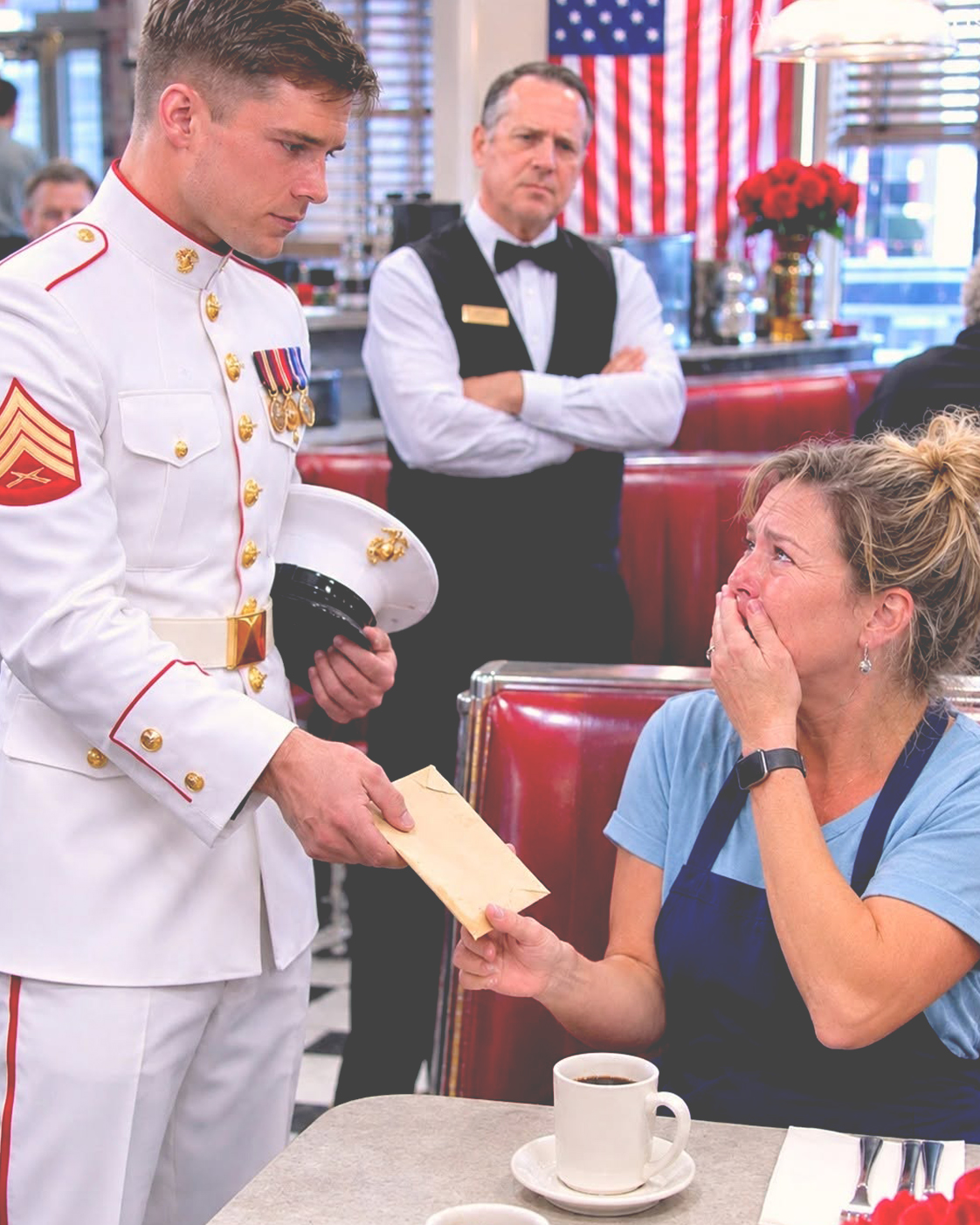
A young Marine in immaculate dress blues stepped inside, carrying his white cover beneath one arm.
He looked around until he spotted my name tag.
“Ma’am, are you Roberta Kane?”
“Yes.”
He swallowed.
“I’m Corporal Devin Lambert. Cyrus Lambert was my grandfather.”
I noticed he’d said was.
“He passed away in September,” the young man continued. “Before he died, he made me promise to bring you this.”
He handed me a worn envelope bearing my name in shaky handwriting.
Then he glanced toward the empty seat in Booth 4.
“My grandfather said you’d finally understand why he always ordered two coffees.”
Part 2: The Young Marine Told Me His Grandfather Had Died—Then He Showed Me a Photograph of My Father
I stood behind the counter, holding the envelope Corporal Devin Lambert had placed in my hands. For nine years, his grandfather had occupied Booth 4 every Veterans Day, and now I knew he would never return.
“I’m sorry about your grandfather,” I whispered.
“Thank you, ma’am. He talked about you often.”
Before I could ask what he meant, Chad approached us.
“Sir, just so you know, we’re limiting booth use to fifteen minutes today. It’s a busy holiday.”
Devin looked at him briefly, then turned back to me.
“My grandfather specifically asked me to sit with you at his usual table.”
I took the young Marine to Booth 4. The two mugs I’d prepared that morning were still waiting there, although the coffee had gone cold.
Devin sat in the chair Cyrus had always left empty.
Seeing someone occupy that seat felt strangely unsettling.
“My grandfather knew he was getting weaker,” Devin explained. “He wrote this letter because there was something he couldn’t bring himself to tell you.”
I carefully opened the envelope.
Inside was a faded black-and-white photograph showing two young Marines standing together in jungle fatigues. Their arms rested across each other’s shoulders, and both were squinting against the bright sunlight.
I recognized one of them immediately from the photographs Devin had shown me of his grandfather.
The other man made my breath catch.
He had a narrow chin, a slightly crooked smile, and familiar eyes. I’d seen those features in the mirror for fifty-eight years.
I turned the photograph over.
Written in faded ink were the words:
Cy and Jimmy. Hue City. January 1968.
My hands began trembling.
“Where did your grandfather get this?”
Devin leaned forward.
“He kept it after Vietnam. It was one of his most treasured possessions.”
I looked at the photograph again.
“My father’s name was James Kane,” I said quietly. “Everyone called him Jimmy.”
Devin nodded.
“I know.”
For a moment, the sounds of the diner seemed to disappear.
My father had died in Vietnam when I was three months old. My mother rarely discussed his final days because the memories were too painful.
All my life, I’d known him through one photograph: a young Marine holding his newborn daughter in a hospital room.
Now I was looking at another picture of him, smiling beside the elderly man I’d served coffee for nine years.
“Your grandfather knew my father?”
Devin’s eyes filled with tears.
“They were best friends.”
I pressed my fingers against the photograph.
“Why didn’t Cyrus ever tell me?”
“He wanted to. Every year, he promised himself he would. But he was afraid of what you might think when you learned what happened.”
I couldn’t imagine why knowing my father had been his friend would upset me.
Devin pointed toward the remaining pages inside the envelope.
“He explained everything in his letter.”
I unfolded the first sheet.
The handwriting was uneven, with several words crossed out and rewritten. At the top, Cyrus had addressed me by my full name.
Dear Roberta,
For nine years, you’ve shown kindness to an old man without knowing what he owed your family. I should have told you the truth the first time we met.
Your father saved my life in Vietnam.
I stopped reading.
Across the table, Devin waited silently while I struggled to steady my breathing.
I had spent nearly six decades wondering how my father died and whether anyone had been beside him during his final moments.
The answers were resting in my hands.
And the man who had carried them for all those years had been sitting across from me every Veterans Day.
Part 3: My Father Died in Vietnam When I Was a Baby—And the Marine I’d Served for Nine Years Finally Told Me Why
I stared at the first paragraph of Cyrus Lambert’s letter, unable to believe what I was reading.
For fifty-eight years, I’d known almost nothing about my father’s final days in Vietnam. Now, sitting in Booth 4, I was holding a letter written by the man whose life he’d saved.
I wiped my eyes and continued reading.
Roberta, your father, Private First Class James Kane, was the finest Marine I ever knew. We went through boot camp together, trained together, and eventually found ourselves serving in Vietnam.
Jimmy talked about you constantly. Before we shipped out, he showed me a photograph of you wrapped in a hospital blanket.
He was so proud that he must have shown that picture to everyone in our unit.
I stopped and looked at Devin.
“My father talked about me?”
Devin nodded.
“Grandpa said your dad carried that photograph everywhere.”
I pressed the letter against the table and tried to imagine my father, barely more than a young man himself, showing his friends a picture of the daughter he’d hardly had time to know.
Then I read the next paragraph.
On February 4, 1968, during the fighting in Hue City, our unit came under heavy fire while moving across a street.
I was hit in both legs and fell where there was almost no protection. I couldn’t stand, and I knew staying there meant I probably wouldn’t survive.
Jimmy saw me fall.
Before anyone could stop him, he ran into the open, grabbed my equipment, and pulled me behind a wall.
My hands tightened around the paper.
He could have stayed there with me. He’d already risked his life to bring me to safety.
But another Marine was still stranded across the street.
Jimmy went back for him.
I already knew how my father’s story ended, yet I found myself silently hoping the next sentence would somehow change it.
He never returned.
Tears blurred the words.
I’d spent my childhood hearing that my father had died serving his country. My mother had received official documents and condolences, but she could never bring herself to describe what happened.
Now I understood that his final actions had saved another man’s life.
And that man had spent nine Veterans Days sitting across from an empty chair in my diner.
Devin waited while I composed myself.
“Grandpa told me he thought about that day for the rest of his life,” he said. “He always wondered why he survived when your father didn’t.”
I looked down at the letter again.
Before we left for Vietnam, Jimmy made me promise something.
He said, “If anything happens to me, Cy, make sure somebody checks on my little girl.”
I promised him I would.
But when I came home, I was dealing with my injuries and memories I didn’t know how to face. I lost contact with Jimmy’s family, and the years slipped away.
I never forgot my promise, Roberta. I just failed to keep it when it mattered most.
I could almost hear the regret in his words.
The letter continued.
Forty-nine years passed before I finally found you.
One morning, I saw you working through the window of the Harbor Diner. Your name tag said Roberta Kane, and when you smiled at a customer, I recognized Jimmy’s smile.
I knew I’d found his daughter.
I looked toward the front window, remembering the first Veterans Day Cyrus had walked through our door.
He hadn’t been a stranger who happened to choose my section.
He had come looking for me.
And when I offered to pay for his coffee, he already knew exactly who I was.
Devin glanced at the photograph beside my hand.
“He told me that first visit was one of the hardest days of his life.”
“Why?”
“Because he wanted to tell you everything, but he was afraid you’d hate him for taking so long.”
I shook my head, unable to speak.
There was still another page of the letter.
At the top, Cyrus had written a sentence that made me reach for the untouched coffee cup.
Now I need to explain why I always ordered two.
Part 4: The Old Marine’s Letter Revealed Why He Always Ordered Two Coffees—And What My Father Had Asked Him to Do
I looked at the untouched coffee across the table, then returned to Cyrus Lambert’s letter.
For nine years, I’d assumed he was remembering a fallen friend. I never imagined that friend was my own father.
Roberta, the second coffee was always for Jimmy.
Your father and I used to talk about what we’d do when we returned home. He wanted to raise you, take you fishing, and watch you grow up.
When I finally found you at the diner, I couldn’t bring myself to tell you who I was. So I started coming every Veterans Day, ordering two coffees, and imagining Jimmy sitting across from me.
I covered my mouth as tears ran down my face.
Every year, you came over and sat with me for a few minutes. You asked how I was doing, listened to my stories, and never made me feel like I was taking up space.
You didn’t know it, sweetheart, but every time you joined me, you were sitting with your father too.
I had to stop reading.
I remembered Cyrus carefully moving the second mug toward the empty seat. Sometimes, he would look across the table with an expression I couldn’t understand.
Now those memories felt completely different.
Devin watched me quietly.
“Grandpa said those visits became the most important day of his year.”
“Why didn’t he tell me?” I whispered.
“He was ashamed it had taken him so long to find you. He thought you’d be angry that he hadn’t kept his promise to your father.”
I shook my head.
“I would’ve wanted to know him.”
Devin’s eyes filled with tears.
“He knew that near the end. That’s why he wrote the letter.”
I unfolded the final page.
Thank you for every cup of coffee you paid for, Roberta. You always told me it was your way of thanking a veteran.
But I never came for free coffee. I came because seeing you reminded me that Jimmy’s life had meant something beyond the war.
You grew into the kind woman he hoped you’d become.
I wish I’d found the courage to tell you sooner.
The second coffee was for your father. And whenever you paid the bill, I liked to imagine Jimmy was treating his little girl.
Semper Fi,
Cy
I pressed the letter against my chest.
For most of my life, I’d wondered whether my father had thought about me before he died. Now I knew he’d carried my photograph through Vietnam and asked his closest friend to look after me.
Across the diner, several elderly veterans had fallen silent.
One removed his cap. Another lowered his head.
Chad stood beside Booth 4, staring at the photograph.
“Bobbie,” he said softly. “I didn’t know.”
I looked up at him.
“You didn’t ask.”
He glanced at the two coffee mugs, then stepped away without another word.
Devin reached inside his uniform jacket.
“There’s something else my grandfather wanted you to have.”
He placed a small velvet box on the table.
Inside lay a Bronze Star Medal.
“My grandfather received this for his actions during the fighting in Hue City,” Devin explained. “But he always said he wouldn’t have survived long enough to earn it without your father.”
I stared at the medal.
“He wanted me to have this?”
Devin nodded.
“He said it belonged with the family of the man who saved his life.”
I carefully lifted the box.
For decades, Cyrus had carried the memory of my father’s sacrifice. Now he’d entrusted me with something that represented both their service and the friendship that had survived in his heart.
I looked at Devin, sitting where the second coffee had always waited.
“Your grandfather gave me something I’ve wanted my entire life,” I whispered.
“What was that?”
“A story about my father from someone who actually knew him.”
For the first time that morning, I understood why Cyrus had chosen Booth 4.
It wasn’t simply a place to remember a friend.
It was the place where he’d finally found his friend’s daughter.
Part 5: My Boss Called an Old Marine a Cheapskate—Then He Learned Why Booth 4 Would Never Be Empty Again
I sat in Booth 4 with Cyrus Lambert’s letter in one hand and his Bronze Star Medal in the other. Across from me, his grandson Devin quietly waited while I tried to collect myself.
For nine years, I’d served Cyrus two coffees every Veterans Day. Now I knew the untouched cup had always been for my father, the Marine who’d saved his life in Vietnam.
I looked at Devin.
“Did your grandfather ever talk about my dad at home?”
“All the time,” he replied. “He said your father was the bravest man he’d ever known.”
Devin smiled faintly.
“He also told me about the waitress who never let him pay for coffee. He said you had your father’s kindness.”
I started crying again.
My father had died before I could remember his voice or the warmth of his embrace. Yet somehow, through Cyrus, he’d remained part of my life without my knowing it.
Around us, the diner had grown unusually quiet.
Several veterans sitting near the window approached our booth. One elderly man gently touched the back of Devin’s chair.
“Your grandfather sounds like a good Marine, Corporal.”
“He was, sir.”
The man looked at the photograph of Cyrus and my father.
“Sounds like they both were.”
Chad had been standing near the counter, watching everything unfold. Finally, he walked over.
“Bobbie, could I speak with you?”
I carefully placed the medal back inside its box.
“Go ahead.”
He looked at Devin before turning toward me.
“I owe you an apology. I called Mr. Lambert a cheapskate without knowing anything about him.”
“You knew he was a veteran,” I replied. “You knew he came here once a year and never caused trouble.”
Chad lowered his eyes.
“You’re right.”
He paused.
“I was so focused on how long he occupied that booth that I never considered why he kept coming back.”
That afternoon, Chad apologized in front of the staff. He also removed Booth 4 from the holiday table-turnover schedule.
A few weeks later, a small brass plaque appeared on the table.
BOOTH 4
Reserved for Cy and Jimmy
Coffee’s on the house.
When Chad showed it to me, I couldn’t speak.
He stood beside me for a moment.
“I thought they deserved a permanent place here.”
I thanked him.
Life gradually returned to its usual rhythm. Customers came and went, the morning rush remained exhausting, and I continued working the same shifts I’d worked for years.
But Booth 4 felt different.
I kept Cyrus’s letter, the photograph, and the medal safely at home. Sometimes, after a difficult day, I’d take out the photograph and study my father’s face.
For the first time, I could imagine him as more than a young man frozen in a single family picture.
He’d been a friend, a father who proudly showed off his daughter’s photograph, and a Marine who risked everything to save another man.
The following Veterans Day, Devin returned to Oceanside.
He walked into the Harbor Diner shortly after seven, wearing his dress blues.
“Morning, Miss Bobbie.”
I smiled.
“Good morning, Corporal. Booth 4 is waiting.”
He sat down beneath the brass plaque, and I joined him after asking another waitress to cover my tables.
This time, I brought three coffees.
Devin looked at the mugs.
“Three?”
“One for you,” I said, placing the first in front of him.
I set the second beside my chair.
“One for me.”
Then I gently moved the third toward the empty space between us.
“And one for your grandfather and my dad.”
Devin looked at the untouched cup for a long moment.
Then he smiled through tears.
“I think Grandpa would’ve liked that.”
We spent the next hour sharing stories.
He told me about Cyrus teaching him to fish, taking him to Marine Corps events, and encouraging him to enlist. I told Devin about growing up with my father’s photograph beside my bed and wondering what kind of man he’d been.
For once, I had someone who could help answer that question.
When Devin eventually stood to leave, he reached for his wallet.
I shook my head.
“Not in this booth.”
He laughed softly and put it away.
After he left, I remained seated for another minute, looking at the two photographs I’d brought from home.
One showed my father holding me as a newborn.
The other showed him standing beside Cyrus in Vietnam.
For most of my life, I’d believed those were two separate stories: the father I’d lost and the elderly Marine I’d befriended.
Now I understood they had always been connected.
Cyrus had spent nine years honoring a promise he believed he’d broken, while I had unknowingly welcomed a piece of my father’s life back into mine.
And every Veterans Day, when I place that extra coffee on Booth 4, I remember that some friendships don’t end when one person is gone.
Sometimes, they find their way to the people left behind.