Part 1: The Terrible Secret Behind My Father’s Locked Garage: I returned to Phoenix three weeks earlier than expected and discovered my eighty-one-year-old father locked inside his own garage during a scorching Arizona afternoon. The temperature outside had reached 114 degrees, and while my father struggled to survive in the unbearable heat, my older brother was hosting a cheerful pool party just a few yards away. My name is Marisol, and I’ve spent the past twelve years working as an intensive care nurse. My career involves thirteen-week travel contracts in cities
such as Seattle, Denver, and Boston, wherever hospitals need experienced staff. When our mother passed away two years earlier, my older brother Ray offered to move into our father’s house in Mesa. He assured me that he and his wife, Tiffany, would handle Dad’s daily needs while I continued working. “You’re always traveling, Marisol. I’ll take care of Dad, and you can keep sending money for his medications.” I agreed because I trusted my brother and believed our father would be safer with family nearby. Every month, I transferred $1,200 to cover his heart
medication, insulin, physical therapy, and other essential expenses. I also called every Sunday, hoping to hear Dad’s voice and ask about his week. Unfortunately, Tiffany always answered and provided another explanation for why he couldn’t speak. “He’s sleeping right now, sweetie. He’s been getting confused lately, and phone conversations only upset him.” Sometimes she claimed he was attending therapy or simply wasn’t feeling well enough to talk. Although those excuses worried me, I continued believing that Ray and Tiffany were doing their best.
My father, Arturo, was a Vietnam veteran and retired machinist who had always been remarkably sharp. He loved solving crossword puzzles in ink and rarely needed help remembering anything, so the suggestion that he had suddenly become confused seemed strange.
Last Friday, my nursing contract in Denver ended unexpectedly, giving me an opportunity to return home early. Instead of announcing my plans, I purchased a plane ticket and decided to surprise Dad.
I arrived at his house around three o’clock on Saturday afternoon and immediately noticed several unfamiliar cars parked along the street. Loud music and laughter drifted from the backyard, accompanied by the unmistakable smell of grilled carne asada.
Through the side gate, I could see Ray relaxing in the swimming pool with a beer while Tiffany served margaritas to approximately twenty neighbors. A large banner hanging over the patio announced that they were celebrating a housewarming party.
I couldn’t understand why my brother was hosting a housewarming celebration in a property that belonged to our father. Before confronting him, however, I decided to check the garage at the side of the house.
The main garage door was closed, and a new padlock secured the smaller entrance. I knocked several times without receiving an answer, but just as I was about to leave, I heard a faint voice beneath the music.
“¿Mija? Is that you?”
I recognized my father’s voice immediately, although it sounded much weaker than I remembered. I grabbed a garden spade from the nearby flowerbed and forced the lock’s fastening away from the doorframe.
When the door opened, an overwhelming wave of heat rushed toward me. The garage had no functioning air conditioning, fan, or open windows, and the temperature inside felt even more dangerous than the afternoon heat outside.
Dad was lying on a camping cot in the corner, wearing only an undershirt. His lips were cracked, his skin was unusually hot and dry, and his eyes were barely open.
Beside the cot sat a plastic dog bowl containing a small amount of warm water, while a bucket had been placed in another corner. After twelve years of intensive care nursing, I immediately recognized signs of a potentially life-threatening heat-related emergency.
“Dad, it’s Marisol. I’m here now.”
He reached for my wrist with a trembling hand, and I was shocked by how thin he’d become. Then he whispered something that made the entire situation even more horrifying.
“They told me you weren’t coming back. They said you didn’t want me anymore.”
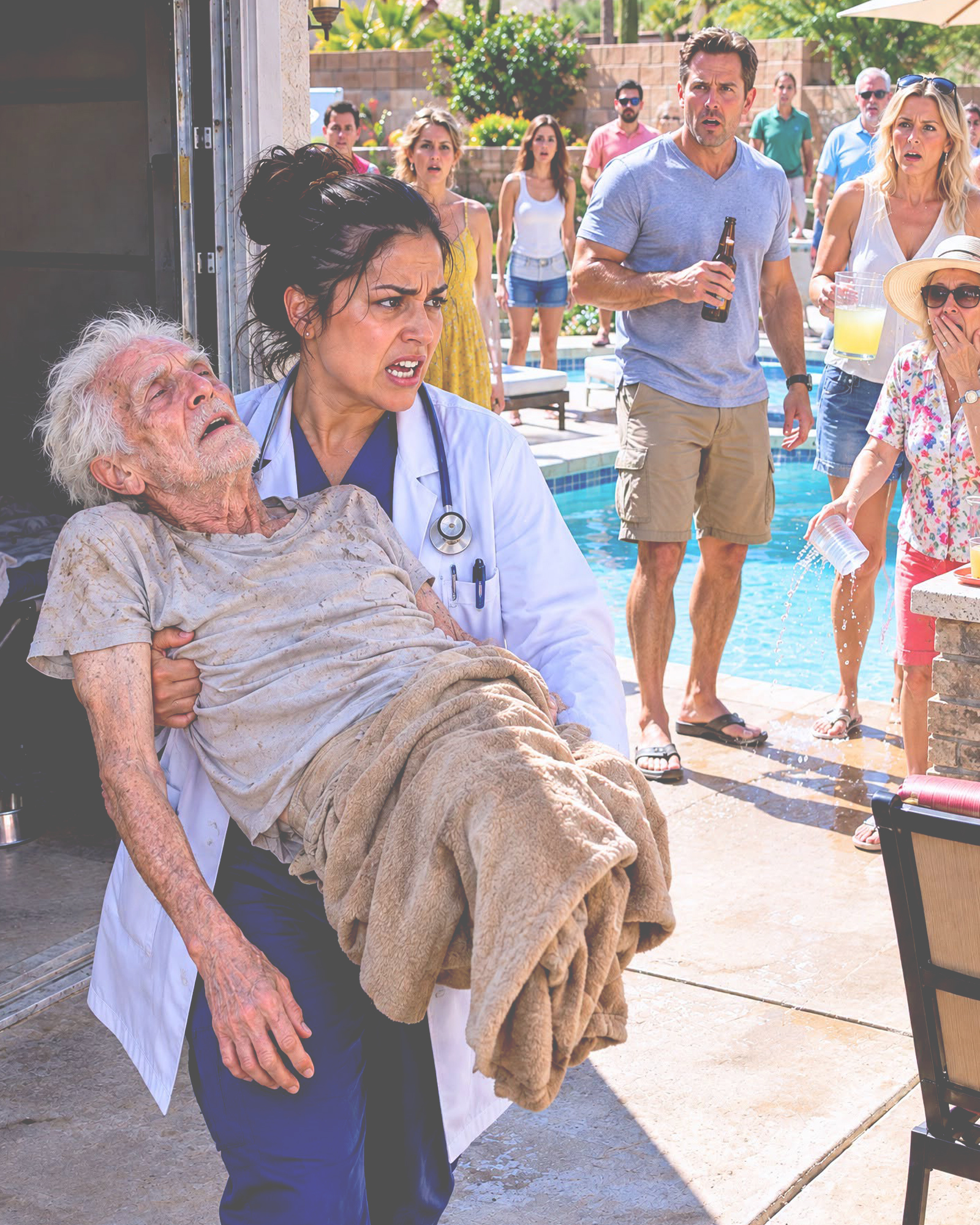
I began cooling him with water from my bottle while calling 911 and explaining his condition. Because remaining inside the garage was dangerous, I carefully lifted him and carried him toward the shaded backyard.
My father had once carried me on his shoulders when I was little, but now he felt frighteningly light in my arms. I walked straight through the side gate and into the middle of Ray’s crowded pool party.
The music stopped as the guests noticed us, and Ray climbed out of the pool demanding to know why I’d returned without warning. Tiffany froze beside the drinks table while I lowered Dad onto a lounge chair and started cooling him with ice from their party cooler.
Ray insisted that Dad enjoyed staying in the garage and claimed the lock was necessary because he wandered. I told him that my father wasn’t simply confused, but severely dehydrated and in immediate medical danger.
Then an elderly neighbor named Lupe Medina stepped forward, staring at Dad as though she’d seen someone return from the grave.
“Arturo? Ray, we went to his funeral in March. You told everyone your father was dead.”
I stared at my brother, realizing that locking Dad inside the garage wasn’t the only terrible secret he’d been keeping from us.
Part 2: The Funeral for a Man Who Was Still Alive
Lupe Medina stood beside the swimming pool, staring at my father with an expression of complete disbelief. She had lived across the street from our family for thirty years, and I knew she would never mistake Arturo for someone else.
“We held a memorial service at St. Timothy’s in March. Ray, you stood in front of everyone and told us your father had passed away peacefully in his sleep.”
The backyard fell silent as the guests turned toward my brother, waiting for an explanation. Ray’s face reddened, but he remained standing near the pool, apparently struggling to decide what to say.
Another neighbor, a broad-shouldered man wearing an Arizona Diamondbacks cap, stepped forward. He explained that he’d contributed two hundred dollars toward funeral flowers because Ray had claimed our family needed help covering the expenses.
“You told us Marisol couldn’t afford to fly home. We thought she was grieving somewhere out of state.”
I felt sick as I realized how carefully Ray had constructed his story. He hadn’t simply concealed our father’s condition from the neighbors; he’d convinced an entire community that Arturo was already dead.
Ray finally insisted that the situation was complicated and claimed Dad had requested privacy. According to him, our father no longer wanted visitors and had agreed that a memorial would discourage people from asking questions.
“I never agreed to anything.”
Dad’s voice was faint, but everyone nearby heard him clearly. He turned his exhausted face toward me, and tears began gathering in his eyes.
“Ray told me you died in a car accident in Denver. He showed me a newspaper and said I had nobody left.”
For several seconds, I couldn’t speak because I was trying to understand what my father had endured. While I’d been calling every Sunday and sending money for his care, he’d apparently been mourning a daughter who was still alive.
“I cried for you every night, mija. I thought I’d lost you, too.”
I held his hand and assured him that I was alive and would not abandon him again. Across the patio, Tiffany dropped the pitcher she’d been holding, sending broken glass and margaritas across the concrete.
Ray immediately claimed that Dad was confused and couldn’t distinguish reality from his imagination. He repeated his earlier explanation about wandering and insisted that the garage had been secured for everyone’s protection.
“Then explain why you locked him inside without air conditioning. Explain the dog bowl and why he hasn’t been receiving proper care.”
Ray had no convincing answer, and several neighbors began moving away from him. In the distance, approaching sirens grew louder as the emergency responders reached our street.
Paramedics hurried into the backyard and immediately began assessing Dad’s condition. When they measured his core temperature, the reading was 105.1 degrees, confirming the seriousness of his heat-related illness.
One paramedic looked at me after beginning emergency cooling measures. His expression made it clear that my father had been in immediate danger.
“Ma’am, another hour in that garage could have cost him his life.”
As the medical team prepared Dad for transport, two Mesa police officers arrived and began questioning the people at the party. I explained the locked garage, the false reports about my father’s condition, and the monthly payments I’d been sending Ray.
Lupe described the memorial service and confirmed that several neighbors had donated money after being told Arturo had died. The officers then asked Ray to identify himself and explain why he’d announced his father’s death while continuing to live in his house.
Ray insisted there had been a misunderstanding, but his increasingly contradictory answers raised further questions. Tiffany tried to defend him, claiming that caring for an elderly parent was difficult and that I had no right to criticize them after working away from home.
I refused to argue with her while Dad needed urgent medical treatment. Instead, I climbed into the ambulance and held his hand as the paramedics continued monitoring him.
Before the doors closed, I saw an officer walking toward the house with Ray. I had no idea what they would discover inside, but the false funeral already suggested that my brother had been hiding something far more calculated than neglect.
By the time we reached the hospital, investigators were beginning to uncover why Ray had wanted the entire neighborhood to believe our father was dead.
Part 3: The Documents That Exposed My Brother’s Scheme
The ambulance rushed my father to the hospital while paramedics continued treating his dangerously elevated body temperature. I remained beside him, watching the monitors and struggling to accept that someone I’d trusted with his care had allowed him to deteriorate so severely.
As an intensive care nurse, I understood the medical risks associated with prolonged exposure to extreme heat. Dad needed immediate treatment, but I was equally concerned about his dehydration, weight loss, and the possibility that he’d gone without essential medications.
At the hospital, the emergency team began stabilizing him while I provided his medical history. I explained that he had diabetes, a heart condition, and prescriptions that my brother was supposedly managing.
“I’ve been sending Ray twelve hundred dollars every month for Dad’s medications and physical therapy. I believed he was receiving everything he needed.”
The physician assured me that the team would evaluate Dad’s condition carefully. While they continued treating him, I received a call from one of the officers investigating what had happened at the house.
The officer explained that investigators had discovered several suspicious documents in the kitchen. Among them was a death certificate bearing Arturo’s name, although it appeared to be a counterfeit document printed from an online source.
They had also found a sympathy card from the American Legion containing a check. The discovery supported Lupe’s account that Ray had organized a false memorial and accepted contributions from people who believed our father had passed away.
Another set of papers revealed something even more disturbing. Dad’s Veterans Affairs pension statements were still arriving every month, but the payments were being deposited into an account controlled by Ray.
I stared at my phone, remembering how often my brother had complained about the cost of caring for Dad. He’d convinced me that my monthly contributions were necessary while apparently collecting our father’s benefits for himself.
Then the officer described a real estate listing that investigators had discovered among Ray’s papers. It advertised my father’s Mesa home for $489,000, with an open house scheduled for the following Saturday.
“Are you telling me my brother was trying to sell Dad’s house while everyone believed Dad was dead?”
The officer confirmed that the listing was part of the investigation, although the circumstances surrounding its authorization still needed examination. I suddenly understood why Ray and Tiffany had been celebrating a housewarming party in a property that didn’t belong to them.
They’d been living comfortably in Dad’s home while preparing to dispose of it. If I hadn’t returned early, I might not have discovered what was happening until the house had already attracted potential buyers.
The investigators also contacted the pharmacy responsible for filling Dad’s prescriptions. Its records showed that his medications hadn’t been collected for eleven months, despite the money I’d continued sending specifically for his treatment.
I sat beside his hospital bed, overwhelmed by the scale of the deception. Ray had told the neighbors that Dad was dead, told Dad that I was dead, and told me that our father was too confused to speak.
Each lie served the same purpose: keeping us separated so nobody would discover what he was doing. Meanwhile, Dad had been deprived of proper care and confined to a dangerously hot garage while Ray and Tiffany enjoyed his home and money.
When Dad finally opened his eyes, I gently reassured him that he was safe. He looked around the hospital room before reaching for my hand.
“Marisol, are you really here? I’m not dreaming?”
I moved closer so he could see my face clearly and feel my hand in his. After everything Ray had told him, I understood why he needed reassurance.
“I’m here, Dad. I’m alive, and I’m not leaving you.”
As he closed his eyes again, I realized that rescuing him from the garage was only the beginning. Investigators now had evidence of a much larger scheme, and my brother would soon have to answer for what he’d done.
But while the police worked to expose Ray’s crimes, I faced a painful question of my own: how could I explain to Dad why I’d believed my brother for so long?
Part 4: The Truth I Had to Tell My Father
My father remained hospitalized as doctors worked to stabilize his condition and evaluate the damage caused by prolonged exposure to extreme heat. Although his recovery was encouraging, the medical team remained concerned about his dehydration, diabetes, and the months he’d apparently spent without proper treatment.
I stayed at the hospital every day, helping him eat, speaking with his doctors, and reassuring him whenever he woke up frightened. After believing I was dead for so long, Dad sometimes reached for my hand simply to confirm that I was still beside him.
Meanwhile, investigators continued examining Ray and Tiffany’s financial activities. The false death certificate, diverted pension payments, unfilled prescriptions, and attempted sale of Dad’s house provided evidence that their treatment of him had involved more than ordinary neglect.
Ray was charged with elder abuse, theft from a vulnerable adult, forgery, and fraud. Tiffany also faced charges for her participation, and the authorities continued reviewing how the couple had used Dad’s property and money.
I learned that the planned open house had been canceled and that the property would not be sold. For the first time since arriving in Mesa, I felt some relief knowing that Dad would still have a home when he recovered.
Nevertheless, I couldn’t stop thinking about the warning signs I’d overlooked. Every unanswered Sunday call and every excuse Tiffany had offered now seemed painfully obvious.
On the fourth day of Dad’s hospitalization, we were sitting quietly together when he turned toward me. His voice was stronger than it had been in the garage, but his question was one I’d been dreading.
“Why didn’t you come sooner, mija?”
I wanted to explain everything immediately, but the words caught in my throat. I had spent years caring for critically ill strangers, yet I’d failed to recognize that my own father needed help.
I finally told him about the weekly telephone calls and Tiffany’s repeated explanations. I described how Ray had assured me that Dad was receiving medical care and how I’d continued sending money because I believed my brother was fulfilling his promises.
“They kept telling me you were sleeping or attending therapy. They said you were confused and didn’t want to talk.”
Dad listened without interrupting, his expression revealing how deeply the deception had hurt him. I admitted that his supposed confusion hadn’t sounded believable, especially because he’d always been so independent and mentally alert.
I also confessed something that was harder to say aloud. My demanding work schedule had made it convenient to trust Ray rather than question his explanations and arrange a trip home.
“I should have checked on you myself. I kept believing what they told me because it was easier than confronting the possibility that something was wrong.”
Dad remained silent for a long time, and I feared that I’d damaged his trust beyond repair. Then he reached across the blanket and gently squeezed my hand.
“You came, Marisol. That’s what I’ll remember.”
I began crying because his kindness was more than I felt I deserved. He didn’t pretend that the past two years had been harmless, but he chose to focus on the fact that we were finally together.
During the following days, his strength gradually improved as he received proper nutrition, medication, and medical supervision. I spent those hours learning what he needed and making arrangements to ensure that he would never again depend on Ray or Tiffany.
The legal case continued while Dad recovered. The court later described the exploitation as exceptionally cruel, recognizing that Ray and Tiffany had isolated an elderly man from his daughter while taking advantage of his finances.
For me, the most important outcome wasn’t the judge’s condemnation or the charges against my brother. It was seeing Dad regain enough strength to sit comfortably, hold a conversation, and begin looking forward to returning home.
After nine days in the hospital, he was finally ready to leave. As I helped him prepare, I realized that returning him to the same house would mean nothing unless I also changed the circumstances that had allowed his suffering.
I had already made a decision about my career, although I hadn’t told him yet. The travel contracts that once seemed so important no longer mattered as much as being present for the father who’d spent his life looking after me.
When Dad asked where my next nursing assignment would take me, I finally had an answer that would change both our lives.
Part 5: The Homecoming That Changed Everything
When Dad asked where my next nursing assignment would take me, I told him I wasn’t planning to accept another travel contract. For years, I’d moved between hospitals across the country, but after everything that had happened, I wanted to build a life closer to him.
“I’m staying in Mesa, Dad. I’ve decided to find a nursing position nearby so we can spend more time together.”
He looked surprised, and for a moment, I thought he might object to my changing careers because of him. Instead, he reached for my hand and smiled with the same warmth I remembered from childhood.
“You’ve always worked so hard, mija. I don’t want you giving up your dreams just to take care of an old man.”
I explained that I wasn’t abandoning nursing or sacrificing something I loved. I simply wanted to practice my profession without living hundreds of miles away from the person who mattered most to me.
Within a short time, I accepted a position at a hospital approximately twenty minutes from Dad’s house. The work was familiar, but returning home after every shift felt completely different from spending months in unfamiliar cities.
Dad and I also began making changes to the house. We installed a new air-conditioning system, organized his medications, and made sure he had everything necessary to live comfortably and safely.
The garage was the one part of the property I couldn’t bear to leave unchanged. Every time I passed its entrance, I remembered finding my father lying helpless on that camping cot, surrounded by unbearable heat.
Rather than allowing that memory to define our home, I decided to repaint the garage door a bright shade of blue. Dad watched from the driveway as the old color disappeared beneath fresh paint.
“That’s certainly brighter than anything I would’ve picked.”
I laughed and told him that was exactly the point. I wanted the garage to become an ordinary part of our home again, rather than a reminder of the place where he’d suffered.
The criminal proceedings against Ray and Tiffany continued, and their actions remained a painful subject for both of us. The court condemned the exploitation of my father, and the house was never sold.
Although I was relieved that the authorities had intervened, I knew legal consequences couldn’t erase Dad’s experiences. He’d spent months believing his daughter had died, and rebuilding his sense of security would take patience and consistent care.
Fortunately, we weren’t alone in that process. Lupe Medina, the neighbor who’d recognized Dad at the pool party, began visiting regularly and bringing him the daily crossword puzzle.
She’d known my parents for decades, and her friendship helped restore some of the ordinary routines Dad had lost. Soon, he was sitting at the kitchen table every morning with a cup of coffee, a pen, and a fresh puzzle waiting to be solved.
Watching him return to that familiar habit gave me more reassurance than almost anything else. The man Ray had described as hopelessly confused was still capable of solving difficult clues and teasing me whenever I struggled to answer one.
Some afternoons, I joined Dad at the table after my hospital shift. We talked about his years as a machinist, his memories of Mom, and the small neighborhood changes I’d missed while traveling.
He never demanded that I spend every free moment beside him. Instead, he seemed happiest knowing that I would return home at the end of the day and that he could reach me whenever he needed help.
I gradually stopped punishing myself for every warning sign I’d overlooked. I couldn’t change the months when Ray had kept us apart, but I could make certain that Dad would never again have to wonder whether I cared about him.
One morning, I came downstairs and found him concentrating on a particularly difficult crossword. He was wearing his reading glasses and holding his favorite black pen, looking more like the father I remembered than he had in years.
After finishing the puzzle, he slid the newspaper across the kitchen table toward me. He pointed to a clue that asked for an eight-letter answer describing someone who comes back for you.
I looked at the squares and noticed that he’d written my name across them. MARISOL had only seven letters, and the answer didn’t fit the clue’s required length.
“Dad, you know that’s not the right number of letters.”
He studied the puzzle for a moment before smiling at me. His expression made it clear that he understood the mistake and had no intention of correcting it.
“Doesn’t matter, mija. It’s the right answer for me.”
I looked down at my name written in his careful handwriting and felt tears gathering in my eyes. After everything we’d endured, that small gesture meant more than any apology or explanation I could have offered.
My brother had tried to convince Dad that I was gone forever, just as he’d tried to convince me that our father no longer wanted to speak. His lies had nearly destroyed our family, but they hadn’t succeeded in keeping us apart.
Dad was home, his health was improving, and our days were once again filled with ordinary moments that we’d almost lost. I couldn’t undo the past, but I could be present for the future we still had together.
I folded the crossword and placed it somewhere safe because I wanted to keep it for the rest of my life. The answer didn’t fit the puzzle, but it captured something my father had never stopped believing.
To him, I would always be the daughter who came back. And to me, he would always be the father worth coming home for.