Part 2 : Three days later, the rain had stopped, but the weather was the least important storm in town. The motel room smelled like mildew and industrial cleanser. The wallpaper peeled at one seam near the air conditioner, and the buzzing neon vacancy sign outside threw a pulse of red through the curtains every few seconds that made it impossible to forget where I was. A microwave lasagna sat untouched on the little laminate table. Beside it was a stack of legal documents thick enough to stun a horse. I had spent the past seventy-two hours in motion—transfers, title searches, wire authorizations, verification calls, signatures, notaries, bank officers, one legal clerk who looked at my wheelchair and then at the six-figure transfer amount and visibly decided I was above her pay grade emotionally. My phone buzzed with a text from Leo. Dad and Chloe are screaming happy screams. They got a letter from the bank. Dad says we’re rich. I closed my eyes and saw it immediately. Frank would be standing in the kitchen holding the letter from First National, the one that said the mortgage had been satisfied in full. He would stare at the zero balance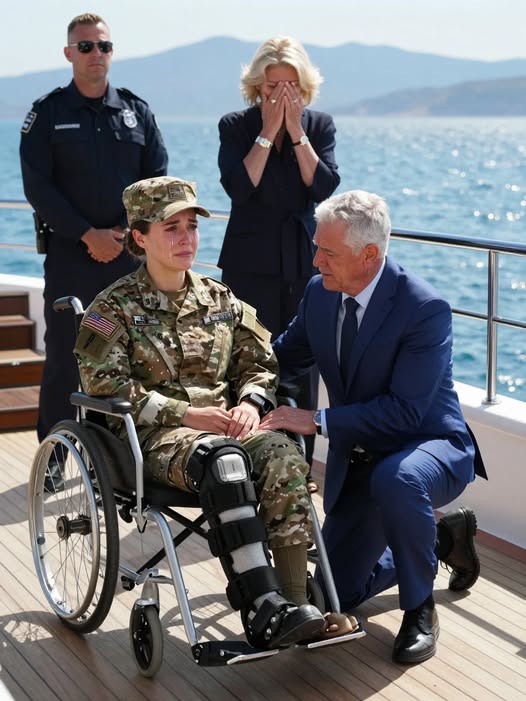
and instantly invent a reason it belonged to him. Maybe some payout. Maybe a bank error. Maybe justice finally finding the little guy after years of his own laziness and bad luck, because in his mind the world always owed him compensation for the effort of existing. Chloe would already be
halfway to planning purchases in her head—designer bags, some oversized television, the next visible thing that let her perform status while contributing nothing to its cost.
They would mistake relief for ownership.
That was the thing about people who spend their lives relying on others to carry structure for them. The second a burden disappears, they call it luck. The second a debt vanishes, they call it inheritance. They do not ask why. They celebrate the result and assume the universe has finally agreed with their self-image.
There was a knock at the motel door.
“Come in,” I said.
Mr. Henderson from First National stepped inside in a gray suit that looked painfully overdressed against the stained carpet and humming mini-fridge. He carried a leather briefcase and the expression of a man trying hard not to show how strange he found the scene.
“You know,” he said after sitting across from me, “given the size of the wire you just transferred, you could have booked the penthouse downtown.”
“I did buy my own place,” I said. “I just need to evict the squatters first.”
He set the briefcase on the table and opened it. “You’re sure about this, Ethan? You used your entire deployment bonus, the disability backpay, and the injury settlement. This is everything.”
“No,” I said. “It’s the price of admission.”
That was the truth. I wasn’t buying revenge. I was buying clarity. The mortgage had been in Frank’s name because when I first started sending money home, I had still believed in saving the family rather than exposing it. I had made payments for years, paid arrears, covered tax deficiencies, refinanced twice to stop him from losing the place outright, and each time I let him believe what men like him always want to believe: that surviving the consequences of their own choices is somehow proof of their competence. This time, I wanted the record clean.
Henderson slid the deed transfer papers across the table. “Technically, title passed at nine this morning.”
I signed without hesitation. The scratch of the pen was the only sound in the room.
My phone buzzed again. Another text from Leo.
Mom is crying. Dad and Chloe are throwing a party. They bought a new 85-inch TV on credit. They ordered lobster. I miss you.
I stared at the screen a second, then typed back.
Pack your backpack. Favorite toys. Be ready.
Then I looked up at Henderson. “What time is the courtesy call?”
He checked his watch. “One hour.”
“Good,” I said, turning toward the door. “I’d like to be there when the world shifts.”
By early evening, the driveway was full of cars. Frank had not wasted any time. He had invited his poker buddies, Chloe’s circle of performatively stylish friends, and anyone else likely to admire him for money he had not earned. I parked the rental van—a hand-controlled model I hated on sight but respected for function—half a block away and rolled the rest of the distance under cover of dusk.
Through the bay window I could see the new television already mounted and flickering over the room, a ridiculous slab of glossy excess dwarfing the fireplace. Frank stood in the middle of the living room in his socks, red-faced, sweating, and pouring whiskey like he had personally negotiated peace with the gods of debt. Chloe was shrieking happily with her friends, all white teeth and brittle laughter and heels too expensive for girls with no income. The house I had paid for with blood and bone had been turned into a party set.
Then the landline rang.
The sound cut through the music with surgical sharpness.
Frank, drunk enough to be bold and sober enough to want an audience, slapped the speakerphone button. “Talk to me,” he said, grinning at his guests.
“Hello,” Mr. Henderson said, his voice rich, professional, and carried across the room by the speaker. “Is this the Miller residence?”
“Depends who’s asking,” Frank replied.
“This is Daniel Henderson from First National Bank. I’m calling to confirm final title transfer details regarding the property at 42 Oak Street.”
The grin on Frank’s face wavered.
“You got the payoff letter, right?” he said. “Looks like your bank finally did something right.”
“Yes,” Henderson said evenly. “The mortgage was satisfied in full by wire transfer from Sergeant Ethan Miller. As per the notarized agreement executed this morning, title has now been transferred to his sole name. We are simply confirming when the current occupants intend to vacate, as the new owner has requested immediate possession.”
The silence that followed was not ordinary silence. It had weight. It pulled the air out of the room.
Chloe’s wineglass slipped from her hand and shattered against the hardwood, splashing red across her brand-new white heels. Frank turned a color I had previously seen only in morgues.
“Ethan?” he said stupidly. “That’s not possible. He’s broke. He’s a—”
I opened the front door with my key.
I didn’t knock. I didn’t ring the bell. I unlocked it and rolled in on the same hardwood he’d told me my wheels would ruin. The house went dead quiet except for the low hum of the oversized television and the sound of rubber on oak.
I was still in my dress blues. The medals flashed under chandelier light. The chair was polished. The posture was perfect. I stopped right in the middle of the Persian rug Frank had once bragged he got at a “steal” from a liquidation sale and looked around the room at all of them.
“You bought my house?” he asked finally, his voice cracking under a mix of rage and fear.
I took the blue folder from my lap and dropped it on the coffee table beside the whiskey bottle. “Correction,” I said. “I bought my house.”
Chloe recovered first, shrieking, “Dad, do something!”
Frank lunged for the papers, tearing them open. His hands began to shake as he read.
“You ungrateful little bastard,” he spat. “I raised you. I put food on your table.”
“And I put a roof over your head,” I said. “For ten years I sent money home. Where did it go, Frank? Gambling? Beer? Chloe’s wardrobe? Because it sure as hell didn’t go to the mortgage.”
“You can’t do this!” Chloe screamed. “Where am I supposed to go?”
I looked at her calmly. “The VA has beds for people like you, remember?”
The line landed exactly where I wanted it to.
Frank stumbled forward, fists clenched, soaked in whiskey and humiliation. “I’ll call the cops. I’ll have you removed.”
“Please do,” I said. “Officer Miller is on duty tonight. He served in my unit. I’m sure he’d love to help you load your things.”
That was when Leo came downstairs at a run, backpack bouncing against his shoulders, superhero blanket clutched under one arm. He stopped at my side so instinctively it was almost military.
“I’m ready, Captain,” he said, trying to keep his chin from wobbling.
Frank looked at him, then at me. “You’re taking my son?”
“I’m taking my brother,” I said. “Unless you want Child Services to hear how you tried to leave a disabled veteran in the rain while you celebrated with lobster and a television you bought on credit.”
Around us, the guests were already backing out of the room. Nobody wants to stay for the end of a party when the host is being evicted by his wheelchair-bound son in full dress blues. It ruins the appetite.
My mother appeared in the hallway then. She looked smaller than I remembered. Deflated. Tired in a way that had nothing to do with age and everything to do with years spent standing beside a man who taught himself to be cruel and called it realism.
“Ethan, please,” she said. “We’re family.”
I looked at her for a long moment. I saw the woman who had stood behind my father on the porch while he called me a burden. I saw the woman who had watched and said nothing.
“Family doesn’t leave family in the rain,” I said quietly. “You have one hour. Essentials only. I’m changing the locks at midnight.”
Forty-five minutes later Frank and Chloe were standing on the curb surrounded by trash bags, loose hangers, a stack of mismatched suitcases, and an eighty-five-inch television that looked absurd sitting on wet grass. Neighbors watched through curtains lit blue by their own televisions. The whole street had that electric hush suburban blocks get when scandal finally walks outside.
Inside, I slid the deadbolt home.
The sound it made—solid, final, mechanical—was one of the most satisfying noises I have ever heard.
I turned to Leo. He stood in the entryway gripping his blanket with both hands, eyes wide, watching me as if I were some version of a superhero he hadn’t decided how to name yet.
“So,” I said, forcing a brightness I didn’t entirely feel, “how do you feel about pizza and cartoons on that giant TV?”
His whole face changed. “Even cartoons?”
“Especially cartoons.”
He ran toward the couch. I rolled past the hallway mirror and caught sight of myself. The uniform was immaculate. The medals looked brave. But the eyes staring back at me were older than they had any right to be. I had secured the objective. Neutralized the threat. Retaken the ground. And still, even in victory, I could feel the shape of what had been lost.

Part 3
Six months later, the house smelled like coffee and bacon in the mornings instead of stale smoke and resentment.
Sunlight poured through the new widened kitchen windows, warming the slate floor I had installed because it rolled easier under the chair than the old uneven oak. The place looked almost unrecognizable now. Frank’s heavy, dark furniture was gone, replaced by clean lines, lighter woods, open sightlines. A ramp had been built into the front landscaping so naturally most people didn’t notice it until they needed it. The walls were brighter. The clutter had vanished. Rooms no longer held the feeling that someone angry had passed through them recently.
Leo sat at the kitchen table in pajama pants, working through fourth-grade fractions with the dramatic suffering only a ten-year-old boy can bring to math homework. He had color back in his face now. He slept through storms. He laughed without checking first to see if someone might punish him for being loud.
I stood at the stove with a practiced rhythm I had worked hard to build. Cooking from the chair had taken time, and a fair amount of swearing, but by then I had a system. Everything had a place. Everything had a reason.
“Hey, Ethan,” Leo said, pencil between his teeth, “Mom called again. She wants to know if she can come for Thanksgiving.”
I paused with the spatula in my hand.
In the months since that night, Frank and Chloe had landed in a cramped two-bedroom apartment across town. Chloe had gotten a receptionist job and, according to neighborhood gossip, was learning the hard truth that shoes become less fun when you buy them with your own money. Frank was working mall security and blaming everyone but himself. They were miserable. They had learned nothing.
My mother, though, had changed. Or maybe she had simply run out of room inside herself to keep defending the same man. She left Frank a month earlier and moved in temporarily with her sister. She called Leo regularly. She called me less often, which I appreciated. Shame is quieter when it is genuine.
“Tell her she can visit,” I said finally. “Just her. And tell her Chloe’s shoe collection stays in the car.”
Leo laughed. “You’re mean.”
“I’m practical.”
Then the phone on the counter rang. The caller ID flashed Frank’s name.
He called once a week. Sometimes to yell. Sometimes to beg. Sometimes to do both in the same message.
I looked at the screen and felt nothing. Not anger. Not satisfaction. Not grief. He had become what he truly was: a ghost from a former life who no longer had access to the living.
“Aren’t you going to answer?” Leo asked.
“Nope,” I said, putting a pancake onto his plate. “Breakfast outranks nonsense.”
Later that morning, I rolled out onto the porch with a fresh mug of coffee. The air had that crisp edge Midwestern fall mornings get just before the first real cold sets in. I looked down the drive out of habit more than expectation.
A silver sedan pulled up slowly.
Not a taxi. Not family.
A woman stepped out, favoring her right leg with a slight limp I recognized before I recognized her face. She wore jeans, boots, and a simple jacket, but there was no mistaking the posture. Some things military service engraves too deeply to hide.
Sarah.
She had been the medic in the sand, the one whose hands stayed steady while the world came apart. I hadn’t seen her since the hospital in Germany, when everything smelled like iodine and metal and relief. She stood in the driveway now holding a bottle of wine and smiling like she had every right to be there.
“I heard you run a pretty exclusive club,” she said. “Someone told me you have to be a hero to get past the gate.”
I smiled before I realized I was doing it. Real warmth. Not politeness. Not survival. Something easier.
I hit the button for the automatic door opener, and the front door swung wide behind me.
“For the right people,” I said, rolling forward to meet her, “there’s always room.”
Then I looked back at the house—the one I had bought twice, really. First with money, then with clarity—and felt something I had not felt on that porch six months earlier.
Not victory.
Home.