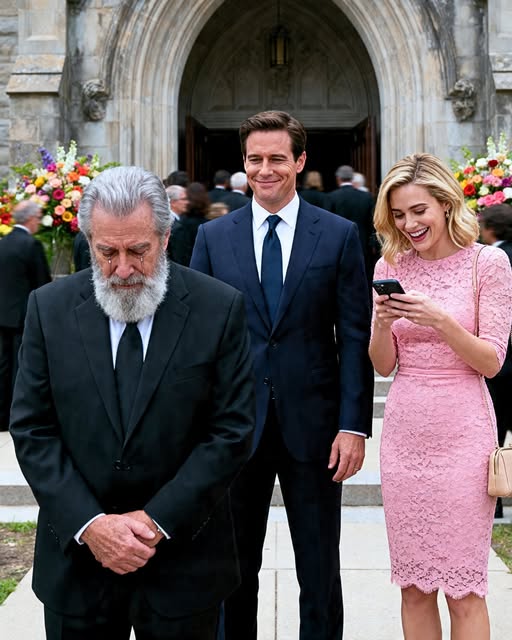
During Emily’s last year, I had started to see things clearly. When death lingers close, it strips away pretense. People stop hiding who they are.
Lauren had visited, yes—but never with warmth. Never with tenderness. Her questions were always the same: paperwork, property, insurance policies. Practical things, she called them. Necessary conversations. But not once did she sit beside Emily and hold her hand just to comfort her. Not once did she speak with genuine care.
And she never called me “Dad.”
Only “Mr. Collins.”
During the service, Andrew remained still, his eyes fixed on the coffin as if he could will it open, as if somewhere inside him he believed time might reverse if he stared hard enough. When Lauren whispered those words, I saw his shoulders tense, just slightly. He had heard her. I knew he had.
But he said nothing.
That had always been Andrew’s flaw. He avoided conflict, even when silence cost him something deeper than an argument ever could.
When the ceremony ended, we moved to the cemetery. The heat pressed down on us as the coffin was lowered into the ground. I stood there, unmoving, until the final shovelful of dirt struck the wood below.
That sound—hollow, final—echoed in my chest.
A door closing.
Forever.
I thought that was the end of it. That the hardest part was behind us.
I was wrong.
As people began to leave, a man approached me quietly. It was our attorney, Michael Carter, his briefcase tucked neatly under his arm.
“Mr. Collins,” he said gently, “Emily left very clear instructions. She requested that her will be read today—with you, Andrew, and Lauren present.”
I nodded, still numb.
But Lauren’s reaction was different.
Her eyes lit up—just for a fraction of a second, but long enough for me to notice. It was subtle, controlled, but unmistakable.
At the lawyer’s office, the air felt still, heavy with the scent of old paper and coffee. Andrew sat quietly beside me, his hands clasped tightly together. Lauren crossed her legs, her heel tapping lightly against the floor, her gaze drifting across the room as if she were evaluating it.
Michael began reading.
At first, everything seemed ordinary. Small personal items, charitable donations, sentimental gifts. Lauren pretended disinterest, but I could see the way she leaned forward ever so slightly whenever anything of value was mentioned.
He reached into his briefcase and pulled out a sealed envelope.
“She asked for this to be read first,” he said. “It’s addressed to Andrew… and Lauren.”
Andrew’s breath caught. Lauren smiled faintly.
Michael opened the letter.
“Andrew,” he read, “if you are hearing this, it means I am no longer here to protect you from what you chose not to see.”
Andrew’s head snapped up.
Lauren’s foot stopped tapping.
The room grew heavier, as if the air itself had thickened.
Emily’s words continued, steady and clear. Over the past year, she explained, things had begun to disappear—money, jewelry, checks. At first, she doubted herself. She blamed her medications, her memory. But eventually, she realized the truth was something far worse.
Andrew’s breathing became uneven.
“What is this?” he murmured.
Lauren let out a soft, dismissive laugh. “This is absurd. Your mother wasn’t thinking clearly—”
“I’m not finished,” Michael said firmly.
Emily had hired a private investigator.
Not out of anger. Not out of revenge.
But because she needed certainty—because she had to know whether the threat came from outside… or from within her own home.
Michael began listing the evidence.
Pawn shop receipts.
Security footage.
Fraudulent credit applications.
Audio recordings—Lauren’s voice, pressuring Emily to sign documents while heavily medicated.
Andrew stared at one of the photographs placed in front of him—Lauren standing at a counter, selling jewelry that had once belonged to his mother.
“No…” he whispered, shaking his head.
Lauren stood abruptly. “That proves nothing. I was helping. That house was going to be ours anyway.”
“It never was,” Michael replied calmly.
Then came the final will.
Everything had been placed into a protected trust. I would retain lifetime residency in the house. Andrew would receive financial support—but only under strict conditions. And if he remained married to Lauren, all payments would be suspended unless a court confirmed she had no access to the funds.
Lauren blinked, confusion turning into something closer to panic.
“And one more condition,” Michael added. “If anyone contests this will without valid cause, they receive one dollar.”
For the first time, Lauren looked afraid.
Andrew turned to her slowly, his expression hollow, unfamiliar.
“Did you do it?” he asked.
Tears filled her eyes instantly. “I was trying to protect us.”
“You called my mother’s funeral a holiday,” he said quietly. “Was that part of protecting us too?”
She reached for him.
He pulled away.
The chair behind her scraped loudly against the floor as she stumbled back.
And she walked out.
Andrew didn’t follow.
He remained seated, staring at the letter in his hands, as if everything he believed had just been erased.
But it still wasn’t over.
Michael placed a small silver key on the table.
“There’s one final instruction,” he said.
At the bank, we opened Emily’s safety deposit box.
Inside were pieces of our life—jewelry, documents, photographs, a USB drive. And another letter.
“If you are reading this together,” it began, “then we are still a family.”
Andrew broke down completely.
Among the contents were not just memories, but evidence—enough to take legal action if we chose to.
But the hardest part was the video.
We played it in silence.
Emily appeared on the screen, thinner, weaker—but calm. Her eyes were still the same, steady and full of quiet strength.
“Andy,” she said softly, “love doesn’t mean closing your eyes to the truth. Real love never uses pain as an excuse to hurt others.”
Andrew cried harder than I had ever seen.
Emily gave him a choice.
Let Lauren walk away quietly—if she returned everything.
Or pursue justice.
Andrew didn’t answer immediately. He sat there, breathing heavily, processing everything.
Then, finally, he chose.
Not anger.
Clarity.
He called Lauren.
“Return everything and sign the papers,” he said. “Or we go to court.”
She tried to persuade him. Then manipulate him. And when that failed—her anger surfaced, sharp and undeniable.
Two days later, she signed.
No shouting. No scene.
Just the quiet collapse of something that had already been broken for a long time.
Months passed.
Andrew began therapy. Slowly, piece by piece, he started to rebuild himself. We honored Emily’s memory, creating a scholarship in her name—something meaningful, something lasting.
And I learned something I will never forget.
It isn’t inheritance that destroys families.
It’s the truth it reveals.
And grief—no matter how heavy—will always weigh less than betrayal.
But it has a way of showing you, with absolute clarity, who truly belongs in your life… and who never did.