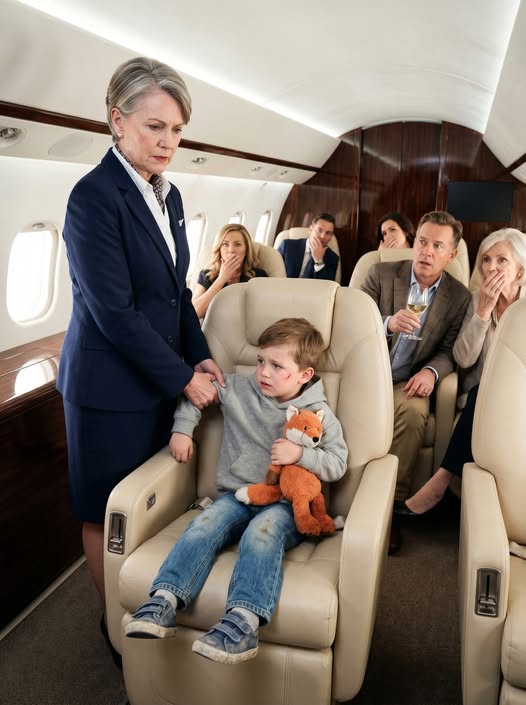
Her posture shifted.
Her face lost color.
“Margaret…” she said slowly, “do you understand who this child is?”
Margaret’s irritation returned, sharper this time.
“I don’t care who he is,” she replied, “rules apply to everyone.”
Rachel swallowed, then spoke carefully.
“He’s the son of Jonathan Walker,” she said, “the founder and current chairman of this airline.”
The silence that followed was heavier than anything I had ever felt inside an aircraft cabin.
Margaret blinked, her certainty cracking for the first time.
“That… doesn’t change anything,” she said, though her voice lacked the confidence it had carried moments earlier.
But everything had already changed.
Because passengers had been watching.
And some of them had been recording.
A Landing No One Expected
Within minutes, the captain received instructions from corporate operations, and the decision was made to divert the flight to Chicago for immediate review of the situation.
During the descent, the cabin remained unusually quiet, as though everyone understood they had witnessed something that could not simply be overlooked or explained away.
Ethan stayed beside me, quietly sipping from a small cup of juice while holding his stuffed fox close, his earlier confusion slowly giving way to a quieter, more settled calm.
“Are you okay now?” I asked gently.
He nodded, though his voice remained soft.
“I just want my dad,” he said.
When the aircraft touched down, airport personnel surrounded the plane, their presence visible even through the small windows along the cabin walls.
Moments later, a tall man in a dark coat boarded through the forward door, moving down the aisle with a focus that made the entire space feel smaller.
Jonathan Walker did not look at anyone else.
His eyes found Ethan immediately.
He knelt in front of him without hesitation.
“Hey, buddy, I’m here,” he said, his voice steady but warm.
“She hit me,” he whispered.
Jonathan closed his eyes briefly, as though steadying himself before standing again.
When he turned toward Margaret, there was no raised voice, no dramatic gesture, only a controlled intensity that felt far more powerful than anger alone.
“You saw my son,” he said, “and decided he didn’t belong where his ticket placed him.”
Margaret tried to respond, her words coming quickly now.
“Sir, I’ve served this airline for years, I believed I was following protocol—”
Jonathan raised his hand slightly, stopping her without effort.
“Your employment ended the moment you chose force instead of judgment,” he said, his voice calm but final.
Security stepped forward quietly.
And just like that, the moment was over.
What Came After
The story spread quickly, far beyond that single flight, because people recognized something deeper than a mistake had occurred.
It was not just about one child, or one employee.
It was about the assumptions people make when they believe they understand where someone belongs.
In the weeks that followed, Jonathan Walker made a decision that surprised many inside the company.
Instead of quietly moving on, he created a new division focused entirely on passenger dignity, safety, and ethical decision-making.
And he asked me to lead it.
I had never expected my career to change direction so suddenly, yet within months I found myself standing in training centers across the country, speaking to crews who had far more experience than I did, but who were willing to listen because something fundamental had shifted.
During one session, a veteran attendant raised her hand.
“Are you saying one mistake should define an entire career?” she asked.
I paused, considering the weight of that question before answering.
“No,” I said slowly, “but when trust is placed in us, especially by someone who depends on us for safety, we don’t get to decide when that trust matters.”
The room stayed quiet.
“Every passenger steps onto an aircraft believing they will be treated with respect,” I continued, “and the moment we forget that, we stop doing our job the right way.”
A Different Kind of Flight
Six months later, I boarded a flight anonymously, choosing to observe rather than lead, because I wanted to see whether the changes we had worked toward were actually taking hold.
During boarding, a man in business class began raising his voice about a child seated nearby, clearly frustrated by something he did not understand.
Before the situation escalated, a young flight attendant stepped forward.
Her voice was calm, steady, and firm in a way that felt intentional.
“Sir, every passenger here has the right to feel comfortable,” she said, “and that includes the child you’re speaking about, so I need you to lower your voice or we’ll need to address this before departure.”
The man quieted immediately.
The tension dissolved before it could grow.
Later, I introduced myself to her.
She looked surprised.
“I hope I handled that okay,” she said.
I smiled.
“You did exactly what this job is meant to be,” I told her, “you protected someone who needed it before things went too far.”
That evening, as I stood near the window watching aircraft lights move slowly across the dark runway, I realized something had truly changed.
Not just policies.
Not just procedures.
But people.
And for the first time in a long while, the sky felt like a place where everyone, no matter how they looked, had the right to belong.