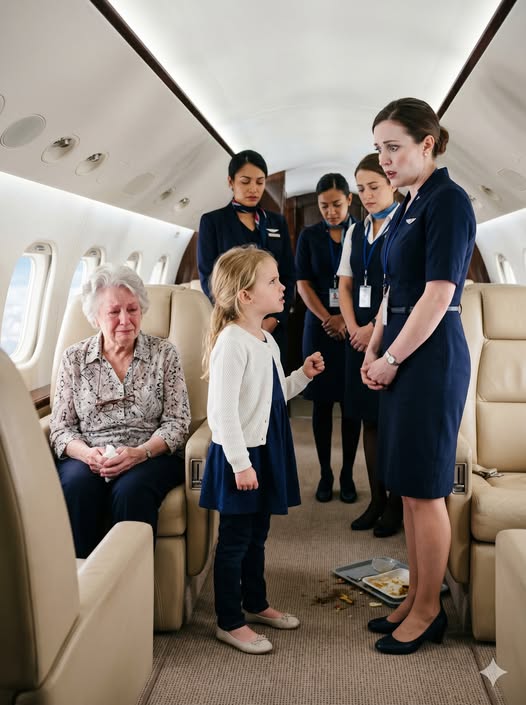
When Captain Collins stepped into the cabin, the atmosphere had shifted in ways that were difficult to explain but impossible to ignore, as though something unspoken had begun pressing against the carefully maintained surface of normalcy.
He approached Eleanor’s seat and lowered himself slightly to meet her at eye level, his voice steady but sincere.
“Ma’am, I’m very sorry for what happened,” he said. “It should not have occurred, and we’re going to address it right away.”
Eleanor looked up, surprised by the attention, her instinct still guiding her toward minimizing her own discomfort.
“It’s alright,” she replied softly. “I don’t want to cause any problems.”
Charlotte said nothing, her gaze fixed on the captain with quiet expectation.
He stood, turning toward the rear of the cabin, where the flight attendant now stood with a subtle tension in her posture.
“Lauren,” he called, his tone firm. “I need to speak with you.”
She approached, her earlier confidence still present but beginning to crack under the weight of the moment.
“Is there an issue?” she asked, attempting composure.
“Did you remove and discard a passenger’s personal food?” he asked directly.
She crossed her arms slightly, defensive.
“It wasn’t compliant with service standards,” she replied. “We have rules—”
“Show me the policy that says you can take it and throw it away,” he interrupted, his voice calm but unyielding.
For a moment, she had no answer.
The silence stretched just long enough to make the truth unavoidable.
Her phone vibrated in her pocket.
She glanced down, hesitated, then pulled it out and opened the notification.
Her expression changed instantly.
The color drained from her face as she read the message.
“Effective immediately, you are suspended pending investigation. Please await further instruction upon landing.”
Her hands trembled slightly as she lowered the phone.
“This… this doesn’t make sense,” she whispered.
The Voice That Carried Weight
Charlotte stood up slowly, her movement small but commanding attention in a way that made the surrounding passengers fall quiet without being told to.
She stepped forward just enough to meet the attendant’s gaze.
“No,” she said softly.
The single word stopped everything.
Lauren blinked, confused.
“What?”
Charlotte’s voice remained calm, almost gentle, but every word landed with precision.
“You had a chance to be kind,” she said. “And you chose not to be.”
Lauren swallowed, her composure unraveling.
“I didn’t know—”
Charlotte shook her head slightly.
No one spoke.
The silence held.
The aircraft began its descent, but the real shift had already happened long before the wheels touched the ground.
The Ground That Carried the Consequence
By the time the plane landed in Miami, the situation had moved far beyond a single interaction, because messages had been sent, calls had been made, and decisions had already begun unfolding behind closed doors.
As passengers disembarked, Eleanor moved carefully, supported by Charlotte’s steady presence beside her.
They passed Lauren near the exit, her uniform still in place but her authority already gone, her expression distant, her certainty replaced by something heavier.
Charlotte looked at her briefly, not with anger, not with triumph, but with clarity.
Then she continued walking.
Outside, warm air wrapped around them, and waiting just beyond the terminal doors was a family ready to welcome Eleanor with open arms and genuine relief.
But the story did not stay behind on that aircraft.
That night, a video surfaced.
A testimony followed.
Then another.
Within hours, the incident spread across platforms, conversations igniting as people reacted not only to what had happened, but to what it represented.
The Change That Followed
Victoria Whitaker did not ask for compensation.
She asked for accountability.
In meetings that followed, her voice remained steady as she laid out what mattered.
“This isn’t about money,” she said. “It’s about dignity, and the fact that it was ignored.”
Policies were reviewed.
Training programs were rewritten.
Procedures changed in ways that reached far beyond a single flight.
Weeks later, the matter moved into a formal setting, where statements were given, evidence examined, and responsibility acknowledged.
When Eleanor spoke, her voice was soft, but it carried across the room with undeniable clarity.
“I’m not here to harm anyone,” she said. “I just don’t want anyone else to feel the way I felt.”
Lauren listened, her head lowered, understanding something now that she had not understood before.
The ruling focused on reform rather than retaliation, emphasizing change over punishment, because the situation had revealed something larger than a single decision.
The compensation that followed did not remain in the Whitaker family.
It was redirected, quietly, toward programs that supported elderly care and accessibility, because Eleanor believed that dignity should extend beyond her own experience.
The Lesson That Stayed
Months later, the story no longer circulated as outrage, but as reflection, its impact woven into training sessions, discussions, and quiet reminders of what respect truly meant.
One afternoon, Charlotte sat in the garden outside her grandmother’s home, sunlight filtering through the trees as she turned a question over in her mind.
“Mom,” she asked when Victoria joined her, “did I do the right thing?”
Victoria sat beside her, her expression thoughtful.
“You did what many people hesitate to do,” she said. “You stood up for someone who needed it, and you did it without losing who you are.”
Charlotte looked down, her fingers tracing patterns in the grass.
“She lost her job,” she said quietly.
Victoria nodded.
“Actions have consequences,” she replied. “But people can still learn from them.”
Charlotte considered that, then looked back up, her expression steady once more.
Across the city, Lauren filled out applications, her path uncertain, but her understanding clearer than it had ever been before.
One evening, standing alone, she whispered a simple apology, not expecting it to be heard, but needing to say it anyway.
Back in the garden, Eleanor watched her granddaughter laugh, the sound light and free, and for the first time since the flight, there was no trace of hurt in her eyes.
Only pride.
Because she had raised a daughter who never forgot where she came from.
And that daughter had raised a child who refused to look away when something was wrong.
And sometimes, it was not the loudest voice that created change.
It was the quiet one that simply refused to stay silent.