Then Morgan pointed to a clause in the middle.
“This,” she said, “is where they bury themselves.”
The clause formally acknowledged that my parents had once redirected money intended for me toward James and waived any claim of fairness when repayment was enforced.
“In plain English,” I said, “they admit they took my inheritance and used it for him.”
“Exactly. But we still need them saying it on camera.”
I smiled thinly.
“My father loves an audience.”
By the time I left, Barry had been paid, the note had been legally assigned to my company, and everything was ready.
When I returned to the yacht, dusk had settled.
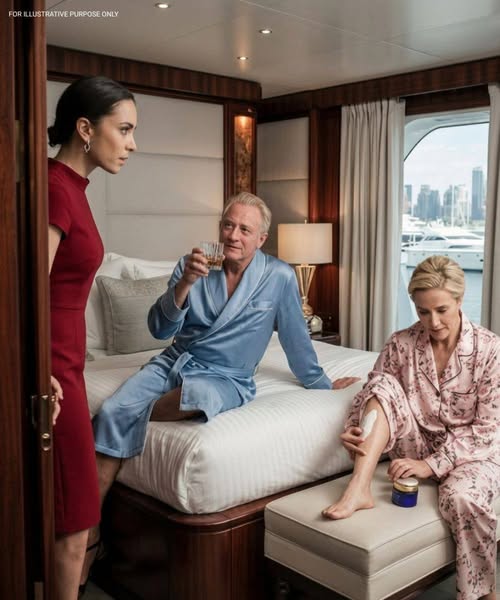
My family was in exactly the same positions as before, as though they had frozen in place while waiting for me to surrender.
James had opened one of my wine bottles. My mother was flipping through a magazine. My father looked up like a man expecting results.
“Is it done?” he asked.
I let my shoulders slump just slightly and softened my voice.
“I can move the money. But there’s an IRS issue.”
That got their attention.
“If I send it as a gift, it gets flagged,” I said. “It has to be documented as a debt purchase. Compliance needs paperwork and a short video statement saying everyone agrees voluntarily.”
My father scoffed, but greed overruled suspicion.
“Fine,” he said. “Do it.”
I set my phone on the table with the camera running.
Then I poured champagne.
We toasted.
They signed.
Not one of them actually read the documents.
Finally, I nudged the conversation where I needed it to go.
“It would help the auditors,” I said lightly, “if you explained the prior time family money was used for one of James’s ventures. Patterns matter.”
My father sat straighter, eager to sound knowledgeable.
“For the record,” he said into the lens, “we used Vanessa’s inheritance to fund James’s first app. It was all family money anyway.”
And just like that, I had everything I needed.
I ended the recording.
Then I looked at them calmly.
“The money has moved,” I said. “But I didn’t pay off James’s debt.”
Three faces turned toward me.
“I bought it. The note belongs to me now. These aren’t fake forms. They’re enforceable legal guarantees. Your house and wages are collateral. And you just admitted on camera that you used my inheritance to finance James before.”
My mother made a choking sound.
My father went completely still.
“You can’t enforce that,” he said.
“Judges enforce contracts,” I replied.
James lunged for the papers. I stepped back.
“That,” I told him, “is the last time you ever reach for something that belongs to me.”
Then I pressed the remote in my pocket.
A minute later, two harbor officers stepped inside.
“These three are unauthorized on a commercial vessel,” I said. “Please remove them.”
My mother stared at me.
“You called the police on your own family?”
“No,” I said. “You did that yourselves when you refused to leave.”
They were escorted down the gangway with their luggage following behind.
At the far end of the dock, my father turned and looked back.
I stood at the rail and gave him a small, polite wave.
Then I went back inside.
Three weeks later, the hearing went exactly as Morgan predicted.
Their lawyer argued emotional pressure and family misunderstanding.
Morgan argued facts.
The judge watched my father’s recorded confession twice.
Then he granted the lien, approved foreclosure on their house, and ordered wage garnishment for James.
Afterward, on the courthouse steps, my mother caught up to me.
“You destroyed your family,” she said.
I turned and looked at her fully.
“No,” I said. “I just stopped letting you use me to keep it standing.”
She flinched.
“We gave you everything,” she whispered.
“You gave me the minimum and called it a debt,” I said. “I’m done paying.”
Then I walked away.
That evening, back on the Sovereign, we cast off at golden hour.
The city slowly fell behind us.
At the helm, with the engines humming through the floor beneath my feet, I let myself feel what remained after everything was over.
Not triumph.
Not exactly.
Something quieter.
A deep, unfamiliar stillness.
The obligations I had carried for so long were gone.
What was left was the boat, the crew, the open water ahead, and the undeniable fact that this life was mine.
Not owed.
Not borrowed.
Not measured against what anyone else thought I should repay.
Just mine.
I adjusted the course, and the bow turned north toward cleaner water.
Behind us, the city lights began to appear one by one in the dark.