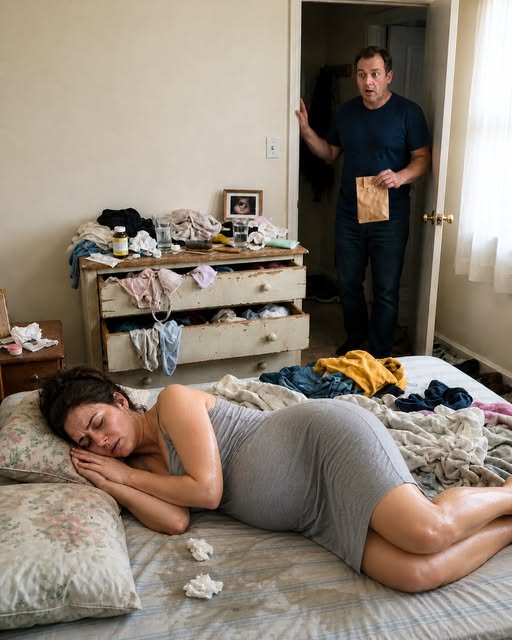
My chest tightened so hard it hurt to breathe.
There were also two brief emergency calls that lasted only seconds before disconnecting.
“I couldn’t talk properly,” Claire murmured quietly after following my stare. “I panicked. Then I thought maybe I was overreacting.”
That sentence hurt in a way I didn’t deserve.
Because while she was terrified of being dramatic, I had spent those first moments standing there imagining betrayal instead of danger.
I helped her sit up carefully, but the second she moved, pain crossed her face sharply and she grabbed my arm hard enough to stop me.
“We need to go,” I said quickly.
She nodded weakly.
“My medical file,” she whispered. “Top drawer.”
I opened the drawer too fast, scattering papers across the floor. Old receipts, appointment reminders, movie ticket stubs, prenatal paperwork. Finally I found the blue folder she always kept organized so carefully.
I remembered teasing her for labeling everything months earlier while she sat at the kitchen table writing our baby’s name across documents with exaggerated seriousness.
Now my hands barely worked.
When I looked back at her, Claire was watching me with an expression I couldn’t fully understand.
Not suspicion.
Not anger.
Something heavier.
Like she already knew what I had thought when I walked through the door.
“Did you think I was with someone?” she asked softly.
The question landed gently.
That somehow made it worse.
I opened my mouth, but nothing came out that didn’t sound pathetic.
Outside our apartment building, somewhere far below, a motorcycle passed through the empty street with a faint metallic growl. Claire turned slightly toward the sound, then looked back at me again.
“I saw your face,” she whispered. “Before you touched me.”
Shame hit me so violently I couldn’t look at her.
The backward nightgown.
The wet sheets.
The unanswered calls.
I had allowed every ugly suspicion my mother planted over the past few months to rise instantly inside me.
“I don’t know what I was thinking,” I said weakly.
It wasn’t enough.
Claire closed her eyes briefly, breathing unevenly as another wave of pain crossed through her body. I grabbed her coat from the chair and helped her into it carefully, trying not to stare at the stains again.
Then she noticed my eyes flick toward the backward seams.
“I changed after showering,” she explained quietly. “I felt dizzy. I didn’t even realize it was backward.”
The explanation was painfully simple.
No secret affair.
No hidden man.
Just a pregnant woman alone in pain trying to dress herself while scared and exhausted.
I knelt to tie her shoes because she couldn’t bend over properly, and while my hands worked, silence filled the room heavily between us.
Not empty silence.
Punishing silence.
The elevator ride downstairs felt endless.
Claire leaned against the wall holding the blue folder tightly against her chest while fluorescent lights washed all the color from her face. I stayed beside her without touching her this time because suddenly I didn’t know whether my touch still comforted her.
The floor numbers descended slowly.
Fifth.
Fourth.
Third.
Every pause felt deserved.
Outside, freezing November air hit us immediately. Claire inhaled sharply through clenched teeth while I guided her carefully toward the car.
When I opened the passenger door, she stopped suddenly before getting inside.
For one terrifying second, I thought she might collapse.
Instead, she looked at me quietly and asked, “Were you scared for me first… or angry first?”
The question was almost gentle.
That gentleness destroyed me.
Because she could have screamed. She could have accused me directly. Instead, she gave me the chance to tell the truth.
And I knew she already knew it.
“I got angry first,” I admitted quietly.
Claire’s eyes fluttered slightly.
She nodded once.
Just once.
Like some painful suspicion inside her had finally been confirmed.
Then she climbed into the car without another word.
I drove too fast through downtown Chicago while red lights and traffic seemed designed specifically to punish me. Claire sat rigidly beside me, both hands protecting her stomach while she breathed through each wave of pain.
Then my phone buzzed inside my jacket pocket.
I ignored it.
A few seconds later, it buzzed again.
And again.
At the next red light, I finally pulled it out expecting work messages or hotel updates.
Instead, I saw my mother’s name.
Three messages.
Are you home yet?
Call me before you talk to Claire.
Please, Ethan. There are things you need to know.
I stared at the screen until the light turned green and a horn sounded behind us.
Claire turned slowly toward me.
“Who is it?”
“My mother.”
Something changed in her face immediately.
Not surprise.
Recognition.
Like a missing puzzle piece had finally slid into place.
“She called me tonight,” Claire said quietly.
My hands tightened around the steering wheel.
“When?”
“Around nine. Before the pain got worse.”
A sick feeling spread through my stomach instantly.
“What did she say?”
Claire kept her eyes fixed ahead toward the glowing hospital sign appearing in the distance.
“She told me I shouldn’t trap you with a baby if we weren’t completely stable yet.”
I stopped breathing for a second.
Because I recognized the tone immediately.
My mother had been planting those thoughts for months beneath fake concern. Casual comments over coffee. Little jokes disguised as wisdom.
Are you sure the timing isn’t strange?
Pregnancy changes women.
A paternity test protects everybody.
I always dismissed her comments lightly instead of confronting them directly because arguing with her felt exhausting.
Now that cowardice sat between my wife and me inside the car.
Claire’s phone vibrated weakly near her seat. At a stoplight near the hospital entrance, I picked it up from the floorboard.
My mother’s number filled Claire’s missed calls too.
And one answered call.
Six minutes long.
Six minutes before panic overtook her completely.
At the emergency entrance, nurses rushed a wheelchair toward us the moment they saw Claire trying to stand. Questions came rapidly afterward.
“How many weeks?”
“Any bleeding?”
“Any falls?”
“Previous complications?”
Claire answered as best she could while I stood uselessly beside her holding the blue folder like evidence of my failure.
Then one nurse asked quietly, “Are you the father?”
Claire hesitated.
But long enough to cut through me like glass.
Not because she doubted the baby.
Because my doubt had become visible enough for her to feel it.
They wheeled her behind a curtain while I followed until a nurse gently stopped me.
“Just give us a minute.”
Inside the examination room, machines hummed softly while doctors prepared ultrasound equipment. Claire stared silently at the ceiling while one exhausted-looking physician reviewed her records.
Then my phone vibrated again.
This time the sound seemed enormous.
Claire heard it.
The nurse heard it.
Even the doctor glanced toward my pocket.
I looked down at my mother’s name glowing on the screen again and suddenly understood something I should have realized years ago.
I had spent my entire marriage trying to avoid choosing between my wife and my mother.
I told myself staying neutral kept peace.
But silence isn’t neutrality when someone you love is being wounded.
It’s permission.
The phone kept ringing.
Claire watched me quietly, pale and exhausted beneath hospital lights.
Then I finally did something I should have done months ago.
I rejected the call.
And turned the phone completely off.
— The Heartbeat on the Screen
Claire closed her eyes after I turned the phone off, but it wasn’t relief I saw on her face.
It was exhaustion.
The kind that settles into someone after carrying fear alone for too long.
Cold ultrasound gel spread across her stomach while the doctor adjusted the monitor beside the bed. The room became painfully quiet except for the low mechanical hum of the machine and the occasional sound of wheels squeaking somewhere in the hallway outside.
I stood beside her holding the blue medical folder against my chest like it could somehow make me useful.
The doctor moved the probe slowly across Claire’s abdomen, his expression carefully neutral in the way medical professionals learn to hide concern. I stared at the monitor without understanding anything I was seeing.
Gray shadows.
Blurry shapes.
Movement I couldn’t interpret.
Claire wasn’t watching the screen.
She was watching the doctor.
That frightened me more than anything else.
Another sharp wave of pain crossed her face, and instinctively I reached for her hand. For half a second, she didn’t take it.
That tiny hesitation nearly crushed me.
Then another contraction hit, and finally her fingers wrapped around mine tightly enough to hurt. I held on like someone trying desperately to keep from drowning.
The doctor adjusted the image again.
Silence stretched longer.
Then suddenly a faint flicker appeared on the monitor.
Small.
Rapid.
Fragile.
“There’s cardiac activity,” the doctor said carefully.
The breath left my body all at once.
Claire made a broken sound beside me that almost turned into crying before she swallowed it back down. My knees weakened so suddenly I had to brace myself against the side of the bed.
The baby was alive.
Nothing else mattered for one suspended moment except that tiny heartbeat flashing against the screen.
The doctor continued speaking, explaining risks and complications in calm clinical language.
Threatened miscarriage.
Observation period.
Stress-related complications.
Strict bed rest.
There were no guarantees yet.
Only possibilities.
Claire stared at the monitor without blinking, as if looking away might make the heartbeat disappear.
I stared at her instead.
At the damp strands of hair stuck near her forehead. At the backward nightgown visible beneath her open coat. At the woman I almost failed in the exact moment she needed me most.
After the examination, nurses moved Claire into a small observation room overlooking the hospital parking lot. Dawn had started creeping slowly across the horizon, turning the sky pale gray beyond the windows.
A nurse suggested I sit down before I collapsed.
I ignored her.
Claire lay quietly beneath thin hospital blankets with one hand resting protectively over her stomach. My phone sat powered off in my pocket like a stone I couldn’t escape carrying.
Eventually she opened her eyes again.
Morning light softened her face slightly, making her look younger and somehow more distant at the same time.
“I need you to tell me something,” she said quietly.
I moved closer immediately.
“Anything.”
She studied me silently for several seconds before speaking again.
“If your mother asks for proof that the baby is yours… would you ask me for it?”
The question didn’t surprise me.
Because somewhere deep inside myself, I already knew the truth.
A weak, frightened part of me had imagined tests before tonight. Not because Claire ever gave me reason to doubt her, but because my mother’s poison had remained inside my head long enough to leave stains.
Outside the room, someone laughed softly near the nurses’ station. The ordinary sound somehow made the question feel even harsher.
I thought about my mother sitting alone in her apartment waiting for obedience disguised as concern.
Then I thought about Claire lying alone in our bed calling me twenty times while pain folded her in half.
And finally I thought about the tiny heartbeat blinking on the screen moments earlier, asking nothing from me except honesty.
“No,” I said quietly.
This time my voice didn’t shake.
Claire kept watching me carefully.
So I said it again.
“No. And I should’ve said no a long time ago.”
Her eyes filled slowly, but not with relief.
Something more complicated.
Because late honesty still arrives carrying damage.
I picked up the blue folder from the chair beside me and placed it gently on the bed.
“For a moment tonight, I believed something terrible,” I admitted. “I’m not going to pretend I didn’t.”
Claire turned her face toward the window.
“And I let my mother’s words stay inside my head because confronting her felt harder than shutting her down.”
The silence afterward hurt, but it was honest.
“I don’t know what this makes us now,” Claire whispered finally.
Neither did I.
Not broken completely.
Not healed.
Just two exhausted people sitting in a hospital room trying to figure out what might still survive.
A few minutes later, my phone vibrated weakly in my pocket even though it was still turned off. Phantom vibration, probably. Guilt pretending to be physical.
I pulled it out anyway and set it facedown on the table without powering it back on.
Claire noticed immediately.
“When we leave here,” she said softly, “I don’t want to go home and still feel like your mother lives between us.”
There it was.
The real wound.
Not the comments themselves.
The space I allowed them to occupy inside our marriage.
I looked at the phone for a long moment before answering.
“I’ll call her from here,” I said quietly. “And you won’t have to say anything.”
Claire closed her eyes again, one hand moving slowly across her stomach.
Outside the room, hospital machines beeped steadily while dawn spread across the corridors.
I turned the phone back on.
Messages flooded the screen instantly.
Adrien, I know you’re upset, but a mother has the right to protect her son.
Don’t let emotions trap you.
A paternity test would give everyone peace of mind.
You deserve certainty before committing forever.
I read every message completely.
Not because I wanted to.
Because looking away now would just be another form of cowardice.
My thumb hovered over the call button for several seconds.
Then I pressed it.
My mother answered almost immediately, breathless like she’d been waiting beside the phone.
“Adrien, finally,” she said quickly. “Listen to me before Claire starts filling your head with—”
“No,” I interrupted quietly. “You’re going to listen to me.”
Silence.
Real silence.
The kind I had avoided creating with her my entire adult life.
I could hear her breathing on the other end of the line, already offended before I even continued.
“Claire is in the hospital,” I said. “The baby almost didn’t make it tonight.”
Her tone softened instantly into familiar manipulation.
“Oh honey, I was only trying to help you think clearly—”
“Stop.”
The word came out sharper than I intended.
But not sharper than it needed to.
“I was protecting you.”
“No,” I said quietly. “You were poisoning my marriage because you couldn’t accept boundaries.”
The silence afterward felt enormous.
Then finally she spoke again, colder this time.
“So you’re choosing her over your own mother?”
For years, that question terrified me.
Tonight, it suddenly sounded simple.
“I’m choosing my family,” I answered.
Behind me, Claire opened her eyes slowly.
And for the first time that entire night—
she looked at me without fear.
— The Cost of Choosing
My mother didn’t speak for several seconds after I told her I was choosing my family.
The silence stretched long enough for me to hear faint hospital noises through the receiver—rolling carts, distant voices, the steady mechanical rhythm of machines somewhere down the corridor.
Then she laughed softly.
Not kindly.
The disappointed laugh she used whenever she believed I was being manipulated by someone else.
“So this is what she wanted,” she said coldly. “To isolate you from your own family.”
I closed my eyes briefly.
Even now, even after hearing Claire was in danger, my mother still framed herself as the victim.
“She never asked me to cut you off,” I said. “She asked me to protect her.”
“And you think I’m dangerous?”
The question sounded offended rather than reflective.
I looked toward Claire lying quietly beneath pale hospital blankets with one hand over her stomach.
I thought about her calling me twenty times while my mother’s doubts echoed through my head louder than her fear.
“Yes,” I answered honestly. “I think what you’ve been doing to us is dangerous.”
My mother inhaled sharply.
“You’re emotional right now.”
“No,” I said quietly. “I’ve been emotionally weak for years. This is the first honest thing I’ve done.”
Another long silence followed.
Then came the guilt.
Predictable. Familiar. Heavy.
“After everything I sacrificed raising you alone,” she whispered, “this is how you speak to me?”
For most of my life, that sentence worked instantly. My father died when I was fourteen, and afterward my mother wrapped grief around us both so tightly that disagreeing with her always felt cruel. She relied on me emotionally in ways I didn’t fully understand back then.
At first it looked like closeness.
Then loyalty.
Eventually it became obligation.
And somewhere inside that obligation, I stopped recognizing the difference between compassion and surrender.
But standing in that hospital room beside my exhausted wife, the pattern finally looked clear instead of complicated.
“I love you,” I said carefully. “But loving you doesn’t mean letting you wound my marriage.”
She laughed again.
“You think this woman won’t leave you eventually? You think children keep people together forever?”
Claire shifted slightly in the bed behind me, not because she could hear the exact words, but because she recognized the tone. Tension moved visibly through her body whenever my mother’s voice entered our lives, even from across a room.
“That’s enough,” I said.
“What?”
“You don’t get to talk about my wife like that anymore.”
“And if I refuse?”
The question arrived sharp and challenging, like she still expected me to retreat.
For years, I always had.
I looked down at the ring on my finger.
Then at Claire.
Then at the blue folder beside her bed containing ultrasound images and emergency paperwork and proof of how fragile life suddenly felt.
“If you refuse,” I said quietly, “then you won’t be part of our lives until you can respect boundaries.”
The words shocked even me once they were spoken aloud.
My mother went completely silent.
Because for the first time, she realized I meant them.
“You’d keep my grandchild from me?”
“No,” I answered. “Your behavior would.”
The call ended badly after that.
Not explosive.
Worse.
Cold.
She accused Claire of manipulating me. Accused hospitals of dramatizing complications. Accused me of becoming ungrateful and weak. Eventually I stopped defending myself and simply repeated the same thing over and over.
“This conversation is over.”
When I finally hung up, my hands were shaking hard enough that I had to place the phone carefully on the windowsill.
Behind me, Claire watched quietly.
I moved back toward the bed slowly, unsure what came next now that the fight I’d avoided for years had finally happened.
“How bad was it?” she asked softly.
I sat beside her.
“Bad enough.”
Claire studied my face carefully, like she was searching for signs I might still retreat from what I’d said.
Then she asked the question that mattered most.
“Did you mean it?”
“Yes.”
The answer came immediately this time.
No hesitation.
No balancing act.
Claire looked toward the window where weak morning light had fully replaced the darkness outside.
“She’s going to hate me now,” she whispered.
I shook my head slowly.
“No,” I said. “She’s going to hate losing control.”
That distinction mattered.
For years I convinced myself my mother’s behavior came from love expressed badly. And part of it probably did. But love without boundaries eventually starts consuming instead of protecting.
Claire closed her eyes again, exhausted beyond words.
A nurse entered shortly afterward with fresh blankets and updated test results. The baby’s heartbeat remained stable for now, though the doctor wanted Claire monitored through the afternoon before discussing discharge.
For the first time all night, I finally allowed myself to breathe properly.
Not because everything was fixed.
Nothing was fixed.
Trust doesn’t heal in one conversation, especially not after fear like this.
But something had changed fundamentally.
The truth was finally visible between us instead of hidden beneath politeness and avoidance.
Around noon, sunlight spilled through the narrow hospital window while Claire slept quietly. I sat beside the bed reading through discharge instructions when movement near the doorway caught my attention.
An older nurse stood there watching us with gentle curiosity.
“First baby?” she asked softly.
I nodded.
She smiled knowingly.
“Men usually look terrified the first time.”
“I almost lost them tonight.”
The nurse glanced toward Claire.
“You showed up,” she said simply.
I almost corrected her.
I almost explained how late I had been emotionally even after arriving physically.
But then I looked at Claire sleeping with one hand still resting over her stomach protectively.
Maybe showing up late was still better than never showing up honestly at all.
That evening, the doctor finally cleared Claire to return home under strict conditions. Bed rest. Minimal stress. Follow-up monitoring within forty-eight hours.
As I helped her into the wheelchair near the hospital exit, she looked smaller somehow. Fragile in ways pregnancy books and doctor appointments never prepared me to witness.
Outside, Chicago glowed gold beneath the setting sun while cold wind swept between buildings.
Before helping her into the car, I paused.
“Claire.”
She looked up at me carefully.
“I know saying sorry isn’t enough.”
“No,” she said quietly. “It isn’t.”
I nodded.
“But I’m still sorry.”
For a moment, neither of us moved.
Then Claire reached for my hand slowly.
Not forgiveness.
Not fully.
But not rejection either.
Something quieter.
Something fragile enough to survive only if handled honestly from now on.
As we drove home through evening traffic, my phone remained silent in the center console.
No messages from my mother.
No calls.
The silence hurt more than I expected.
But beside me, Claire rested one hand over her stomach while the other remained loosely intertwined with mine across the space between us.
And for the first time in years—
I finally understood which silence mattered more.