“Who was upstairs today?” she demanded sharply.
One of the staff managers answered nervously.
“Elena cleaned the master suite this morning.”
Vanessa immediately pointed toward the kitchen.
“It was her.”
Nathaniel’s anger ignited instantly because his mind connected the accusation to something he’d seen earlier that day. Elena had been standing near the kitchen exit holding a bulky plastic bag. The moment she noticed him, she shoved it quickly into her old backpack and lowered her eyes.
At the time, he ignored it.
Now it looked obvious.
Vanessa demanded the police be called immediately.
“Have her arrested,” she snapped. “People like that only understand consequences.”
People like that.
Nathaniel didn’t question the phrase because he secretly agreed with it. In his world, theft from wealthy families wasn’t shocking. It was expected.
But instead of calling the police immediately, pride pushed him toward something uglier. He wanted to catch Elena himself. He wanted to walk into her home, find the ring, and watch her realize her lies were over.
Without telling anyone, Nathaniel searched the employee files for her address.
Then he climbed into his black Mercedes and drove away from the polished streets of Highland Park.
The city changed slowly around him.
Luxury storefronts disappeared first. Then glass office towers. Then the carefully maintained neighborhoods gave way to crowded intersections, aging apartment blocks, and streets patched unevenly with old asphalt.
Nearly ninety minutes later, GPS guided him into a struggling neighborhood on Chicago’s south side where streetlights flickered weakly against cracked sidewalks and abandoned buildings.
His car looked obscene there.
People stopped and stared openly as he drove past.
Finally, the GPS announced he had arrived.
Nathaniel stared through the windshield at a tiny concrete duplex with rusted railings and a sagging porch roof held together by warped wood and duct tape. One weak yellow light glowed behind thin curtains.
Anger returned immediately.
“How dare she steal from me?” he thought.
He stepped out of the Mercedes, adjusted his expensive coat, and walked toward the front door with his jaw clenched tight.
The door wasn’t fully closed.
Through the narrow opening, he saw Elena moving quickly inside the tiny kitchen.
Then he saw the plastic bag.
The same one from earlier.
His stomach hardened.
He had been right.
A small child’s voice suddenly called out from somewhere deeper inside the house.
“Mama?”
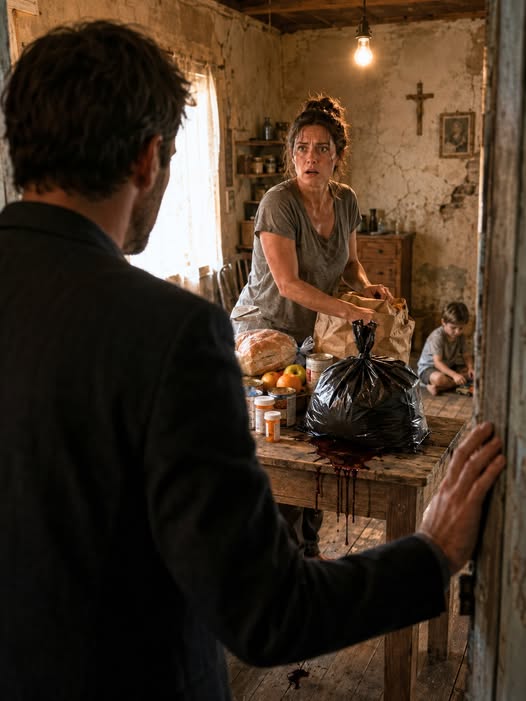
Elena didn’t answer immediately. Her hands shook as she pulled containers carefully from the bag and placed them on a crooked kitchen table beneath the weak ceiling light.
Nathaniel pushed the door open hard, ready to confront her.
But the moment he saw what sat inside those containers—
everything inside him stopped.
There was no diamond ring.
No jewelry.
No stolen valuables.
Only leftovers.
Half a roasted chicken wrapped in foil. Bread folded inside napkins. A cup of soup from his own kitchen. Small portions of food his chef would have thrown into the trash without hesitation.
Nathaniel’s anger collapsed so quickly it almost made him dizzy.
The room around him was painfully small. Cold air slipped through gaps in the windows. One side of the ceiling showed dark water stains from old leaks. The table itself had one broken leg balanced unevenly on stacked bricks.
And sitting around that table were three children.
An older girl hugged a school notebook tightly against her chest while pretending not to stare at him. A thin little boy sat silently in a plastic chair, his enormous eyes filled with fear. Beside him, a younger girl clutched a stuffed rabbit so worn it barely held its shape anymore.
Four chipped plates sat on the table.
All empty.
Elena looked like she might collapse from panic.
“Mr. Brooks,” she whispered. “Please… I can explain.”
But Nathaniel couldn’t speak.
His eyes drifted toward the far corner of the room where an elderly woman lay beneath a thin blanket on a mattress placed directly on the floor. Beside her sat pill bottles, unpaid medical bills, and a jar half-filled with loose coins.
Then the little boy spoke softly.
“Mama… is that the rich man from the big house?”
The question hit Nathaniel harder than any accusation ever could.
He stepped farther inside slowly, his polished shoes crossing cracked linoleum floors that suddenly made his designer clothes feel ridiculous.
He came expecting to uncover theft.
Instead—
he had walked into hunger.
Elena lowered the food containers onto the table carefully.
“I didn’t steal the ring,” she said quietly. “I swear on my children. I only brought home food that was going to be thrown away.”
The oldest girl spoke before Elena could stop her.
“She always asks first,” the girl explained softly. “Sometimes the cook says yes. Sometimes he says no, but throws it away anyway. Mama says food shouldn’t die in the trash if people are hungry.”
Nathaniel stared at the tiny portions on the table.
In his mansion, Vanessa once threw away an entire dessert tray because she thought the frosting looked “cheap.”
Suddenly, the memory made him sick.
Then he noticed something else sitting in the middle of the table.
A tiny piece of leftover cake with a bent candle melted nearly to the bottom. Around it, someone had drawn flowers on a napkin using blue ink.
“Whose birthday is it?” Nathaniel asked quietly.
The little boy raised his hand slowly.
“Mine.”
Elena’s face crumpled slightly.
“Mateo turned seven today.”
Nathaniel looked at the child.
At seven years old, Nathaniel had private tutors, elaborate birthday parties, expensive toys he forgot about within weeks. This little boy had a nearly melted candle and leftover food carried home like treasure.
Something inside Nathaniel cracked painfully.
But pride fought back immediately.
“Why didn’t you ask for help?” he asked.
Elena looked exhausted rather than offended.
“I did.”
She walked toward a metal shelf and retrieved a folded envelope filled with paperwork. Salary advance requests. Requests for extra shifts. Medical forms for Mateo.
Every request carried the same stamped answer.
Denied.
Nathaniel’s stomach dropped when he saw the signature line.
Approved under policy of Nathaniel Brooks Holdings.
He didn’t even remember creating those policies.
That realization horrified him most of all.
People like Elena never truly reached him. Their problems were filtered away long before they could inconvenience his life.
Elena didn’t accuse him.
That somehow hurt worse.
“I know you’re busy, Mr. Brooks,” she said quietly. “I know my problems aren’t your responsibility.”
The little girl clutching the rabbit whispered something so softly he almost missed it.
“Please don’t take Mama away.”
Nathaniel felt shame rise through him like heat.
That’s what they thought.
That he came there to destroy their family.
He looked at Elena again and, for the first time in three years, she stopped looking invisible. She wasn’t background anymore. She was a mother trying desperately to protect her children with whatever scraps the world allowed her to carry home.
Nathaniel had come there to humiliate her.
Instead—
he felt humiliated himself.
— The Woman in Diamonds Was the Real Thief:
Nathaniel stood motionless in the middle of Elena’s kitchen while shame settled over him heavier than anger ever had.
The children stared at him cautiously, unsure whether the wealthy stranger standing in their home would explode or leave. Elena still looked terrified, but beneath the fear was something else now—exhaustion. The exhaustion of someone used to being judged before she could defend herself.
Nathaniel glanced again at the tiny birthday cake sitting in the center of the table.
One weak candle.
Four empty plates.
A mother carrying leftovers across the city because she couldn’t afford enough groceries for her children.
And he had followed her there expecting stolen diamonds.
“Where’s your husband?” he asked quietly.
Elena lowered her eyes.
“He died two years ago.”
The answer landed heavily.
The elderly woman in the corner coughed weakly beneath her blanket, and Nathaniel noticed oxygen tubes beside the mattress. Hospital invoices spilled from an open folder nearby.
Everything in the room spoke the same language.
Survival.
The little boy—Mateo—looked nervously between Nathaniel and the cake.
“Are we still having my birthday?” he whispered.
That question shattered something inside Nathaniel completely.
He looked at Elena.
“May I?” he asked softly, pointing toward the candle.
She hesitated before nodding once.
Nathaniel pulled a gold lighter from his coat pocket, the expensive kind he carried mostly for image, and lit the tiny crooked candle. The flame flickered weakly beneath the drafty ceiling.
No one moved at first.
Then Elena began singing softly in Spanish. The older girl joined her. The little girl with the stuffed rabbit followed quietly a second later.
Nathaniel didn’t know the melody well, but somehow he found himself singing too, standing there in a tailored coat inside a freezing kitchen while a seven-year-old boy closed his eyes and made a wish over scraps rescued from his trash.
When Mateo blew out the candle, everyone clapped softly.
Even Nathaniel.
Then his phone buzzed.
Security footage.
His stomach tightened instantly.
He stepped outside into the narrow yard while cold Chicago wind pushed against his face. Behind him, through the thin walls of the duplex, he could hear Elena dividing food carefully onto plates, making sure everyone else received portions before serving herself.
Nathaniel opened the security files.
The first camera showed Elena entering the master bedroom at 10:14 that morning carrying cleaning supplies. She dusted furniture, adjusted pillows, wiped down Vanessa’s vanity, and left eight minutes later.
Nathaniel frowned.
Then the next timestamp appeared.
10:31 a.m.
Vanessa entered the room alone.
Nathaniel’s thumb froze over the screen as he watched her walk calmly to the vanity, pick up the ring, and slip it into a velvet pouch from her purse.
Then she looked directly toward the security camera.
And smiled.
A slow, cold smile.
Nathaniel felt his blood turn to ice.
The next clip showed Vanessa downstairs near the kitchen entrance where Elena’s backpack rested beside the staff lockers. Vanessa opened the bag briefly and slipped something inside.
Not the ring.
An empty jewelry box.
Ten minutes later, she began screaming that the diamond was missing.
Nathaniel watched the footage twice.
Then a third time.
Nothing changed.
Vanessa framed Elena deliberately.
But another message appeared from his security chief before he could process the shock.
“Sir, there’s additional footage from the private garage office. You need to see this immediately.”
Nathaniel opened the second video.
And his world cracked apart.
Vanessa stood inside the garage office with a man Nathaniel recognized instantly.
Daniel Mercer.
Nathaniel’s chief financial officer. His closest business advisor. The man who helped manage nearly half his investments.
The audio sharpened gradually.
“Once the maid gets fired,” Vanessa said calmly, “Nathaniel will be too distracted to notice the transfers.”
Daniel laughed.
“And after the wedding?”
“He’ll sign whatever I put in front of him,” Vanessa replied. “He trusts me.”
Then Daniel kissed her.
Nathaniel stopped breathing.
The missing ring wasn’t just cruelty.
It was distraction.
Vanessa planned to weaponize his arrogance against an innocent woman while she and Daniel quietly stole millions through fraudulent transfers hidden inside company accounts.
And the worst part—
it worked perfectly.
Because Nathaniel never questioned her accusation.
Not because of evidence.
Because Elena was poor.
Elena stepped quietly into the yard behind him.
“Mr. Brooks?”
Nathaniel turned toward her slowly.
She looked at his face once and immediately understood something had changed.
“You were telling the truth,” he said.
Elena didn’t smile.
“I know.”
The simple answer cut deeper than anger ever could.
Nathaniel swallowed hard.
“I didn’t.”
Elena crossed her arms tightly against the cold.
“Rich people usually don’t.”
He deserved that.
Every word.
Nathaniel looked back toward the duplex where the children were eating quietly beneath weak yellow light.
“You won’t lose your job,” he said.
Fear crossed Elena’s face immediately.
“Please,” she whispered. “Don’t mention my children to anyone. I can’t lose this work.”
Even now—even after being falsely accused—her greatest fear wasn’t humiliation.
It was unemployment.
Because poverty leaves people negotiating with survival every day.
Nathaniel finally understood that.
“I need to go back,” he said quietly.
Elena nodded once.
But before he reached his car, she spoke again.
“Mr. Brooks?”
He turned back.
“I need the job,” she said softly. “But I need dignity more.”
The sentence stayed with him the entire drive home.
By the time Nathaniel returned to Highland Park, night had fully settled across the mansion. The gates opened automatically as his Mercedes rolled through perfectly trimmed gardens and glowing fountains that suddenly looked grotesque to him.
Inside, Vanessa waited in the living room holding a glass of wine.
Her makeup was flawless.
Her expression carefully concerned.
“Well?” she asked immediately. “Did she confess?”
Nathaniel closed the front door behind him slowly.
“No.”
Vanessa’s face hardened instantly.
“What do you mean no?”
“She didn’t steal the ring.”
Vanessa laughed sharply.
“Of course she denied it. People like her always deny everything.”
People like her.
The phrase burned now.
Nathaniel placed his phone on the marble table.
“What exactly does that mean?”
Vanessa rolled her eyes impatiently.
“Oh, please. Don’t act naive now. She’s a maid, Nathaniel. You think someone living in those neighborhoods wouldn’t steal if they had the chance?”
Nathaniel stared at her quietly.
Then he pressed play.
The security footage filled the room.
Vanessa watched herself remove the ring from the vanity.
For the first time since Nathaniel met her—
she looked afraid.
“You recorded me?” she whispered.
Nathaniel laughed once without humor.
“I recorded my own house.”
Vanessa recovered quickly.
“She was stealing food!” she snapped.
The words escaped before she could stop them.
Nathaniel went completely still.
“You knew?”
Vanessa realized her mistake immediately.
“She was taking leftovers from our kitchen like some homeless scavenger,” Vanessa said defensively. “Do you know how humiliating that looks?”
Nathaniel thought about Mateo’s birthday candle.
The empty plates.
The frightened little girl holding a torn stuffed rabbit.
“It looks like hunger,” he said quietly.
Vanessa scoffed.
“It looks pathetic.”
That sentence finished whatever remained between them.
Not broke.
Finished.
Because suddenly Nathaniel saw her clearly. She didn’t love him. She loved the mansion, the status, the invitations, the social power attached to his last name.
And he allowed it because she reflected the coldest parts of himself.
Nathaniel opened the second video.
Daniel appeared on screen.
The kiss.
The fraud.
The plan.
Vanessa’s wine glass slipped from her fingers and shattered across the marble floor.
“Nathaniel…”
“I already sent copies to my attorneys.”
Fear spread visibly across her face now.
“Please listen to me—”
“No.”
She rushed toward him desperately.
“Daniel manipulated me! I made a mistake!”
Nathaniel remembered Elena standing protectively in front of her children while holding a bag of discarded food.
“A mistake,” he said quietly, “is forgetting an appointment. You tried to destroy a woman’s life.”
Vanessa began crying then.
Perfect tears.
Beautiful tears.
The kind that once would have made Nathaniel forgive her instantly.
Now they did nothing.
“You can’t cancel the wedding,” she whispered.
Nathaniel looked at her carefully.
“I can.”
“You’ll humiliate both of us.”
Nathaniel’s expression darkened.
“I already humiliated myself.”
And for the first time in years—
he meant it completely.
— The Table That Changed Everything:
By the following morning, Nathaniel’s mansion felt different.
Not quieter.
Exposed.
For years, he believed the smooth operation of his household meant loyalty. Staff members moved silently through hallways, meals appeared exactly on time, gardens stayed perfect, and problems disappeared before reaching him. He mistook fear for professionalism because fear kept wealthy people comfortable.
Now he saw it everywhere.
The careful voices.
The tension that entered rooms whenever he walked in.
His employees weren’t loyal to him.
They were afraid of him.
Nathaniel entered the kitchen just before six in the morning, the exact time Elena usually arrived. Conversations stopped instantly when staff members noticed him. One cook pretended to reorganize trays that were already aligned perfectly. Another housekeeper lowered her head without speaking.
Then Elena entered through the service door carrying her worn black backpack.
For a moment, she looked smaller inside the mansion than she had inside her own home. That realization hit Nathaniel painfully because in her duplex she had seemed strong despite the poverty surrounding her. Here, surrounded by marble and chandeliers, she became invisible again.
But not today.
Nathaniel stood.
The entire kitchen froze.
“Elena,” he said calmly.
She looked at him carefully.
“Mr. Brooks.”
Nathaniel wanted to apologize publicly. He wanted to undo the damage immediately with one dramatic speech. But as he studied her exhausted face, he understood something important: wealthy people often use apologies to make themselves feel noble again.
So instead, he chose precision.
“You were falsely accused,” he said clearly. “That accusation came from this house, and it was wrong. No employee here will repeat it or treat her differently because of it.”
The staff exchanged shocked glances.
Nathaniel continued.
“From today forward, safe leftover food will never be thrown away again. It will be distributed properly to staff members who want it or donated through approved programs. Anyone who finds that embarrassing is free to leave.”
The executive chef looked stunned.
One older housekeeper quietly wiped tears from her eyes.
Elena remained still, watching him cautiously like someone waiting to see whether the change would survive longer than one morning.
Later that afternoon, Nathaniel asked her to meet privately in his office.
She hesitated before sitting in the chair across from his desk, and even that hesitation disturbed him. He wondered how many wealthy people had spent years making her feel like certain rooms weren’t meant for her.
Nathaniel placed her denied salary requests on the desk between them.
“I saw these.”
Elena lowered her eyes briefly.
“I’m sorry,” he said quietly. “Not because I got caught being blind. Because I chose not to see.”
She didn’t respond immediately.
Nathaniel continued carefully.
“I’m arranging back pay for unpaid overtime. Your salary will increase immediately. Mateo’s medical treatment will be covered through a company assistance fund, and your children’s education expenses will be handled separately through legal scholarship accounts.”
Elena’s eyes sharpened instantly.
“I don’t want charity that disappears when rich people change moods.”
Nathaniel nodded slowly.
“You’re right.”
He picked up the office phone immediately and called his attorney in front of her. He instructed him to draft permanent employee assistance protections with no repayment clauses, no loyalty agreements, and no conditions tied to continued employment.
Elena watched silently until the call ended.
Then she finally asked the question waiting between them.
“Why now?”
Nathaniel leaned back slowly.
There were easy answers.
Because he felt guilty.
Because Vanessa betrayed him.
Because he finally saw poverty up close.
But none of those felt honest enough.
“Because yesterday,” he said quietly, “I followed you home believing poor people were naturally dishonest. And instead of finding stolen diamonds, I found children eating leftovers beside a birthday candle.”
Elena remained silent.
Nathaniel looked toward the office windows.
“I spent years thinking money made me smarter than everyone else,” he admitted. “But all it really did was make my ignorance more expensive.”
The room stayed quiet for several seconds.
Then Elena finally spoke.
“You didn’t steal my dignity, Mr. Brooks,” she said softly. “I kept that.”
Nathaniel looked back at her.
“You stole your own.”
That sentence stayed with him longer than the scandal ever did.
Over the following months, Nathaniel’s life became public disaster material. Society columns reported the collapse of his engagement. Financial investigators uncovered millions stolen through Daniel Mercer’s fraudulent transfers. Business rivals whispered that Nathaniel had been too arrogant to notice corruption inside his own company.
The painful part?
Some of them were right.
For the first time in his life, Nathaniel stopped fighting every criticism. Instead, he started examining the systems inside his company that allowed people like Elena to remain invisible for years.
He removed managers who buried employee complaints beneath policy language. He created direct reporting systems so workers could bypass executives entirely. He increased wages for service staff and established emergency assistance funds for employees facing medical crises.
At first, everyone assumed it was image repair.
Maybe part of it was.
Real change rarely arrives pure.
But gradually, something shifted.
Nathaniel started learning names.
Not for performance.
Because ignorance embarrassed him now.
He learned that his groundskeeper wrote poetry late at night. His driver was putting three daughters through college. The pastry chef sent money monthly to his mother in Detroit.
And he learned Elena’s children’s names.
Mateo.
Isabella.
Luna.
He never tried becoming their hero.
Elena wouldn’t allow that.
She accepted support because her children needed stability, not because she wanted rescuing. Nathaniel slowly realized the difference between helping someone and needing them to feel grateful.
About a year later, Nathaniel attended a small company family event held on the mansion grounds. Children ran across the gardens while staff members laughed more freely than he had ever heard before.
Then he spotted Mateo sprinting through the grass holding a toy airplane.
The little boy looked healthier now. Stronger. Louder.
Nathaniel walked toward him carrying a wrapped gift box.
Elena narrowed her eyes immediately.
“What is that?”
Nathaniel smiled faintly.
“Relax. It’s not a sports car.”
“I’d reject a sports car.”
“I know.”
When Elena nodded permission, Nathaniel handed the gift to Mateo. Inside was a wooden architecture set filled with miniature pieces for building bridges, houses, and towers.
Mateo’s face lit up instantly.
“I can build your mansion!”
Nathaniel crouched beside him.
“Build something better.”
The boy grinned.
“I’m gonna build my mom a house that doesn’t leak.”
Elena turned away quickly, pretending to watch Luna near the garden fountain.
Nathaniel felt his throat tighten.
A year earlier, he might have solved the discomfort by writing a check immediately just to escape the emotion. Now he understood that dignity mattered more than dramatic gestures.
So instead he said quietly, “When you design it, I’d like to see the plans.”
Mateo nodded seriously.
“I’ll charge you.”
Nathaniel laughed.
So did Elena.
It was the first time he heard her laugh naturally inside his house.
Nearly two years after the missing ring scandal, Elena left the mansion permanently.
Not because of conflict.
Because she no longer needed to clean wealthy people’s floors to survive.
Using savings, legal assistance, and relentless determination, she opened a small food service business serving affordable meals to working families across Chicago’s south side. Safe leftover food from Nathaniel’s company events now moved through Elena’s donation network instead of into garbage bins.
On opening day, Nathaniel arrived quietly carrying flowers and the company’s first official catering contract for her business.
No cameras.
No reporters.
No speeches.
Elena read the contract twice before looking up at him.
“No discount because you feel guilty,” she warned.
Nathaniel smiled.
“I was hoping you’d say that.”
Mateo carried trays of bread between tables while Isabella handled payments at the register with impressive authority. Little Luna still carried the same repaired stuffed rabbit tucked beneath one arm.
The restaurant smelled like soup, bread, cilantro, and warmth.
Real warmth.
The kind Nathaniel’s mansion never had during all those years Vanessa lived there.
Elena handed him a plate of food.
Chicken.
Rice.
Fresh mango slices.
Nathaniel stared at it silently, remembering the plastic bag from that night. The crooked table. The dying birthday candle. His knees hitting cracked concrete floors as shame finally tore through him.
Elena noticed his expression immediately.
“Don’t cry in my restaurant,” she said dryly. “You’ll scare customers.”
Nathaniel laughed softly.
“I’m trying not to.”
She glanced around the crowded room proudly.
“You asked once why I didn’t ask for help,” she said.
Nathaniel nodded.
“I did ask,” she continued. “Many times. But help from people who think they’re above you always comes with chains. Help from people who respect you comes with doors.”
Nathaniel looked around her restaurant again.
“And this?” he asked quietly.
Elena smiled.
“This is my door.”
Years later, when people retold the story, they always simplified it. They claimed a wealthy businessman suddenly discovered compassion inside a poor woman’s kitchen. They described one emotional night transforming an arrogant millionaire into a good man.
Nathaniel knew better.
That wasn’t the truth.
The truth was slower and uglier.
He accused an innocent woman because poverty made her easy to suspect. He trusted polished lies because wealthy people sounded familiar to him. And he only recognized his cruelty after walking into a tiny kitchen where children treated discarded leftovers like treasure.
That night didn’t magically make him noble.
It made him ashamed.
And shame only became useful once he turned it into action.
Whenever people later asked Nathaniel what truly changed him, he always answered the same way.
He went looking for a stolen diamond.
And instead—
found his conscience sitting on a broken kitchen table.