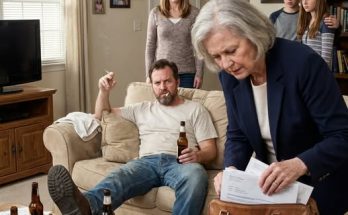
Mason explained that food became “a reward for being easy.”
Eli said Aunt Tessa lived in “the sad room” because Vanessa believed it was “where bad people learn.”
There is no dramatic response to statements like that.
Only silence.
Only paperwork.
Only exhausted adults trying to translate unbearable truths into legal language strong enough to stop monsters permanently.
Part 3: The Camera That Saved Them
The criminal trial began almost a year after the night I turned the car around. By then the story had spread far beyond our city. National media framed it as a shocking case involving wealth, forged guardianship documents, and child abuse hidden inside a luxury home. But every headline still felt too clean compared to reality.
Real horror is rarely dramatic while it’s happening.
Most of the time it hides inside ordinary routines, polite conversations, and people convincing themselves they are probably overreacting.
Vanessa entered the courtroom wearing ivory-colored designer clothing, calm and perfectly styled as if appearances alone could still manipulate reality. Even after everything uncovered inside that house, she continued behaving like the victim of some misunderstanding rather than the architect of deliberate cruelty.
Adrian looked very different without expensive suits and carefully rehearsed charm. Prison had already stripped away the polished confidence he once used to move through wealthy social circles like a parasite searching for new hosts.
The prosecution spent weeks laying out the full structure of what they built together.
False imprisonment.
Child endangerment.
Assault.
Kidnapping.
Forgery.
Coercive financial fraud.
Conspiracy.
The courtroom grew especially quiet whenever prosecutors described the children. Jurors handled those moments differently than financial crimes or legal deception. Money creates anger. Harm toward children creates something heavier.
Then the prosecutor played the nursery footage.
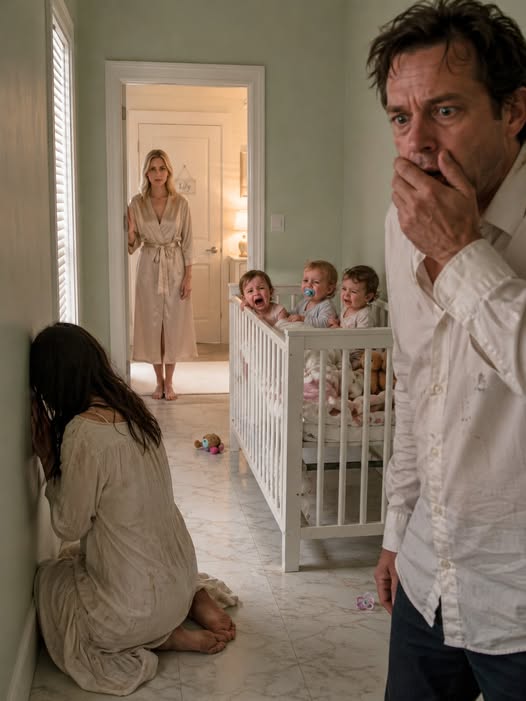
The screen showed my three boys pounding against the locked door while crying hysterically. Vanessa stood outside wearing a silk robe, composed and patient. She leaned toward the door slightly before whispering the sentence that destroyed every illusion I still carried about her.
“Be quiet, or you won’t eat tonight.”
The courtroom atmosphere changed instantly afterward.
Not because the words themselves sounded especially violent.
Because they sounded intimate.
Whispered cruelty unsettles people more than screaming rage because it reveals comfort. It reveals practice. Monsters who whisper are monsters who feel completely safe.
I testified over two exhausting days. Prosecutors asked about the hidden camera, the drive home, what I found inside the nursery, and the moment I discovered Tessa locked upstairs.
I answered everything carefully because rage makes people emotional, but precision destroys liars more effectively than anger ever will.
The defense attempted turning me into the villain almost immediately. Their attorneys painted me as a paranoid billionaire obsessed with control, a man so suspicious he secretly monitored his own household. They claimed Vanessa merely enforced discipline while I interpreted ordinary parenting through the lens of stress and emotional instability.
Then one attorney asked the question that hit hardest.
“If you trusted your fiancée, Mr. Cole, why install hidden cameras at all?”
The courtroom went completely silent.
The truthful answer felt ugly, but I gave it anyway.
“Because part of me already knew my children were afraid of her,” I said quietly. “And instead of confronting the truth directly, I chose surveillance because I hoped I was wrong.”
That sentence changed the room.
Not because it excused me.
Because it exposed something painfully human.
Most people do not ignore warning signs because they enjoy denial. They ignore them because accepting the truth would force their entire life to reorganize itself around something terrifying.
After that moment, the defense lost momentum completely.
Evidence overwhelmed everything else. Rosa’s injuries. Tessa’s captivity. The forged documents recovered from Adrian’s briefcase. Financial records. Psychiatric forms prepared in advance. Audio recordings. Security footage.
And worst of all, the boys’ interviews.
Children describe trauma differently than adults. They don’t organize pain into legal terminology or psychological language. They explain it through routines and emotional associations.
Noah said Vanessa smiled more when they cried.
Mason described food as something you earned by “being easy.”
Eli explained that the guest room was “where sad people stayed until they learned.”
Those statements stayed inside the courtroom long after the interviews ended.
Vanessa was eventually convicted on the most serious charges alongside Adrian. Watching the verdict read aloud didn’t feel victorious the way movies pretend justice should feel. It felt exhausting. Heavy. Like surviving surgery after realizing how close the infection came to reaching your heart.
Tessa relocated afterward under a different last name and slowly rebuilt her life somewhere far away from cameras and courtrooms. Before leaving, she hugged me in the hospital hallway one final time and apologized again for not saving the boys sooner.
I finally stopped her mid-sentence.
“You survived,” I told her. “That’s not failure.”
She cried harder after that.
Rosa remained part of our lives long after the case ended. Not as an employee anymore, but as family. Real family. The kind chosen deliberately rather than inherited accidentally. The boys still trusted her more easily than almost anyone else in the world, and honestly, so did I.
My wedding never happened.
The Napa resort deal collapsed shortly afterward, and for months the engagement ring stayed hidden in my desk drawer because I couldn’t even look at it without feeling physically ill. Eventually I melted the ring down and used the gold to create three simple medallions engraved with each boy’s initials.
People assumed it was symbolic.
It wasn’t.
I simply couldn’t stand seeing the object tied to everything I almost sacrificed my children to protect.
The triplets are six now.
They still sleep in the same bedroom because separation makes them anxious. We no longer call it a nursery because certain rooms deserve to lose the names they once hid behind. Noah eats normally again, although sometimes he still asks whether dinner is “real” if someone besides me or Rosa prepared it. Mason’s nightmares happen less often now. Eli still checks every lock twice before bed.
Some wounds heal like bruises.
Others permanently reshape the architecture of a child’s nervous system.
Recovery became less about dramatic breakthroughs and more about repetition. Therapy appointments. Predictable routines. Warm lighting. Consistent meals. Doors that are never locked from the outside. Every night before bed, I let each boy open and close the hallway door himself so control slowly returns to their own hands instead of remaining associated with fear.
One evening about eight months after the trial, Noah asked me a question that still follows me everywhere.
“Dad, if the camera didn’t tell you… would we have disappeared?”
Children ask apocalyptic questions with terrifying normality.
I looked at all three of them sitting together on the bed and answered as honestly as love allowed.
“I don’t know,” I admitted quietly. “But I know she didn’t win.”
That answer satisfied him for the night.
It never satisfied me.
Because the hardest truth I carry now is understanding how narrow the timing really was. Rescue wasn’t destiny. It wasn’t heroic instinct. It was opportunity. A traffic pattern. A hidden camera. A warning arriving early enough for me to turn around before paperwork, manipulation, and fear fully trapped my children inside a system designed to erase me.
That realization still wakes me up some nights.
People constantly ask whether I hate Vanessa.
Hate feels too simple for what remains.
I hate what she did, yes. I hate the softness of her voice outside that nursery door. I hate the precision of the entire plan. I hate that she viewed my sons as obstacles between herself and control.
But what I carry most isn’t hatred.
It’s vigilance.
I understand now that love without attention becomes permission for predators to operate comfortably inside ordinary lives. Evil rarely introduces itself dramatically. Most of the time it arrives polished, patient, attractive, intelligent, and deeply skilled at explaining away instinct.
That’s the part nobody wants to hear afterward.
Not every monster looks unstable.
Some wear silk robes and whisper softly through locked doors.
Some understand legal systems better than compassion.
Some smile beautifully while studying exactly how to turn your trust against you.
And sometimes the only thing separating survival from disappearance is one hidden camera installed by a father who already suspected something terrible was happening, but still prayed he was imagining it.
I still see that footage sometimes in my nightmares.
Three small boys crying behind a locked nursery door.
Vanessa standing calmly outside.
And me turning the car around too late to feel innocent, but just early enough to save what mattered more than every empire I had ever built.