The doors slowly, silently parted, pulled open by two towering security guards.
I stepped into the light.
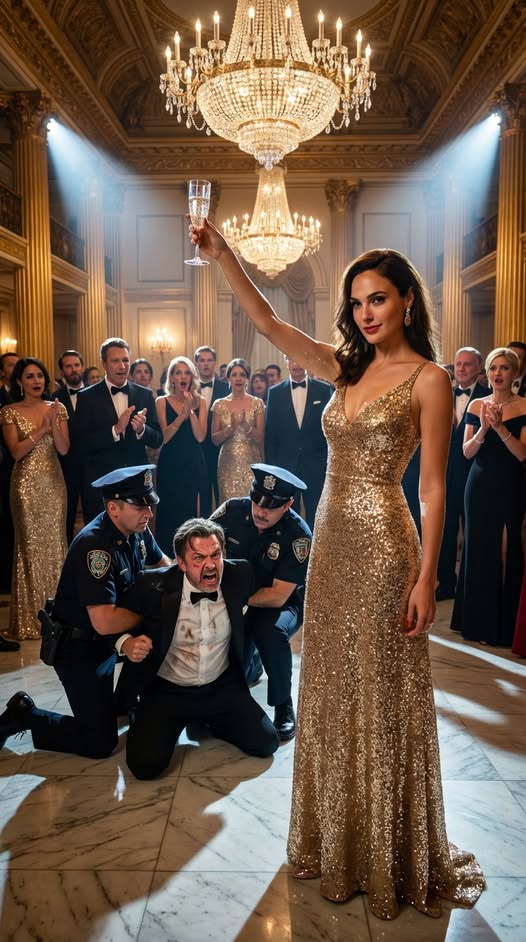
I walked slowly, deliberately down the wide center aisle of the ballroom. The ten-million-dollar diamond collar around my neck caught the fierce glare of the spotlight, sending blinding, fractured rainbows of light dancing across the walls. My black tuxedo was a sharp, lethal contrast to the colorful gowns of the guests. I radiated a cold, absolute, and terrifying authority that sucked the oxygen out of the massive room.
As I walked past the tables, the elite board members, the vice presidents, and the billionaire investors didn’t just stare. They immediately, unanimously stood up from their chairs in a wave of profound, shocked respect.
I kept my eyes locked dead ahead. I looked straight at the stage. I looked straight at Marcus.
I watched the exact, agonizing, magnificent moment the reality of the universe crashed into his brain.
Marcus’s eager, sycophantic smile froze.
As I stepped into the light, as my face became clearly visible on the massive jumbotron screens flanking the stage, his brain struggled violently to process the impossible visual data. He was looking at the “ugly, unsophisticated” wife he had just slapped and thrown into a dirty alleyway not thirty minutes prior. He was looking at the woman he thought was a broke, pathetic liability.
And she was wearing diamonds that cost more than his entire projected lifetime earnings, being announced as the absolute ruler of his universe.
The blood entirely, violently drained from Marcus’s face, leaving him a sickly, ashen grey. His eyes widened to a comical, horrifying degree, bulging in their sockets. He staggered backward on the stage, his legs visibly trembling. He gripped the edges of the wooden podium so hard his knuckles turned stark white, his knees physically buckling under the crushing, suffocating weight of his own monumental stupidity.
He was hyperventilating, his mouth opening and closing silently like a dying fish.
I ascended the three small steps onto the stage. I didn’t rush. I walked directly up to him.
I didn’t look at him with anger. I didn’t look at him with hatred, or sorrow, or the pain of a betrayed wife.
I looked at him with the cold, clinical, utterly dismissive disgust of a homeowner looking at a cockroach that had scuttled across a clean floor.
I reached out. Marcus was paralyzed, trembling so violently the podium shook. I effortlessly, smoothly plucked the microphone from his sweating, shaking fingers.
I turned my back on him entirely, facing the silent, captivated, breathless room of hundreds of elite guests and dozens of flashing media cameras.
“Good evening,” I said. My voice echoed through the massive sound system, low, resonant, and dripping with lethal calm.
A collective shiver seemed to run through the crowd.
“Marcus,” I continued, gesturing vaguely behind me with my free hand without turning around, “was just telling you a very inspiring story. He was telling you about being a self-made man. About pulling himself up by his bootstraps through his own unparalleled intellect.”
I paused, letting a cold, sharp smile touch my red lips.
“It’s a fascinating, beautiful fairy tale,” I said, my voice echoing off the high ceilings. “Because the absolute truth of the matter is that Marcus Vance is entirely, fundamentally incompetent.”
A loud, audible gasp ripped through the front row of the board of directors.
“The truth is,” I stated clearly, looking directly into the camera lens of the primary news network broadcasting the event, “I bought the subsidiary company he worked for five years ago. I systematically, artificially elevated him from a failing mid-level manager to the position of CEO using a network of proxy votes and blind capital. I built every single step of the staircase he claims to have climbed.”
I turned my head slightly, looking at Marcus over my shoulder. He was weeping openly now, tears of pure, unadulterated terror and humiliation streaming down his face, ruining his expensive grooming.
“I did it purely out of charity,” I announced to the room, delivering the fatal, public execution of his entire existence. “A blind, foolish, matrimonial charity. I wanted to see what a weak man would do with absolute power.”
I turned fully to face him, the microphone held near my mouth.
“He failed the test,” I whispered, the words booming through the speakers. “He is a fraud. He is a violent, abusive parasite. And that charity ends tonight.”
I looked back at the board of directors in the front row.
“As majority shareholder, I am officially exercising my executive authority to terminate Marcus Vance from the position of CEO, effective immediately, for gross incompetence and moral turpitude,” I declared. “Security will escort him from the premises.”
5. The Ashes of Arrogance
The ballroom erupted.
It wasn’t a murmur; it was an explosion of chaotic, frantic shouting, the blinding, continuous strobe of hundreds of camera flashes, and the sudden, aggressive movement of the crowd. The financial press was frantically typing into their phones, broadcasting the most spectacular, humiliating corporate implosion of the decade in real-time.
Marcus completely broke.
The arrogant, abusive playboy who had slapped me in a coatroom collapsed entirely. He fell heavily to his knees on the stage floor, directly in front of me. He sobbed loudly, a pathetic, guttural wail of absolute despair. He reached out with trembling, sweaty hands, desperately trying to grab the hem of my tailored suit jacket, begging for mercy in front of the entire world.
“Elena! Please! Elena, I’m sorry!” Marcus bawled, his voice cracking, his face a mess of snot and tears. “I didn’t know! I didn’t know it was you! Please, I love you! Don’t do this to me! I have nothing!”
I took a slow, deliberate step backward, easily avoiding his grasping, desperate hands.
I didn’t scream at him. I didn’t kick him while he was down. He was already drowning; he didn’t need my help to sink.
I reached into the inner breast pocket of my tuxedo jacket. I pulled out a thick, heavy manila envelope.
I dropped it.
It hit the wooden floor of the stage with a heavy thud, landing inches from his trembling, outstretched fingers.
“What… what is this?” Marcus sobbed, staring at the envelope as if it were a bomb.
“That,” I said coldly, “is a formal petition for divorce. Filed and expedited this evening.”
I watched him stare at the envelope.
“And inside,” I added, ensuring the microphone picked up my final words to him, “you will find a copy of the prenuptial agreement you eagerly signed five years ago. The one you bragged to your friends about, the one you insisted upon to ‘protect your future corporate assets from a poor gold digger’.”
Marcus looked up at me, his eyes wide with a new, horrifying realization.
“You didn’t read the fine print, Marcus,” I smiled, a dark, terrifying expression. “The prenup states that in the event of a divorce initiated by infidelity or physical abuse, the offending party forfeits absolutely all claims to marital assets, shared capital, and spousal support. You signed an ironclad shield that protected a billionaire from you.”
I looked at the two massive, armed security guards who had just stepped onto the stage behind him.
“You are leaving this marriage with exactly what you brought into it,” I whispered. “Nothing.”
I turned my back on him. I didn’t watch as the security guards grabbed Marcus roughly by the armpits, hauling the weeping, ruined, humiliated man to his feet and dragging him unceremoniously off the stage and out the service doors of the ballroom.
I stepped up to the podium, placing my hands on the wood, and looked out over the chaotic, buzzing room of executives and investors.
“Now,” I said, my voice cutting through the noise, instantly commanding absolute silence and attention from the most powerful people in the city. “Let’s talk about the future of Vanguard Holdings. Under my direct leadership.”
Six months later, the contrast between our two lives was absolute, staggering, and incredibly poetic.
In a bleak, cramped, fluorescent-lit studio apartment on the grimy, industrial edge of the city, Marcus Vance sat at a cheap, wobbly card table. He was wearing a stained, gray undershirt, his hair unwashed and thinning. He stared blankly at the cracked screen of a cheap laptop, looking at his bank account balance.
It read zero.
He was entirely, fundamentally blacklisted. He was a pariah. No corporate entity, no mid-level firm, no small business in the entire country would dare hire a man who had been so publicly, spectacularly humiliated and fired for incompetence and abuse by the legendary, notoriously ruthless Elena Rostova. He was untouchable, toxic waste in the professional world. He was drowning in legal fees from the divorce he couldn’t afford to fight, crying himself to sleep on an air mattress, realizing every single day that his staggering, blinding arrogance had cost him the universe.
Miles away, the downtown skyline was glowing in the vibrant hues of a summer sunset.
In the massive, glass-walled, top-floor boardroom of Vanguard Holdings, I sat at the head of a thirty-foot mahogany table. I was surrounded by my senior executive team, brilliant, capable men and women who looked at me not with fear, but with profound, absolute respect.
I was wearing a sharp, immaculate white suit. I held an expensive fountain pen.
I listened to the final projections for a multi-billion-dollar international merger I had personally orchestrated over the last three months. The company was reporting record-breaking, historic profits, entirely unburdened by the dead weight and gross incompetence of my toxic, abusive ex-husband.
I smiled warmly at my Chief Financial Officer, nodding my approval. With a swift, confident stroke of my pen, I signed the merger documents, cementing Vanguard’s position as a global titan.
I raised my left hand and gently touched my cheek.
I didn’t touch it in pain. The physical bruise from Marcus’s slap had healed months ago. I touched it in quiet, profound remembrance. I touched it as a reminder of the exact, brutal moment that had finally, thankfully woken me up from a five-year nightmare.
I didn’t feel a single shred of guilt for what I had done to him. I didn’t feel pity. I felt only the immense, empowering, beautiful weightlessness of absolute, unquestionable sovereignty over my own life.
6. The View From the Top
Two years later.
It was a vibrant, crisp, brilliant Tuesday afternoon in Manhattan. The city was alive with the frantic, electric energy of millions of people hustling, striving, and surviving.
I stepped out of the heavy, revolving glass doors of Le Bernardin, having just concluded a highly successful, two-hour charity luncheon where my foundation had pledged fifty million dollars to global women’s education initiatives.
I was wrapped in a stunning, custom-tailored camel cashmere coat, protecting me from the biting autumn wind. I felt energized, powerful, and entirely at peace.
My personal chauffeur, standing sharply in a dark suit, immediately hurried forward to open the heavy rear door of my sleek, black Rolls-Royce Phantom idling at the curb.
As I paused on the sidewalk, adjusting my silk scarf, my gaze drifted casually across the busy, rain-slicked street.
A city sanitation crew was working on the opposite sidewalk, clearing heavy, wet bags of garbage and debris from the overflowing municipal trash cans.
One of the workers, wearing a bright, neon-orange, reflective safety vest over a faded, dirty sweatshirt, was struggling to heave a massive, leaking black trash bag into the back of the idling garbage truck.
He looked exhausted. He looked aged beyond his years, his posture hunched, his face lined with the deep, permanent exhaustion of hard, grueling, manual labor.
He turned his head to wipe the sweat from his forehead with a grimy gloved hand.
It was Marcus.
For a fleeting, microscopic second, his dull, tired eyes locked across the busy street. They locked onto the gleaming, impossible luxury of the Rolls-Royce, and then, they drifted upward and locked directly onto the breathtaking, powerful woman preparing to step into it.
He froze. The heavy trash bag slipped from his grasp, hitting the wet pavement with a dull, wet thud, splashing dirty water onto his boots.
His eyes widened in a flash of agonizing, humiliating recognition. He recognized the woman he had called ugly. The woman he had called unsophisticated. The woman he had told to stay in the shadows because she would ruin his aesthetic.
I didn’t hide. I didn’t quickly duck into the car to spare his feelings or avoid an awkward encounter.
I stood perfectly still on the sidewalk. I looked directly back at him across the divide of the street, and the divide of our entire existences.
I searched my heart for a reaction. I expected a flare of vindictive triumph. I expected a pang of lingering sadness for the man I had once loved.
I felt absolutely nothing.
No anger. No pity. No love. No hate.
He was just a stranger in an orange vest. He was a ghost haunting the gutters of a city that I owned.
I offered him a small, polite, completely detached smile—the kind of smile you give a passing stranger on the street.
Then, I turned my back on him. I stepped smoothly into the luxurious, quiet, leather-scented interior of the Rolls-Royce. The chauffeur firmly closed the heavy door, instantly sealing out the chaotic noise, the smell, and the grime of the street.
“To the office, please, William,” I told my driver, settling back into the plush seat and opening my iPad.
“Right away, Madam Chairwoman,” he replied, smoothly merging the massive car into the endless stream of bright city traffic.
I looked out the tinted window as we glided past the sanitation truck, leaving the shadows, the abuse, and the dead weight of my past permanently in the rearview mirror.
“I finally learned,” I whispered to myself, a genuine, deeply peaceful smile touching my lips as I looked ahead at the towering skyscrapers, “that the view from the very top is so much better when you aren’t carrying trash.”
I drove fearlessly into a limitless, brilliant future, a kingdom that I had built entirely, unquestionably, with my own two hands.