Margaret smiled, a cold, thin line that barely parted her lips. “She’s in the best hands, Jax. I’ll treat her exactly how she deserves to be treated.”
I didn’t hear the venom in that promise. I only heard a mother’s reassurance.
The isolation happened with the slow, invisible creep of black mold. Over the first few months, my letters went unanswered. My satellite calls dropped or were intercepted. When I did manage to get Margaret on the line, her voice dripped with practiced, faux-maternal concern. Elena is resting, Jaxson. Her hormones are making her incredibly unstable. The doctor said no stress. I’m handling it. I learned later, through the tear-soaked confessions of my wife, exactly how Margaret “handled” it. A month into my deployment, Elena had sat at our kitchen table, joyfully writing a letter to me about the baby’s first kick. Margaret had glided into the room, her perfume suffocating in the small space, and offered to mail it. The moment the front door clicked shut, Margaret marched straight to the home office. She fed the delicate, heartfelt words into the heavy-duty cross-cut shredder, watching the paper turn to confetti. He doesn’t need distractions from a girl like you, she had whispered to the empty room.
I was blind to it all, buried under the weight of combat operations, until the communication blackout lifted, and our unit was green-lit for an early, classified return. I stood on the tarmac, waiting to board the flight home, and powered up my civilian phone.
There was only one new voicemail. It was from Elena.
There was no voice on the recording. Just the horrifying, ragged sound of shallow, panicked breathing. Then, the heavy, metallic CLANG of a deadbolt slamming shut into a reinforced frame.
And in the background, echoing with a chilling, echoing cruelness, my mother’s voice: “Go to sleep, mutt.”
The transport vans cut through the midnight fog of our North Carolina town like silent, predatory beasts. There were twenty of us, a full platoon of battle-hardened infantrymen, returning three weeks ahead of schedule. We expected a quiet homecoming, a chance to slip into our beds and surprise our families in the morning light.
Instead, I found a nightmare.
The house was immaculate from the street. The porch light was off, the windows dark, the lawn pristine. But as our vans idled at the curb, I saw a harsh, fluorescent glare spilling from the backyard mudroom—a small, uninsulated concrete addition attached to the back of the garage. It was designed to hold dirty boots and wet gear. It was, essentially, a glorified dog kennel.
A cold dread coiled in my gut, tighter and heavier than any fear I had ever felt in a combat zone. I signaled for my men to hold position, slipping out of the van and moving silently across the damp grass. The night was dead quiet.
Until a sharp splash and a muffled, agonizing scream erupted from the kennel.
I lunged for the small, reinforced window set into the mudroom’s heavy door. My breath hitched, dying in my throat at the scene playing out inside.
There was Elena. My beautiful, vibrant wife was curled in the corner on a filthy, thin mattress meant for camping. She was severely malnourished, her collarbones sharp against her pale skin, shivering uncontrollably in an oversized, soiled t-shirt.
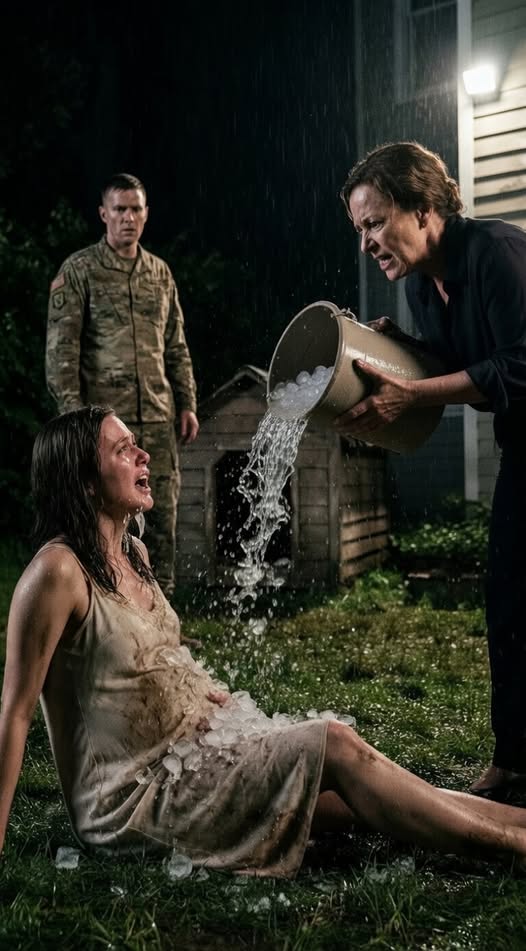
Standing over her was Margaret. My mother held an empty, galvanized steel bucket, the remnants of crushed ice clinging to the bottom. Water pooled on the concrete floor, soaking into Elena’s thin mattress.
“This is where stray mutts belong,” Margaret spat, her face contorted in a mask of elitist rage I didn’t recognize. The polished, society-woman veneer had completely peeled away, leaving only a monster.
Elena sobbed, wrapping her thin arms protectively around the swollen mound of her belly. “Please,” she begged, her voice a raspy, broken whisper. “The baby is cold.”
Margaret threw her head back and laughed—a sharp, jagged sound like glass shattering on stone. “That baby isn’t part of this family,” she snarled. “My son is a hero. He doesn’t need a burden like you anchoring him down.”
Margaret turned, expecting the quiet submission she had brutally enforced for the last nine months.
Instead, she saw my face pressed against the glass.
I didn’t come alone. Behind me, stepping silently from the shadows of the manicured oak trees, were twenty uniformed soldiers. We stood like statues in the misty darkness, the ambient streetlights catching the sharp angles of our tactical gear. The collective, terrifying anger radiating from my brothers-in-arms was a physical weight in the air.
I stepped fully into the harsh light spilling from the window. My face felt frozen, completely devoid of emotion, masking a rage so profound it felt like a singularity in my chest.
I didn’t look at my mother. I didn’t scream. I reached down, gripped the heavy metal padlock securing the mudroom from the outside, and brought the hardened steel heel of my combat boot down on it with bone-shattering force. The latch exploded.
As I ripped the heavy door open, the hinges screaming in protest, I didn’t look back at my men. I didn’t have to.
“Secure the perimeter,” I whispered into the freezing night. “No one leaves. Especially not her.”
The moment I breached the threshold, the tactical part of my brain took over. I stripped off my heavy, fleece-lined tactical jacket and wrapped it around Elena’s shivering, soaked frame. She flinched violently at my touch, a reflex that tore my heart entirely in two, before her wide, terrified eyes focused on my face.
“Jax?” she whimpered, collapsing into my chest. She felt like a bundle of fragile, frozen twigs.
While I held the center of my world, the rest of the unit moved with terrifying, practiced precision. Staff Sergeant Miller, my hulking Second-in-Command and the closest thing I had to a brother, stepped into the mudroom. He didn’t touch Margaret. He didn’t have to. He simply used his massive frame to completely block the doorway leading into the main house, looming over her like a grim reaper in digital camouflage.
Margaret scrambled backward, the empty ice bucket clattering against the concrete. She tried to frantically smooth her designer blouse, desperately attempting to piece her arrogant facade back together in the face of two dozen silent, furious sentinels.
“You can’t talk to me like this, Jaxson!” Margaret shrieked, her voice pitching into a hysterical vibrato. “I am your mother! I did this for you! I saved you from this gold-digger! She was going to ruin your career!”
I didn’t look up from Elena. I was busy checking her pulse, brushing her matted, damp hair away from her sunken cheeks. How long? I thought, bile rising in my throat. How long has she been living in this concrete box?
“You didn’t save me, Margaret,” I said, my voice eerily calm. It wasn’t the voice of her son; it was the voice of a man issuing a casualty report. “You declared war on my family. And you’re currently standing on a battlefield you don’t own.”
Over the next ten minutes, as our medic evaluated Elena, the full scope of my mother’s treason came to light. The forged emails claiming Elena had “run away.” The calls to the base commander’s office, staged by Margaret, citing “comms blackouts” while she spread vicious rumors of Elena’s infidelity to my commanding officers. Margaret had completely drained my deployment pay, redirecting the funds to her own accounts, leaving Elena penniless and trapped.
But Margaret had made one catastrophic tactical error. She had forgotten the ground she stood on.
This house was part of a highly specialized, command-directed military housing program. It wasn’t standard civilian real estate. Margaret had absolutely no legal right, no lease, and no standing to be on the premises without the primary occupant’s explicit, ongoing consent. She was an unauthorized civilian.
I slowly stood up, letting our combat medic take my place beside my wife. I looked at Staff Sergeant Miller.
“Call the MP. Military Police,” I ordered, my eyes locked on Margaret’s suddenly pale face. “Get the Base Commander on the line. Wake him up. Tell them we have a civilian trespasser who has been misappropriating military funds, committing fraud, and executing aggravated assault on a dependent.”
“You can’t do that!” Margaret screamed, genuine panic finally breaking through her entitlement. The sound of distant sirens was already beginning to wail in the quiet night. “I have rights! I have power of attorney over your affairs, Jaxson! I am the head of this household!”
I reached into the breast pocket of my uniform. Three months ago, when the letters first stopped and my gut told me something was deeply, fundamentally wrong, I had visited the JAG office on base in the desert. I pulled out a crumpled, heavily stamped piece of paper. A total, immediate revocation of all legal power.
But as I raised the document to show her, a sharp, ragged gasp echoed from the corner.
Elena clutched her swollen stomach, her face draining of what little color it had left. Her fingers dug into the fabric of my jacket. “Jax…” she groaned, her voice tight with blinding agony. “Something’s wrong. The baby.”
The tactical precision of the moment instantly shattered, replaced by the chaotic, terrifying reality of a medical emergency. The trauma, the months of malnutrition, and the vicious shock of the ice water had pushed Elena’s battered body past its limit. She was going into premature labor, right there on the freezing concrete floor of the kennel.
The focus shifted. The perimeter my men had secured against my mother suddenly became a protective cordon for my wife. The unit medic barked orders, elevating Elena’s legs and calling for emergency civilian EMS.
Margaret, watching the flashing red and blue lights of the Military Police cruisers painting the front lawn, realized her absolute control was evaporating. As two heavily armed MPs jogged down the driveway, their hands resting on their sidearms, Margaret’s demeanor flipped. The tyrant vanished, replaced by a frail, trembling victim.
“Officers, thank God you’re here!” she cried out, tears of manufactured terror welling in her eyes. She pointed a shaking finger at Elena. “She’s hysterical! She fell, I was just trying to wake her up with the water! My son is confused, he’s suffering from PTSD—”
“Ma’am, step away,” the lead MP barked, completely ignoring her tears. They had been briefed by Miller. They knew exactly whose house they were standing at.
I walked toward my mother. The distance between us felt like crossing a vast, unbridgeable ocean. I looked at the woman who had raised me, searching for any flicker of humanity, any hint of the mother I thought I knew. There was nothing. Just a cold, calculating stranger desperate to save her own skin.
“You’re right, Mom,” I said. My voice was loud enough to cut through the wail of the approaching ambulance, carrying over the radio static of the MPs. “This is your doing. But you made one mistake. YOU’RE RIGHT, MOM—AND SINCE THIS HOUSE IS MILITARY PROPERTY, YOU’RE THE ONLY ONE WHO DOESN’T BELONG HERE.”
I stepped closer, invading her space until she was forced to look up at me.
“Pack nothing,” I commanded, the venom finally bleeding into my words. “Everything in that house was bought with the blood I spilled in the sand for twelve months. You don’t get to keep a single thread of it.”
The MPs moved in. They didn’t offer her the dignity of a gentle escort. They grabbed her arms, spinning her around and securing cold steel handcuffs around her wrists.
As they marched her toward the cruisers, Staff Sergeant Miller and the rest of the platoon stepped out of the shadows. Twenty men lined the concrete walkway from the backyard to the street, creating a tight, silent corridor. They didn’t say a word. They just stared. It was a corridor of absolute, undeniable shame.