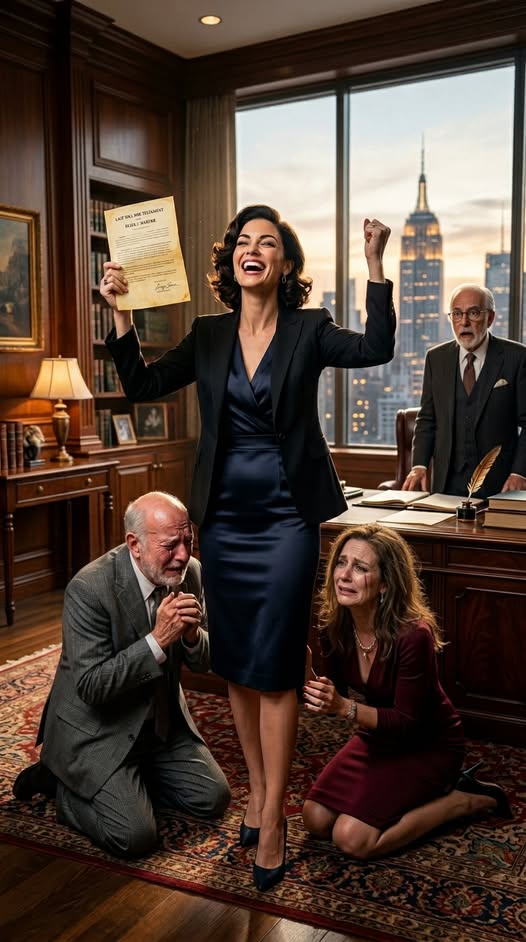
“The trust is ironclad, Paige,” he assured me. “Your father’s name isn’t on a single document. He doesn’t own that house. He never did. He just assumed he did because he’s Gerald Afton.”
Then, I called Cousin Rachel. She was the only one who still spoke to me in whispers.
“Paige, you have to know,” she said, her voice frantic. “Your dad is in deep. He co-signed everything for Meredith’s boutique. He refinanced their own house to keep her afloat. The boutique is failing, the bank is calling in the guarantees, and he owes nearly two hundred thousand dollars. He’s already found a buyer for the lakehouse for three hundred and twenty thousand. He told everyone you’d sign because you ‘owed him’ for the trouble you’ve caused.”
I felt a cold, sharp clarity wash over me. My father wasn’t just asking for a signature; he was asking me to fund his favoritism one last time, using my own inheritance to bail out the sister who had helped exile me.
Part IV: The Audit
On Friday morning, I drove back to the town I had fled. I walked into Mr. Brennan’s office carrying a Manila folder like a shield.
When I entered the conference room, I wasn’t surprised to find my father already there. He sat at the head of the table, looking every bit the bank executive—pressed shirt, expensive watch, a posture of absolute authority.
“Sit down, sweetheart,” Gerald said, his voice dripping with a calculated, patronizing warmth. “Let’s get this squared away. I know you’re busy with your… little life.”
I sat. I didn’t smile. I didn’t offer a greeting.
“You haven’t asked how I am, Dad,” I said quietly.
He waved a hand dismissively. “We’ve been through this, Paige. Your mother and I have tried to reach you, but given your… emotional state… we thought it best to handle this through professionals. The house has been sitting empty. Meredith’s business needs a bridge loan. This solves everything.”
Brennan slid the Quitclaim Deed across the table. My name was typed neatly at the bottom.
“And if I don’t sign?” I asked.
The mask slipped. Gerald’s jaw tightened. “Then we move to legal action. A judge will see that you’re being unreasonable. Don’t make this complicated, Paige. You’ve already embarrassed this family enough with your behavior over the last two years.”
“My behavior?” I leaned back. “You told the entire family I was mentally unstable because I wouldn’t give Meredith five thousand dollars.”
“We were concerned!” Gerald barked.
Suddenly, his phone buzzed on the table. He glanced at it, and before he could silence it, Meredith’s voice shrieked through the speaker.
“Dad! Did she sign it? The landlord is at the store with a lockout notice! Tell her to just sign the damn paper!”
Gerald scrambled to mute the phone, his face turning a deep, bruised purple. The silence that followed was deafening.
“She always caves when you play the ‘strong one’ card, doesn’t she, Dad?” I said, my voice steady as a heartbeat.
“Paige, listen—”
“No, you listen.” I opened my folder and slid the Irrevocable Trust Deed across the mahogany table. “This is a certified copy of the trust Grandpa Howard established seven years ago. The lakehouse was never part of his estate. It never passed through probate. It belongs to a trust of which I am the sole beneficiary.”
Brennan’s eyebrows shot into his hairline. He grabbed the document, his eyes scanning the pages with increasing franticness. Gerald reached for it, but Brennan held it back.
“Mr. Afton,” the lawyer whispered, his face pale. “If this is valid… you don’t have the right to sell this property. You don’t have the right to be in this room.”
Gerald’s hands began to shake. “That’s impossible. It’s my father’s house!”
“No,” I corrected him. “It’s my house. And I have already instructed Mr. Callaway to issue a formal vacate notice. You, Mom, and Meredith have seventy-two hours to remove your personal belongings from my property.”
Part V: The Shoreline of Peace
The fallout was spectacular and quiet, the way a controlled demolition often is.
Without the three hundred thousand dollars from the lakehouse sale, the house of cards my father had built for Meredith collapsed. The boutique closed its doors three weeks later. To cover the bank guarantees, Gerald had to liquidate his 401k and sell his beloved truck. The “respected banker” was forced to push his retirement back by a decade just to keep the roof over his own head.
The rumors changed then, too. When the extended family found out about the trust, the narrative of the “unstable daughter” didn’t hold water anymore. You can’t argue with a county filing. Aunt Linda called me, crying, apologizing for her silence. Cousin Rachel moved her family out to the lake for a weekend to help me scrub the floors.
My parents didn’t apologize. They couldn’t. To apologize would be to admit that I was never the “low-maintenance” child, but the one they had actively exploited.
I sent them one final letter. No lawyers, just my own handwriting.
“I am not writing this to punish you,” I wrote. “I am writing to set a boundary. The lakehouse remains in the trust. If you want a relationship with me, it starts with the truth. It starts with you seeing me as your daughter, not as an insurance policy for Meredith. My door is open, but only for those who walk through it with clean hands.”
They haven’t knocked yet. And that’s okay.
Yesterday, Daniel and I sat on the dock at Cedar Mill Road. He had spent the morning rewiring the old porch lights so they didn’t flicker. I sat in Grandpa Howard’s old green Adirondack chair, the wood warm against my back.
The lake was a mirror of silver and blue. I looked at my hands—rough from sanding, stained from the work of reclaiming what was mine. I wasn’t “the strong one” anymore. I was just Paige.
I finally understood what Grandpa Howard meant. He didn’t just give me a house. He gave me the permission to be loud, to be seen, and to finally, mercifully, be high-maintenance enough to demand the truth.
I cast my line into the water, the reel clicking in the quiet afternoon air. For the first time in my life, the only spin cycle I had to listen to was the gentle ripple of the lake against the shore. I was home. And this time, I had the keys.