Chapter 5: The Blue Crest: The reception hall was a minefield disguised as a celebration. The family table was positioned agonizingly close to the head table. Seated with me were Diane, Patricia, two aloof cousins perpetually glued to their smartphones, and my eighty-two-year-old grandmother, Martha, who surveyed the room with sharp, bird-like intelligence despite her dual hearing aids. The moment the salads were cleared, Diane initiated her campaign. She leaned toward Martha, speaking loudly enough for neighboring tables to eavesdrop. “Brooke’s new position in marketing is just thrilling,” Diane projected. “Of course, some children just rise when you provide the proper foundation. Kyle is a lucky man to marry a woman with such ferocious ambition.” I took a slow, calculated sip of ice water. I was a grandmaster at this game. I knew how to sit perfectly still while my mother casually narrated my insignificance. But Patricia was breaking script. She drained her third flute of champagne and slammed it onto the table. Her cheeks were flushed, her breathing erratic. Diane noticed the glitch in the matrix immediately. A flicker of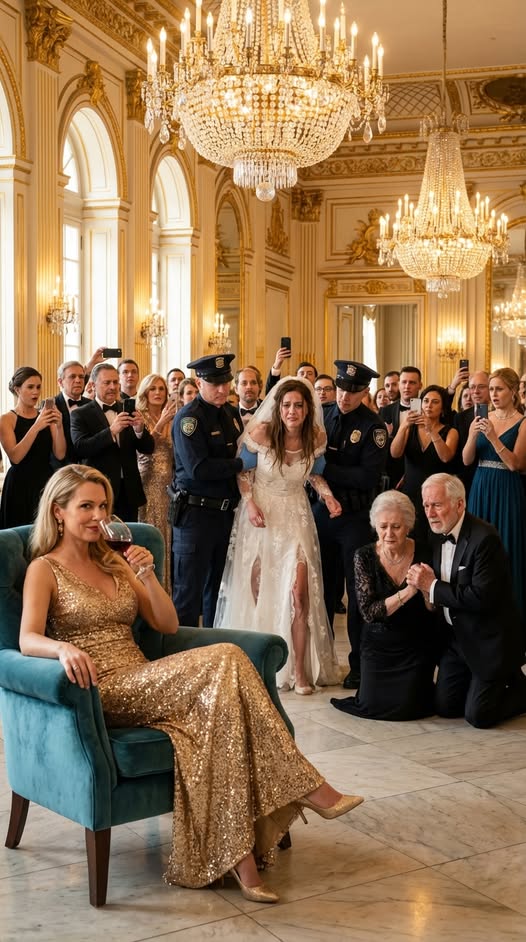
genuine panic crossed her otherwise placid features. “Patty, sweetheart, perhaps switch to sparkling water?” Diane suggested, her tone laced with a subtle threat. “I am perfectly fine,” Patricia said, her voice jagged and a decibel too loud. The cousins finally looked up from their screens.
A distant relative from Kyle’s side leaned across the table, unwittingly dropping a match into the powder keg. “So, Aacia, what are you up to? Brooke says you work in construction?”
Before my vocal cords could engage, Diane intercepted. “Oh, Aacia does administrative office work. It’s perfectly fine. Not everyone is genetically built for the fast track, you know? She’s much more of a behind-the-scenes personality.”
A stagehand in my own life.
I placed my water glass down. The condensation pooled against the linen. “I manage multi-million dollar commercial builds, Mom,” I said, my voice shockingly level. “I believe that constitutes a track.”
Diane waved her hand dismissively, an imperial gesture of invalidation. “You know what I mean. It’s not like Brooke’s high-pressure corporate environment.”
Suddenly, a sound like a gavel striking wood echoed across our table. It was Grandmother Martha. She had slammed her heavy silver fork against the table.
“Diane. Hush.”
The two words were delivered with lethal, freezing authority. Diane blinked, her mouth falling open in genuine shock. Martha, who had spent decades sending five-dollar birthday cards and avoiding conflict, glared at her eldest daughter with a look of profound, bone-deep exhaustion.
“Excuse me?” Diane stammered.
“You heard me,” Martha commanded. “Hush.”
The dynamic fractured. The polite hum of the surrounding tables faltered. Patricia, emboldened by our grandmother’s unprecedented strike, leaned forward, her eyes locking onto mine with terrifying intensity.
“You know she hid it, right?” Patricia’s voice was no longer slurred. It was crystal clear, vibrating with decades of repressed rage.
The table froze. Even the clinking of silverware ceased.
“Hid what?” I asked, a cold dread coiling in my gut.
“Your Columbia letter.” Patricia pointed a shaking finger at Diane. “You got in, Aacia. You were accepted at eighteen. I watched her take it from the mailbox. I watched her rip it open, and I watched her throw it in the trash.”
All the oxygen was sucked from the room. I slowly rotated my head toward the woman who had birthed me. I waited for the denial. I waited for the performance of a lifetime—the tears, the indignation, the furious accusations that Patricia was a drunk.
But Diane did none of those things. She set her wine glass down, reached up to meticulously adjust her pearl necklace, and offered that terrifyingly calm, dead-eyed smile.
“Oh, Patricia, you always were prone to hysterics,” Diane murmured.
“Did you throw away my acceptance letter?” I demanded. I didn’t yell. I didn’t need to. The quiet menace in my voice commanded the attention of everyone within a twenty-foot radius.
Diane met my gaze, calculating how much reality she would permit into her carefully curated world. She decided to lean into the cruelty.
“It was fourteen years ago, Aacia. And quite frankly?” Her smile widened, exposing teeth. “You wouldn’t have lasted a semester.”
A collective gasp rippled from the neighboring table. Martha pressed a trembling hand to her sternum. Patricia squeezed her eyes shut, weeping silently. Diane wasn’t apologizing; she was defending the assassination of my future as an act of maternal mercy.
Fourteen years of carrying a stone in my chest, believing I was defective. In an instant, the stone pulverized. I wasn’t inadequate. I had been sabotaged. The universe hadn’t said no; Columbia had said yes.
I reached down, unzipped my purse, and felt the heavy, textured paper of the envelope I had been carrying for two weeks. I pulled it out, placed it deliberately between my water goblet and Diane’s wine glass, and smoothed it flat against the tablecloth.
Columbia University. The Blue Crest. The address on West 116th Street.
“I applied to Columbia’s School of General Studies six months ago,” I said, my voice adopting the exact, clinical tone I used when a concrete pour was four hours late and millions of dollars were on the line. “On my own. With my own money. Behind your back.”
I unfolded the thick parchment so the golden seal caught the light of the chandeliers.
“And I got in.”
The silence that followed was absolute. It was the sound of a paradigm shifting, of a meticulously crafted illusion shattering into a million jagged pieces. I watched the light behind Diane’s eyes short-circuit. Her gaze flicked frantically from the crest, to my name printed in bold ink, and back to my face. The smirk vanished, replaced by the naked, horrifying realization that she had lost absolute control.
“You stole my first chance,” I told her, leaning in so she could smell the absolute absence of my fear. “But you will not touch this one.”
Chapter 6: The Unraveling
Diane recovered with the desperate agility of a cornered predator. She sat ramrod straight, smoothed the lapels of her ivory jacket, and deployed her ultimate, final weapon: victimhood.
“You are ruining your sister’s wedding,” she hissed, her voice vibrating with a frantic, serrated edge. “This is exactly why I tried to protect you from yourself. You always make a scene.”
“No, Diane,” Patricia interjected, her voice raw but unyielding. “You made it a scene when you stood at that microphone and bragged about your ‘greatest achievement’ while your other daughter sat right here. She earned this. You stole it. Own it.”
The murmur of the reception had shifted from polite conversation to blatant, transfixed voyeurism. A hundred and twenty people were recalibrating their understanding of the elegant woman in the pearls.
Suddenly, Brooke appeared at the edge of the table. She had gathered the massive train of her white dress over one arm. Her new husband, Kyle, stood a half-step behind her, radiating the uncomfortable energy of a man who realized he had just married into a warzone.
“Is it true?” Brooke’s voice was a thin, stretched wire. “Mom? Did you throw her letter away?”
Diane reached out, her fingers grasping the air near Brooke’s lace sleeve. “Sweetheart, please, let’s not let Aacia’s jealousy taint your beautiful day—”
“Did you do it?” Brooke shouted, the sound echoing off the vaulted ceiling.
Diane’s jaw clenched. “I did what was necessary for the stability of this family.”
The admission hung in the air, a toxic cloud. Brooke stumbled backward, as if physically struck. She turned her wide, tear-filled eyes toward me.
“You got into an Ivy League school at eighteen?” Brooke choked out. “She told me you didn’t even bother applying anywhere. She told me… she told me you were happy being ordinary.”
I let the word ‘ordinary’ hang between us. I let Brooke hear the full, unvarnished echo of our mother’s manipulation falling from her own lips.
“I wasn’t happy, Brookie,” I replied softly, my heart aching for the sudden destruction of her innocent worldview. “I just didn’t know I was allowed to leave.”
Brooke clamped a hand over her mouth, her shoulders shaking violently. Kyle immediately stepped forward, wrapping a protective arm around her waist, shooting me a brief, solid nod of solidarity.
“I am leaving,” Diane announced abruptly. She snatched her cream-colored clutch from the table, rising with manufactured, tragic dignity. “You have all made your choices. When you are ready to apologize to me, you know my number.”
She expected a chorus of apologies. She expected us to beg her to stay, to validate her perceived martyrdom. Instead, Grandmother Martha delivered the final blow.
“Sit down, Diane,” Martha commanded.
Diane froze, her hand hovering over the back of her chair, looking at her elderly mother with the panicked expression of a child caught stealing.
“Sit down,” Martha repeated, her voice brooking no argument, “and listen to the daughter you tried to bury.”
Slowly, agonizingly, Diane sank back into her seat. Her empire had fallen.
I looked at the woman who had architected my misery, and I realized I didn’t feel rage. I felt a profound, liberating emptiness.
“I’m not asking for an apology, Mom,” I said, folding the Columbia letter and returning it to the safety of my purse. “I know you don’t have the capacity for one. I just needed you to look at me and know that you didn’t stop me. You only delayed me. And your delay is over.”
I turned to my sister, who was weeping silently against her husband’s chest. “I love you, Brooke. This is your night, and I refuse to let her poison it any further. I’m going to stay for your first dance, and then I am going to leave.”
Brooke nodded fiercely, reaching out to squeeze my hand.
Later, as Etta James’s “At Last” crooned through the speakers and Brooke swayed with Kyle under the amber string lights, Patricia materialized beside me. She smelled of coffee now; the shock had sobered her completely.
“I should have told you years ago,” Patricia confessed, watching the dancers. “She threatened to cut me out of the family. She said she’d convince everyone I was having a psychotic break.”
“It’s over, Patty. I know now.”
Patricia laughed—a sharp, bitter sound. “Do you want to know the ultimate irony, Aacia? The thing that makes this all make sense?” She leaned in close, her eyes hard. “Your mother applied to Columbia when she was eighteen. She was rejected. I found the letter hidden in her dresser. She burned it, and then spent the rest of her life pretending she was too good for them.”
I looked across the room. Diane sat utterly alone at the massive family table, staring blankly at the expensive floral centerpiece, isolated on the island of her own making. For the first time in thirty-two years, I didn’t see a monster. I saw a deeply wounded, pathetic woman who had cannibalized her own child’s future to soothe her own bruised ego.
I didn’t say goodbye to her. I walked out into the crisp, cool October night, the gravel crunching beneath my heels. Sitting in the driver’s seat of my car, I pulled the letter out one last time. Under the weak amber glow of the dome light, the blue crest looked like a promise.
I put the car in drive, and I drove toward my life.
Chapter 7: The View from Morningside Heights
The fallout did not explode; it seeped into the bedrock of our family tree like groundwater.
Within forty-eight hours, Grandmother Martha had systematically dialed every aunt, uncle, and cousin, acting as the unrelenting town crier of Diane’s sins. Diane was quietly but firmly removed from her throne as the family matriarch. The annual holiday planning committees were reformed without her. She wasn’t excommunicated, but she was repositioned to the margins—the exact psychological real estate she had forced me to occupy for decades.
Brooke and I spoke for two hours on the phone days later, dismantling years of fabricated rivalries. I was her trophy, Brooke had sobbed, the realization still raw. But you’re still her daughter, I told her.
Now, it is August. The heavy iron gates of Columbia University loom above me at Morningside Heights.
I stand on the pavement with a lanyard around my neck, surrounded by eighteen-year-olds buzzing with frantic, unearned confidence, and a cohort of fellow General Studies students—veterans, single parents, line cooks—who carry the quiet, heavy grace of people who fought tooth and nail for a second chance.
During orientation, an academic advisor stood at the podium, looked at our diverse, aging crowd, and said the words I had waited half my life to hear:
You belong here. That is why we admitted you.
During my first week of classes, a letter arrived at my apartment. The handwriting was Diane’s—the familiar, slanted cursive that had penned grocery lists and endorsed my community college fate. I read it on my sofa. It was a masterclass in narcissistic defense mechanisms. She wrote of “sacrifice” and “hard choices” and “keeping the family together.” She never once wrote the words I am sorry. Her postscript was the ultimate tell: P.S. I received some of your university mail forwarded here by mistake. I didn’t open it this time.
As if basic restraint was a substitute for remorse. I didn’t burn the letter. I didn’t reply. I placed it in a filing cabinet, closed the drawer, and walked to my seminar on American Political Thought.
I am thirty-two. I am managing a full academic load at an Ivy League institution while balancing my construction projects remotely. I drink too much coffee, I study on the subway, and I have never been more exhausted.
But last night, sitting at the very same kitchen table where I once surrendered my dreams, I opened my portal to check my first-semester grades.
A 3.7 GPA. Dean’s List.
I took a screenshot and sent it to Brooke, who responded immediately with a barrage of celebratory emojis. I didn’t send it to Diane. I had sent her an email months ago, setting an absolute boundary: When you can admit what you stole without making yourself the victim, my door is open. Until then, do not contact me.
She hasn’t replied. She likely never will. And I have found a profound, quiet peace in that silence. Because the girl who stuffed crumpled tip money into an envelope all those years ago finally knows the truth. The only person who possesses the authority to determine your ceiling is you.
I am looking at mine now, and it is made of glass, and it is already shattering.