I did not tell anyone I was coming home. It wasn’t because I wanted to orchestrate a heartwarming surprise. It was because, technically speaking, I wasn’t supposed to exist right now. I was on unofficial medical leave from a classified intelligence unit. The kind of leave where your name gets scrubbed from the active rosters, and if you bleed out in the middle of nowhere, the agency politely pretends they never knew you. I pulled my nondescript sedan up to my parents’ suburban house just before noon. I let the engine idle for a second longer than necessary, my hands gripping the steering wheel as I surveyed the front yard. Two massive catering vans were parked on the lawn. A pristine white event tent was being erected over the back patio, and a florist was arguing vehemently with a delivery driver about the arrangement of white hydrangeas. Right. The wedding. I stepped out of the car slowly. It wasn’t fatigue that slowed my movements, but the sharp, biting pull of the surgical stitches hidden beneath my heavy jacket. The shrapnel wound sat low on my abdomen, tightly bound and heavily bandaged. “Light duty,” the medical officer had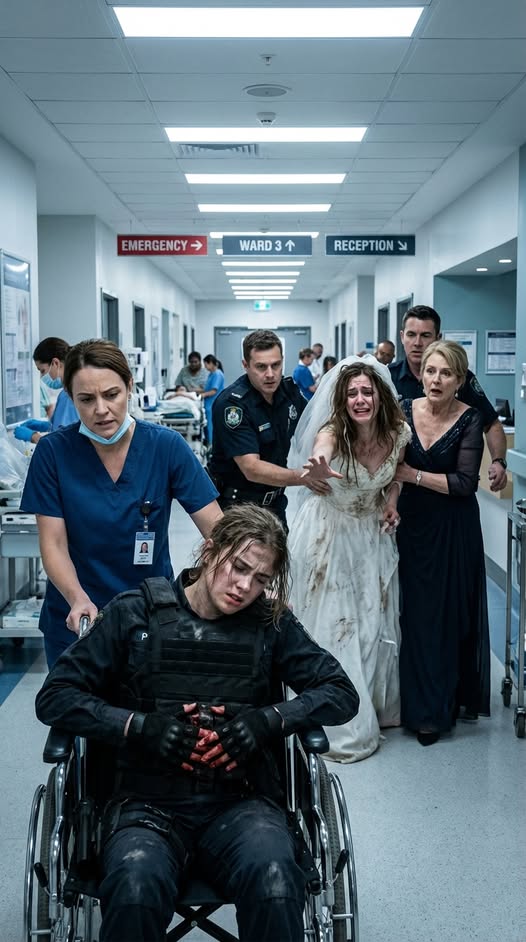
said. Apparently, dragging my own broken body across state lines qualified as light duty. I grabbed my canvas duffel from the back seat and walked toward the front door. It was unlocked. Of course it was. Nothing valuable ever went missing in this neighborhood—unless you counted the people.
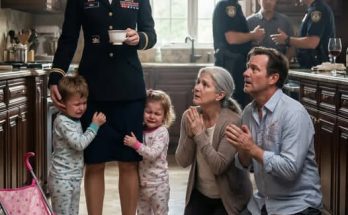
The moment I stepped inside, a wall of noise hit me. Overlapping voices, the clinking of fine china, and upbeat pop music blaring from a Bluetooth speaker. My mother, Barbara, stood in the center of the kitchen, aggressively directing two hired caterers. My father, William, was pacing near the bay window, barking into his cell phone about a delayed ice sculpture.
And in the center of the living room, standing on a small pedestal like the main event she believed herself to be, was my sister, Jessica. She wore a white silk robe, her hair half-pinned, surrounded by an orbit of bridesmaids and garment racks.
I stood in the entryway for a full ten seconds. No one noticed.
Then, Jessica casually glanced over her shoulder. Her eyes landed on me. She didn’t smile. She didn’t gasp. She looked at me the way one looks at mud tracked onto a clean white rug.
“Oh. You’re here,” she said flatly.
I set my bag down against the wall. “Yeah. I got leave.”
She frowned, her manicured fingers adjusting the lapel of her robe. “Didn’t realize I needed to schedule my bridal fittings around your mysterious work trips.”
She didn’t take the joke. She never did. “Can you not do this today, Morgan?” she sighed, turning back to the full-length mirror. “Everything is already absolute chaos.”
My mother finally turned from the caterers. There was no motherly warmth in her eyes, no relief at seeing her daughter alive. Just sheer irritation. “Morgan, really. You could have at least called. We have a full house and zero spare rooms.”
I nodded slowly, swallowing the metallic taste of exhaustion in my mouth. “Yeah. I can see that.”
No one asked why I was deathly pale. No one asked why I was standing stiffly, as if my muscles were locked in a desperate attempt to keep my insides together. No one cared. Jessica mattered. The dress mattered. The aesthetic mattered.
“Actually,” Jessica snapped her fingers, suddenly remembering I had hands. “Since you’re just standing there, you can help. Those boxes by the stairs need to go up to the guest room. Shoes, accessories, some of the early crystal gifts. Don’t drop them.”
I looked at the heavy stack of cardboard boxes, then back to my sister. Saying no would have sparked a screaming match, and I didn’t have the physical or mental bandwidth for a suburban war. Not today.
“Sure,” I muttered.
I grabbed the first box. It wasn’t incredibly heavy, but the moment I lifted it, something deep inside my abdomen shifted. A sharp, burning tear. I gritted my teeth, ignoring the wet warmth blossoming under my bandages. I carried it up, set it down, and came back for the second.
By the third trip, the pain wasn’t subtle anymore. It was a vicious, blinding agony, radiating outward like shattered glass. I paused at the bottom of the stairs, my hand pressing hard against my side, trying to regulate my breathing.
“Are you seriously taking breaks already?” Jessica’s voice cut through the room like a scalpel. She was staring at me with pure disgust.
“I just got here,” I managed to whisper.
“And you’re already acting like you’re dying,” she shot back. “Can you not be dramatic for five minutes?”
I picked up the final box. Halfway up the staircase, my vision blurred. The edges of the world went dark. I blinked hard, set the box on the landing, and turned to go back down.
That’s when the internal dam broke.
It wasn’t a sharp stab this time. It was a slow, heavy drop inside my body. A catastrophic release of pressure. My grip on the oak railing failed. My legs turned to lead. The world violently tilted, and I collapsed onto the hardwood floor, cold sweat instantly soaking through my shirt.
“Jessica,” I gasped, my voice barely a rattle. “I think… something’s wrong.”
She didn’t rush over. She just stared up at me from the living room, annoyed. “What now, Morgan?”
“I need… a hospital.”
The room went entirely silent. Jessica crossed her arms, her face twisting into a mask of pure fury as my consciousness began to slip away into the dark.
“You have got to be kidding me,” she hissed, reaching for her car keys. “You are unbelievable.”
I don’t remember the walk to the car. I remember the harsh slam of the passenger door. I remember the agonizing pressure of the seatbelt against my bleeding torso.
“You better not make a scene at the ER,” Jessica spat, keeping her eyes glued to the road as she sped through the suburban streets. “I don’t have time for this, Morgan. Every time something important happens for me, you pull some stunt to steal the attention.”
I rested my head against the cold glass. Everything felt muted, like I was submerged underwater. “I’m not… making a scene,” I breathed.
“Yeah, well, that’s all you ever do.”
The hospital emerged through the blur of my fading vision. Bright, sterile lights. Jessica parked at the emergency drop-off, marched around the hood, and yanked my door open. “Don’t make me drag you.”
She half-pulled, half-carried me through the automatic sliding doors. The ER was a chaotic symphony of alarms, coughing patients, and rushing staff. We approached the triage desk. A seasoned triage nurse looked up, her eyes immediately scanning my pale, sweating face. Her name tag read Claire.
“Hi, what’s going on?” Claire asked professionally.
Before I could open my mouth, Jessica stepped in front of me. “She’s just being dramatic. Probably an anxiety attack. She does this for attention.”
Claire frowned, leaning around my sister to look directly at me. “Ma’am, can you tell me what you’re feeling?”
“Pain,” I choked out. “Abdomen. Can’t… breathe.”
Claire’s posture changed instantly. The casual triage demeanor vanished, replaced by sharp, clinical focus. “Okay. We’re going to get you a bed right now.”
“No, wait,” Jessica interrupted, holding up a hand. “You do not need to rush her back like she’s dying. She’s jealous because my wedding is in two days. Let her wait. Seriously, it’s not urgent.”
Claire’s eyes snapped to Jessica, flashing with disbelief. “Ma’am, she does not look stable.”
Jessica leaned over the desk, lowering her voice. “Trust me. Just let her sit in the waiting room for a while. She’ll get over it.” Without another word, Jessica grabbed my arm, shoved me into a hard plastic chair against the wall, checked her reflection in her phone screen, and walked out of the sliding glass doors. She didn’t look back once.
I was left alone, bleeding out in a plastic chair.
My vision began to tunnel. The cold plastic dug into my spine. I was slipping somewhere dark, somewhere I couldn’t navigate.
“Hey. Stay with me.”
Claire was suddenly kneeling in front of me. She pressed two fingers to my wrist, checking my pulse. Her face tightened. “What’s your name?”
“Morgan.”
“Morgan, any recent trauma or injury to the abdomen?”
I hesitated. I wasn’t supposed to say it. But survival protocol overrides secrecy. “Yes.”
Claire stood up instantly, shouting toward the back doors. “I need a gurney out here now! Trauma protocol!”
Before the gurney could reach me, the automatic doors slid open again. Heavy, familiar footsteps. My father, William, and my mother, Barbara, stormed into the waiting room. They didn’t look worried. They looked furious.
“What is the meaning of this?” my mother demanded, glaring at me.
Claire stepped between us. “Are you her parents? Good. She needs immediate emergency evaluation. Her vitals are crashing. She’s tachycardic and her pressure is dropping fast. I need consent for an immediate CT scan and emergency surgical intervention.”
My father crossed his arms, his jaw set in a hard line. “How much is that going to cost?”
Claire blinked, stunned. “Sir, that is not the priority right now. She could be bleeding internally.”
“She’s not,” my mother snapped, waving a dismissive hand. “She does this every time there’s a family event. We are not authorizing thousands of dollars in unnecessary tests because she wants to ruin her sister’s wedding week.”
Claire looked at me. “Morgan, can you consent for yourself?”
I tried to speak. My lips moved, but my lungs refused to push the air out. The world tilted violently.
“She is unresponsive,” Claire said, her voice rising in panic and anger. “I need you to sign this authorization.”
“No,” my father said flatly. The word dropped like an anvil. “Give me the AMA form. We are refusing treatment. Put her on an IV drip if you have to, but nothing major.”
Claire stared at them in utter horror. “If you sign a refusal of care in this state, she could die.”
“She’ll be fine,” my father replied coldly, signing the clipboard without a second of hesitation. He handed it back. “Call us if she actually stops breathing. We’re late for the rehearsal dinner.”
They turned and walked out. Just like Jessica.
Claire watched them go, her jaw trembling with rage. She immediately grabbed my shoulders as the gurney arrived. They hoisted me up, the movement tearing a scream from my throat.
“I know, I know,” Claire whispered, running alongside the bed as they rushed me into a trauma bay. “Stay with me, Morgan. Don’t go to sleep.”
The monitors were hooked up. The frantic beeping echoed in my ears. But it was slowing down. Too slow.
“Pressure is plummeting!” someone yelled.
My body felt incredibly heavy, sinking into the mattress. The edges of my vision went entirely black. I knew what was happening. Hypovolemic shock. Total system failure. I couldn’t move my arms. I couldn’t speak.
But beneath the fading consciousness, my military training flared to life. You are not done. With the last microscopic ounce of willpower I possessed, I forced my right hand to slide down to the reinforced seam of my tactical jacket. My fingers found the hidden, raised ridge. I pressed hard, popping the hidden compartment open.
Inside was a cold, flat device. A subcutaneous emergency beacon. Issued only for one scenario: You are about to be killed, and the agency needs to know exactly where to send the cavalry.
As the heart monitor beside my head let out a single, continuous, terrifyingly flat tone, my thumb found the recessed button, and I pressed down until the plastic cracked.
I didn’t hear the click of the device. I didn’t need to. The internal mechanism shattered exactly as designed, sending an encrypted, untraceable, priority-zero distress signal to a satellite orbiting three hundred miles above the earth. The device instantly fried its own circuitry, going dead in my palm.
I let it slip from my fingers. My hand fell limp off the side of the gurney. The monitor’s continuous, flat shriek dominated the room.
“Code Blue!” Claire’s voice shattered the clinical silence. “Get in here now! Starting compressions!”
The physical impact on my chest was brutal, rhythmic, and distant. I felt the electric jolt of the defibrillator lift me off the bed, followed by the sickening thud of my back hitting the mattress.
“Still no pulse! Charge again! Clear!”
Nothing. I was drifting rapidly into the void, untethered from the pain, untethered from the betrayal.
Miles away, in a subterranean facility with no windows and heavily armed guards, a wall of monitors flickered. One screen abruptly flashed crimson red.
VIPER 1: CRITICAL STATUS. LOCATION CONFIRMED. CIVILIAN HOSPITAL.
Chairs were violently pushed back. Operators moved with terrifying efficiency. There was no bureaucracy. No waiting for a chain of command.
“Confirmed signal source,” a voice barked. “Scramble the extraction team. Override all local air traffic protocols. Move!”
Back in the ER, the chaos around my lifeless body reached a fever pitch. Claire was sweating, refusing to step away from my chest. “Come on, Morgan. Don’t you dare quit on me.”
Then, the ambient noise of the hospital began to change.
It started as a low, deep vibration rattling the glass vials on the metal trays. Then, it became a deafening, rhythmic thunder. The heavy, unmistakable thwack-thwack-thwack of military-grade rotor blades cutting through the suburban night sky.
In the trauma bay, the doctors paused for a fraction of a second, looking up at the ceiling. “What the hell is that?” a resident muttered.
“Keep compressing!” Claire screamed.
The automatic doors of the ER didn’t just slide open; they were physically forced apart. A tactical team clad in unmarked black tactical gear flooded the emergency room. They moved with absolute, terrifying precision, securing the perimeter in seconds.
At the helm was Director Vance Hayes. He didn’t look like a man who asked for permission. He looked like a man who ended wars.
He marched straight into my trauma bay, ignoring the screaming hospital administrator trailing behind him.
“Where is she?” Hayes demanded.
“She’s in cardiac arrest!” Claire yelled over the noise. “You can’t be in here!”
“We’re taking over,” Hayes stated, his voice absolute zero.
“No!” Claire positioned herself fiercely over my body. “Not while I’m trying to save her!”
Hayes looked at her, noting her fierce dedication. He stepped forward, pulling a gold-shielded identification card from his jacket and slamming it onto the metal counter.
“She does not belong to you,” Hayes said, his voice echoing over the flatlining monitor. “And she no longer belongs to her family. She is a classified national asset. Prepare her for immediate transport.”
The hospital director stared at the credentials, his face draining of color. He stepped back instantly.
Hayes’s medical team swarmed the bed, seamlessly taking over compressions and securing a portable life-support rig. They didn’t ask for paperwork. They didn’t wait for a discharge form. They lifted my body, surrounded me in a tactical diamond formation, and rushed me out of the hospital doors.
Outside, the sheer force of a Black Hawk helicopter’s downdraft whipped the hospital parking lot into a frenzy. They loaded me into the belly of the beast, the doors slammed shut, and the aircraft pitched violently into the sky, leaving the bewildered civilian hospital entirely in the dark.
For days, I existed only in fragments. Flashing lights. The smell of sterile titanium. The quiet hum of secure medical machinery.
When I finally opened my eyes, the world was perfectly still. I was lying in a secure, subterranean medical suite. My abdomen throbbed with a dull, manageable ache, tightly bound with advanced surgical wraps.
The door opened silently. Director Hayes walked in, his expression unreadable. He placed a thick, heavy manila folder on the metal table beside my bed.
“You’re awake,” he said simply. “Surgery went clean. You died on that table for exactly three minutes. Welcome back.”
“Thanks,” I rasped, my throat feeling like sandpaper. I looked at the folder. “What’s that?”
Hayes didn’t mince words. “Cyber division cracked the local networks. We looked into your family. We found out exactly why they left you to die.”
He pushed the folder toward my hand. “It wasn’t just neglect, Morgan. It was a cover-up.”
I stared at the thick manila folder for a long moment before my trembling fingers reached out to open it.
The silence in the secure medical suite was absolute. Director Hayes stood by the wall, hands clasped behind his back, giving me the space to process the betrayal.
I flipped open the heavy cover. The first page was a master ledger. Bank statements. Offshore routing numbers. Investment portfolios.
But they weren’t mine. Or rather, they were mine, but I had never seen them before.
“That’s four years of forensic financial analysis,” Hayes said, his voice devoid of pity, offering only cold facts. “While you were deployed on black ops, legally a ghost to the civilian world, someone was heavily utilizing your identity.”
I turned the page. My eyes scanned the highlighted columns. Massive sums of money—my combat hazard pay, my military disability benefits from a previous injury, my automated investments—had been systematically drained, routed through dummy accounts, and spent.
“Who?” I asked, though my gut already knew the answer.
“Your sister, Jessica, initiated eighty percent of the transactions,” Hayes replied. “Your parents, William and Barbara, signed the authorizations for the rest. They forged your signature on legal power-of-attorney documents, claiming you were incapacitated abroad.”
I stared at the receipts. High-end luxury cars. First-class vacations. Designer clothing. And most recently, hundreds of thousands of dollars paid to elite catering companies, florists, and a historic cathedral venue in the city.
They had funded their entire aristocratic, suburban facade using my blood money.
“They intercepted your physical and digital mail,” Hayes continued. “They created a perfect, hermetically sealed bubble. You were their personal bank.”
I closed the folder slowly. The physical pain in my gut was entirely eclipsed by the icy, calculating realization taking hold in my brain.
“The ER,” I whispered, the puzzle pieces violently locking into place. “That’s why they refused the CT scan. That’s why they wanted to put me in the waiting room.”
“Yes,” Hayes nodded. “If the hospital admitted you, if they saved you, you would have been medically discharged. You would have returned to civilian life permanently, regained control of your assets, and discovered the fraud. By signing the ‘Against Medical Advice’ form, they weren’t just being cheap.”
Hayes met my eyes, his gaze piercing. “They were murdering you by weaponized neglect. If you died in that waiting room, the money stays theirs. The secret stays buried.”
I leaned back against the stark white pillows. The revelation didn’t make me cry. It didn’t make me scream. It burned away every lingering trace of familial loyalty, leaving behind a cold, structural void. They had looked at their bleeding daughter, their sister, and calculated that a wedding was worth more than her heartbeat.
“What are my options?” I asked, my voice steady.
“Legally? We hand this over to the DOJ. Full federal prosecution. Wire fraud, identity theft, attempted manslaughter. They go to federal prison quietly.” Hayes tilted his head. “But you didn’t ask me for the legal route, did you?”
“No,” I said, looking down at my hands. “Quiet is what they want. They built their entire lives around their public image. If they go away quietly, they spin the narrative. They play the victims of a tragic misunderstanding.”
I looked up at Hayes. The tactical commander inside me, the one who had survived behind enemy lines for years, took the wheel.
“I want to dismantle them,” I said softly. “I want them to lose everything, publicly, in front of the exact people they stole my money to impress.”
Hayes didn’t blink. “The wedding is in two weeks. What do you need?”