We sat in the quiet stairwell for a long time. But the fragile peace we were attempting to build was about to be threatened by a ghost from Sarah’s nightmare. Recovery was not a cinematic montage accompanied by uplifting music. It was brutal, exhausting, highly practical work. I officially paid Sarah’s back rent to stop the eviction process. I bought all three children high-quality, insulated winter coats and waterproof boots. I sat awake at 3:00 AM with little Noah, placing cool washcloths on his forehead through his fever dreams. I brought Chloe to my auto garage on Saturdays, where she set up a desk in my office, did her homework, and ruthlessly bossed my mechanics around, much to their amusement. When Sarah was finally discharged from the hospital, she broke down and wept at the sight of a fully stocked pantry, a warm apartment, and new mattresses for her boys. We were slowly, carefully weaving a life together. But that fragile peace was violently shattered on a rainy afternoon in late April. I was pulling the heavy metal bay doors of the garage shut for the evening. Chloe was sitting in my office doing math homework. As I
turned the key in the padlock, a battered, lifted black pickup truck aggressively jumped the curb and slammed into park right in front of the shop. The driver rolled down his tinted window. He was a heavyset man, his face flushed red, his eyes mean, calculating, and clouded with the distinct glaze of cheap whiskey. I knew his ugly face instantly from an old photograph Sarah had shown me. It was Martin. The abusive ex-husband. The monster who had fathered the boys. “You Daniel Mercer?” Martin sneered, spitting a wad of tobacco onto the wet asphalt. “I heard through the
grapevine my ex-wife found herself a new sugar daddy. I just came to pick up my boys.” My body went completely, lethally still. Every protective instinct I possessed flared into overdrive. I slowly wiped the grease off my hands with a rag.
“You don’t come anywhere near that apartment, Martin. And you certainly don’t come near my shop.”
“Last I checked, pal, you don’t make those calls,” Martin laughed, a wet, ugly sound, as he shoved open his door and stepped out of the truck. He was big, but he was sloppy. “Kids are incredibly expensive. You think because you run a little grease-monkey shop and got some cash, you can play hero? Those boys belong to me.”
“I think,” I said, taking a slow, measured step forward, directly invading his personal space, “that because I have a highly paid corporate lawyer, twelve years of medical records documenting the severe physical abuse you put Sarah through, and a state social worker actively investigating your abandonment, you are about one bad decision away from a maximum-security prison cell.”
Martin’s smug smile vanished instantly. He puffed up his chest, trying to use his size to intimidate me, but I didn’t blink. He realized very quickly that I wasn’t a man who bluffed. I was a father protecting his pack.
He spat on the curb again, his eyes narrowing in hatred, and climbed back into his rusted truck.
“This ain’t over, Mercer,” he threatened, revving the engine loudly. “I know my rights.”
“It is over if you want to stay out of a cage,” I replied, staring him down as he peeled away into the Chicago traffic.
But I knew violent, controlling men like Martin. He wouldn’t just stop and walk away gracefully. He would try to extract a price. He would use the boys to terrorize Sarah. I had to permanently, legally sever his control over Sarah and the children, or we would never truly be safe.
The next two months became a relentless, brutal, highly expensive war of paperwork.
I hired the most ruthless, terrifying family law attorney in Chicago. We filed for immediate emergency protective orders. We submitted a mountain of decade-old hospital records meticulously documenting Martin’s domestic violence. We weaponized the sworn testimony of the school counselor regarding the boys’ severe, life-threatening neglect while they were theoretically under his “care.”
Martin showed up to the final custody hearing in a cheap, ill-fitting suit, smelling strongly of stale beer, cheap cologne, and unearned arrogance. He thought he could charm the judge.
He was wrong.
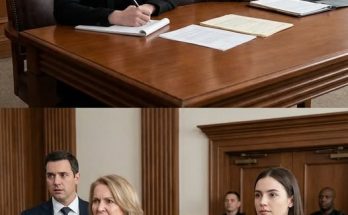
Under my lawyer’s vicious, surgical cross-examination, Martin contradicted his own timeline three separate times, aggressively attempting to paint Sarah as an unstable, drug-addicted mother. He lost his temper on the stand, slamming his fist on the railing.
The judge, a stern woman who had clearly seen right through him from the moment he walked in, wasn’t having a second of it.
Martin’s petition for visitation was permanently, irrevocably denied. His parental rights were effectively suspended. He was legally ordered to undergo intensive psychological assessment, prove two continuous years of absolute, documented sobriety, and pay a staggering mountain of back child support before he could even petition the court to request a single, supervised phone call.
Martin exploded. He screamed vicious profanities at the judge, at Sarah, and at me on his way out of the courtroom, fighting the bailiffs until he was dragged out in handcuffs for contempt of court.
Outside the quiet, marble courthouse, Chloe grabbed my hand. She exhaled so deeply and so hard that her small body seemed to physically shrink in relief. The dark, terrifying hallway of their past was finally closed. The doors to their future were finally thrown wide open to the light.
Summer arrived, burning away the bitter, lingering Chicago cold.
Sarah grew stronger every single day, the color returning to her cheeks. I helped her secure part-time bookkeeping work from home, allowing her to rebuild her independence. Chloe, no longer burdened with the impossible weight of keeping her family alive, blossomed. She passed all her middle school classes with flying colors and joined a soccer league.
I didn’t try to buy their love. I just kept showing up. I wasn’t a savior; I was just a constant, unshakable, boringly reliable presence in their chaotic world.
In October, I made a major move that cemented our new reality. I signed the lease on a spacious, sunlit, three-bedroom duplex in a safe, quiet neighborhood with good schools, right near my sister’s house. I signed the lease in Sarah’s name, paying the first full year of rent in advance so she would never have to fear the threat of an eviction notice again.
On the very first night in the new house, after the children were finally asleep in their own warm beds, Sarah walked out to the back patio. I was sitting on the wooden steps, drinking a beer, listening to the crickets.
“You gave us all of this,” Sarah said, her voice thick with heavy emotion, gesturing to the illuminated windows of the safe house.
“No,” I replied, looking out at the quiet, peaceful street. “I just opened a door. You survived the darkness long enough to walk through it.”
She sat down closely beside me, folding her arms against the crisp, pleasant autumn chill. She leaned her head against my shoulder. “I don’t expect you to forgive me all at once, Danny. I kept your child from you. That’s a sin I have to live with.”
“You’re not getting my forgiveness all at once,” I admitted honestly, wrapping an arm around her. “I lost twelve unrecoverable years of my daughter’s life. I can’t pretend that didn’t happen, and I can’t pretend it doesn’t hurt. But I also found her. And I found the boys. And somewhere in the middle of all this incredible wreckage, I found you again.”
I turned to meet her stormy gray eyes in the moonlight. “I’d like to see what that means for us, if you’re brave enough not to run away this time.”
Tears spilled over her cheeks, catching the porch light, but she smiled radiantly through them. “I’m so incredibly tired of running, Danny.”
“Good,” I said.
And then, I kissed her. It wasn’t the reckless, electric, desperate kiss of our youth. It was slower, deeper. It was anchored in survival, carrying silent apologies, faded anger, and the fierce, undeniable tenderness of two people who had hit absolute rock bottom and still consciously chose to reach out for each other.
From the second-story window directly above us, Chloe’s voice floated down through the open screen. “I can totally hear you guys out there, you know! Gross!”
Sarah and I burst out laughing, breaking the emotional tension. “Go to sleep, kiddo!” Sarah called back up.
“Goodnight, Mom,” Chloe answered. Then, after a short beat of silence that felt like a lifetime of absolute grace, she added: “Goodnight, Dad.”
I closed my eyes, a single tear slipping free. The word entered my soul like brilliant sunlight bursting through a locked, dark door.
Exactly one year to the day after the incident that changed our lives, the five of us returned to Hayes’ Market.
We didn’t go because we needed groceries. We went because Chloe demanded it.
She walked through the automatic doors wearing brand-new, waterproof winter boots and a bright red denim jacket. She radiated an unguarded, joyful confidence that still made my chest swell with immense pride every time I looked at her.
She walked directly up to the front counter where Kevin was working the register. She didn’t flinch. She set down two heavy cans of powdered milk, along with a crisp, brand-new twenty-dollar bill.
Kevin’s face went completely white with recognition and shame. “Look, kid… you don’t owe us—”
“I know I don’t,” Chloe smiled, her gaze perfectly steady, mature, and remarkably kind. “But I wanted to pay my debt anyway. Keep the change.”
Mr. Hayes, standing near the lottery machine, pulled off his glasses and wiped them with suspicious, aggressive vigor. I looked away to give the proud, kind old man his privacy and dignity.
As we walked out into the crisp, beautiful spring air, Chloe slipped her small hand confidently into mine.
“Can I ask you something?” she asked, looking up at me, squinting in the sun.
“Anything in the world.”
“If you hadn’t followed me that day in the snow… what do you think would’ve happened to us?”
I stopped walking. I looked out at the bustling, noisy Chicago street, at the hundreds of people rushing by, all carrying the heavy, invisible weights of their own secret lives. Then I looked down at my brave, beautiful, resilient daughter.
“I think,” I said carefully, squeezing her hand, “that the world would’ve stayed cruel just a little bit longer. But we would have found each other eventually. We were always supposed to.”
She thought about that for a moment, then nodded, leaning her head against my arm as we walked. Ahead of us, Sarah turned back, laughing a bright, musical laugh as little Leo chased Noah down the sidewalk toward my parked truck.
It was noisy. It was highly imperfect. It was incredibly, brutally hard-won.
It was family. And this time, I wasn’t going to let it pass me by for anything in the world.
If you want more stories like this, or if you’d like to share your thoughts about what you would have done in my situation, I’d love to hear from you. Your perspective helps these stories reach more people, so don’t be shy about commenting or sharing.