Chapter 1: A Casket of White Roses: I awoke with the cloying, nauseating stench of lilies and formaldehyde trapped deep within the back of my throat. I did not open my eyes immediately. This was not born of a refusal to face the waking world, but a horrifying physical impossibility. My eyelids felt as though they had been fused shut with industrial cement, weighed down by an invisible, crushing pressure, as if molten lead had been poured directly over my face. Panic, sharp and metallic, flared in my chest, but my body refused to flinch. I attempted to clench my fists. Nothing. I tried to shift my legs beneath the covers. Nothing. I commanded my tongue to dart across my dry lips. It lay dead and heavy in my mouth. The only entity still functioning within the desolate shell of my body was my consciousness—a frantic, screaming mind imprisoned inside a meat sack that no longer recognized my authority. At first, the fog of the paralytic allowed me a brief, merciful delusion: I am trapped in a severe night terror. Sleep paralysis. Then, the murmurs began to filter through the darkness. They were soft voices, laced with the awkward,.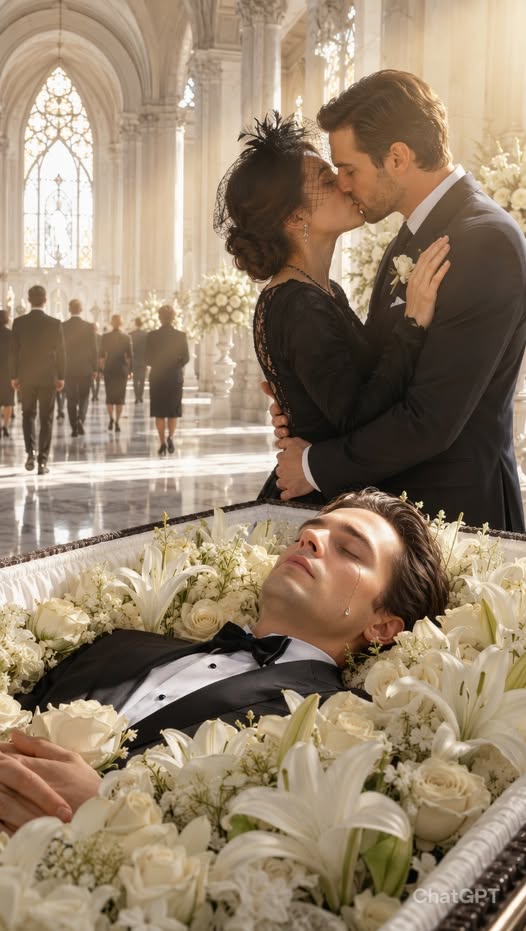
manufactured reverence of people who have absolutely no idea how to behave in the presence of death. I heard the slow, shuffling cadence of dress shoes against a polished floor. I heard the muffled, restrained weeping of individuals desperately attempting to maintain their social composure. Somewhere just inches above my head, a woman I did not immediately recognize sobbed quietly into a tissue. Then, a low, solemn voice whispered a sentence that stopped the blood in my veins: “Poor Ethan… he was entirely too young to go.” I screamed. I am alive! I am right
here! But the scream existed only within the cavernous echo chamber of my skull. Not a single vibration breached my lips. The darkness enveloping me was not the airy void of a bedroom at midnight. It was absolute, suffocating, and terrifyingly intimate. The air was thick, tasting heavily of polished mahogany, fresh lacquer, cheap satin lining, and the oppressive bloom of white roses and carnations. As the fragmented puzzle pieces of my reality violently slammed together, a profound, glacial terror froze my soul solid. I was not recovering in a sterile hospital ward. I was not trapped in a nightmare. I was lying inside a coffin. And they were actively conducting my funeral.
The final, lucid memory I possessed materialized behind my sealed eyelids. It was my wife, Olivia. She was stepping gracefully onto the sun-drenched balcony of our sprawling estate in Brookside Heights, cradling a steaming ceramic mug. The previous night’s thunderstorm had washed the city skyline clean, and the distant, rhythmic hum of morning traffic floated up to us.
“Drink this, sweetheart,” she had murmured gently, her manicured hand resting lightly on my shoulder. In horrifying retrospect, her tone sounded chillingly rehearsed. “The herbs will help calm your heart.”
I had offered her a weak, grateful smile. For the past six weeks, I had been deteriorating. Debilitating dizzy spells. A persistent, violent tremor in my hands. A terrifying, heavy pressure sitting squarely on my chest. Olivia had expertly diagnosed it as acute executive stress. My trusted physical therapist, Mason Carter, had eagerly corroborated her theory. Even my primary physician, Dr. Bennett, had lectured me about chronic fatigue, an overworked cardiovascular system, and the absolute necessity of holistic rest.
I drank the coffee. It tasted of raw honey. Earthy cinnamon.
And buried deep beneath those comforting flavors, something distinctly, aggressively bitter.
Then came the sudden, violent vertigo. The desperate stumble toward the mattress.
Then, the absolute dark.
Until this very second.
My sanity began to violently splinter. The primal, animalistic hemisphere of my brain wanted to detonate—to violently thrash against the tufted satin, to shatter the wooden lid with my knuckles, to claw my way out of this velvet purgatory like a feral beast. But the other, colder hemisphere of my mind processed the agonizing, clinical truth.
I was breathing. I was alive.
But to the shuffling mourners above me, I was already a corpse.
Then, cutting through the ambient hum of fake grief, I heard her. Olivia.
She was standing so agonizingly close to the casket that I could smell the sharp citrus notes of her signature perfume seeping through the microscopic gaps in the wood. It was the exact same fragrance she wore on our wedding anniversary, during opulent dinner parties, and while smiling for our holiday portraits.
But as she leaned against the polished wood, her voice was completely devoid of the grieving widow facade she was undoubtedly projecting to the room.
“Finally,” she whispered, her breath barely a ghost against the mahogany. “We actually got rid of him.”
The blood in my veins transmuted into jagged ice.
A man’s voice answered her, pitched low and terrifyingly calm.
“I guaranteed you the chemical formula would hold. The dosage was immaculate. Even Bennett suspected absolutely nothing.”
Mason.
I didn’t require functioning eyes to visualize the grotesque tableau hovering above my paralyzed face. Olivia, draped in expensive, mourning black, dabbing at dry eyes. Mason—the empathetic therapist, my supposed confidant, the man who spent hours manipulating my joints and preaching about my road to physical recovery.
“Now, the empire defaults to us,” Olivia murmured, a sick thrill vibrating in her tone. “The Brookside estate. The offshore accounts. The vineyard out in Sonoma. Every last dime.”
Mason released a dark, muted chuckle.
“We simply need to endure the theatrics for a few more hours. The cremation is scheduled for precisely six o’clock. Once the fire catches, there is no body. No autopsy. No evidence. Nothing but ash.”
Cremation.
That single, devastating word materialized like an executioner stepping into the coffin beside me.
They weren’t merely planning to bury me alive to suffocate in the dirt.
They intended to burn me alive, and the clock was already violently ticking down toward the flames.
Chapter 2: The Echoes of Betrayal
For several agonizing minutes, my brain simply ceased to function. The sheer magnitude of the horror short-circuited my neurological pathways. Had my tear ducts been operational, I would have wept until I dehydrated. Had my vocal cords possessed even a fraction of an ounce of tension, I would have shrieked the name of God until my throat tore open and bled. But I was reduced to a ghost haunting my own physical form. All I could do was listen.
And in the suffocating blackness of the casket, listening morphed into the solitary weapon I had left.
The morbid theater of my wake pressed on around me. The grand parlor of the downtown funeral home was steadily filling with distant relatives, corporate sycophants, and longtime business associates. I heard the heavy thud of footsteps approaching the dais. I felt the slight, sickening vibration of warm hands resting against the exterior of the coffin. I endured the torture of listening to people bid me farewell, speaking of me in the past tense.
“You were an honorable man, Mr. Rivera. A true titan.”
“Rest peacefully in the light, son.”
“It’s just such a catastrophic, sudden shock. He was in his prime.”
Every well-intentioned, grieving syllable felt like another heavy iron nail being brutally driven into the lid of my box.
I listened as Olivia orchestrated her masterpiece. She emitted delicate, tragic sobs whenever a new guest enveloped her in an embrace. She conjured perfect, crystalline tears. It was an exquisite, heavily controlled grief—the exact frequency of sorrow required to convince decent, unsuspecting people. But lying in the dark, I was finally privy to the absolute truth. The woman who had stood before an altar and promised to love and protect me until our dying days had meticulously architected my murder with horrifying, chilling patience.
Then, a new voice cut through the ambient noise—a voice carrying a distinct, jagged edge of defiance.
“Brother… I swear to God, I am going to unravel this.”
Caleb.
My older brother.
A microscopic flicker of hope ignited within the absolute zero of my despair. Caleb Rivera had never, not for a singular second, trusted Olivia. From the very evening I introduced them, he had evaluated her with the cold, calculating stare of a man who had just spotted a venomous viper coiled beneath a bed of orchids.
“She doesn’t love your soul, Ethan,” he had warned me, his voice rough with frustration, over scotch countless times. “She is deeply, passionately in love with your portfolio.”
I had consistently, arrogantly dismissed him. I had called him paranoid.
“You perceive shadows everywhere, Caleb. You think the whole world is out to bleed us.”
Now, permanently entombed in a satin-lined box of my own ignorance, the bitter realization washed over me. Caleb had been the only individual in my orbit possessing 20/20 vision.
I heard Olivia’s heels click sharply against the hardwood as she approached my brother, her tone instantly shifting to a falsely maternal softness.
“Caleb, sweetheart. You must find a way to accept that Ethan has passed on. Dr. Bennett walked us through the cardiac failure step by step.”
A heavy, dangerous silence lingered in the air above me.
“Yeah,” Caleb finally responded, his syllables drawn out, thick with thinly veiled accusation. “His heart simply gave out. Or perhaps it was those bizarre, muddy herbal concoctions you insisted on brewing for him every morning.”
Olivia hesitated.
It was a fraction of a second. A microscopic pause before she formulated her defense. But it was one second too long.
“Do not dare initiate this hostility today, Caleb. Not over his body.”
I heard the tiny, defensive fracture in her carefully curated voice, and I knew, with absolute certainty, that Caleb had detected it too.
I could not see the parlor, but I knew my brother; I knew he was currently staring at my wife and my physical therapist, watching their hands brush together in the shadows, and I prayed to whatever deity was listening that Caleb’s paranoia would finally ignite into a raging fire.
Chapter 3: The Scent of the Venom
While I lay entombed in the dark, measuring the passage of time by the rhythmic shuffling of mourners and the fading echoes of organ music, I could not witness the frantic investigation unfolding miles away. I would only learn the details of my brother’s desperate crusade months later. But as the oxygen in my casket grew steadily staler, Caleb was initiating a war.
At exactly 2:30 P.M., the atmosphere in the funeral parlor had grown suffocatingly tense. Caleb made a tactical decision.
“I am returning to the Brookside estate,” he announced loudly to Olivia, ensuring the surrounding guests heard him. “I want to retrieve the vintage family photo albums. Ethan would have wanted our parents’ faces displayed here.”
Olivia, desperate to maintain her grieving widow persona, barely spared him a glance, waving a tear-soaked tissue. “The spare key is concealed beneath the terracotta planter on the porch.”
Caleb departed the funeral home like a man possessed.
He would later tell me how the sprawling house in Brookside Heights greeted him with an unnatural, sterile silence. Everything appeared entirely too perfect. The throw pillows were militarily aligned. The countertops gleamed. It was as if Olivia had painstakingly rehearsed and sanitized even the emptiness of the home.
He bypassed the living room entirely and marched directly into the massive, marble-clad kitchen.
He began a systematic, violent tear-down of the space. He ripped open mahogany cabinets. He upended silver cutlery drawers. He dumped out glass spice jars, artisanal tea boxes, and opaque ceramic storage containers.
Nothing. The space was clinically devoid of anything suspicious.
Defeated and panting, he leaned against the island. Then, his eyes dropped to the stainless-steel trash receptacle concealed beneath the farmhouse sink.
Pulling a pair of leather driving gloves from his coat pocket, he dropped to his knees. He ruthlessly dug through wet coffee grounds, soiled paper napkins, rotting vegetable scraps, and discarded packaging. Near the very bottom, buried beneath the mundane refuse of domestic life, his fingers brushed against cold, hard glass.
He withdrew a small, completely unlabeled amber glass vial. Inside, a few drops of a viscous, transparent, oily residue clung to the glass.
He unscrewed the dropper. There was absolutely no scent.
But Caleb instantly felt the hair on the back of his neck stand at attention. He knew, with the primal instinct of a protector, that he had just grabbed the very thread leading directly into the heart of the monster’s labyrinth.
He pulled out his phone and dialed Nathan Cole, an old university roommate who now directed a private, high-security toxicology laboratory on the industrial outskirts of the city.
“Nathan. I require a chemical analysis run today. Not tomorrow morning. Right this second.”
“Caleb, be reasonable, I can’t simply bypass the queue and run emergency diagnostics for—”
“My brother is dead, Nathan!” Caleb roared into the receiver. “Or, at the very least, someone is desperately trying to convince the world that he is. And I am holding the poison his wife used to do it.”
A stunned silence echoed over the cellular connection. Then, Nathan released a heavy, resigned sigh.
“Bring it to the subterranean loading dock. South entrance. And do not ask me any questions about protocol.”
While Caleb raced his sedan across the sprawling city, treating traffic laws as mere suggestions, my reality was rapidly deteriorating. Inside the coffin, the funeral wake was noticeably thinning out. The ambient temperature was rising, the air growing heavy and sour with my own recycled carbon dioxide. The external sounds became muffled as the crowd dispersed. My consciousness, however, sharpened with a terrifying, hyper-focused clarity.
I attempted to flex my right pinky finger.
Nothing.
I concentrated every ounce of my neurological willpower onto my left ankle.
Nothing.
I was drowning in a sea of memories. I vividly remembered Olivia standing at the kitchen island, rhythmically grinding imported herbs with a heavy marble mortar and pestle. I remembered Mason leaning over the steaming mug, inhaling the aroma, and flashing me a bright, sociopathic smile.
“Natural remedies are consistently superior to pharmaceuticals, Ethan. Trust the process.”
God, I had been so blindly, pathetically gullible.
At precisely 4:00 P.M., the muffled, authoritative voice of the funeral director pierced the wood above me.
“Mrs. Rivera, the transport vehicle is idling. It is time to officially seal the casket.”
The darkness inside my prison seemed to instantly drop ten degrees.
Olivia requested one final, solitary minute with her beloved husband.
I heard her heels approach. The casket shifted slightly as she leaned her weight against the edge. I could sense the heat of her breath, the sickeningly sweet cloud of her perfume, the pure malevolence radiating from her aura.
“Goodbye forever, Ethan,” she whispered, her voice a razor blade sliding over silk. “You turned out to be vastly more valuable to me dead than you ever were alive.”
She stepped back.
The heavy mahogany lid descended, eclipsing the tiny slivers of ambient light that had bled through the seams.
The heavy thud of the wood meeting wood echoed in my ears like the final gavel strike at the end of the world.
Then came the mechanical, terrifying clack of the brass latches snapping into place.
One.
Two.
Three.
The darkness was now absolute. Hermetically sealed.
I felt the sickening lurch as the casket was hoisted onto the wheeled gurney, and as the rubber tires rolled violently toward the exit, I knew with horrifying certainty that my final journey to the incinerator had officially begun.
Chapter 4: The Descent into the Furnace
Every bump of the gurney against the thresholds of the funeral home, every sharp, pivoting turn of the wheels, every slight shift in the horizontal angle telegraphed the exact same, devastating reality to my paralyzed brain.
They were loading me into the rear of a hearse. They were taking me to the municipal crematorium.
Across the city, sealed inside a sterile, white-tiled laboratory, Nathan Cole stared grimly at the readout glowing on his mass spectrometer monitor.
“Give me exactly ninety minutes, Caleb,” he had instructed upon receiving the vial. “If there is a lethal compound hiding in this oil, the centrifuge will isolate it.”
Caleb remained barricaded inside his parked car outside the lab, watching the oblivious city carry on around him. Commuter traffic lights cycled from green to red. Street vendors hawked hot pretzels on the corner. Car horns blared in frustration. The agonizing, mundane machinery of ordinary life continued to churn forward, entirely ignorant of the fact that his brother was currently trapped in a suffocating void between the living and the dead.
At 4:50 P.M., Caleb’s phone vibrated violently.
“Caleb,” Nathan began, his voice trembling, stripped of all its usual clinical detachment. “This is not a harmless holistic essential oil. It contains massive, concentrated traces of a highly classified synthetic paralytic. It is a neurotoxin. It artificially depresses the respiratory system and slows the cardiac pulse to a rate so microscopic it becomes entirely undetectable to standard medical equipment.”
Caleb felt the leather steering wheel slip through his sweating palms. “But… the victim. Could the victim still possess cognitive awareness?”
Nathan hesitated, the silence stretching out like a wire about to snap.
“Yes. That is the truly horrifying architecture of this specific chemical. The motor functions are entirely severed, but the neurological pathways governing sensory input remain intact. They could be completely conscious.”
Caleb terminated the call without another word. He threw the sedan into drive, tires screaming against the asphalt, and drove like a madman toward the nearest precinct.
Commander Harris sat behind a battered metal desk, listening to my brother with the exhausted, cynical expression of a veteran detective who had been subjected to every impossible, grief-stricken conspiracy theory in the city.
“My brother is currently breathing,” Caleb demanded, slamming his palms onto the desk. “They are scheduled to roll him into an industrial incinerator at six o’clock. His wife and her lover poisoned him to inherit his estate!”
Harris remained completely impassive, his hands folded.
Caleb furiously emptied his pockets onto the desk. He slapped down the printed toxicology report, a stack of glossy photographs depicting Olivia and Mason looking intimately cozy at a recent charity gala, the empty amber vial, and the frantic text messages from Nathan.
“I fully comprehend that the grieving process makes rational people highly desperate, Mr. Rivera,” Harris stated carefully, pushing the photos back. “But I cannot legally halt a state-sanctioned cremation procedure based on familial paranoia and an unofficial, unverified lab readout.”
Caleb leaned over the desk, his face inches from the Commander’s.
“And if my paranoia is accurate? Are you genuinely prepared to allow a living, breathing human being to be roasted alive in an oven simply because a piece of bureaucratic paperwork erroneously declares him deceased?”
The brutal question lingered heavily in the stale air of the precinct.
Commander Harris stared at the toxicology report. He slowly reached out and lifted his desk phone.
“Dispatch,” Harris ordered, his voice suddenly sharp. “Contact the municipal crematorium. Institute a mandatory, one-hour administrative delay on the Rivera cremation. One hour only.”
Caleb closed his eyes, a shuddering breath escaping his lungs. It wasn’t an absolute victory, but it was a lifeline. It bought time.
“I require more concrete justification to breach those doors,” Harris added, standing up to grab his holstered firearm. “Bring me Dr. Bennett. If the attending physician officially questions the validity of his own death certificate, then we mobilize a strike team.”
Meanwhile, my world had violently shifted. The hearse had stopped. I felt the casket being forcefully pulled from the vehicle. The air temperature outside the box shifted drastically.
I was wheeled into a massive, echoing, subterranean facility. Through the thick mahogany, I could hear the terrifying, mechanical symphony of the crematorium. The heavy, metallic clang of industrial doors sliding on tracks. The low, guttural roar of natural gas burners igniting. The casual, bored chatter of the facility workers as they prepared the retort.
My casket was violently shoved onto a steel loading platform.
The ambient heat radiating from the brick furnace mere feet away began to seep through the wood, warming the satin against my paralyzed skin.
But then, a voice echoed through the cavernous room:
“Hold the Rivera burn. Police dispatch just called in an administrative delay. We wait one hour.”
A wave of pure, unadulterated relief so powerful it nearly shattered my fragile mind crashed over me.
Caleb. Caleb was coming.
Out in the sterile waiting room of the facility, Olivia’s flawless complexion drained of all color.
“The police? For what conceivable reason?” she hissed, her facade cracking.
Mason seized her arm, his grip bruising. “Calm your nerves. Do not trigger suspicion now.”
“It is Caleb,” she spit, her eyes wide with terror. “He has hunted me since day one.”
“Suspicion does not equate to physical evidence,” Mason replied, though a bead of sweat tracked down his temple. “In exactly sixty minutes, this entire ordeal is reduced to ash.”
Inside the box, the temperature was steadily climbing; I realized that if Caleb failed to arrive, I could not rely on rescue, so I routed every microscopic ounce of electricity in my nervous system to my right hand, screaming at my index finger to move, praying for a miracle before the flames consumed me.
Chapter 5: A Finger Twitch and the Fire
In the affluent, manicured suburb of Oak Hollow, Caleb’s vehicle skidded to a halt on Dr. Bennett’s pristine driveway just as the setting sun painted the sky a bruised, violent orange. He vaulted up the porch steps and leaned on the doorbell, ringing it incessantly until the elderly physician finally threw open the door, wearing a velvet smoking jacket and crooked reading glasses.
“Caleb? What on earth is the meaning of this intrusion?”
“You signed my brother’s death certificate, Bennett. But Ethan Rivera is still alive.”
Initially, Dr. Bennett bristled, his professional pride deeply offended. Then, Caleb ruthlessly laid out the arsenal of evidence. He shoved the toxicological breakdown into the doctor’s chest. He presented the amber bottle. He aggressively detailed the daily morning coffee routine, how Olivia meticulously answered every diagnostic question on my behalf during our appointments, how Mason eagerly reinforced the symptoms of chronic fatigue, and how Olivia consistently, vehemently refused hospitalization every single time Bennett suggested advanced cardiac monitoring.
Slowly, the color drained from Dr. Bennett’s face. His knees buckled, and he collapsed heavily onto the foyer bench.
“My God,” the doctor whispered, his hands trembling violently. “I genuinely believed she was an exhausted, devoted caretaker.”
“She was systematically isolating him. Building a tomb around him while he was still breathing.”
Bennett covered his mouth, his eyes wide with horrifying realization.
“There was a distinct moment last week…” he admitted, his voice hollow with guilt. “Ethan desperately attempted to communicate something to me in private, but Olivia immediately intercepted. She claimed he was suffering from neurological confusion. I… I should have pushed past her.”
Caleb leaned down, his face a mask of pure desperation.
“Then push past her right now, Doctor.”
Bennett didn’t hesitate. He grabbed his overcoat.