“No, Your Honor.” “Then there was no authorization. Sit down.” Then, Lauren called Eleanor Briggs to the stand. Eleanor wore a soft blue cardigan—my grandmother’s cardigan. “Ms. Briggs,” Lauren asked, “was Dorothy Vance mentally competent when she signed her will?” “Sharp as a tack,” Eleanor declared. “She walked into the attorney’s office and told me, ‘It’s done. Janice gets the house. Roy will try to take it, which is why I’m leaving it only to her.’” A collective gasp echoed from the gallery, where several of my aunts and cousins were sitting. “And,” Eleanor continued, her voice thick with emotion, turning to glare at my father, “Dorothy tried to call Janice for two years. She called Roy’s house, begging him to pass along messages. He never did. She died believing her granddaughter had forgotten her.” The courtroom went dead silent. My mother buried her face in her hands. One of my aunts looked at my father with utter revulsion. My father sat paralyzed, staring straight ahead as his carefully constructed empire of control crumbled into dust. Judge Whitaker called a recess. When she returned, she didn’t waste a single word. “This court finds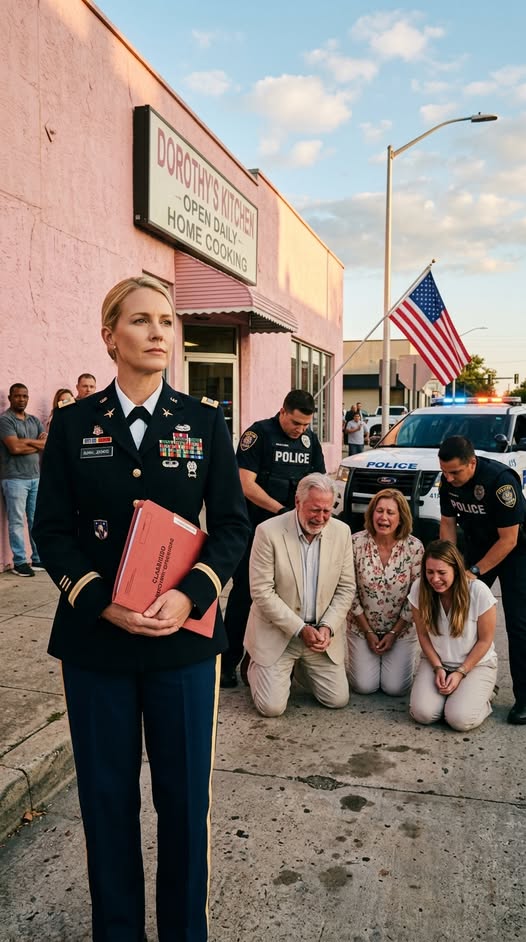
clear and convincing evidence that Roy Vance fabricated a power of attorney, forged the signature of an active-duty service member deployed overseas, and illegally sold her property,” the Judge announced, her voice ringing like a gavel strike. “The court orders the defendants to pay full restitution of $520,000 to the plaintiff, plus $95,000 in compensatory damages and legal fees.” My father’s shoulders slumped, but Judge Whitaker wasn’t finished. “Furthermore,” she said, her gaze pinning my father to his chair. “Forgery of a legal instrument constitutes a felony offense.
Based on the overwhelming evidence presented today, this court is officially forwarding its findings to the District Attorney to support criminal prosecution.” My father’s hands, folded on the table, began to tremble violently. “Mr. Vance,” the Judge said coldly, “the law does not bend for your
ego.” My father’s entire body gave way. He collapsed back into his chair, gasping for air as if he had been shot. “Roy!” my mother shrieked, rushing toward him. The courtroom was adjourned. As I walked into the hallway, my mother stepped directly into my path, her face twisted with a
terrifying rage. “Are you happy now?!” she screamed, pointing a trembling finger at my face. “You’ve destroyed your father! You’ve destroyed us!” I looked at the woman who had enabled my abuser my entire life. “He destroyed himself, Mom,” I said quietly. “I just brought the truth into the
room.” I walked past her, out into the crisp October sunlight. But as I reached my car, my phone rang. It was Major Caldwell. “Janice,” his voice was tight. “The District Attorney just moved. They aren’t just going after your father. They just issued an arrest warrant for the notary.”
The swiftness of the justice system, when properly motivated, is a terrifying thing to witness.
Harold Benton, the notary who had rubber-stamped my forged signature, was arrested within 48 hours. Terrified of federal prison, he flipped on my father immediately. He confessed that Roy Vance had orchestrated the entire scheme, assuring him that I had given “verbal consent.” Benton lost his notary license and faced his own felony charges.
As for Sabrina’s restaurant, the illusion shattered rapidly. Without my stolen money propping it up, the business bled cash. Within six weeks, the shiny new equipment was sold off at auction. She broke her lease, incurring massive penalties. The polished wooden sign reading Dorothy’s Kitchen was ripped down and thrown into a dumpster.
My father’s situation was catastrophic. Stripped of his savings by the massive civil judgment, and facing towering legal fees for his impending criminal trial, he was forced to put the family home on the market. The house on Briarwood Lane—the throne room where he had controlled our lives for thirty years—was sold to strangers. My parents moved into a cramped, two-bedroom rental on the edge of town.
Small towns do not keep secrets. The public nature of the trial meant that everyone knew. My aunts, who had initially believed Sabrina’s tearful social media posts, called me in tears to apologize.
“I should have known,” Aunt Carol sobbed over the phone. “I’m so sorry we doubted you.”
I accepted their apologies, but I kept my distance.
My mother sent me one final, bitter text message from her new rental apartment: “I hope you can live with yourself.”
I took a screenshot, saved it in my evidence folder, and blocked her number.
Months passed. The Army promoted me. I rented a quiet, one-bedroom cabin near Lake Hartwell. It wasn’t Lake Lanier, but it was peaceful. I spent my mornings drinking coffee on the screened porch, watching the herons glide over the water.
One evening, Eleanor called. Sabrina had mailed a letter to Eleanor’s house, knowing she didn’t have my new address. Eleanor forwarded it to me.
I opened it under the soft yellow light of the porch bulb. The handwriting was frantic.
“I knew the money came from the house,” Sabrina wrote. “I knew Dad forged your signature. I told myself it didn’t matter because the Army took care of you. I didn’t want to feel guilty, so I made it your fault. I used Grandma’s name like a brand to sell food. You don’t owe me forgiveness. I just needed you to know that I know what I am.”
I sat with the letter for a long time. Did she mean it? Or was it just the panicked realization of a golden child who finally had to face reality without our father’s money to protect her?
It didn’t matter. My peace did not require her sincerity.
I wrote back a single paragraph: “I read your letter. Thank you for the honesty. I’m not ready for anything more. Take care of yourself.”
I mailed it the next day. It wasn’t a bridged gap, but it was a closed chapter.
I took a portion of the restitution money and established a scholarship at my old high school for seniors enlisting in the military or public service. I named it the Dorothy Vance Memorial Scholarship. My grandmother had always told me to help the ones who didn’t have anyone in their corner.
I finally understood why this all had to happen. For years, I thought strength meant enduring my father’s control, keeping the peace, and swallowing my own voice for the sake of ‘family.’ I thought love meant giving people access to my life without question.
But I was wrong.
Love without boundaries isn’t love. It’s simply permission. It’s permission for people to take from you, to rewrite your story, and to use the word “family” as a weapon to keep you compliant.
Sometimes, the people who cross those lines are the ones you were taught to trust the most. Standing up to them doesn’t make you selfish. Protecting yourself makes you responsible for your own life—and that is a signature no one else is allowed to forge.
If you’re standing in a space right now where something feels wrong, but you don’t have the words yet, let my story be your starting point. You don’t need a perfect argument. You just need one honest sentence to yourself: This isn’t right.
Setting a boundary won’t destroy a family. If the family collapses when you refuse to be a victim, it was never a family to begin with. It was a hostage situation.
I walked down to the edge of the lake, listening to the water lap against the wooden dock. The air was cool and clean. I was alone, but for the first time in my life, I wasn’t lonely. I was finally, truly, free.
If you want more stories like this, or if you’d like to share your thoughts about what you would have done in my situation, I’d love to hear from you. Your perspective helps these stories reach more people, so don’t be shy about commenting or sharing.