Part 1: The Price Tag of Affection: The dining room of my parents’ house always felt airless, heavy with the oppressive scent of Elaine’s expensive, musky perfume and the rich, greasy aroma of pot roast. It was a room designed for performances, not family dinners. The mahogany table was polished to a mirror shine, the silver cutlery meticulously aligned, and the seating arrangement strictly enforced. Robert, my father, sat at the head. Elaine, my mother, sat at his right hand. Madison, my younger sister, sat opposite her. And I, Hannah, sat at the far end, geographically and emotionally isolated, playing my designated role as the audience to their perfection. I was twenty-six years old, wearing a sensible blouse from a mid-tier department store, exhausted from a fifty-hour work week at a mid-level corporate strategy firm. Madison was twenty-four, wearing a designer sundress, glowing with the manicured radiance of a woman who had never been told “no” in her entire life. She had recently gotten engaged to Greg, a man whose primary personality trait was his trust fund. Dinner had been a grueling marathon of passive-aggressive commentary.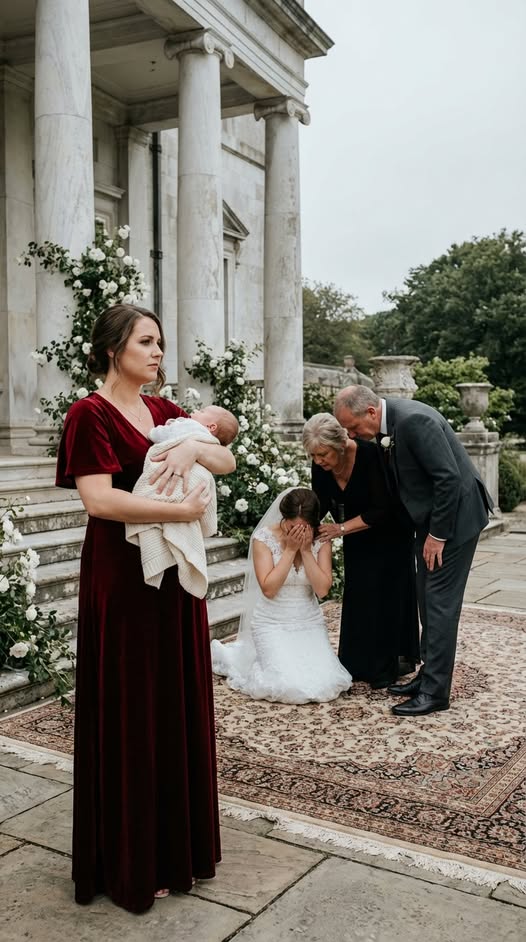
Elaine had already critiqued my hair, my lack of a plus-one, and my apartment. But the true main event was yet to come. As Elaine cleared the dinner plates, Robert cleared his throat. He reached into the breast pocket of his tailored blazer and withdrew a thick, cream-colored envelope. He didn’t just hand it over; he presented it. He slid it across the polished mahogany table with the theatrical flourish of a king granting a fiefdom to his favored lord. “For the wedding,” Robert announced, his voice booming with self-satisfaction. He picked up his crystal water glass and clinked it
against Madison’s. “One hundred thousand dollars. We want it to be elegant. We want it to be an event people remember.” Madison squealed—a high-pitched, piercing sound that set my teeth on edge. She snatched the envelope off the table and pressed it to her chest as if she had just won an Oscar. “Oh my God! Daddy, Mom, thank you! Thank you so much! Greg’s family is going to be so impressed. This pays for the floral installations and the string quartet!”
I sat at the end of the table, my fork suspended halfway to my mouth, a piece of roasted carrot forgotten on the tines. I didn’t expect a check. I never expected anything from them. But the sheer volume of the number—one hundred thousand dollars—stole the breath from my lungs. It was an astronomical sum.
Before my brain could even process the mathematics of the moment, Elaine turned her head to look down the length of the table at me. Her maternal smile remained plastered on her face, but her eyes went dead, sharp, and predatory.
“And before you get any ideas, Hannah,” Elaine said. Her voice dropped into a register of pure, weaponized condescension. It was the tone she used when speaking to telemarketers or waitstaff who had gotten her order wrong. “You don’t deserve any help.”
The room went dead silent, save for Madison’s excited, oblivious, rapid breathing as she tore open the envelope to look at the physical check.
I carefully lowered my fork to my plate. The clink of the silver against the porcelain sounded like a gunshot. The familiar, acidic burn of injustice rose in the back of my throat. It was a burn I had swallowed a thousand times before.
“What did I do?” I asked. My voice was quiet, betraying the tremor in my chest.
Robert didn’t look up from cutting his meat. He didn’t even grant me the dignity of eye contact. “You’re always difficult, Hannah. You job-hop. You don’t settle down. You refuse to listen to our advice. Madison is building a family. She’s marrying a good man from a good family. She deserves support. Why would we invest in you?”
Invest in you.
The words hung in the air, heavy and toxic.
I looked at the three of them. A slideshow of my past five years flashed behind my eyes. I thought of the six months I had quietly paid Robert’s $600 car note when his consulting hours were cut, because he was too proud to trade the luxury sedan in for a cheaper model. I thought of the countless weekends I had given up to babysit Madison’s terror of a golden retriever, or helped her move apartments, or edited her disastrous college essays so she could “have a break.” I thought of the holidays I spent cooking this exact pot roast while Elaine drank wine and complained about her back.
I had bled for this family. I had compromised my own savings, my own time, and my own peace of mind to be the “good daughter,” hoping that one day, the scales would balance.
As I looked at Madison waving a piece of paper worth more than my entire retirement account, I realized with a terrifying, crystal-clear finality: the scales were never broken. They were rigged.
They didn’t see my sacrifices. They only saw my failure to submit. They didn’t want a daughter; they wanted a subordinate. Because I insisted on having my own career, my own opinions, and my own independent life, I was deemed a bad investment. Love, in this house, was entirely transactional, and I had failed to provide the correct currency.
The tremor in my chest vanished. The burning in my throat cooled into absolute ice.
I reached up and plucked the linen napkin from my lap. I folded it deliberately, matching corner to corner, and placed it perfectly next to my plate.
“Okay,” I said quietly.
Elaine frowned. She was irritated by my lack of tears. She had wound up the toy and was waiting for it to spin, but the toy was broken. “Okay what, Hannah? Don’t sit there and sulk. You bring this on yourself.”
“You’ve made it clear where I stand,” I said. I pushed my chair back and stood up. I picked up my purse from the floor.
“Where are you going?” Robert demanded, finally looking up, his brow furrowed in authoritarian anger. “We haven’t had dessert.”
“I’m full,” I said.
I didn’t wait for a response. I turned on my heel and walked out of the dining room. I walked down the long, carpeted hallway, opened the heavy oak front door, and stepped out into the cool evening air. I left their $100,000 illusion behind, completely unaware that the rejection I had just endured was the greatest gift they could have ever given me. I was taking the first step toward my first million.
Part 2: The Ghosting of the Scapegoat
I didn’t slam the car door. I didn’t speed out of the neighborhood, tires squealing. I drove back to my cramped, one-bedroom apartment in absolute, profound silence. I didn’t turn on the radio. I just listened to the rhythmic hum of the tires against the asphalt.
When I unlocked my apartment door, the space felt different. It was small, the rent was too high, and the plumbing in the bathroom always hummed, but for the first time, it felt entirely mine.
I sat down on the cheap rug in the center of my living room floor. I pulled my phone from my purse. The screen glowed in the dim light.
I opened my contacts.
Contact: Mom.
My thumb hovered over her name. I thought of the daily text messages demanding to know where I was, the passive-aggressive comments about my weight, the constant comparisons to Madison.
Block Caller.
Contact: Dad.
I thought of the financial lectures from a man whose car I had to pay for. I thought of the cold, dismissive look in his eyes when he asked why he would invest in me.
Block Caller.
Contact: Madison.
I thought of the $100,000 check. I thought of her squeal. I thought of the lifetime of entitlement I had been forced to cater to.
Block Caller.
I didn’t stop there. I opened Facebook, Instagram, LinkedIn. I went through my aunt, my uncle, the family friends who acted as Elaine’s flying monkeys. Block. Block. Block.
I didn’t post a dramatic, tear-filled status update. I didn’t send a final, fiery text message explaining my feelings. They wouldn’t have listened anyway; they would have just used it as ammunition to prove how “unstable” I was.
I simply evaporated from their digital and physical world. I became a ghost.
I knew exactly what they were saying the next morning. I could picture Elaine sitting in her country club, sipping a mimosa, telling her friends that Hannah was “throwing a tantrum.”
She’s just jealous of her sister, Elaine would sigh dramatically. She’ll come around. She always does when she needs something.
They expected me to break in a week. They expected me to call, crying, apologizing for “ruining” the dinner, begging for scraps of their attention. They believed they were the sun, and I was just a rogue planet that would inevitably be pulled back into their gravitational orbit.
But the week turned into a month. The month turned into six months. And the six months turned into a year.
I won’t lie and say the silence was easy at first. It was agonizing. It was like withdrawing from a heavy narcotic. You don’t realize how much of your brain’s bandwidth is consumed by anticipating abuse until the abuse stops. For the first few months, I jumped every time my doorbell rang. I had phantom anxiety attacks on Sunday afternoons, the time Elaine usually called to complain about her life.
But as the silence stretched on, the void they left behind began to fill with something else: energy.
Without the constant, crushing weight of their judgment, my mind cleared. The anxiety that had plagued me for a decade vanished. I had been carrying a 100-pound backpack my entire life, and I had finally taken it off.
I channeled every ounce of my grief, my anger, and my newfound energy directly into my career. Robert had called me a “job-hopper.” He didn’t understand that I wasn’t failing; I was learning. I was gathering data, building networks, and understanding the corporate landscape.
By the beginning of year two, the quiet had become my superpower.
I quit my job at the corporate strategy firm. I took my meager savings, drafted a relentless business plan, and launched my own risk-management consulting firm. I specialized in identifying supply-chain vulnerabilities for mid-size tech companies.
I worked eighty-hour weeks. I lived on black coffee, scrambled eggs, and sheer, unadulterated willpower. When I felt tired, when I felt like quitting, I just pictured Robert’s smug face. Why would we invest in you?
I became a machine. I pitched to venture capitalists. I secured a tiny contract, over-delivered, and used it to secure a medium contract. Then I secured a massive contract with a tech firm whose name Robert couldn’t even pronounce. I hired a team. I opened an office.
I turned the humiliation of that dining room table into pure, staggering revenue.
While Madison was spending her $100,000 on ice sculptures, custom monogrammed napkins, and a two-week honeymoon in Bora Bora—assets that depreciated to zero the moment the wedding was over—I was building equity. I was investing in the stock market. I was scaling a company.
Three years passed. Three years of absolute, unbroken silence.
I didn’t know if Madison was happy. I didn’t know if Robert had retired. I didn’t care. They were strangers who shared my DNA, characters from a past life I had outgrown.
Then, on a random Tuesday afternoon in late October, the collision course finally reached its destination.
I was standing in the kitchen of my new home, unpacking boxes.
It wasn’t just a house. It was a monolithic fortress of glass, black steel, and old-growth timber sitting on two heavily wooded acres in the most exclusive, gated zip code in the state. It featured floor-to-ceiling windows, a wine cellar, a heated infinity pool, and a kitchen anchored by a massive expanse of imported white quartz.
It cost two point two million dollars. And I had put down forty percent in cash.
I was wearing yoga pants and an oversized t-shirt, using a box cutter to slice through the packing tape on a box of crystal wine glasses. The house was quiet, smelling of fresh paint and pine needles from the trees outside.
Suddenly, my business phone—a sleek, secondary device with a number I had never given to any member of my family—buzzed on the quartz island.
I glanced at the screen.
UNKNOWN CALLER.
I let it go to voicemail. I didn’t answer unknown numbers; my assistant handled incoming client queries.
Two minutes later, the phone chimed, indicating a voicemail had been left. I wiped my hands on a towel, picked up the phone, and pressed play.
The ghost of my past filled the echoing, two-million-dollar kitchen.
Part 3: The Drive-By Revelation
The voicemail crackled to life, the audio slightly distorted by wind and heavy, erratic breathing.
It was Madison.
She wasn’t calling to say hello. She wasn’t calling to ask how I was doing after three years. She was hyperventilating. Her voice was shrill, completely unhinged, vibrating with a toxic cocktail of rage, panic, and absolute disbelief.
“Mom…” Madison sobbed into the receiver.
I froze, the box cutter heavy in my hand. She thought she was leaving a message for Elaine. She must have either misdialed in her panic, or she was trying to forward a voice note to Elaine and accidentally sent it to the number she had dug up for me online.
“Mom, I just… I just drove past the address Aunt Sarah found on the public tax registry,” Madison gasped, her words tumbling over each other. “I’m parked across the street. I’m looking at Hannah’s house. Mom, it’s huge. It’s a literal estate. It has iron gates, Mom. There are cameras everywhere.”
I could hear the sound of her crying—wet, angry, resentful tears.
“Why does she have that?!” Madison screamed into the phone, her voice cracking. “Why does SHE get a house like that?! Greg lost his bonus, we’re drowning in credit card debt from the wedding, and we can barely afford the mortgage on our townhouse! It’s not fair! She’s a failure! Dad said she was a failure! Why does she have this, Mom?!”
The voicemail abruptly cut off with a sharp beep.
I stood in the center of my vast, sunlit kitchen, staring at the phone.
The $100,000 wedding had apparently not guaranteed a happily-ever-after.
I listened to the silence of my home, analyzing what I had just heard. Madison’s worldview wasn’t just challenged; it was actively short-circuiting. In her mind, the universe operated on a strict set of rules dictated by Elaine and Robert. Because our parents had deemed me unworthy, the universe was supposed to agree and punish me with poverty and misery. Madison believed that because she had followed the rules—getting married, playing the golden child—she was owed perpetual luxury.
The sight of a two-million-dollar estate with my name on the deed destroyed the narrative she had built her entire identity upon. Her phrasing—“Why does she get a house like that”—proved she still believed success was something “given,” like a cream-colored envelope slid across a dining room table, rather than something earned through years of blood, sweat, and isolation.
Before I could fully process the schadenfreude blooming in my chest, my phone screen lit up again, buzzing violently against the quartz countertop.
INCOMING CALL: ELAINE (Scam Likely / Unsaved Number).
She had breached the perimeter. Madison had likely called her directly after leaving the botched voicemail, screaming about the mansion in the hills. Elaine, desperate for information, frantic to regain control of a narrative slipping through her fingers, was using a burner app or a new phone line to bypass my three-year blockade.
The panic had set in. The parasites had suddenly realized the host they discarded was now a queen, and they were starving.
I stared at the glowing green ‘Accept’ button.
For three long, grueling years, while I ate ramen at my desk at 2:00 AM, while I lay awake stressed over payroll, while I signed the closing papers on this house alone, I had craved this exact moment. I had fantasized about the moment they realized how spectacularly, catastrophically wrong they were.
The phone vibrated violently in my hand. It was demanding my attention. It was demanding that I return to the role of the obedient daughter, ready to explain myself, ready to apologize for outshining the Golden Child.
I took a slow, deep breath, letting the cool, conditioned air of my massive house fill my lungs. I was not the girl at the end of the dining room table anymore. I was the CEO.
I pressed ‘Accept’.
Part 4: The Intercom Execution
I placed the phone flat on the kitchen island and tapped the speaker button.
“Hello?” I said. My voice was perfectly steady, pitched low and calm.
“Hannah!” Elaine gasped.
The performance began immediately. She laid the fake maternal relief on so thick it was practically dripping from the speaker.
“Oh my god, honey, it’s Mom! It is so good to hear your voice! I’ve been trying to reach you for years, we’ve been so worried about you!”