The sergeant looked at the lease and then looked at Logan with a questioning expression. “Major, if she has a signed lease, this might be a civil matter rather than a criminal one,” he said. “That document is a forgery,” Logan said through his teeth while staring at my sister. The sergeant noted that tenant laws were complicated and that they might not be able to remove her that night. My father’s mouth twitched with a small and smug look of victory because he thought they had found a gray zone. They wanted to wrap the situation in enough confusion that it would take time and money for anyone to prove the truth. My mother looked toward the camera again and said loudly that I could not just throw my sister away. For a moment, the room seemed to tilt in their favor as the officers lowered their urgency and asked about the kids. Sienna clutched her fake lease like it was holy scripture while my parents moved closer to her for support. Logan looked at the smart screen where my face had not yet appeared and said that I had not warned him she was a professional grifter. That was when I connected the video call to the wall mounted smart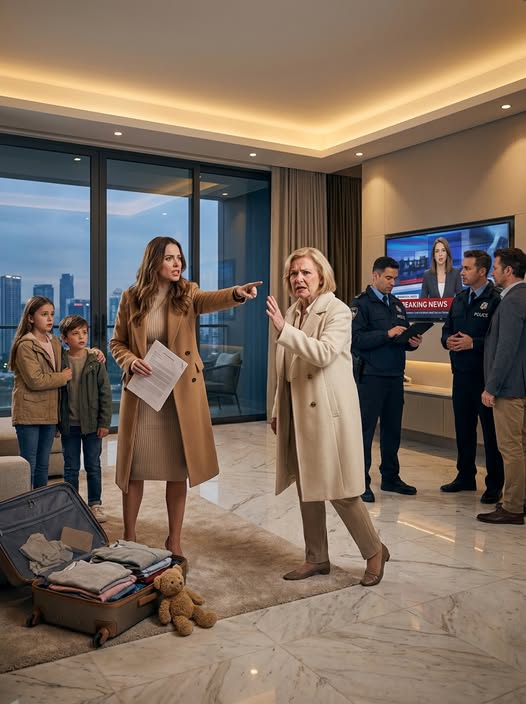
screen in the living room. The screen flickered from its idle mode to the live feed of my face looking down at all of them. “Officer, before you accept that lease as evidence, please check the entry log on the panel beside the door,” I said. My voice came through the surround speakers clearly enough to silence every person in the room. The sergeant’s eyes narrowed as he asked who I was and what I wanted. “I am Morgan Miller, the former owner of this property and the person whose name has been forged on that document,” I stated calmly. Sienna shot to her feet and
screamed that I had set her up, but I told her that I had simply documented her actions. I asked the sergeant to read the access classification for the code that was used at 9:42 p.m. He hesitated for a moment before moving to the panel and tapping on the screen to view the log. His
expression changed instantly, and he read aloud that the access type was for a service vendor with no residency status. I asked him to scroll to the terms accepted screen so he could see exactly what Sienna had agreed to. He tapped the screen and read the header about non-residential
entry and the liability waiver. Sienna exploded and claimed she had not read the text because it was just a door code. “You clicked the accept button, and the system recorded the timestamp and your image as you did so,” I told her.
My father pointed at the screen and shouted that I had tricked her, but I told the police about the text messages I had sent. I explained that I warned her the code was for one-time service only and that she would be responsible for any damage.
I reminded the room that she had replied by saying she would handle my trash, which made one of the officers lift his eyebrows. Sienna’s face went pale as the sergeant looked back at the forged lease in his hand.
“The lease is a complete forgery because I did not sign it and I did not receive any cash from her,” I said. I explained that I had sold the property weeks ago and that Logan Pierce was the legal owner of record.
Logan turned toward the sergeant and stated that his purchase documents were in his office safe and his email. The room shifted as the paper lease began to lose its power against the forensic digital logs.
Sienna grabbed at the only argument she had left and claimed they could not throw children into the street. My mother added that the babies needed shelter and that I had always resented the fact that my sister had children.
Mason was still crying in the bedroom, and Lily had fallen asleep on the edge of the bed with one shoe still on her foot. For the first time that night, I felt a hot surge of anger move through me because those children were being used as props.
“Officer, please ask her where the children’s medication and school records are located,” I suggested to the sergeant. I pointed out that if she had truly relocated as a tenant, she should have those basic essentials with her.
Victoria’s mouth opened, but nothing came out as the sergeant turned toward her for an answer. She claimed they were in the bags, so an officer went to check the luggage near the entry.
They found clothes and toys along with Sienna’s cosmetics and two bottles of wine she had taken from the cabinet. There were no school materials or lease receipts, and there was no evidence of a moving company invoice.
“Check the yellow designer bag under the console table,” I said while watching Sienna freeze in terror. I explained that the camera showed her leaving the study with it right before Logan arrived home.
The sergeant asked why that was important, and I told him that the room contained secured equipment belonging to a federal officer. Logan moved before the officer could and noted that his biometric safe was in that study.
Sienna claimed she had not touched any safe, but an officer called back from the study to report that the safe door was forced open. The sergeant looked at her and realized the lease story was completely dead.
Sienna turned on me and screamed that I told her to clean out the trash and handle everything inside. She claimed I knew the drive was there and that I wanted her to take it so I could get her in trouble.
“I did not tell you to steal from a safe, and those decisions were yours alone,” I said without raising my voice. My mother stepped forward with blazing eyes and called me an evil girl who always wanted her sister punished.
“No, I simply wanted her to finally be stopped,” I said, and the words landed heavily in the silent room. Logan told the sergeant that the drive contained sensitive law enforcement material, which raised the stakes significantly.
The word federal changed the atmosphere of the room and made my father take a step back in fear. My mother looked at the officers and then at the yellow bag while her ability to calculate a way out finally failed her.
Sienna was screaming as they turned her around to place her in handcuffs. “You cannot arrest me because I have kids, so Mom and Dad, please tell them to stop!” she yelled.
My mother moved forward to interfere, but I told her to stop and reminded her of the consequences. I explained that she had used the same code and accepted the same terms, which made her a participant in the unauthorized entry.
“If you interfere with this arrest, you are becoming an accessory to her crimes,” I warned her through the speakers. My mother’s face changed as her personal mythology of sacrifice was replaced by the fear of prison.
She stepped back and left Sienna to face the officers alone, which looked like a childish betrayal to my sister. Sienna screamed as she was led toward the door while a female officer knelt down to comfort Mason and lead him away.
“Lauren, how could you do this to your own sister?” my mother sobbed as she looked at the screen. I told her that I was not the one who forged a lease or broke into a federal officer’s home that night.
I reminded her that I was not the one who brought children to a crime scene or called an employer to frame someone for murder. She trembled and said she was only trying to help because she knew Sienna was desperate.
“Yes, and for the first time in her life, that help is going to look like real consequences,” I said firmly. The sergeant took my information while Logan provided proof of his ownership to the officers on the scene.
My firm’s crisis contact called me while the officers were still inside the apartment and said they had received serious allegations. I told them I was sending the live documentation and the recording of the false accusation immediately.
They placed the matter under review for twelve minutes before deciding the allegations were not credible at all. My firm’s general counsel called me personally and told me that my family was a significant litigation hazard.
She asked if I required security support when I returned to the country, which was a question no one in my family had ever asked. I told her I did not think so but that I would let her know if anything changed.
After the police cleared the apartment, Logan stayed alone in the living room and looked up at the screen at me. “I owe you an apology for the timing and for not calling you directly,” I said to him.
He asked if calling him would have stopped my sister or my parents from making their choices. When I told him no, he told me not to apologize for actions that were not my own.
He rubbed his jaw and mentioned that the hard drive was actually an empty decoy he used for training purposes. He studied me through the screen and remarked that I was very calm for someone whose family had just tried to frame her.
“I get paid to model cascading failures, so I am used to seeing things fall apart,” I explained to him. He smiled faintly and said he was changing every access credential in the place that very night.
I recommended that he do exactly that, and he added that he would be having a very stern conversation with the building management. The call ended and the hotel room in Edinburgh returned to a heavy silence.
The rain tapped against the glass while my cold tea sat on the desk next to my laptop. I sat very still for a long time and then let my body finally release the adrenaline it had been holding in check.
I remembered the first time I was blamed for Sienna’s choices when I was only nine years old. She had stolen money from our mother’s purse and claimed that I had dared her to do it even though I was in my room reading.
My mother had turned to me and asked why I always provoked my sister instead of looking for the truth. I realized then that truth in our house was determined by whatever reduced Sienna’s distress the fastest.
If blaming me calmed her down, then blame became a useful tool for my parents to use. I had spent my entire life defending reality against people who were more invested in their own comfort than in the facts.
My parents called me five times after the arrest, but I did not answer any of their calls. I read the voicemail transcripts that claimed I had gone too far and that I needed to tell the police it was a misunderstanding.
My father sent a text at 4:06 a.m. and told me that I had made my point and that it was now time for me to fix the situation. He saw the consequences as a negotiation tactic rather than a legal reality.
“I am not your risk transfer mechanism anymore,” I typed back to him before closing my phone. I slept for ninety minutes before my alarm went off for a client workshop where I had to explain risk exposure to executives.
“Your greatest risk is often the internal weakness that everyone has normalized because addressing it is uncomfortable,” I told the room. One executive nodded solemnly while I thought about my own internal family weakness.
Victoria was charged with unlawful entry and forgery along with theft and other related offenses. The forged lease became a major issue when it was discovered the notary stamp was copied from an old email of mine.
My parents tried to use emotional and reputational pressure to get me to drop the charges. They claimed Sienna was confused and that they had been frantic and imprecise when they called my employer.
When I returned to the United States, I did not go to see them but instead moved into a new apartment in Alexandria. It was a quiet place with strong locks and a security desk that had a strict no-access list with my family’s names on it.
My mother showed up anyway and tried to get past the desk, but she was not authorized to come up. She texted me and asked me not to humiliate her in public, but I told her we could communicate through our lawyers.
“I am your mother,” she replied, but I reminded her that she had tried to get me fired by accusing me of murder. She claimed she was just scared, but I knew that her fear only revealed her habit of lying to protect Sienna.
I stood in my kitchen and realized that I felt neither victory nor guilt, but only a sense of clarity. The absence of guilt was a new feeling for me, and I examined it carefully while the sun set over the city.
Sienna eventually pleaded down to lesser charges but received probation and a permanent criminal record. Child services stayed involved with the kids, and they spent some time with their steady aunt Sarah in Maryland.
My parents used silence as a punishment for a while, which was their usual pattern when things did not go their way. I responded by removing them from every emergency contact form and medical document in my life.
I moved the folder of evidence labeled family to an encrypted storage drive and gave the key to my attorney. Peace was not about destroying the evidence of what they had done, but about not having to look at it every single day.
Logan Pierce sent me one final email to confirm that all the access credentials had been updated. He hoped my new residence was secure, and I told him that it was and that I hoped his home was much quieter now.
The night in the penthouse was not an act of revenge but a cancellation of an insurance policy that had cost me too much. I had spent years warning them, but they never believed I would actually enforce my boundaries.
On the anniversary of the incident, I was back in London and walking along the river in the rain. An unknown number called my phone, and when I answered, I heard the small voice of my nephew, Mason.
He was calling from his grandmother’s phone and asked if I hated them for what happened. My voice almost broke when I told him that I never hated him or his sister and that I was glad they were safe.
He mentioned that Lily had lost her stuffed rabbit, so I contacted Logan to see if it was still at the apartment. He found the rabbit and mailed it to Sarah’s house so that Lily could have her comfort back.
I realized that I could care about those children without letting that care become a door for my parents to walk through. Compassion without surrender was the hardest boundary of all to learn, but I was finally getting better at it.
My family will always tell a different story where I am the villain who chose systems over blood. I am fine with that because I no longer live inside their edited version of my life.
I live in a world where a lock only turns for the people who are authorized to enter my space. That is not just a security measure, but a form of wealth that I have worked very hard to earn for myself.
THE END.