The timestamp kept running in the top right corner of the monitor, a pulsing red digit that felt like a hammer against my skull. One minute. Two minutes. Five. I sat frozen in my office chair, the heavy mahogany desk grounding me while my reality fractured. I was staring at the security footage from the upstairs hallway of my own home, watching as my six-year-old son disappeared behind the heavy, oak door of the cleaning closet. At first, a desperate, pathetic part of my brain tried to rationalize it. I told myself Caroline would come back quickly. Maybe she was just angry. Maybe she had lost control for a single, regrettable moment. Maybe, somehow, there was a logical explanation that would allow my pristine, carefully constructed world to remain intact. But the timer kept moving. Ten minutes. Fifteen. Twenty. My hand tightened around the computer mouse until my knuckles turned a bruised white. A cold dread coiled in my gut. On the screen, the hallway remained empty, bright, polished, and suffocatingly silent. Behind that narrow door, my little boy had been trapped in the dark. At minute twenty-seven, Lily appeared on the camera.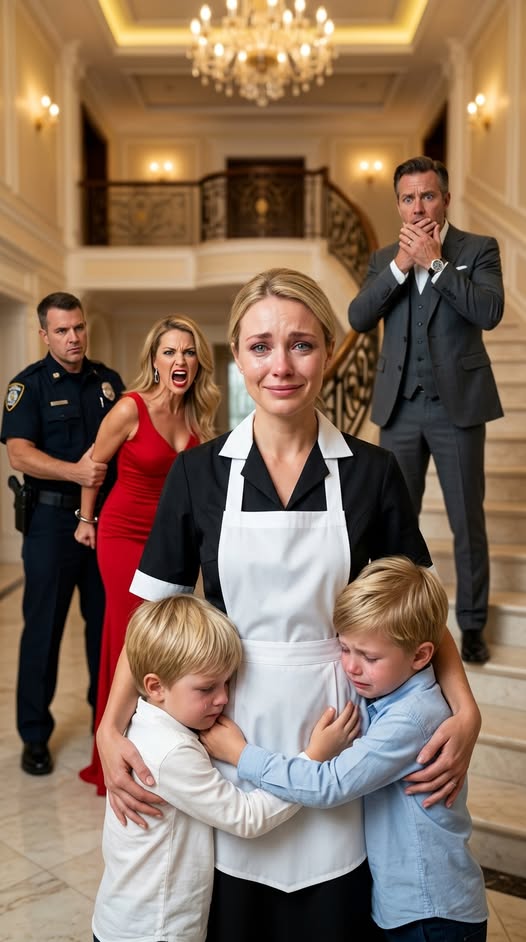
She was carrying a woven basket of folded towels. She stopped suddenly in front of the cleaning closet, her head tilting as if she had heard a faint vibration through the wood. Then, she dropped the basket so fast that crisp white towels spilled like ghosts across the marble floor. She opened the door. Noah stumbled out. Even through the grainy, pixelated camera footage, I could see his small body vibrating with tremors. He lunged forward, clinging to Lily’s waist with both arms, burying his face in her apron. She crouched in front of him, her hands frantically wiping his tears,
checking his pale face, her lips moving rapidly in a desperate whisper I could not hear. Then, she looked over her shoulder. She was afraid. Not of the dark. Not of the sobbing child. She was terrified of my wife. My stomach turned violently, an acidic surge of nausea rising in my throat.
I clicked the next saved clip. Another day. Liam refused to eat his broccoli at dinner. Caroline smiled coldly, a terrifying, statuesque grimace. She waited until I walked out of the dining room to take a business call. The second I was gone, she grabbed him by his fragile wrist, her manicured
nails digging into his skin, and dragged him down that same hallway. Lily followed at a distance, her body language screaming a silent battle between paralyzing fear and desperate duty. The closet door closed. Seven minutes later, Lily returned with shaking hands and unlocked it. Liam came
out sobbing, his chest heaving. Lily held him against her chest while looking toward the grand staircase, terrified of being caught offering him comfort.
I clicked another clip.
Then another.
Then another.
By the fifth video, I was no longer drawing oxygen normally. The air in my lungs felt like shattered glass.
By the tenth, the horrific truth settled over me like a burial shroud.
This was not a bad day.
This was not maternal stress.
This was not a tragic misunderstanding.
This was a calculated, sustained pattern of abuse.
It was a secret system of psychological torture happening under my own roof while I was away running medical clinics, attending black-tie charity dinners, signing multi-million dollar contracts, and blindly believing my sons were perfectly safe because they lived inside an impenetrable fortress. I thought the gates, the cameras, the private drivers, and the army of housekeepers were enough. I thought money was a shield.
I had built an empire of private medical centers across New York and New Jersey.
I knew how to read fear in patients’ eyes.
I knew the clinical signs of trauma.
Yet, I had completely missed the symptoms in my own flesh and blood.
That realization hit me harder than the betrayal itself. I was not just violently furious at Caroline. I was disgusted by my own negligence.
The heavy door to my office clicked open behind me.
Caroline walked in wearing a flowing silk blouse and diamond earrings that caught the ambient light. She was holding a chilled glass of white wine, strolling with the casual grace of a woman whose day had been merely inconvenient.
“There you are,” she murmured, her voice smooth and melodic. “I’ve been looking for you.”
I did not turn around. I couldn’t. If I looked at her, I wasn’t sure what I would do.
On the monitor, the paused frame showed Lily kneeling beside Noah outside the closet, one hand tenderly cupping his tear-streaked cheek, the other completely enveloping his tiny, trembling fingers.
Caroline’s designer heels stopped clicking against the hardwood floor.
The silence in the room shifted, growing thick and heavy.
“What are you watching?” she asked.
My voice came out as a low, unrecognizable rasp. “The truth.”
She did not answer.
I finally pushed my chair back and slowly turned to face her.
For the first time since the day I had married her, I saw genuine, raw fear break through the flawless porcelain of her face.
It wasn’t guilt.
It was the panicked terror of a narcissist realizing they were exposed.
That subtle difference in her eyes told me everything I ever needed to know about the woman I had sworn to love.
“You planted your grandmother’s vintage jewelry in Lily’s backpack,” I said, the words falling like stones between us.
Caroline’s mouth parted slightly.
Then, she recovered.
Fast.
Too fast.
“Alexander, listen to me,” she cooed, taking a measured step forward. “You’re upset. You don’t understand what happened today.”
I stood up slowly, planting my feet to keep from shaking.
“I watched you take the jewelry from your own walk-in closet.”
Her eyes darted nervously to the glowing monitor behind me.
“I was testing her.”
“You called the police,” I countered, my volume rising.
“She needed to learn her place—”
“You had her handcuffed and dragged out of this house in front of my sons!”
“Our sons,” she snapped back, her mask slipping to reveal the venom underneath.
The words detonated inside my chest.
“No,” I growled, stepping into her space. “Not when you lock them in a dark closet.”
Her face went bone-white.
For a fraction of a second, she looked as if I had physically struck her.
Then, she did the unthinkable.
She laughed.
It was a small, breathless, incredibly ugly sound.
“Oh, please,” she scoffed, waving her free hand dismissively. “Don’t be so terribly dramatic. They’re children, Alexander. They exaggerate everything. The utility closet is not a medieval dungeon.”
I stared at her, utterly paralyzed by the sheer sociopathy of her statement.
The woman standing in front of me was draped in diamonds I had purchased, standing in a mansion I had paid for, mere hours after calling the police on the young, impoverished woman who had secretly been the only shield protecting my children from her cruelty.
And she genuinely believed my reaction was the problem.
“You grabbed Noah by the arm,” I said, my voice dropping to a lethal calm. “You locked a six-year-old in pitch blackness for twenty-seven minutes.”
Carolineslammed her wineglass down on my desk with a sharp, glass-rattling clack.
“Because he ruined a $30,000 Persian rug with his juice!”
“He is six.”
“He is old enough to learn consequences!”
I closed the distance between us until she was forced to look up at me.
“Consequences are losing dessert. Consequences are sitting in a chair and apologizing. Consequences are not being dragged into a suffocatingly dark closet until his body physically shakes from terror.”
Her eyes hardened into twin chips of flint.
“You don’t know what it is like to be stuck here all day with them. You are always at the clinics.”
“No,” I agreed softly. “I don’t. But Lily did. And she never abused them.”
Caroline’s mouth twisted into a vicious sneer.
“Lily,” she spat, the name dripping with disgust. “Of course, this is all about her. Poor little saint Lily, the devoted peasant nanny. Do you have any idea how pathetic you sound, defending the help over your own wife?”
There it was.
The rotting core beneath the polished, high-society surface.
I had seen fleeting glimpses of it over the years. The condescending tone she used with waitstaff at expensive restaurants. The vicious way she complained about housekeepers. The way she wielded the word “staff” like it denoted a sub-human species.
But I had cowardly justified it. I had called it her elite upbringing. Her class expectations. A momentary bad temper. I had softened the edges of her cruelty in my own mind because facing the unvarnished truth would have required me to admit a devastating failure: I had willingly brought a monster into my children’s sanctuary.
“Her name is Lily,” I said, pronouncing every syllable with ironclad respect. “And she is the only reason my sons survived your punishments.”
Caroline stumbled back a step, looking at me as if I were something vile she had scraped off her shoe.
“You are losing your mind.”
“No,” I corrected her. “I am finally finding it.”
She reached her hand toward her pocket, pulling out her phone.
I caught the motion instantly.
“Do not call anyone.”
Her eyes flashed with defiant rage. “You don’t get to order me around in my own home.”
“You called the police on an innocent woman. You committed felony evidence tampering to frame her for theft. You systematically abused our children. Right now, Caroline, the only thing standing between you and catastrophic consequences is how carefully I choose my next move.”
For the first time in our eight-year marriage, Caroline had nothing to say.
I picked up my cell phone from the desk.
My hands were finally steady.
I called my corporate attorney.
Then, I called the local police precinct.
Finally, I called the pediatric family therapist my colleagues had once casually recommended—the one Caroline had aggressively dismissed as “a ridiculous waste of time” when Noah started suffering from severe night terrors.
Caroline stood rooted to the floor, watching me make every single call.
By the time I hung up with the precinct, she was crying.
They were not real tears.
They were strategic, calculated drops of moisture.
“Alexander,” she whispered, letting her voice break perfectly as she stepped toward me, reaching for my shirt. “Please. Think about what you’re doing. Don’t destroy our family.”
I looked down at her manicured hands, then up into her calculating eyes.
“Our family was being destroyed in a closet while I was away. I am just putting out the fire.”
She flinched, pulling her hands back as if burned.
Good.
I walked past her without another word and headed downstairs.
The silence of the house felt different now. It wasn’t peaceful; it was a crime scene waiting to be processed.
Noah and Liam were sitting on the cold kitchen floor, their backs pressed against the marble island, their small knees pulled tightly to their chests. Our head housekeeper, Rosa, had draped them in heavy fleece blankets and placed mugs of hot chocolate in front of them, but the marshmallows were melting untouched.
Their red, swollen eyes darted up when they saw me enter.
They instinctively flinched, shrinking back against the cabinets. They looked terrified of what my mood would dictate next.
That micro-expression of fear directed at me broke something fundamental inside my soul.
I dropped to my knees on the hard floor, uncaring about my tailored suit, bringing myself down to their eye level.
“I saw the cameras,” I said, keeping my voice as soft as a whisper.
Liam’s lower lip trembled violently. “Are… are you mad at us?”
I had never hated a question more in my entire life.
“No, buddy,” I choked out, a raw sob threatening to break my composure. “I am not mad at you. I could never be mad at you.”
Noah refused to look up from the grout lines in the floor. “Mom said if we told you… Lupi would go to jail forever. She said it would be our fault.”
I closed my eyes for one agonizing second, battling a surge of homicidal rage toward the woman upstairs.
When I opened them, I forced a gentle smile, because my overwhelming anger was a burden they should never have to carry.
“Your mom lied to you.”
Liam cracked first. He threw off his blanket and scrambled into my arms, burying his wet face in my neck.
Noah hesitated.
He was always the quieter one. The observer. The child who had learned entirely too early that absolute silence sometimes felt safer than the risk of the truth.