The night my husband threw me out, it was raining so hard the street looked like shattered black glass. He did not even let me take an umbrella. “Three years,” Julian said, standing in the doorway of the sprawling colonial house I had paid half the mortgage on. His voice was remarkably steady, lacking any of the heat one might expect from a dying marriage. “Three useless years, Clara. No child. No legacy. Nothing.” Behind him, seated comfortably in the foyer’s leather armchair, his mother, Evelyn, smiled over the gold rim of her chamomile tea cup. The scent of it—sweet, floral, cloying—drifted out into the damp night air, making my stomach turn. And then there was Chloe. His new woman leaned against the sweeping mahogany staircase, wrapped in my ivory silk robe. My silk robe. The one I had bought in Milan on our honeymoon. I stood on the porch, the freezing rain already beginning to soak through my thin trench coat, and looked down at the single piece of luggage Julian had packed for me. It was a flimsy, carry-on weekender. Inside, I knew, were exactly two sweaters, one pair of sensible walking shoes, and my grandmother’s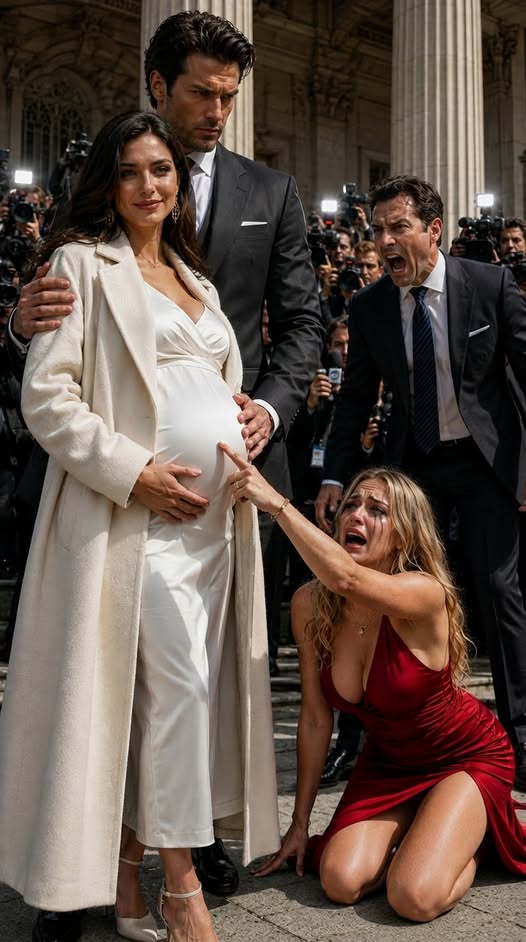
silver-framed photograph, the glass newly cracked diagonally across her smiling face. “That’s all?” I asked, my voice barely audible over the drumming rain. Julian’s mouth twisted into a smirk masquerading as a grimace. “You should be profoundly grateful I’m not asking for financial compensation.” “For what?” I shot back, a sudden spike of adrenaline piercing through the shock. “For wasting my youth,” he replied coldly. From the armchair, Evelyn laughed softly, a dry, papery sound. “Don’t make a scene, dear. Women like you age terribly when they cry. It ruins the
capillaries.” I did not cry. My eyes were dry, burning with a strange, sudden clarity. That lack of tears seemed to irritate them more than a screaming fit ever could have. Julian stepped closer to the threshold, his polished Italian loafers stopping exactly one inch from the wet porch. He
lowered his voice to a conspiratorial, venomous whisper. “The monthly allowance stops tonight. The joint accounts are frozen. My legal team will contact you in the morning. Sign the dissolution papers quietly, without a fuss, and I might generously provide you enough to rent a studio
apartment in the suburbs.”
“You froze my accounts?” The words felt heavy, foreign in my mouth.
“Our accounts,” he corrected smoothly. “My company’s money.”
Chloe shifted on the stairs, lifting her left hand to casually inspect her nails. The foyer chandelier caught the massive diamond ring sparkling on her finger. It was the exact ring I had found hidden in Julian’s study drawer six months ago. When I had asked him about it, he had claimed it was a corporate gift for a retiring executive.
“Don’t worry about the legacy, Julian,” Chloe cooed, looking directly at me with dead, beautiful eyes. “I’ll give him beautiful children.”
Those words hit far harder than the freezing rain.
For three agonizing years, I had surrendered my body to the relentless machinery of modern medicine. I had swallowed a pharmacy of hormones, endured agonizing abdominal surgeries, tracked my temperature until it became an obsession, and withstood the pitying whispers of Evelyn’s social circle. I had felt like a defective machine. And through it all, Julian had never once submitted to a comprehensive fertility panel himself. His mother had repeatedly assured me that “real men” with his pedigree did not need to prove their virility; the flaw, naturally, resided in the outsider. Me.
I reached down and gripped the handle of the cheap suitcase. My knuckles turned white.
“You’re making a catastrophic mistake,” I said, my voice finally finding its steel.
Julian laughed, a booming, dismissive sound that echoed out into the storm. “No, Clara. I finally corrected one.”
He slammed the heavy oak door. The deadbolt clicked shut like a gunshot.
I stood in the torrential downpour until the automatic porch lights timed out, plunging me into darkness. The headlights of a passing car washed over me, illuminating the sheets of rain bouncing off the asphalt. I had nowhere to go. My phone was locked inside. My wallet was empty.
From the deep shadows of the porch next door, a rough, gravelly voice cut through the howling wind.
“You’ll catch pneumonia out here long before you catch justice, girl.”
I spun around, nearly slipping on the wet slate.
The neighbor was watching me from under the sickly yellow glow of his bug light. Everyone in the gated community knew him only as Mr. Hayes, the reclusive, eccentric veteran who lived in the imposing brick fortress at the end of the cul-de-sac. He walked with a heavy iron cane, never attended neighborhood association meetings, and received strange, tinted black SUVs at his gates at midnight.
His face was deeply lined, marked by a faded scar that ran from his temple to his jaw, but his eyes were perfectly calm. They were the color of winter steel.
“I don’t need pity,” I yelled over the storm, wrapping my arms around myself.
“Good,” he replied, not raising his voice, yet somehow carrying perfectly over the distance. “I don’t offer pity.”
He pushed his heavy front door open, revealing a sliver of warm, golden light.
“I offer contracts.”
I stared at him, shivering violently, paralyzed by the sheer absurdity of the moment.
He didn’t look at me. He looked past me, his gaze fixing on Julian’s glowing, triumphant windows.
“Come inside, Mrs. Vale,” he said, his tone shifting into something that sounded dangerously like a commanding officer. “Your husband just declared a war on the absolute wrong woman.”
For the first time in what felt like three years, the corners of my mouth twitched upward.
“My name is Clara,” I said, stepping off the curb and into the puddles.
“And mine,” the old man answered as I reached his steps, “is not Hayes.”
Inside the veteran’s house, there were none of the things I had expected. There were no dusty glass cases of military medals, no faded, sad photographs of lost comrades, no cheap, worn-out recliner facing a blaring television.
Instead, it looked like a high-end corporate command center stripped of all pretense.
There were glowing security screens mounted on reinforced walls. Thick, biometric wall safes. A private, brushed-steel elevator in a house that only had two stories. Most jarringly, in the corner of the massive kitchen, there was a medical-grade refrigerator humming quietly behind a locked, tinted glass panel.
I probably should have run back out into the rain.
Instead, I sat perfectly still at his massive granite kitchen table, soaked to the bone, trembling, while he placed a thick, heated towel over my shoulders. He moved with a quiet, deliberate efficiency.
“You know what Julian did,” I said, pulling the warm towel tighter around my neck.
“I know far more than that.” The man who called himself Hayes walked to a metal filing cabinet, unlocked it with a fingerprint scan, and pulled out a thick, manila folder. He slid it across the smooth granite. “I know he systematically moved seven figures of marital assets through three offshore shell companies over the last fourteen months. I know his mother, Evelyn, forged your signature on the secondary clinic consent forms to hide data from you. I know Chloe was being heavily compensated from his company’s ‘consulting’ funds long before she formally became his mistress.”
My fingers went entirely numb. The cold from the rain seemed to seep directly into my bones.
“How?” I breathed. “How could you possibly know any of this?”
The old man’s eyes remained completely impassive. “Because your arrogant husband attempted to aggressively purchase my land last year to build his new guest compound. When I politely declined, he sent three private security contractors to physically intimidate me.”
“And?” I asked, my heart hammering against my ribs.
“They apologized,” he stated simply, offering no further elaboration.
I reached out with a shaking hand and opened the folder.
It was a meticulous chronicle of betrayal. Bank transfer receipts. Hidden property deeds. Internal clinic emails. But then, near the bottom of the stack, I saw a document printed on the heavy, textured paper of my fertility clinic. It was a comprehensive medical report. A report Julian had deliberately hidden from me.
I scanned the medical jargon, my eyes finally locking onto a single, bolded line of text.
Patient Name: Julian Vale. Diagnosis: Male factor infertility – severe and irreversible.
My breath caught in my throat. The room seemed to pull away from me.
“He knew,” I whispered, a sickening wave of nausea washing over me.
“Yes.”
“All those needles,” I choked out, tears finally breaking free, hot and angry down my frozen cheeks. “The surgeries. The hormones that made me feel crazy. All those nights I lay awake, crying, begging God to fix my broken body. I blamed myself for every single negative test.”
The old man said nothing. He didn’t offer a platitude. He didn’t reach out to pat my hand. That stoic, respectful silence was infinitely kinder than any hollow comfort he could have offered.
He let me read the document three times until the reality of the horror settled into my blood. Then, he made the proposition.
“I run a foundation,” he said, taking a seat across from me. “We handle veterans’ affairs, orphan advocacy, and heavily fund aggressive medical research. I am currently in need of a director for our public health division. I require someone with discipline, absolute discretion, and someone who has nothing left to fear. Take the position, Clara. I will provide a top-tier executive salary, secure housing on my estate grounds, and an army of legal protection. In return, you stop thinking, acting, and breathing like a victim.”
I looked up at him, letting out a sharp, broken laugh. “That’s your master plan? Offer a homeless, unemployed, discarded housewife a corporate executive job?”
“No.” He reached back into the folder and pulled out a smaller, blue-tabbed file. “That is merely the beginning of the campaign. The real asset is here. You froze seven viable embryos three years ago, just before your first invasive surgery. Julian signed the initial consent forms to appease you, then quietly buried the subsequent paperwork when his own secret test came back catastrophic. Legally, because of a loophole in how his mother forged the later destruction orders, they belong solely to you.”
The room violently tilted. I gripped the edge of the granite table.
“My… my embryos?”
“Your embryos. Alive. Safe. Waiting.” He leaned forward, his steel eyes locking onto mine. “Now, do you want to cry, Clara? Or do you want to go to war?”
Six weeks later, I was living in the secure guest wing of his sprawling countryside estate under an assumed maiden name.
Three months later, I was entirely running the Sterling Foundation’s public health division, managing a budget that dwarfed Julian’s entire corporate net worth.
Five months later, Julian officially sued me.
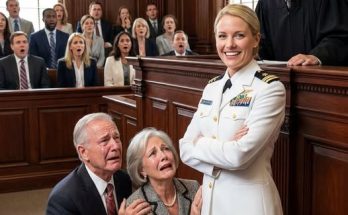
He filed a highly publicized lawsuit for “fraudulent abandonment,” claiming I had stolen priceless family heirlooms and embezzled from his private accounts before fleeing into the night. It was a classic Julian Vale maneuver: attack first, control the narrative, crush the opponent under a mountain of expensive legal filings.
He looked absolutely delighted on the morning of the preliminary hearing. He stood outside the towering granite columns of the downtown courthouse, dressed in a bespoke charcoal gray suit. Chloe hung off his arm, draped in designer labels, while Evelyn stood behind him, surveying the crowd like a crowned snake in pearls.
“You look remarkably tired, Clara,” Julian said loudly as I approached the steps, ensuring the smattering of local reporters caught the exchange. “Poverty and isolation really do suit you.”
I paused, looking down at my tailored, unbranded black wool coat. “Does it?”
Chloe’s heavily mascaraed eyes dropped immediately to my stomach.
I wasn’t showing yet.
Not quite enough.
Julian leaned in close, his cologne suffocating. “You should have signed the papers that night. I gave you an out. Now, my lawyers are going to take whatever microscopic shred of pride you have left. I’m going to ruin you in that room.”
I looked over his shoulder at his high-priced defense attorney, who was grinning smugly. Then, I looked at the flashing cameras waiting just beyond the security checkpoint.
“You always did love a captive audience, Julian,” I said softly.
Evelyn stepped forward, her smile dripping with venom. “Poor, delusional girl. Still pretending she has any cards left to play in this game.”
I didn’t answer. I simply walked past them and through the metal detectors.
That afternoon, after the preliminary circus concluded, my benefactor brought me to a private, hyper-secure clinic located on the top floor of a high-rise hospital that bore no name on its frosted glass doors.
Doctors whose faces I recognized from international medical journals greeted the old man not just with respect, but with absolute reverence.
One surgeon had recently separated conjoined twins for a European royal family. Another had pioneered a revolutionary fetal surgery technique.
A celebrity obstetrician with impeccably styled silver hair walked into my examination room, reviewed my chart, and warmly shook my hand. “Mrs. Vale, it is a profound honor. We will take excellent, unparalleled care of you and the twins.”
Twins.