I glanced at Miles. All the blood had vanished from his face, leaving him a sickening shade of gray. He looked like a man watching a tidal wave crest over his head. Genevieve’s expression was morphing rapidly: from polite confusion, to stunned disbelief, to the very first, terrifying cracks of suspicion. My mother, driven by decades of desperate damage control, broke the paralysis. She practically sprinted across the carpet, her heels sinking into the plush wool, emitting a high-pitched, manic laugh. “Oh, Theodore! You know our Audra!” she babbled, attempting to physically insert herself between the judge and me. “She is just so terribly modest! She absolutely hates the spotlight, practically begged us to let her sit back here in the quiet!” Judge Ward did not even dignify my mother with a glance. His focus remained locked onto my face, his sharp eyes narrowing as his legendary deductive reasoning kicked into gear. “Why didn’t you inform me you were coming?” he asked me softly, ignoring Evelyn entirely. I opened my mouth, debating how much rope to hand my family, but I was spared the decision. From the adjacent table, Judge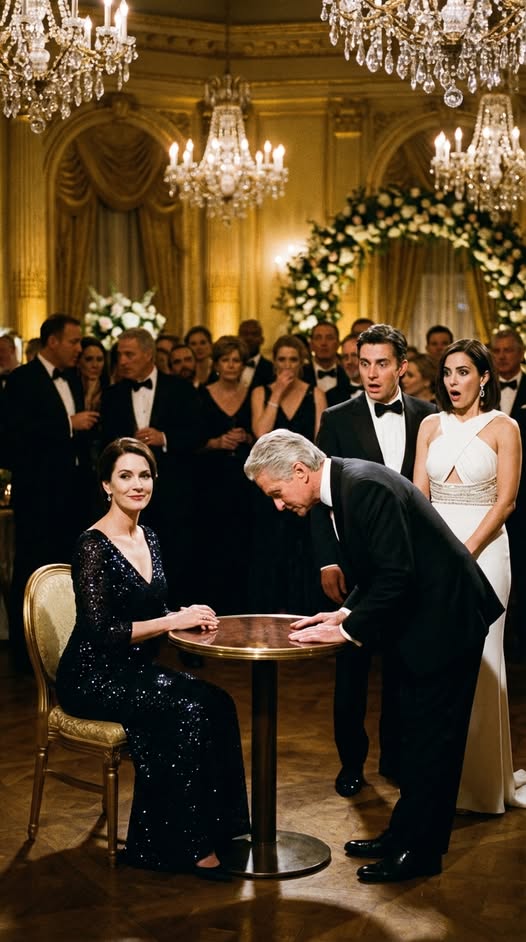
Miriam Caldwell rose with the slow, unhurried grace of an apex predator. The sea of guests literally parted for her as she approached. “Theodore,” Miriam said, her voice smooth as aged bourbon. “I had a distinct suspicion this evening might contain a few surprises.” Ward spun around. The shock of finding one federal judge by the kitchen was massive; finding two was paralyzing. “Miriam? Good lord. Did you bring her?” “Of course I brought her,” Miriam replied, a dangerous, elegant smile playing on her lips. “Though I confess, I was taking bets with myself on precisely how long
it would take someone in this establishment to realize exactly who had been shoved into the back of the room.” There was nowhere left to hide. The illusions were evaporating under the harsh glare of judicial scrutiny. Ward looked from Miriam, to me, and finally, his gaze swept across the
room to the head table. Miles was still standing there, practically vibrating with terror beside the woman he was attempting to con into marriage. Theodore Ward lowered his voice, but the acoustic design of the room carried every syllable. “Miles. Why is Judge Audra Cole seated at a two-
top by the service door?” Miles opened his mouth. His jaw worked, but no sound emerged. He offered a sickly, terrified smile that collapsed instantly. “There was… a clerical error with the seating chart,” he stammered out, his voice cracking. “And you know… Audra doesn’t really care where
she sits.” It was a tiny, pathetic sentence, but it was the final nail in his coffin. It encapsulated his entire worldview: his assumption that he could dictate my worth, and his absolute certainty that I would absorb his disrespect in silence. Judge Ward’s eyes went dark. Genevieve stared at her
fiancé as if a stranger had just unzipped his skin.
And then, Theodore Ward did the most devastating thing a man of his stature could do. He pulled out the empty chair directly across from me at the tiny, shadowy table, and he sat down. He abandoned the head table entirely.
He didn’t scream. He didn’t cause a scene. He simply weaponized his presence, making it brutally clear to the entire room exactly who commanded his respect. And watching Miles physically wither under the weight of that realization, I knew the execution was just beginning.
Chapter 4: The Verdict Delivered
For five interminable seconds, the dining room existed in a vacuum. The waitstaff, possessing that sixth sense for impending carnage, had vanished through the swinging doors like ghosts.
Miles remained anchored beside the head table, one hand half-raised in a pathetic, aborted gesture, as if he believed he could still orchestrate his way out of the abyss if he could just conjure the perfect sequence of lies.
He couldn’t.
Judge Ward rested his forearms on my tiny table, his hands loosely clasped. When he spoke, his voice was conversational, which somehow made it infinitely more terrifying.
“I asked a very straightforward question, Miles,” Ward said, projecting across the silent room. “Why is a sitting federal judge relegated to the shadows?”
My mother threw herself onto the grenade. “Theodore, please, it was just a dreadful mix-up with the venue coordinator!” Evelyn babbled, her hands fluttering wildly. “Everything has been so chaotic, so rushed! Nobody meant anything malicious by it, I assure you!”
Miriam Caldwell did not allow her to complete a third sentence.
“I think the seating arrangement was exceptionally intentional,” Miriam stated, her voice slicing through my mother’s hysteria like a cleaver.
Miriam reached into her designer clutch and retrieved her smartphone. She looked at me, her eyebrows raised in a silent question, offering me one final chance to abort the strike. I held her gaze and gave a microscopic shake of my head. I wasn’t backing down.
Miriam turned the screen outward so the bright light caught the dim ambiance of the room. She didn’t summarize. She didn’t soften the blow. She read my brother’s exact, unedited text message aloud to the frozen audience.
“You can attend the dinner, but do not tell anyone you are my sister. Her father is a federal judge, and it would be embarrassing.”
The silence that followed was apocalyptic. It was the devastating quiet that occurs when denial is stripped away, because every single person in the room has digested the exact same truth simultaneously.
Genevieve stared at Miles, her eyes wide, waiting for him to burst into laughter, to declare it a horrific prank, to offer any plausible deniability. But Miles was paralyzed. My father, coward that he was, was intensely studying the weave of the tablecloth. My mother looked as though she might physically vomit.
Judge Ward extended a steady hand. “May I?”
Miriam handed him the phone. He read the glowing screen himself. Once. Twice. When he finally looked up, his face had hardened into the impassive, terrifying mask of a magistrate about to deliver a maximum sentence. The warm, social host was dead. The judge had arrived.
“Is this correspondence authentic, Miles?” Ward asked, the temperature of the room dropping ten degrees.
Miles swallowed audibly. “It… it looks incredibly bad out of context, sir.”
Out of context. Even staring into the sun, my brother’s narcissism demanded a better filter. He wasn’t ashamed of the cruelty; he was aggrieved by the lighting.
Genevieve let out a sound—a sharp, ragged intake of breath that was half-sob, half-scoff. The confusion had fully metastasized into absolute, blinding disgust.
She turned on him, her voice trembling with barely suppressed rage. “You explicitly told me she did basic data entry at the courthouse! You told me she was a recluse who despised formal events! You told me you barely spoke to her because she was difficult!”
Miles attempted to plug all three leaks simultaneously, tangling himself in a web of frantic desperation. “Gen, baby, please, I was just trying to keep the evening streamlined! I didn’t want things to be awkward! I thought introducing a federal judge would steal the focus away from us, from our night!”
Theodore Ward raised a single hand, and Miles’s frantic babbling ceased instantly.
“No, son,” Ward said, his voice ringing with absolute, crushing finality. “What you feared was comparison.”
He set Miriam’s phone down on the table with a soft click. “You did not hide your sister to protect the sanctity of this dinner. You hid her because you knew, deep in your marrow, that the truth of her existence would make every inflated story you have ever told about yourself look profoundly small.”
No one leaped to Miles’s defense, because the surgical accuracy of the statement left no room for debate. The truth hit the room like a physical shockwave.
Genevieve’s face tightened. The humiliation of being deceived was warring with the furious realization that she had been weaponized as an accessory to my erasure. “How many times have you done this?” she demanded, stepping away from him. “Did your parents know?”
Evelyn and my father failed to answer quickly enough. Their terrified hesitation was a full confession.
Miriam, sensing the kill, applied the final pressure. “For the record,” she announced to the room, “Judge Cole spent years prosecuting the kind of complex corruption cases that send arrogant men to federal prison. Her mind is revered in legal circles across this country. Anyone in this room who claims to respect the law should have known her name long before the appetizers were served.”
Ward nodded in solemn agreement. He looked at his daughter, his eyes softening slightly with paternal grief before hardening again. “I have literally recommended her legal reasoning to my brightest clerks. And this man,” Ward pointed a heavy finger at Miles, “shoved her by a service door because he believed her brilliance might tarnish his reflection.”
Miles physically shrank. His broad shoulders caved inward. The golden boy armor had shattered into dust. He took a stumbling, desperate step toward my table, finally attempting to speak to me, the sister he had spent a lifetime diminishing.
I sat perfectly still, my posture immaculate. I didn’t glare. I didn’t sneer. I simply looked at him with the cold, unbothered detachment of a scientist observing an insect trapped under glass.
“Audra…” he pleaded, his voice breaking.
And as he reached a trembling hand toward me, Genevieve Ward reached for her left hand and slowly began to slide her blinding engagement ring off her finger.
Chapter 5: The Collapse of the Facade
The removal of the ring was not executed with theatrical flair. Genevieve did not weep. She did not hurl the diamond across the room or deliver a hysterical monologue about betrayal.
She simply pulled the heavy platinum band over her knuckle, stared at it for a fraction of a second as if it belonged to a dead woman, and set it down next to her water goblet. The faint clink of the metal striking the mahogany table sounded louder than a bomb blast.
Miles stared at the jewelry as if it were a venomous snake. His lungs hitched. For the first time all evening, the slick veneer of social embarrassment melted away, revealing pure, unadulterated panic.
“Gen…” he choked out, stepping toward her, his hands raised in surrender. “Please. We can fix this.”
Genevieve didn’t even bother to sit back down in her chair. She looked at him with eyes entirely devoid of warmth. “You didn’t just lie to me about her occupation, Miles,” she said, her voice eerily calm. “You lied about the fundamental core of the man you are.”
Driven by sheer, blind desperation, Miles pivoted. He did what he had always been conditioned to do when his life caught fire: he ran toward the designated family shock-absorber. He crossed the carpet, stopping inches from my small table, leaning over me with a wild, strained urgency.
“Audra, please,” he begged, his voice dropping to a frantic whisper meant only for me. “Can we please just step out into the hallway for two minutes? Can we just talk?”
He asked it as if I owed him my complicity. He expected me to shield him from the public execution, to help him contain the radioactive fallout of his own arrogance. Looking up into his terrified, sweating face, I finally saw the absolute truth of my brother. He wasn’t begging because he grasped the profound cruelty of his actions; he was begging because the universe had abruptly stopped rewarding him for them.
I did not break eye contact. I did not lower my voice to protect his dignity.
“No, Miles,” I said, my voice carrying clearly to every corner of the silent room. “You were perfectly comfortable attempting to humiliate me in front of a room full of strangers. You can listen to my answer in front of them, too.”
He flinched violently, as if I had struck him across the jaw with a closed fist. Several guests at the main table suddenly found their napkins fascinating, unable to bear the sheer brutality of his public dismantling.
Judge Theodore Ward stood up. He moved with the heavy, undeniable authority of a man rendering a final verdict. He turned to his daughter. “Genevieve, gather your coat, please.”
He then shifted his imposing gaze to my brother. “The wedding is indefinitely canceled. There will be no further discussions regarding financial obligations, event planning, or familial integration. Have a good evening.”
The sentence was absolute. There was no appeals process.
My mother finally shattered. “Theodore, you cannot be serious!” Evelyn wailed, tears streaking her expensive makeup. “You are overreacting! Families have disagreements! Miles made a foolish mistake, but he shouldn’t lose his entire future over one stupid text message!”
Miriam Caldwell adjusted her silk scarf and looked at my mother with withering disdain. “Evelyn, this was not one isolated text message. This was a lifelong pathology that finally had the misfortune of encountering credible witnesses.”
The truth of Miriam’s words stripped the final layer of defense from the room. The text was merely the smoking gun; the crime had been ongoing for decades. My father opened his mouth, perhaps attempting to salvage some scrap of patriarchal dignity, but the words died in his throat. He had spent his entire life remaining silent while I was diminished. It was far too late to pretend he possessed a spine now.
Genevieve returned from the cloakroom, her cashmere coat draped over her arm. She didn’t spare Miles a final glance. She walked directly to my tiny table in the shadows.
The humiliation was etched deeply into her features, but beneath the shock, I saw a remarkable, steely gratitude.
“I am so incredibly sorry, Audra,” Genevieve said softly. “I should have asked harder questions.”
“You only knew the fiction you were presented with,” I replied with a nod. “Take care of yourself.”
She left with her parents. The moment the heavy oak doors of the private dining room clicked shut behind the Ward family, the ambient temperature of the room plummeted. The dinner was over, though the entrees had barely been touched. The polished, glittering illusion of my brother’s supremacy had burned to ash.
Miles stood entirely alone in the center of the room. He turned toward me, his shoulders slumped, looking small and broken. “Audra…” he whispered, using the childhood tone that used to successfully manipulate me into doing his homework.
I stood up, pushing my chair in meticulously. “There is absolutely nothing left to discuss, Miles,” I said, my voice devoid of anger or pity. “Not tonight. Not in private. I am no longer available to be pruned so that you can bloom.”
I retrieved my evening bag. Miriam rose seamlessly beside me. We walked toward the exit, our heels clicking rhythmically against the hardwood. I could feel the horrified stares of my parents burning into my back, but for the first time in thirty-nine years, their attention didn’t feel like a condemnation. It felt like a coronation.
Outside, the brutal Boston wind bit into my cheeks, clearing the last remnants of the stagnant dining room air from my lungs. Miriam paused at the curb, signaling for her driver.
“Are you all right, Audra?” she asked quietly.
I paused, looking back through the frosted glass of the Union Club windows. I could just make out the silhouette of my brother, still standing exactly where I had abandoned him, marooned in the wreckage of a kingdom he had tried to build on my ghost.
I turned back to the freezing night air, a profound, terrifying lightness expanding in my chest. “I am now.”
But as the town car pulled away from the curb, I knew the true devastation for my family was only just beginning. The weekend would end, and Monday morning was waiting.
Chapter 6: The Bench and the Boundaries
By the time the sun rose on Monday, the story had already metastasized through the exclusive, mahogany-lined corridors of Boston’s legal elite.
I didn’t utter a single syllable to anyone. I didn’t need to. Rooms populated by men like Theodore Ward possess a highly efficient, invisible nervous system. A canceled high-society wedding is merely juicy gossip. A canceled high-society wedding triggered by an arrogant junior partner attempting to erase his sister—who happens to be a universally respected federal judge—is a radioactive warning siren.
Within five days, the meticulously curated facade of Miles’s career began to violently fracture.
A senior managing partner at his prestigious law firm was a longtime golfing companion of Judge Ward. My brother was summoned to an unannounced, closed-door meeting on the 40th floor. They didn’t accuse him of malpractice or criminal negligence. They did something far more lethal in corporate law: they questioned his fundamental judgment, his integrity, and the authenticity of the persona he had been hawking to their elite clientele.
In that ruthless echelon of power, a man can easily survive being disliked. What he cannot survive is being exposed as deeply insecure, vain, and fundamentally untrustworthy.
First, Miles was quietly scrubbed from a major client-development initiative. Next, the internal partnership votes he had spent years bribing his way toward evaporated overnight. Three agonizing weeks later, the firm formally requested his resignation. They couched it in polite, corporate legalese, ensuring the bloodstains looked civilized, but it was an unceremonious execution.
The dominoes fell with terrifying speed. Stripped of the six-figure salary, the impending Ward family trust fund, and the social elevation he had banked his entire existence on, his reality collapsed. The luxury penthouse lease he had signed in anticipation of his marital wealth was abruptly broken. The German sports car was repossessed. By late January, the very man who had deemed me too embarrassing to acknowledge was leaving desperate voicemails for contacts he had previously sneered at, begging for entry-level associate positions.
Most of them let him go straight to voicemail.
My parents, true to their pathological conditioning, attempted to aggressively rewrite history.
First, they flooded my inbox, pleading with me to intervene and “save” him. When I ignored them, my mother pivoted to weaponized guilt, sending a manifesto detailing the sacred bonds of blood and how I was “allowing an outsider to destroy our family.” I read precisely three sentences before permanently blocking her email address.
My father left a slurry of exhausted, pathetic voicemails. He claimed Miles was suicidal with stress. He claimed the family was disintegrating. He utilized the ultimate manipulative trump card: You have always been the stronger one, Audra. You need to know when to let things go.
That voicemail was the final key turning in the lock. I finally understood their core desperation. They didn’t crave justice or reconciliation; they craved access. They desperately needed the old version of me back—the designated emotional sponge who would quietly absorb their toxicity so they could resume their lives without facing consequences.
That version of Audra was dead. I changed my personal cell phone number, initiated aggressive spam filters on my remaining accounts, and instructed the courthouse security detail to reject any unverified personal deliveries sent to my chambers. I didn’t enforce these boundaries out of lingering spite. I enforced them out of pristine, absolute clarity.
A month after the disastrous dinner, a heavy, cream-colored envelope arrived at my office. It was a handwritten note from Genevieve.
It was devoid of self-pity or dramatic flair. She thanked me for inadvertently saving her life. She wrote that witnessing the chilling ease with which a man could erase his own flesh and blood had forced her to recognize how frequently she had mistaken sociopathic charm for genuine character. She ended the letter noting that while the dinner was the most humiliating night of her life, marrying Miles would have been a terminal sentence.
I placed the letter in my desk drawer. I respect truth, especially when it is brutally earned.
As for my own trajectory, I did exactly what I had always done: I lowered my head and worked. I reviewed appellate briefs, presided over complex litigation, and constructed my jurisprudence with the same relentless discipline I had utilized since community college. But a profound, heavy weight had vanished from my shoulders. I was no longer subconsciously waiting for my bloodline to catch up to my reality.
Eleven months later, a highly coveted vacancy opened on the First Circuit Court of Appeals.
For the first time in my career, my name wasn’t just casually floated as a diversity metric; it was aggressively championed. Miriam Caldwell threw her considerable political weight behind my nomination. And Theodore Ward, a man who owed me absolutely nothing, publicly vouched for my rigorous intellect, my flawless temperament, and my unyielding spine during a judicial committee dinner. He did not do it as a favor. He did it because he believed it to be empirical fact.
The confirmation hearings were exhausting, partisan, and thoroughly exhilarating. When the final Senate vote confirmed my lifetime appointment, I didn’t weep with relief. I sat in my office, looking out at the Boston skyline, and thought about the tiny, cramped table next to the swinging kitchen doors. I thought about the sheer volume of energy my brother had expended trying to render me invisible.
And I smiled, realizing that in the end, the only person permanently erased from polite society was him.
My formal swearing-in ceremony was conducted in a packed, sun-drenched federal courtroom. The mahogany benches were overflowing with the people who had consciously chosen me. Miriam was seated in the front row. Judge Ward offered a warm, respectful nod from the aisle. My brilliant clerks, my former co-counsels, and the friends who had witnessed my darkest moments were all in attendance.
My parents were not invited. My brother did not even possess the security clearance to enter the building.
Some critics would undoubtedly label that exclusion as overly harsh or vindictive. I classify it as highly accurate. True family is not proven by the accidental sharing of genetic material, especially when that biology has been weaponized as a tool for subjugation and shame. Family is forged by mutual, unwavering respect. It is proven by the people who loudly declare their association with you in rooms where silence would be far more profitable.
That is the devastating lesson Miles Cole paid his entire future to learn.
He lost the aristocratic marriage he thought would mask his mediocrity. He lost the prestigious career built on smoke and mirrors. But the absolute most expensive asset he forfeited was a luxury he will never be able to repurchase: the right to claim a sister who would answer his calls when the world burned down.
Sometimes, the most lethal, catastrophic revenge you can exact upon the people who try to minimize you isn’t screaming, or vengeance, or public destruction.
Sometimes, the most terrifying revenge is simply standing perfectly still in the blinding light of your own truth, and letting the world watch as the people who tried to hide you burn to ash in the glare.