“Ma’am,” he said, his voice raspy but firm. “Colonel Isaac Monroe, retired. I served under General Whitaker. I just wanted to say… it’s an honor to have you here.” Trevor’s face went stiff. The Colonel turned to him, offering a polite, unaware smile. “You must be very proud. Your sister is a legend in the 1st Marine Division.” Trevor muttered something that sounded like a strangled “thanks” and dragged Melissa away. I watched them go, feeling the weight of my medals like they were made of lead. The Mirror in the Room: For the next two hours, I became an accidental landmark. It was exactly what Trevor had feared, but for reasons he couldn’t grasp. People didn’t come to me because they were “distracted.” They came because they were hungry for something real. A young woman, a nurse at a local veteran’s hospital, thanked me for the work the Corps did for wounded warriors. A college student in the ROTC program asked me how I handled the loneliness of command. But the one that broke me was the little girl from the church. She walked up to me, holding her mother’s hand, and touched the scarlet stripe on my trousers. “Are girls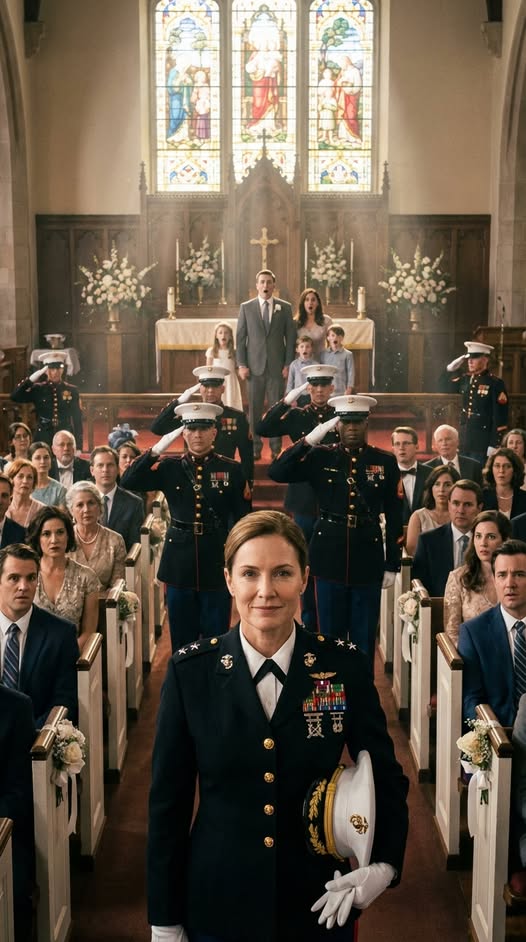
allowed to lead the whole army?” she asked. I knelt down, the fabric of my uniform stretching, and looked her in the eye. “Not the whole army, honey. But we can lead the Marines. And we can lead anything else we set our minds to.” As I stood back up, I caught my mother watching me from across the lawn. She was dabbing at her eyes with a lace handkerchief. For years, she had enabled Trevor’s resentment because it was easier than confronting it. She had encouraged me to be “less” so he could feel “more.” But seeing me with that little girl, she looked like she was finally
seeing the cost of that bargain. The anger that had sustained me all day began to dissipate, replaced by a crystalline clarity. My family’s embarrassment wasn’t about politics or “stiff” atmospheres. It was about the fact that my life required a level of discipline and sacrifice they didn’t want to
admit they lacked. It was easier to call me “embarrassing” than to admit they felt small in the shadow of a life lived for something greater than oneself. I saw Trevor standing by the stone railing at the edge of the property, looking out over the darkened golf course. He looked lonely. Despite
the tuxedo, the expensive wedding, and the curated guests, he looked like that nineteen-year-old kid again, angry that the world wasn’t bending to his will.
I walked over to him. The night air was cool, carrying the scent of cut grass and expensive perfume.
“Mom’s crying,” he said, not looking at me.
“She’s been crying since 1998, Trevor. That’s her baseline.”
He gave a sharp, involuntary huff of laughter. It was the first honest sound he’d made all day. He finally turned to me, his tuxedo tie undone, the “perfect groom” facade slipping.
“I didn’t think it would be like this,” he admitted. “I thought if you wore a dress, you’d just be my sister. I thought the General would stay in the car.”
“The General doesn’t stay in the car, Trevor. She’s the one who kept the house. She’s the one who made sure you had tuition. You can’t divide me into parts that are convenient for you.”
He looked down at his shoes. “Monroe… that Colonel. He talked to me for twenty minutes. He told me about a night in a place called the ‘Fish Market.’ He said you stayed behind to coordinate an extraction while your own convoy was under fire.”
I stayed silent. I didn’t need to tell him that I’d had nightmares about that night for a decade.
“I didn’t know that,” Trevor whispered. “You never told us.”
“Because when I come home, I want to be Danny,” I said softly. “But you wouldn’t let me be Danny. You wanted me to be a ghost.”
He swallowed hard, his jaw working. For a long moment, the only sound was the distant beat of the DJ’s music from the tent. Then, he looked up, and for the first time, I saw my brother.
“You looked… you looked incredible in the church,” he said, the words sounding like they were being pulled out of him. “I was a jerk. I was wrong to ask you to hide.”
I reached out and squeezed his arm. The fabric of his tuxedo felt thin compared to the wool of my tunic. “I accept the apology, Trevor. Now go back in there and dance with your wife.”
The Exposed Lie
I stayed until the very end. I danced with my mother, who whispered, “Your father would have given anything to see you today,” through her tears. I didn’t point out that she’d spent the last week trying to prevent that very sight. I signed a cocktail napkin for the ROTC kid. I took a photo with the little girl.
When I finally walked to my car, the stars were out over Virginia. I felt lighter than I had in years.
Families are complicated machines. They often don’t know how to handle the parts that grow faster or stronger than the rest. They try to prune you, to keep you in the “visual harmony” of their own limited expectations. But as I drove back toward Arlington, the brass buttons of my uniform glinting in the dashboard lights, I knew that the truth had been worth the friction.
I hadn’t ruined Trevor’s wedding. I had merely brought the light into a room that was too comfortable with the dark.
If this story resonated with you, I’d love to hear your thoughts. Should we ever dim our own light to make our family feel more comfortable? Or is the greatest service we can provide to those we love simply being the most authentic version of ourselves, no matter how much noise it makes?
If you want more stories like this, or if you’d like to share your thoughts about what you would have done in my situation, I’d love to hear from you. Your perspective helps these stories reach more people, so don’t be shy about commenting or sharing.