Chapter 1: The Illusion of the Bloodline: My name is Emily Carter, and until the second week of last July, I harbored a dangerous, naive delusion. I truly believed that no matter how fundamentally flawed a family might be, no matter how deep the dysfunction ran, there were invisible, sacred lines that decent human beings simply would not cross. I thought the biological imperative to protect one’s own flesh and blood was an unbreakable failsafe. I was catastrophically wrong. The shattering of my reality did not happen in the dead of night, nor was it accompanied by the dramatic swell of a movie soundtrack. It happened on a blinding, brutal Saturday in Phoenix, Arizona. It was the kind of high-summer desert day where the heat doesn’t just radiate; it suffocates. The air feels sharp enough to singe the delicate tissue of your lungs the moment you step outside, and the asphalt shimmers with a malevolent, watery mirage. I was scheduled to cover an emergency, short-notice shift at the pediatric dental clinic where I worked as a hygienist. At 7:00 a.m., my regular babysitter called, her voice thick with a sudden, violent stomach flu. Panic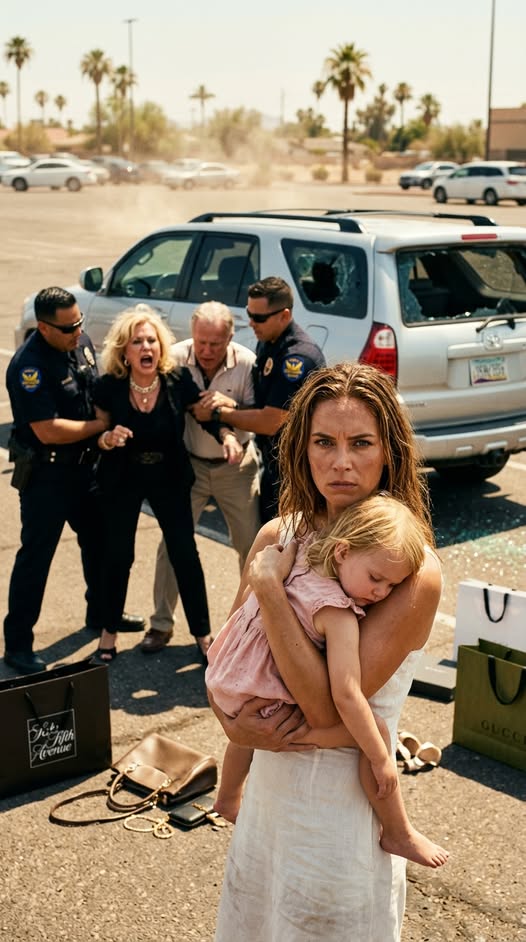
fluttered in my chest. My parents, Richard and Linda, happened to be visiting from Nevada for the week. They were currently occupying my guest room, complaining about the firmness of the mattress and the temperature of my thermostat. When I rushed into the kitchen, desperately calculating how fast I could call a backup service, they were sitting at my island, nursing black coffee. They offered to watch my three-year-old daughter, Ava, for the five hours I needed to be at the clinic. I hesitated. My hand literally hovered over the handle of my purse. My mother, Linda,
had always possessed a terrifyingly casual relationship with responsibility. She was a woman who moved through life distracted by shiny things, treating focus as an optional accessory. My father, Richard, was a man who treated every domestic duty, every emotional requirement, as an
irritating inconvenience wrapped in a sarcastic joke. He was allergic to accountability. But they were her grandparents. They were biologically wired to keep her safe, weren’t they? They immediately sensed my hesitation, and their defense mechanisms flared into life. They acted profoundly
offended that I even looked uncertain, their postures stiffening with indignation. “Emily, for God’s sake, she will be absolutely fine,” my mother sighed, waving a manicured hand at me as if swatting away a gnat. “We raised you to adulthood, didn’t we? You act as if we’ve never seen a toddler
before.”
We raised you. Those three words should have been a blaring air raid siren. They hadn’t raised me so much as I had simply survived their distracted orbit. But the clock was ticking, my manager was texting me, and the guilt of insulting my own parents in my kitchen overwhelmed my maternal instincts. I kissed Ava’s soft, strawberry-scented cheek, handed my mother the diaper bag, and walked out the door.
At precisely noon, I stepped into the breakroom and dialed my mother’s cell phone to check in. It rang until it hit voicemail. I texted. Just checking on you guys. Did Ava eat her lunch? Nothing. A digital void. I told myself they were probably wrangling her at a restaurant, their phones buried deep in a purse or left on a counter.
By one-thirty, a cold, unexplainable dread began to coil tightly in my gut. I was distracted at the clinic, my hands slightly clumsy with the dental instruments, my eyes darting to the screen of my Apple Watch every ninety seconds.
At two-fifteen, my phone vibrated in my scrub pocket. It wasn’t my mother. It wasn’t my father. The caller ID glowed with an unknown local number. My thumb hovered over the red reject button. I almost ignored it, assuming it was a telemarketer. But that icy coil in my stomach twisted violently, and I answered.
“Hello?”
A woman’s voice came through the speaker. It was not a professional voice. It was tight, ragged, and vibrating with pure, unfiltered urgency. “Are you… are you Ava Carter’s mother?”
Every single biological process in my body seemed to instantly halt. The hum of the breakroom refrigerator faded into absolute silence. My vision narrowed to a pinprick. “Yes,” I breathed, the word scraping against my throat. “Who is this?”
“I need you to listen to me,” the stranger stammered, her voice cracking. “I found your daughter. She was unconscious in the backseat of a silver SUV. We are in the south parking lot of the Chandler Fashion Center. The child was completely alone.”
My knees lost their structural integrity. I gripped the edge of the breakroom counter so hard my knuckles turned bone-white.
“The windows…” the woman sobbed, catching her breath. “They were only cracked a tiny sliver. Her face was dark red. She was totally limp, and her clothes were completely soaked in sweat. I broke the glass. Someone else called 911. The paramedics just got here. They’re loading her into the ambulance now.”
I don’t remember the phone slipping from my hand. I don’t remember screaming for my manager, tearing off my disposable gown, or sprinting through the glass doors of the clinic into the blinding heat. I don’t remember putting my keys in the ignition.
I only remember the ragged, hyperventilating sound of my own breathing, and the insane, pounding, deafening thought repeating in my skull like a hammer striking an anvil:
They left her there. Oh my god. They left her there.
Chapter 2: The Furnace
The drive to St. Joseph’s Hospital is a psychological blur of swerving metal, blaring horns, and red lights I simply refused to acknowledge. My palms were slick with a cold sweat that made the steering wheel dangerously slippery. The air conditioning in my sedan was blasting on maximum, freezing the tears onto my cheeks, but all I could feel was the phantom, suffocating heat of a sealed vehicle in the Arizona sun.
When I finally abandoned my car in the emergency drop-off lane and sprinted through the sliding electronic doors of the ER, my lungs felt like they were bleeding. I was a frantic, wild-eyed woman in pale blue scrubs, demanding my child.
A triage nurse intercepted me before I could push my way through the double swinging doors leading to the trauma bays. She placed a firm, steadying hand on my sternum. I looked into her eyes, and the professional neutrality I was used to seeing on medical staff was gone. Her face told me exactly how catastrophic the situation was before her lips even parted.
“Mrs. Carter,” she said, her voice dropping to that low, soothing register reserved for the bereaved. “They have her in Trauma Room 3. You cannot go in yet.”
“Where is she? Is she breathing?” I shrieked, clawing at the nurse’s arm, my professional decorum completely vaporized.
“Ava has suffered profound environmental heat exposure and severe systemic dehydration,” the nurse explained quickly, trying to anchor me to the floor. “She was entirely unresponsive by the time the civilian pulled her from the vehicle. Her core temperature was critically elevated. An attending physician and a respiratory team are actively working to stabilize her vitals right now.”
Just then, the heavy doors pushed open, and a doctor stepped out. He looked exhausted, his surgical cap slightly askew. He locked eyes with me. He didn’t offer a reassuring smile. He didn’t offer comfort.
He stepped close, lowering his voice to cut through the chaotic noise of the emergency room. “Are you Mom?”
I nodded frantically, unable to form words.
“She is fighting,” he said, his tone grim and entirely clinical. “But her neurological responses are sluggish, and her kidneys are under massive stress from the fluid loss. We are packing her in cooling blankets and pushing chilled IV fluids.” He paused, his jaw tightening. “The next hour is highly critical. If her temperature does not regulate, we are looking at permanent organ damage, or worse.”
That was the exact, devastating moment I fully comprehended the reality of my existence. It felt as if a fault line had cracked open right through the center of my chest, swallowing my heart whole. My beautiful, vibrant, three-year-old daughter—the child who loved strawberry yogurt and giggled when I tickled her ribs—might actually die today.
And she might die simply because the two people who brought me into this world decided they wanted to browse air-conditioned department stores without the inconvenience of holding a toddler’s hand.
I was exiled to the hallway outside Trauma Room 3. They handed me a plastic clipboard thick with intake forms. My hands were vibrating so violently that the pen repeatedly slipped from my fingers, clattering against the linoleum floor. The doctor reappeared briefly to pepper me with rapid-fire questions that I answered from a state of pure dissociation: known allergies, current medications, underlying medical history.
And then, he asked the question that stopped time.
“Mrs. Carter, do we have any metric on exactly how long she was trapped inside the vehicle?”
The question cut through me like a serrated blade.
“I…” My voice broke into a pathetic, dry heave. “I don’t know.”
“Was it thirty minutes? Two hours?” he pressed, needing the data to calculate the physiological damage.
“I don’t know!” I wailed, sliding down the pristine white wall until I hit the floor, burying my face in my knees. The absolute horror that I could not answer that question made me feel like I was complicit. I had handed her to the monsters. I had failed her, too.
Twenty minutes later, the heavy boots of law enforcement echoed down the corridor. Officer Daniel Ruiz of the Phoenix Police Department approached me. He was a large, imposing man, but his demeanor was remarkably calm, direct, and far kinder than I felt I deserved in that wretched moment. He crouched down to my eye level so he didn’t tower over my crumpled form.
“Ms. Carter, I am the responding officer from the Chandler Fashion Center,” he said softly, notebook in hand. “I need to give you the facts as we currently understand them.”
I nodded, staring blankly at the polished toe of his boot.
He told me that several civilian witnesses had noticed the silver SUV parked out in the open, unshaded asphalt for hours. A woman named Melissa Grant had been returning her shopping cart to the corral when she thought she saw a strange, jerky movement through the tinted glass. She cupped her hands to the window and saw my daughter, slumped sideways in her five-point harness, foaming slightly at the mouth.
Melissa Grant didn’t hesitate. She sprinted to her own truck, retrieved a heavy steel tire iron, and shattered the rear passenger window, dragging my limp child out onto the blazing pavement while screaming for someone to call emergency services.
“Based on the witness statements of when the vehicle was first noticed in that spot,” Officer Ruiz continued, his voice dropping to a near-whisper, “the paramedics estimate Ava had likely been locked in that cabin for over three hours.”
Over three hours.
The number didn’t even process in my brain as a human measurement of time. Three hours in a sealed metal box in Phoenix in July. The temperature inside that car would have easily eclipsed one hundred and forty degrees. It wasn’t neglect. It was an oven.
I scrambled up from the floor, grabbing my phone. I dialed my parents again. And again. And again. The calls went straight to voicemail. I left audio messages that devolved rapidly. The first was a frantic demand to know their location. The second was a guttural, terrifying scream that tore my vocal cords. By the fourth voicemail, I was just sobbing into the receiver, choking on my own saliva, begging them to pick up.
I paced the waiting area like a caged, rabid animal until 4:30 p.m.
That was when the elevator doors chimed, and Richard and Linda strolled into the chaotic emergency department.
They did not look panicked. They did not look disheveled. They looked as if they were arriving fashionably late to a casual neighborhood barbecue. My mother was laden with four large, glossy shopping bags from Nordstrom. My father was casually sipping an iced Americano, the condensation dripping down his knuckles. They were actively laughing about something as they approached the nurse’s station.