The Admiral’s Final Command: Chapter 1: The Anchor Line Snaps: The first sentence my father uttered after the attorney concluded the reading of the will was a masterclass in calculated cruelty. “Perhaps now you finally comprehend your actual standing in this family.” I can still hear the sharp, hollow clink of ice striking the sides of his crystal tumbler as he delivered the blow. We were gathered in the opulent parlor of Whitaker Manor, my late grandfather’s sprawling estate. It was a room steeped in history, the very space where decorated combat veterans, visiting senators, and the Secretary of the Navy had once grasped the formidable hand of Admiral Thomas Whitaker. The waning afternoon sun bled through the sheer curtains, casting long, golden geometric shapes across the antique Persian rugs and illuminating the stern, oil-painted portraits of long-dead men in uniform. My mother positioned herself beside the colossal marble fireplace. Her arms were firmly crossed over her chest, and her features were already arranged into that familiar, smug expression she reserved for moments when she believed she had orchestrated a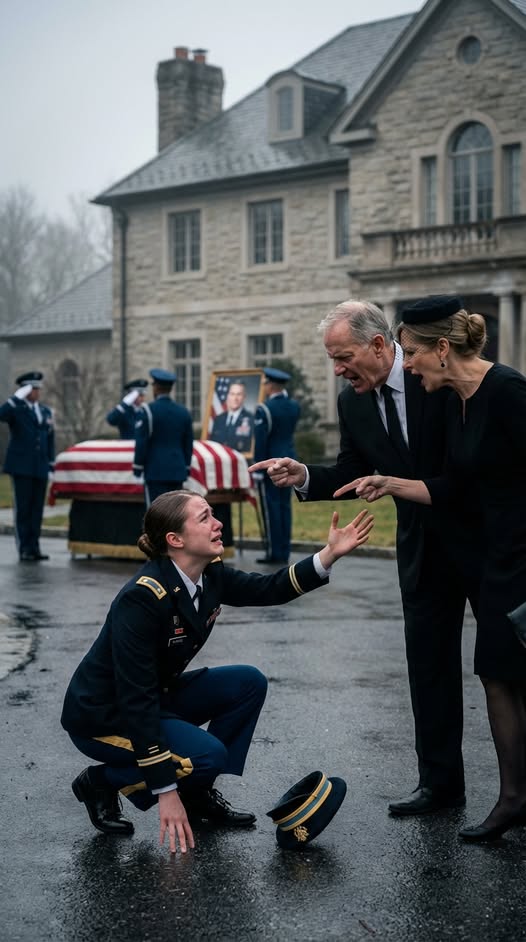
flawless victory. And there I stood, Amelia Whitaker, a thirty-two-year-old Captain in the United States Marine Corps. I was still clad in the crisp, navy-blue service uniform I had worn on the grueling drive home from Quantico, clutching my cover in my left hand as though I were an unwanted solicitor rather than the Admiral’s granddaughter. My mother’s gaze met mine, cold and unyielding. “You will need to gather your things and pack tonight, Amelia. This property belongs exclusively to us now.” My father took a slow, deliberate sip of his bourbon, adding with
chilling casualness, “You’re homeless as of tonight.” In that precise fraction of a second, it felt as if a fault line had cracked open right through the floorboards beneath my polished boots. Retrospectively, the sheer velocity of the shock shouldn’t have paralyzed me the way it did. I was a
combat-tested officer, entirely old enough to recognize that the sudden scent of unimaginable wealth can summon the absolute worst demons hiding within human nature. Yet, there is a profound, primal vulnerability in being forcefully exiled from the sanctuary where you first learned to
walk, where you navigated the rocky terrain of adolescence, and where you learned to grieve. It reduces you, momentarily, to a helpless child. I didn’t utter a word of protest. A cold dread coiled in my gut, choking off my voice. I merely stood rooted to the spot, the somber echoes of my
grandfather’s military funeral at Arlington National Cemetery still reverberating in my marrow, staring blankly at the two individuals whose fundamental biological duty was to protect me.
But I am getting ahead of the timeline.
Just seventy-two hours prior, I had stood rigidly at attention in my dress blues, the biting wind whipping across the manicured lawns of Arlington, watching an honor guard meticulously fold the American flag into a perfect, solemn triangle. My grandfather had reached the venerable age of ninety-two before his heart finally gave out. Up until the very last calendar year of his existence, he had possessed the aura of a man who commanded armadas. He had navigated the brutal cold of Korea as a freshly minted lieutenant, survived the sweltering chaos of Vietnam, and ascended the naval hierarchy clothed in an old-fashioned, iron-clad discipline that men of his era wore as naturally as their own skin.
Publicly, the Admiral was not a creature of warmth. Colleagues remembered the crisp cadence of his voice, the impossibly straight line of his spine, and his uncanny ability to instantly silence a chaotic briefing room without ever elevating his decibel level. But within the walls of Whitaker Manor, hidden away from the brass and the bureaucracy, he was a different entity entirely. He was the man who taught me the mechanics of a square knot long before I was allowed to ride a bicycle without training wheels. He showed me how to check the viscosity of motor oil, how to deliver a firm, respectful handshake, and why maintaining unbroken eye contact was the currency of honest people.
My parents, conversely, drifted through their decades like permanent tourists eternally waiting for the concierge to fulfill their requests. My father had dabbled in commercial real estate during my youth, yielding spectacular failures that he masked with grandiose tales of impending, elusive opportunities. My mother’s primary occupation consisted of occupying chairs on charitable boards, driven strictly by the allure of catered luncheons and society page photography. They absolutely adored the Admiral’s prestigious surname, the societal elevation it afforded them, and the exclusive gala invitations that materialized in their mailbox. However, they vehemently despised the relentless moral expectations and severe discipline that accompanied his legacy.
When his health irrevocably collapsed that final winter, I requested immediate leave and drove through the night to Norfolk. The manor, an imposing structure of weathered brick and towering white columns, sat proudly on the waterfront. Inside, the atmosphere was a comforting amalgamation of lemon-scented wood polish, decaying paper from ancient naval histories, and the briny breath of the Chesapeake Bay.
Even confined to the indignity of hospice care, Granddad demanded to be wheeled into his massive library every afternoon. Two days before his lungs finally gave out, he motioned for me to sit beside his wheelchair. His face had become translucent, the skin stretched tight over prominent cheekbones, but his eyes retained the piercing clarity of a sniper’s scope.
“People show their true colors with absolute clarity when the anchor line snaps, Amelia,” he had rasped, his voice sounding like dry leaves skittering across pavement.
I had offered a fragile smile, not entirely grasping his meaning. “That sounds remarkably like one of your lectures, sir.”
“It is.” He placed a trembling, paper-thin hand over mine. “Read everything carefully, Amelia. Especially when grief is making everyone else careless.”
Those were the last truly lucid syllables he ever directed at me. And now, standing in the parlor as an outcast, the weight of his absence threatened to crush my ribs.
“You’ve got a secure career,” my father remarked, interrupting my grief. He swirled the amber liquid in his glass. “You’re a Marine. You’ll figure out your logistics. Frankly, you ought to have secured your own real estate years ago.”
The simmering anger finally ignited, a slow, hot burn rising from my stomach. “I just buried my grandfather this morning,” I whispered, my voice deceptively level. “This is my home, too.”
My father offered an indifferent shrug. “You heard the attorney’s summary. It’s ours.”
I didn’t give them the satisfaction of a theatrical outburst. Marines are explicitly trained to govern their neurological responses; unchecked emotion is a tactical vulnerability. I pivoted on my heel, marched up the creaking oak staircase to my childhood bedroom, and packed my duffel bags with mechanical precision. Uniforms, civilian attire, and a small brass compass my grandfather had gifted me before my first deployment. Its engraved back read: Stand steady.
When I carried my burdens downstairs, my father wordlessly escorted me to the driveway. The evening air was thick with the scent of wet grass and approaching rain. Before I could even unlatch my trunk, he ripped the heavy canvas bags from my grip and unceremoniously dumped them onto the wet asphalt near the curb.
“That should conclude our business,” he muttered, turning his back.
My mother’s silhouette appeared in the glowing doorway. “Oh,” she trilled, an afterthought wrapped in poison. “We are having the security codes wiped and reprogrammed tonight.”
The heavy oak door slammed shut, the deadbolt engaging with a definitive, metallic click. I stood utterly alone on the pavement, the coastal wind biting through my uniform. I loaded my bags, my mind a whirlwind of betrayal. But as I engaged the ignition, my grandfather’s fragile, dying voice echoed in the claustrophobic cabin of my car.
Read everything carefully, Amelia.
I stared at the darkened windows of the mansion. Suddenly, my sorrow was pierced by a sharp, thrilling realization. The Admiral was a master tactician who never lost a war. Why would he surrender his legacy without a fight?
Chapter 2: The Unread Pages
Two agonizing, restless days later, my cell phone vibrated aggressively against the sticky formica of a roadside diner table. It was Mr. Harold Callahan, the venerable attorney who had managed the Whitaker estate since before I was born.
The call pierced the gloom of a dreary, monochromatic Tuesday morning. I was seated in a dilapidated diner just outside the gates of Quantico, a relic of an establishment characterized by ripped vinyl booths, the perpetual aroma of burnt coffee, and a grizzled waitress who addressed every patron as ‘hon’. The rain was lashing against the large pane glass, distorting the shapes of passing eighteen-wheelers on the interstate. A few booths down, an elderly man in a faded Korean War veteran cap was quietly nursing a mug of tea.
I swallowed a mouthful of bitter, black coffee and answered. “Captain Whitaker speaking.”
“Good morning, Amelia,” came the measured, gravelly cadence of Mr. Callahan. He sounded remarkably composed, but beneath the professional veneer, there was an unmistakable undercurrent of grim amusement. “I trust I am not interrupting your duties?”
“No, sir. I’m currently on administrative leave.”
“Excellent,” he replied, pausing for a beat that stretched just a second too long. “I have a rather specific, perhaps delicate, inquiry for you. Did your parents actually read the entirety of your grandfather’s will?”
The question was so bizarre it temporarily short-circuited my thought process. “I naturally assumed they did,” I replied cautiously.
Mr. Callahan exhaled a breath that sounded dangerously close to a triumphant chuckle. “Well. That certainly explains a multitude of sins.”
I sat up straighter, my tactical instincts flaring. The exhaustion in my muscles vanished, replaced by a sudden, brassy tang of adrenaline. “I’m afraid you’ve lost me, Mr. Callahan.”
“Indulge me for a moment, Amelia,” he continued, his tone shifting into the realm of cross-examination. “Following the preliminary reading at my office, did any… unusual domestic altercations occur?”
Unusual was certainly a sanitized piece of vocabulary for what had transpired. “They evicted me from the premises,” I stated bluntly. “They dumped my luggage on the curb and informed me I was no longer welcome on the property.”
A heavy silence descended over the cellular connection. Then, Mr. Callahan genuinely laughed. It wasn’t a malicious sound, but rather the deeply satisfied noise of an experienced chess player watching his opponent walk blindly into a meticulously laid trap.
“That comprehensively answers my core question,” he murmured.
“Which question is that, exactly?”
“Whether your parents possessed the fundamental patience to turn the page.”
My brow furrowed. “Turn the page?”
“Precisely,” the lawyer confirmed. “Admiral Whitaker’s last will and testament is a phenomenally dense, multi-layered legal instrument. It is not a document designed for those who skim for immediate gratification.”
A profound shift occurred within the architecture of my chest. The diner around me—the clinking silverware, the hum of the neon sign—faded into white noise. “Mr. Callahan,” I said, my voice dropping an octave. “Are you implying there is a secondary component to the inheritance?”
“Oh, there is significantly more than a component, Captain. The section I recited to your parents two days ago was merely the bait. The preliminary inheritance structure.”
My grip on the phone tightened until my knuckles blanched white. Read everything carefully, especially when grief makes everyone else careless. The ghost of my grandfather was suddenly sitting in the booth across from me.
“What exactly are the consequences if a beneficiary neglects to read the full document?” I asked, my heart hammering against my ribs.
“Well,” Callahan drawled, “that depends entirely upon how they choose to behave once they believe they possess absolute power.”
The hair on the back of my neck stood at attention. “What sort of behavior?”
“I strongly suggest you make the drive back to Norfolk immediately so we can review the architecture of this trap in person,” he advised gently. “Your grandfather was a man of terrifying deliberation. He possessed a surgical understanding of human frailty. He engineered a scenario, predicting exactly how certain individuals would conduct themselves.”
I threw a twenty-dollar bill onto the table, not waiting for the waitress. “I’m leaving now. I’ll be there in three hours.”
“Drive safely, Amelia,” Mr. Callahan warned. “Because once you read the rest of this document, your entire world is going to change.”
Chapter 3: The Admiral’s Final Trap
The journey southward to Norfolk felt agonizingly dilated. The weather remained foul, a oppressive canopy of bruised gray clouds weeping relentlessly onto the interstate. My windshield wipers fought a losing battle against the deluge as my mind raced, dissecting every word Mr. Callahan had spoken. Whether they possessed the fundamental patience to turn the page.
My parents were creatures of instant gratification. They craved the headline, not the article. The Admiral had known this. He hadn’t just understood their flaws; he had weaponized them.
By the time I pulled into the parking garage adjacent to Callahan & Burke Law Offices, my uniform was slightly damp, but my mind was violently awake. The firm’s interior remained an enclave of old-world stability—dark mahogany paneling, the scent of leather-bound statutes, and the soft, amber glow of brass desk lamps.
Mr. Callahan rose from behind his massive desk the moment his secretary ushered me in. “Captain Whitaker. Please, take a seat.”
“Sir,” I acknowledged, sliding into the leather wingback chair.