The first thing my stepfather did was point a loaded service weapon directly at my face. The second thing he did, with a staggering lack of self-awareness, was call me a liar. I was standing in the center of my mother’s meticulously kept kitchen. The air smelled faintly of lemon bleach and the stale coffee she always kept brewing in a desperate attempt to feign domestic normalcy. I was still dressed in my black uniform trousers, the sharp crease untouched despite a grueling forty-eight hours of transit. On my left wrist, the heavy silver watch the Secretary of Defense had personally handed me after the extraction in Kabul caught the harsh fluorescent light of the ceiling fixture. In my right hand, I held a heavy, encrypted satellite phone pressed tightly to my ear. “Say that again, General,” the voice of the Pentagon aide crackled through the secure line, the audio artificially compressed but carrying the undeniable weight of federal authority. Before I could formulate a response, the swinging door that led to the garage violently burst open. Frank Hale stormed into the room. He brought the smell of cheap cigars and wet asphalt with him. Frank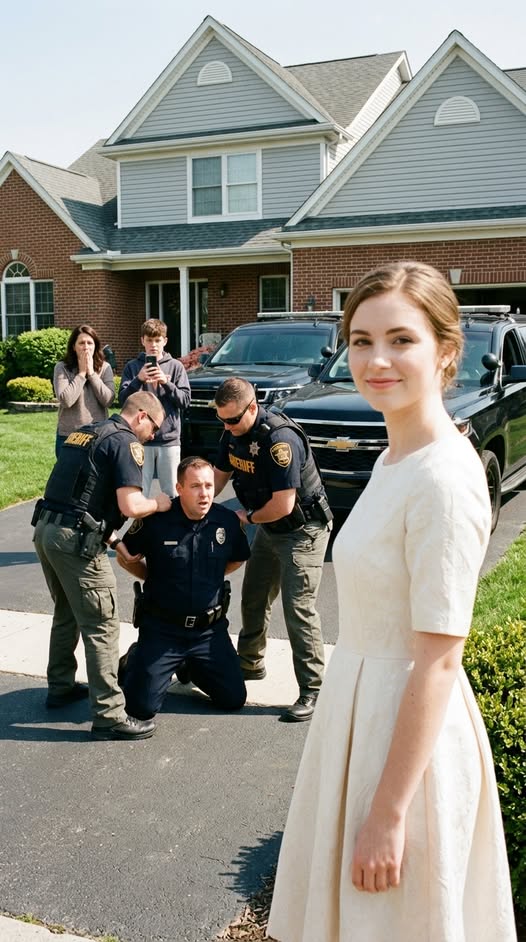
was my mother’s second husband, a small-town police lieutenant for the Ashford Police Department. He possessed a loud, tarnished badge and a starving, fragile ego that demanded constant feeding. He was a man who had peaked in his high school locker room and had spent the last three decades punishing the world for moving on without him. He had harbored a deep, simmering hatred for me since the day I first came home from the Army. I had returned with medals he couldn’t comprehend and a cold, disciplined silence he couldn’t break with his usual bluster. “What the
hell are you doing in my house?” Frank snapped. His face was flushed, the veins in his thick neck straining against the collar of his uniform shirt. I didn’t flinch. I didn’t move my feet. I simply let my eyes track him as he stomped across the linoleum. “My mother invited me,” I said, my voice
perfectly level. Never elevate your volume when dealing with an amateur, an old drill sergeant had once told me. It validates their panic. He stopped a few feet away, his chest heaving, and stared at the bulky device in my hand. It didn’t look like a standard smartphone; it was encased in
ruggedized rubber, featuring an external antenna and a blinking green uplink indicator. “Who are you talking to? Put that damn thing away.” I turned slightly away, shielding the mouthpiece, prioritizing the security of the communication over his temper tantrum. “A secure line. Give me a
moment.” That was precisely the wrong answer for a man who demanded absolute subservience in his kingdom of drywall and suburban misery. Frank’s eyes darkened, the pupils constricting into tight, furious pinpricks. Behind him, hovering near the archway of the dining room, stood my
mother, Ellen. She was thin, painfully nervous, and currently twisting her gold wedding ring around her finger so hard I worried she might deglove herself. Leaning against the faux-granite island was my younger stepbrother, Kyle. He was twenty-four, chronically unemployed, and currently
holding his smartphone up, the red recording light flashing. He was grinning, a vicious, wet smirk that suggested he had been waiting years for this exact confrontation.
“A secure line,” Kyle mocked, his voice cracking slightly with unearned arrogance. “Listen to her, Dad. She’s still playing soldier. Thinks she’s in a movie.”
Through the earpiece, the Pentagon aide’s voice sharpened, cutting through the background noise of the operations center. “General Mara Voss, is there a problem on your end? We are registering elevated audio.”
Frank froze. He had caught the tail end of the word ‘General’ bleeding through the speaker.
For a second, the room was suspended in complete silence. Then, Frank threw his head back and laughed. It was a harsh, scraping sound.
“General?” he scoffed, stepping into my personal space. His breath was sour. “You? A general? You’re a glorified secretary who couldn’t hack it in the real world so you hid in the government.”
His jealousy had always been an ugly, pathetic thing, but today, it had teeth. Today, there was a manic energy behind his eyes that I hadn’t seen before.
He lunged forward and grabbed my left wrist, his thick fingers digging aggressively into my skin, right beside the silver watch.
Assess the threat, my training demanded. I could have rotated my arm, applied a rudimentary wrist lock, and broken his hand in three distinct places before he even registered the pain. I felt the muscle memory twitch in my shoulders, begging to be unleashed. Instead, I forcefully suppressed the instinct. I lowered the satellite phone, keeping the connection open, and locked my eyes onto his.
“Lieutenant Hale,” I said, my voice dropping an octave, radiating absolute authority. “Remove your hand from my person. Immediately.”
That command, delivered without an ounce of fear, shattered whatever restraint he had left.
He didn’t let go. Instead, he twisted my arm, using his weight to spin me around. He slammed my palm flat onto the wooden surface of the kitchen table, rattling the salt and pepper shakers. In one fluid motion born of years of arresting drunks outside local dive bars, he withdrew a pair of steel handcuffs from his belt and snapped one rigid cuff around my wrist. The metal bit cold and sharp into my skin.
My mother let out a strangled gasp. “Frank, oh my god, don’t—”
“Shut up, Ellen!” he barked, not even looking at her. “I am handling this.”
He yanked my arm back, forcing me to lean awkwardly over the table, and attempted to grab my right hand to secure the other cuff. But my right hand was still gripping the satellite phone. The line was still wide open.
Frank noticed the blinking green light. He snatched the device from my fingers with a grunt of triumph and pressed it aggressively to his ear.
“Listen to me, whoever the hell this is,” Frank shouted into the secure receiver. “This woman is a fraud. She is actively impersonating a federal officer, and she is currently in custody.”
The kitchen held its collective breath. Kyle stepped closer, his phone angled to capture Frank’s moment of perceived glory.
Then, a voice emanated from the speaker, turned up loud enough by Frank’s clumsy fingers for everyone in the room to hear. It wasn’t the aide. It was the distinct, winter-steel tone of the Deputy Director of Operations.
“Identify yourself immediately,” the voice commanded.
Frank smirked at Kyle, a look of pure, triumphant vindication. “This is Lieutenant Frank Hale. Ashford Police Department. Badge number four-two-seven. And you are aiding a delusional civilian.”
“Lieutenant Hale,” the Deputy Director replied, the words dropping like heavy stones into the quiet kitchen. “You have just unlawfully interfered with a classified, secure Department of Defense communication. You are currently assaulting a commanding officer. Release her immediately.”
Frank’s smile flickered, a sudden shadow of doubt crossing his flushed features. He looked at the heavy phone, then at me.
I slowly turned my head, ignoring the awkward pull of the cuff on the table, and met his eyes. “You should really hang up now, Frank. While you still have a career.”
His face contorted into a mask of pure, unrestrained rage. He didn’t hang up. He dropped the phone, reached for his holster, and the distinct, terrifying sound of a leather strap unsnapping echoed through the room.
Frank believed fear was a universal solvent because fear was the only tool that had ever worked for him.
Down at the local station, petty suspects confessed to misdemeanors when he leaned too close and invaded their space. In this house, my mother relentlessly apologized for things she hadn’t done the moment he slammed a door or raised his voice. Kyle, desperate for a masculine figure to emulate, copied Frank’s every move because, to a weak mind, cruelty looked exactly like power—especially when no one possessed the courage to challenge it.
But I was not my mother. I was not a teenager caught stealing beer. I had commanded battalions of terrified soldiers under relentless, earth-shaking mortar fire. I had stood in command tents and watched, via satellite, as entire buildings folded into dust and smoke. I had made agonizing, split-second decisions that carried the terrible weight of folded flags and grieving widows.
Frank Hale was not a terrifying man. He was just a loud man in a small room.
When he drew his service pistol, he didn’t aim it right away. He used the heavy polymer frame of the grip to strike my shoulder, shoving me violently off the chair. The sudden force, combined with my cuffed wrist anchored to the heavy oak table, sent me sprawling.
My cheek hit the hard ceramic tile of the floor with a sickening crack. A sharp, metallic taste immediately flooded my mouth. I had bitten the inside of my cheek. Warm blood began to pool behind my teeth.
He stood over me, his chest heaving, the black pistol shaking slightly in his grip. He was losing control of the narrative, and violence was his only remaining anchor.
“Who do you think you are?” he yelled, a spray of saliva catching the light. “You come into my house, disrespecting me, looking at me like I’m garbage?”
I slowly turned my head against the cold tile. I swallowed the blood, felt it coat my throat, and smiled. A genuine, terrifying smile.
“I already told you who I am, Frank.”
“Get up!” he ordered, waving the barrel of the gun.
“I can’t,” I said calmly, lifting my left arm to demonstrate the steel chain tethering me to the furniture. “You made sure of that, Lieutenant.”
From the corner, Kyle let out a nervous bark of laughter. “Maybe you should use your telepathy to call the President next, General.”
Frank, agitated by the sound of Kyle’s voice, turned and kicked the satellite phone where it had fallen. It skidded violently across the linoleum, crashing under the edge of the floor cabinets. But the rugged device didn’t break. In the shadows beneath the wood, its small green light continued to blink. The connection was still live. Every breath, every threat, every rustle of clothing was being transmitted directly to a secure bunker in Arlington.
Frank didn’t notice the light. He was too blinded by adrenaline.
My mother did.
I saw her eyes track the phone, then dart to my face. Her eyes were wide, dilated with absolute terror, but beneath the fear, I saw the crushing weight of profound shame. She knew what she had married. She knew what she had allowed to happen in her home.
“Frank,” she whispered, her voice trembling like a dry leaf. “Frank, please. Put the gun away. Maybe we should just stop and—”
“No!” he roared, spinning on her. She flinched, shrinking back into the archway. “She comes into my house, acting superior. Whispering on fake government phones. Looking down on me like I’m nothing. Like I’m some rent-a-cop.”
“You did that yourself,” I interjected, spitting a small amount of blood onto the pristine white tile. “Your insecurity is not my responsibility.”
His jaw tightened so hard I heard his teeth grind. He holstered the weapon, stepped forward, and grabbed my right arm, yanking me upward with brutal force. Pain flashed hot and bright through my shoulder socket, but I forced my breathing to remain even, executing a tactical breathing exercise to lower my heart rate. In for four, hold for four, out for four.
“You always thought you were better than us,” he hissed, his face inches from mine as he unlocked the cuff from the table, only to immediately wrench my arms behind my back and snap it onto my right wrist. I was fully restrained. “All those uniforms. All those mysterious, secret trips you took. You never said where you worked because you knew nobody would believe a pathetic liar like you.”
“I didn’t tell you where I worked, Frank, because you didn’t possess the required security clearance to know,” I stated, keeping my tone strictly informational.
Kyle snorted loudly. “Clearance. Right. Just like your secret trust fund.”
The moment the words left Kyle’s mouth, the entire puzzle clicked together in my mind with devastating clarity.
Frank grabbed the center chain of the cuffs, jerking me forward toward the front door. “I’m taking you in. You’re going to sit in a holding cell until you remember how to respect authority.”
“For what exact charge, Lieutenant?” I asked, stumbling slightly but catching my balance.
“Obstruction of justice. Impersonation of a federal officer. Resisting arrest.”
“I haven’t resisted,” I pointed out.
“You will by the time we get to the cruiser,” he promised, his voice dropping to a sinister whisper.
That was when I truly understood. This elaborate display wasn’t just a fragile ego throwing a tantrum. It was a calculated, albeit incredibly sloppy, premeditated plan. It was wearing anger as a mask to hide sheer greed.