I was nothing but an accessory to them, a quiet prop meant to stand in the background of their curated lives. I thought, staring at my own reflection in the tinted glass of the private terminal. But they forgot one crucial rule of architecture: if you put too much weight on a load-bearing pillar, eventually, it brings the whole house down. Chapter 1: The Gilded Cage: The air inside the private aviation lounge at Teterboro Airport was thick with the suffocating scent of expensive, synthetic floral perfumes and the endless, pretentious clinking of crystal champagne flutes. I sat in a plush leather corner chair, desperately trying to keep my two-year-old son, Leo, entertained with a quiet picture book. Beside us, my ninety-year-old grandmother, Evelyn, rested in her lightweight transport wheelchair. The rhythmic, soft hum of her portable oxygen concentrator was barely audible over the chaotic chatter of the room. My name is Vivian. By trade, I am an architectural preservationist. I spent my life studying structural integrity, learning how to reinforce old, beautiful things so they could withstand the test of time. I thought I had found that same solid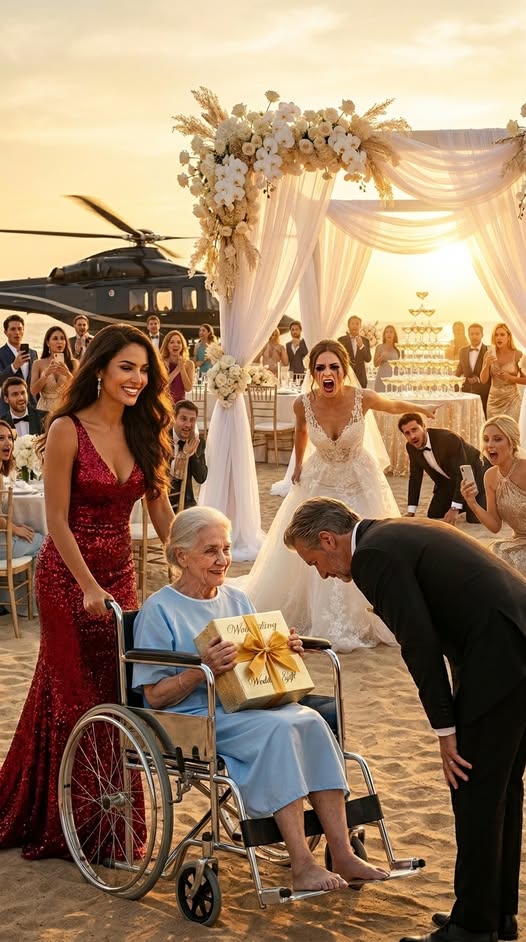
foundation in my husband, Preston Harrison. When we met in graduate school, he had played the part of the rebellious heir, wearing thrifted sweaters and mocking his family’s obsession with old-money optics. I believed he valued my intellect and my quiet, grounded upbringing. I was dangerously naive. The moment his father, a ruthless New York investment banker, suffered a mild heart attack two years ago, Preston was summoned back into the fold. The thrifted sweaters vanished, replaced by bespoke Italian suits and a terrifying, rapid regression into his family’s
shallow, elitist circle. Across the lounge, Preston’s younger sister, Victoria, stood at the epicenter of a swirling hurricane of bridesmaids. She was a spoiled, hyper-fixated lifestyle influencer whose entire existence was dedicated to projecting an illusion of limitless wealth. She held up a
massive, gloss-printed mock-up of a wedding seating chart, her manicured finger tapping aggressively against the cardboard. Her upcoming tropical wedding on the highly exclusive, privately-owned St. Jude’s Isle off the Florida coast was being treated by the family as the social event of the
decade.
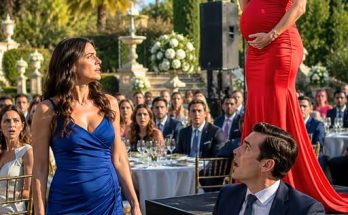
“I just think a wheelchair in the front row is going to completely ruin the drone footage,” Victoria sighed loudly. Her voice dripped with an artificial, syrupy sweetness that made the hair on the back of my neck stand up. She didn’t look at me; she looked directly at my husband. “Preston, can’t you tell your wife to leave her grandmother at the hotel? St. Jude’s Isle is an ultra-exclusive luxury resort. Having someone dragging a noisy plastic oxygen tank through the sand is literally going to destroy my tropical-chic aesthetic.”
My stomach tightened. I closed Leo’s book and stood up, my hand instinctively reaching down to grip my son’s small, warm shoulder.
“Victoria,” I said, keeping my voice perfectly level to hide the tremor of anger. “Grandma Evelyn raised me after my parents died. She’s ninety years old, and she received an invitation. I personally paid for her specialized medical transport to be here. She has as much right to witness this weekend as anyone else.”
Before Victoria could even roll her heavily lashed eyes, Preston crossed the room. He didn’t defend me. He never did anymore. He stepped directly between us, his large hand gripping my elbow. His fingers dug into the soft flesh just above my joint with a sudden, painful, bruising pressure that forced me to take a half-step backward.
“Watch your tone, Vivian,” Preston whispered, leaning down so his lips brushed my ear. His breath smelled heavily of expensive, peaty scotch, even though it was barely noon. “My family is paying for this entire destination weekend. You are here solely as our guest. If you make a scene or embarrass my sister in front of the press she invited, I swear to God, I’ll have my family’s legal team begin custody proceedings for the kids before we even fly back to New York. I will bury you in litigation. Do you understand me?”
I looked up into my husband’s cold, arrogant blue eyes. The man I had loved, the man who had held me when I cried during my pregnancies, had been entirely swallowed by a monster. He used my children as a leash, constantly threatening to rip them away from me using his family’s boundless financial resources whenever I dared to step out of line.
“I understand,” I choked out, looking down at the carpet.
“Good,” Preston sneered, releasing my bruised arm and smoothing his lapels. “Keep her out of the cameras.”
I turned back to my grandmother. Evelyn’s pale, wrinkled hand reached out, gently patting my wrist. Her eyes, milky with age but sharp with an unspoken intelligence, held a deep, sorrowful understanding. She didn’t say a word, but her grip was surprisingly firm.
As the lounge attendant called for our boarding, I began to push Evelyn’s chair toward the tarmac. We were ushered out a side door, separated from the laughing, champagne-drunk bridal party.
As we approached the steps of the private charter flight bound for the island, my blood ran instantly cold. Sitting on the tarmac beside the luggage conveyor belt was Grandma Evelyn’s backup medical equipment and her heavy-duty oxygen compressor. Slapped across the front of the pristine medical cases was a glaring, neon-red sticker that read: “RESTRICTED ACCESS – HOLD IN CARGO.”
Chapter 2: The Breaking Point
The afternoon heat on the white beaches of St. Jude’s Isle was absolutely oppressive. The humidity hovered near ninety-five percent, hanging in the air like a hot, wet towel that smelled faintly of rotting sea kelp masked by thousands of imported, blooming orchids.
Five hundred of the country’s wealthiest elites—ruthless corporate executives, vapid socialites, and corrupt local politicians—sat under a massive, sheer white canopy, fanning themselves with custom-printed silk programs. I sat in the very back row, the farthest point from the altar, pressing a cold, condensation-soaked water bottle against the back of Grandma Evelyn’s neck. Her breathing was shallow, the rhythmic hiss-click of her portable oxygen tank working overtime in the sweltering tropical heat.
The string quartet began to play. The crowd stood. Victoria made her grand entrance, a vision of excessive lace and diamonds, walking down an aisle constructed of imported glass over the sand.
But as the priest began his opening remarks, the ambient noise of the ocean breeze dropped. In that brief pocket of silence, the mechanical hum of Evelyn’s oxygen machine became audible. It wasn’t loud. It was just a quiet, persistent heartbeat of survival.
Victoria stopped dead. Right in the middle of the altar.
She turned her head, her face contorting beneath her expensive veil into a mask of pure, unadulterated rage. She locked eyes with Preston, who was standing as a groomsman, and then aggressively pointed her manicured finger toward the back row.
Preston nodded. He snapped his fingers at two burly, black-suited private security guards stationed near the edge of the dunes.
Without a word of warning, the two massive men marched down our aisle. One of them grabbed the rubber handles of Grandma Evelyn’s wheelchair. The other grabbed the handle of her oxygen tank. Before I could even process what was happening, they jerked her backward, rolling her rapidly away from the canopy and toward a rusted, windowless corrugated metal shed that was used for storing landscaping equipment and diesel generator parts.
“Wait! Stop!” I screamed, the sound tearing from my throat as I lunged out of my seat, breaking entirely away from the guest seating. “She needs her oxygen in the shade! She can’t breathe in that heat! It’s over a hundred degrees inside that metal shed!”
“Get her out of my sight!” Victoria shrieked from the altar, completely abandoning her bridal composure. Her voice echoed horribly over the microphone. “The hum of her disgusting machine is ruining my video! Lock the door until the ceremony is over!”
Panic, raw and blinding, exploded in my chest. Locking a frail ninety-year-old woman in an unventilated metal box in the Florida sun was a death sentence. I sprinted toward the shed, my heels sinking into the deep, burning sand.
I was five feet away from the guards when a sharp, devastatingly heavy blow struck the back of my knees.
My legs gave out instantly. The world tilted violently, and I crashed face-first into the burning sand. Hidden, jagged seashells sliced into my bare knees and the palms of my hands. I gasped, choking on the hot dust, trying to push myself up.
Preston stood directly over me. His polished, custom leather dress shoe was planted firmly in the sand mere inches from my bleeding face.
A collective gasp rippled through the canopy, followed almost immediately by the sickening, cruel sound of mocking laughter from Preston’s father and his circle of investors. They were watching a disobedient dog being brought to heel, and they found it immensely entertaining.
“KNEEL AND APOLOGIZE TO THE BRIDE, OR I’M TAKING THE CHILDREN,” Preston hissed, his voice a venomous snake in the grass. He bent down, his fingers wrapping brutally into the hair at the nape of my neck, forcefully wrenching my head up so I was forced to look at Victoria on the altar.
“You’ve finally lost your mind,” Preston spat, his spit hitting my cheek. “You will kneel right there in the dirt. You will apologize to my sister loudly for ruining her perfect day, or I swear to God, you will never see our children again. I will have them flown off this island by tonight on a private jet, and you will be left with absolutely nothing.”
I felt the hot sand burning the cuts on my knees. I felt the agonizing pull of my hair. The humiliation was absolute, broadcasted live to some of the most powerful and ruthless people in the country. The woman who preserved foundations was currently being ground into the dust.
But as I looked past Preston, I saw the heavy metal door of the storage shed slam shut, locking my grandmother in the dark oven.
The terror that had kept me paralyzed for two years evaporated in the sweltering heat. The fear of losing my children was entirely eclipsed by the sudden, terrifying realization that these people were perfectly willing to commit murder for an aesthetic.
I slowly let my muscles go limp. Preston, thinking I was submitting, released his grip on my hair with a smug, satisfied grunt.
I did not apologize. I slowly stood up, ignoring the stinging pain in my bleeding knees and the murmurs of the crowd. I wiped a mixture of sweat and sand from my face. I looked directly into Preston’s eyes, and for the first time in our marriage, he saw a woman completely and utterly devoid of fear.
I reached into the hidden pocket of my dress, pulled out my cell phone, and hit the single emergency speed dial contact I had promised my grandmother I would only use if the world was ending.
Chapter 3: The Revelation
I pressed the phone to my ear. The line didn’t even ring; it clicked open instantly.
I wiped a smear of blood from my knee, my voice dropping into a dead, hollow calm. “Grandma. You were right. They don’t deserve another chance.”
A faint, static-laced click sounded from the earpiece. It was a signal.
Preston threw his head back and laughed. It was a loud, theatrical sound meant for the audience. He adjusted his tuxedo jacket, brushing invisible lint from the lapel. “Who are you calling, Vivian? The police? You really are stupid. We are on a private island. My father’s firm owns the local authorities here. You are completely powerless. Now get on the ground and apologize before I call the jet.”
Before he could finish his sentence, the heavy, humid air began to change.
It started as a deep, rhythmic thrumming deep in my chest. The ocean waves crashing against the shoreline suddenly seemed to ripple in reverse, the water violently disturbed. The thrumming rapidly grew into a deafening, terrifying roar that drowned out the string quartet, the murmuring guests, and the sound of my own heartbeat.
From the eastern horizon, cresting over the turquoise water, three sleek, massive, military-grade black executive helicopters emerged. They had no identifying tail numbers, only a subtle, matte-black crest painted on the side doors.
They didn’t head for the island’s designated helipad. They descended directly onto the pristine, crowded beach.
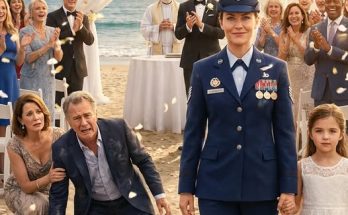
The sheer, catastrophic power of the downdraft from the massive rotors hit the wedding like a localized hurricane. The sheer white canopy violently snapped off its moorings, collapsing onto the screaming guests. The imported silk floral arches were torn to absolute shreds, raining pink petals into the chaotic wind. Victoria screamed in pure horror as the wind caught her magnificent, five-tiered artisanal wedding cake, blowing it entirely off its pedestal and exploding it into the sand.
The 500 VIP guests abandoned their dignity, scrambling on their hands and knees, covering their heads as fine sand sandblasted their designer clothes.
The lead helicopter touched down hard, kicking up a massive cloud of dust directly in front of the altar. The side doors slid open.
A man stepped out into the chaos. He was tall, impeccably dressed in a charcoal three-piece suit, with silver hair and eyes like chipped flint. This was Franklin Mercer, the legendary, ruthlessly private chief executor of Mercer Global—the apex predator of international finance, a man whose actual face was known only to the highest, most secretive echelons of the global economy.
He didn’t look at Preston. He didn’t acknowledge Victoria, who was currently weeping over her ruined, cake-covered dress. He marched with terrifying purpose, flanked by four heavily armed security contractors.