By the moment Lucía raises herself a little higher beneath the heavy woolen blanket, using her own head to cut off that razor-thin sliver of light, every trace of drowsiness vanishes from my body. My heart pounds so violently against my ribs that I am absolutely certain whoever stands beyond the wooden door can hear it. I still do not fully understand what is happening in the suffocating darkness of my own bedroom, but one terrifying truth lands with instinctive, gut-wrenching certainty: my sister-in-law is not sleeping in my bed because she is odd. She is not here because she is clinging to some backward village superstition. She is here because she is shielding someone. The sharp, invasive strip of light holds for two more agonizing seconds. It paints a harsh yellow line against the baseboard. Then, it slips away. A faint rustle follows in the hallway outside. It is so slight, so meticulously controlled, that it could easily be mistaken for the ancient pipes of our home settling, or a cold draft moving beneath the eaves of the Puebla night. After that, silence settles back over the room—a dense, absolute, suffocating silence, like a heavy hand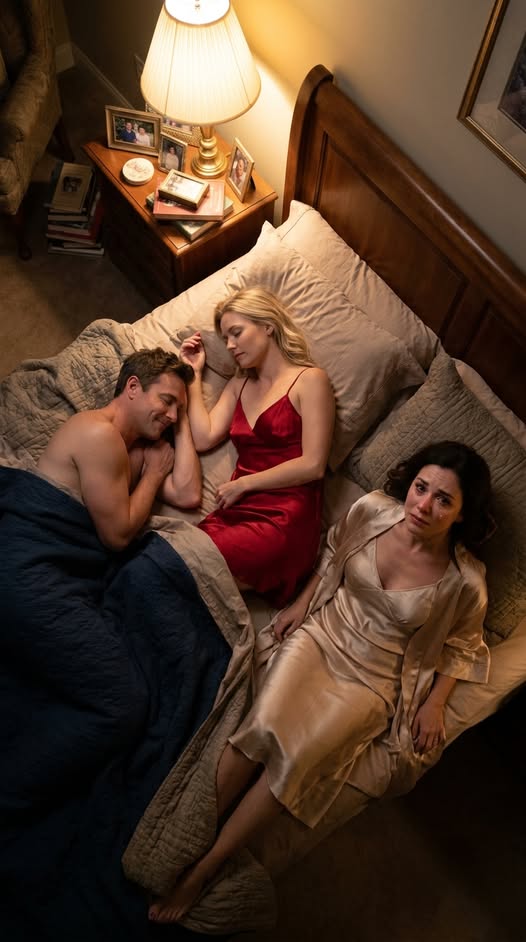
clamped violently over the house’s mouth. Lucía continues to hold my fingers. She does not grip them tightly, nor does she tremble. She simply rests her small, calloused hand over mine, warm and terrifyingly steady beneath the blanket, waiting until my breathing slows enough not to betray my sudden, blinding panic. Beside her, my husband, Esteban, remains deeply asleep. One arm is thrown casually across his pillow, his chest rising and falling with the maddening, rhythmic calm of a man who has heard nothing at all. I lie there for what feels like an hour, though the clock on
the nightstand tells me it cannot be more than five minutes. My mind races, frantically searching the dark corners of the room for rational explanations, finding absolutely none that make sense. When Lucía finally lets go of my hand, she does not whisper a single word. She does not sit up to
check the door. She only settles back against the mattress, her eyes wide open, staring into the pitch-black ceiling as if willing the morning sun to forcefully drag itself over the horizon. I stay upright a moment longer, my spine rigid against the headboard, my mouth tasting like dry ash. At
dawn, Lucía is already downstairs in the kitchen. She stands at the ancient gas stove in one of her simple, faded cotton dresses, stirring a pot of oatmeal as if the night had been completely uneventful. Pale, watery morning light spills through the narrow window above the sink, catching in
the loose, dark strands of hair that frame her exhausted face. If not for the lingering phantom sensation of her hand on mine, and the searing memory of that light slicing across my bedroom wall, I might have convinced myself the entire ordeal had been a nightmare born of indigestion. I
linger in the doorway, my arms crossed tightly over my chest, watching her. She notices my shadow before I even open my mouth to speak. “Coffee’s ready,” she says, her voice flat, not bothering to turn around.
I stay exactly where I am, my bare feet cold against the tile. “Who was outside our room last night?”
The wooden spoon stills in the pot.
Just for a beat—a fraction of a second, but long enough to confirm what my nervous system already sensed—her hand freezes. Then, with excruciating forced casualness, she resumes stirring.
“I don’t know what you mean,” she murmurs.
I almost laugh out loud. Not because anything about this is amusing, but because bad lies possess a recognizable, clumsy shape, and I am looking straight at a monumental one right now. Lucía is many things: quiet, fiercely helpful, modest to the absolute point of self-erasure. But she has never been careless with her words. Every syllable she speaks feels weighed and measured before it leaves her lips. Hearing her feign ignorance with such obvious effort tells me that the truth is far larger, and far darker, than a strange noise in the night.
“You took my hand,” I say, my voice dropping to a hiss. “And you moved your head into the light. Deliberately.”
Lucía sets the spoon aside. When she finally turns to face me, her dark eyes carry the hollow look of someone who has already been worn down to the bone before the day has even begun. “Please,” she says softly, glancing nervously toward the ceiling. “Not here.”
The answer frustrates me far more than her denial did.
Not here. In this sprawling, multi-generational house, nothing is ever spoken out loud where it actually happens. Fear moves from room to room, wrapped suffocatingly in daily chores, heavy silences, and polite, manufactured explanations about village customs. I have been living with this bizarre inconvenience for over two weeks, enduring the venomous whispers of the neighbors, the undeniable strain on my own marriage bed, and the slow, crawling humiliation of knowing people imagine twisted things about my home.
“Then where?” I demand, stepping fully into the kitchen.
Lucía flicked her gaze toward the narrow stairwell.
Upstairs, I can hear my mother moving heavily in her room on the second floor. On the third floor, Esteban is still asleep. My younger brother, Tomás, who is Lucía’s husband, left hours before sunrise for his grueling shift at the automotive parts warehouse. The house is waking up in fragmented, domestic routines, and suddenly I harbor a deep, violent resentment for the timing of ordinary life.
“Tonight,” Lucía whispers, her voice barely carrying over the bubbling oatmeal. “On the roof. After everyone is asleep.”
I know I should insist on right now. I should demand the truth in the harsh light of day. But something in Lucía’s face paralyzes my tongue. It is terror, stretched so thin and taut that it desperately resembles courtesy.
I give her a single, tight nod. “Tonight.”
All day, the house feels like a poorly constructed stage play. My mother complains about her arthritis. Esteban appears exactly ten minutes later, casually scratching his bare chest, pressing a lazy kiss to my cheek, and complaining loudly that he slept poorly. A lie. I know he slept like a rock; I listened to his rhythmic breathing for hours.
But when Esteban turns and sees Lucía standing at the stove, his expression shifts so rapidly I almost miss it.
It isn’t desire. It isn’t irritation. It is something far stranger, far colder.
Recognition.
It lasts less than a second before he smiles warmly. “Morning,” he says cheerfully. Lucía refuses to meet his eyes.
I feel the brief exchange like a phantom breath of ice across the back of my neck. Until this exact moment, I had treated Lucía’s nightly intrusion as a mere problem orbiting around shame and social propriety. A severe boundary issue.
But now, a canyon of a possibility opens up beneath my feet. What if Lucía has not been sleeping between me and Esteban because she fears the dark, drafty hallways of an unfamiliar city house?
What if the monster she is hiding from isn’t in her head? What if he is lying right beside me?
The thought is so incredibly ugly, so violently disruptive, that my mind attempts to reject it at once.
Not Esteban.
Not my husband, who patiently rubs foul-smelling ointment into my mother’s shoulder. Not the meticulous man who folds plastic grocery bags into perfect triangles under the kitchen sink. Esteban is not a cruel man. He is absolutely not one of those leering, dangerous men whose darkness clings to them like cheap cologne.
And yet. That look in the kitchen this morning. The rigid way Lucía avoided his eyes. The deliberate flashlight at the door.
Late that afternoon, as I stand on the flat concrete roof hanging damp, heavy sheets along the clothesline, my mother joins me, carrying a faded plastic bucket of clothespins.
“The neighbors are talking again,” she says, her tone dripping with disapproval. “Mrs. Delgado said her daughter claims she saw Lucía sneaking into your room after midnight carrying her own pillow. Twice. Clear as day through the window.”
I force my facial muscles to remain entirely neutral. “And?”
“And people will imagine far worse things if you give them enough silence to work with,” she warns, her eyes searching my face for a crack.
Her words sting sharply because they are undeniably true. In tight-knit neighborhoods like ours, mystery is a lit match dropped carelessly into dry summer grass.
“I’ll handle it,” I say sharply, snapping another clothespin.
My mother stops and studies me intently. “Will you?”
I swallow the jagged truth and say only, “I will.” She nods slowly, though I know she does not believe me.
That evening, Tomás returns home from the warehouse, his clothes smelling of motor oil and sweat. He brings a greasy paper bag filled with sweet pastries. He kisses my mother’s forehead affectionately, calls out a greeting to Esteban, and smiles at Lucía with the distracted, pure affection of a tired husband who implicitly assumes the woman he married is completely safe simply because she is enclosed within his family’s walls.
Watching him chew a pastry, a heavy, suffocating dread settles deep in my stomach. Tomás is the man who still reaches for hope long before he ever reaches for suspicion. If something truly dangerous is living and breathing under his roof, he will be the very last one capable of accepting it.
Dinner passes in a bizarre, hazy blur of ordinary conversation. Through it all, Lucía barely speaks a single word. She serves everyone else first, moving like a ghost. She eats almost nothing and keeps her dark eyes lowered as if the wooden dining table itself might suddenly rise up and accuse her of a crime.
When bedtime finally comes, I feel my pulse thudding a frantic rhythm in my throat.
Lucía appears quietly at my bedroom door, exactly as she always does, clutching her tightly folded blanket and pillow to her chest like armor. Esteban is in the bathroom down the hall. I sit on the very edge of the mattress. Lucía looks at me just once, and that single, terrified glance carries the weight of a desperate question.
Still tonight?
I give a sharp, imperceptible nod.
She steps inside, moves to the bed, and places her pillow exactly in the middle.
By the time the house finally goes dark and quiet, every single nerve ending in my body is straining, listening to the abyss.
At exactly 1:13 a.m., the sound comes again.
Click.
This time, I am fully awake and waiting for it. A thin, searingly bright strip of LED light appears first along the bottom crack of the door, then slowly, agonizingly, it begins to rise. Lucía doesn’t have to warn me—my muscles lock, freezing me in place.
Esteban lies just beyond her, his back turned away from both of us. His breathing sounds steady. But now that my senses are completely dialed in, it feels far too steady. It lacks the occasional snorts or shifts of true sleep. It sounds rehearsed.
The creeping light pauses right near the wooden headboard.
Then comes the soft, sickening knock.
Tac.
Lucía shifts her body upward slightly, placing her head directly into the beam’s path, eclipsing it. After two agonizing beats of silence, the light abruptly vanishes.
A loose floorboard in the hallway lets out a faint, complaining creak. Then comes the unmistakable sound of a physical withdrawal—footsteps that are slow, heavily controlled, and dripping with intentionality.
I wait, barely breathing.
Five minutes later, Lucía sits up in the dark. “Now,” she whispers, her breath trembling.
I cast a hard glance over her shoulder at Esteban’s unmoving form.
Lucía follows my gaze. “He won’t move for at least ten minutes,” she states.
The sheer, terrifying certainty in her tone makes my stomach twist into violent knots. Because she knows his routine. Because this is a routine. The monster was not in her head. It had always been him.
I slide out of the bed without a single word. The decorative ceramic tiles feel like ice against my bare soles. Lucía tightly gathers her woolen blanket around her shaking shoulders, and the two of us step out into the shadowed hallway, creeping through our own home like fugitives behind enemy lines.
Up on the roof, the night air hits us sharp and cool. Puebla stretches out endlessly around us in beautiful, oblivious fragments of yellow streetlights and shadowed concrete terraces.
Lucía places her pillow gently on an overturned, paint-splattered bucket and sits down.
I refuse to sit. I stay standing, my arms crossed so tightly my fingers dig into my own ribs. “Talk.”
She nods slowly, looking down at her bare feet. “It started long before we moved in here,” she says, her voice fragile but clear.
I remain perfectly silent.
“At first, I really thought it was just in my head. Tomás worked those late night shifts, and sometimes Esteban would stop by our old apartment. He was always so helpful. Always so excessively polite.” Her mouth tightens into a bitter line. “Then, one hot afternoon, he stood just a little too close to me in the kitchen. He brushed his body against mine when there was absolutely no need for it. After that came the quiet comments. Small, insidious ones. About the smell of my hair. The shape of my mouth. Exactly the kind of poisonous things a supposedly decent man can always claim were harmless compliments if a woman ever dares to repeat them.”
My skin feels far too tight for my skeleton. “And you didn’t tell Tomás?”
Lucía shuts her eyes tightly. “No. Because if I articulated it wrong, I would instantly be branded the crazy, jealous woman who poisoned the perfect family. Because men exactly like him build their entire lives relying on our hesitation.”
I slowly lower myself onto the low concrete wall across from her. “What happened after you and Tomás moved into this house?”
“The first week was fine. Then, one night, Tomás was on the night shift. I woke up at 2 a.m. and saw a bright light shining under our bedroom door. When I cracked the door open slightly, the hallway was completely empty.” She swallows hard. “The very next night, I heard heavy footsteps stop directly outside our room. And stay there.”
My hands close into fists on my knees.
“The third night,” she whispers, “the doorknob slowly turned. I locked the door every night after that. The next morning at breakfast, Esteban smiled and casually joked that the old iron hinges in this house made strange settling noises and could easily make paranoid people imagine things. He knew.”
The entire night seems to violently tilt on its axis.
“Why sleep between us?” I ask, though the vile answer is already blooming in my mind.
Lucía’s eyes completely fill with tears. “Because he won’t dare try anything with you lying right there. I thought… I thought if I made myself completely impossible to reach without exposing himself to you, he would eventually give up.”
Pure, acidic nausea rolls aggressively through my stomach. “Why didn’t you just tell me?”
“I wanted to!” She wipes her wet face harshly. “But I saw how deeply everyone here loved him. How your mother constantly praised his goodness. I thought if I was never left completely alone in a room with him, maybe the obsession would pass.”
My hands begin to shake violently.
Lucía sees the tremor and tragically mistakes it for doubt. “I know exactly how insane it sounds.”
“No,” I say, the sudden, fierce force of my own voice surprising us both. “I believe you. Completely.”
She stares at me, and then the tears spill out all at once, an unstoppable dam breaking. For the very first time since she married into my family, she finally looks her actual age. She is just twenty-six years old. Terrified. Exhausted.
I place a firm, heavy hand right between her shoulder blades. “We are not handling this quietly anymore.”
Her head snaps up, eyes wide with fresh panic. “No, please! If Tomás hears it the wrong way, he might kill him. If Esteban simply denies everything with that calm smile of his, it will all turn to smoke. He’ll tell everyone I misunderstood his kindness. He’ll tell them I am a hysterical woman who wanted attention. He’ll weaponize the shame against me.”
I look at her, the cold truth washing over me. Because that is exactly how men like Esteban survive. By being deeply, charmingly believable in the light, and letting their victims choke to death on how unbelievable their truth will sound.
I force myself to take a deep breath. “If we tell them right now, he will easily deny it. We need more.”
Lucía slowly loosens her desperate grip on my arm. “More?”
“Proof.”