“This year marks the completion of a thirty-year anonymous endowment,” Dr. Harrison continued, the gravity of his words pulling the air from the room. “We call it the Lifetime Hero Award. It is a scholarship fund that has quietly paid the tuition for dozens of our most promising, under-privileged students over the last decade. But today, the anonymity ends. Today, for the first time, we are revealing the identity of the woman who scrubbed floors to fund it.” Chapter 4: The Turning Point: The Climax of Truth The silence that followed Dr. Harrison’s words was absolute. It was the kind of heavy, breathless quiet that precedes an earthquake. I sat frozen in my cheap plastic seat in the rafters, my hands gripping the armrests so tightly my knuckles turned stark white. “This endowment,” Dr. Harrison continued, his voice thick with uncharacteristic emotion, “was not created by a hedge fund or a corporate conglomerate. It was built, dollar by agonizing dollar, by a single woman. For thirty years, this woman worked grueling double shifts as a custodial worker. She lived in a drafty studio apartment. She went without heat, without proper medical care,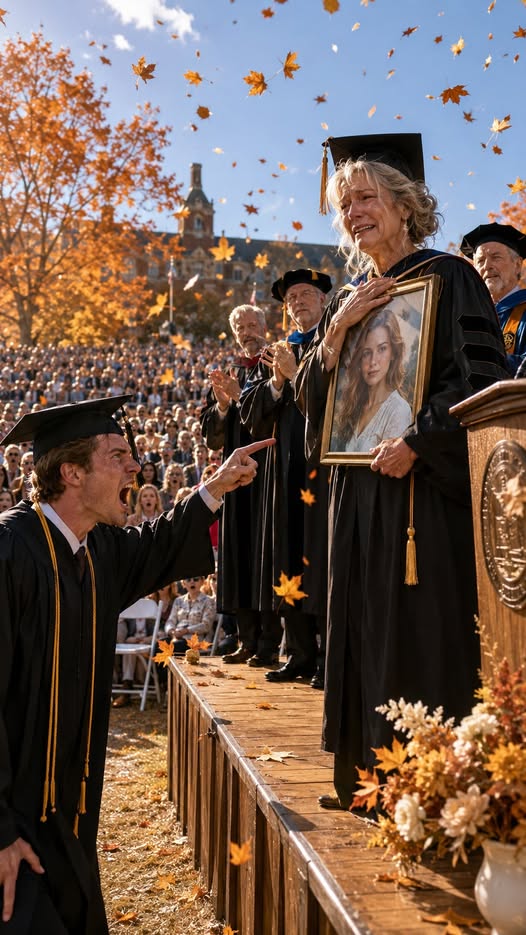
and without basic comforts, secretly donating forty percent of her meager wages to this institution’s scholarship fund. A fund that caught the attention of the Van Der Camp Foundation, who were so moved by her unparalleled sacrifice that they matched her contributions tenfold to support other struggling students.” A ripple of shock washed through the auditorium. The murmurs began, a low hum of disbelief and awe. “Her name,” Dr. Harrison’s voice boomed, cutting through the noise, “is Margaret Ross.” The name hit the room like a physical blow. Down in the VIP
section, Arthur and Beatrice Van Der Camp gasped loudly. They stood up immediately, their expressions shifting from polite curiosity to profound reverence, tears welling in Beatrice’s eyes. But it was Connor’s reaction that stopped my heart. From my vantage point, I watched my son
shatter. He froze, his entire body going rigid as if struck by lightning. The smug, patrician mask he had so carefully crafted melted off his face, leaving behind a portrait of absolute, paralyzing horror. The color drained from his cheeks until he was as pale as the marble I used to polish. He
stared straight ahead, his mouth slightly open, his chest heaving under his black robe. In the VIP section directly behind him, Grace leaned forward. I could see the confusion contorting her beautiful features, slowly morphing into a terrifying realization. She looked at Connor’s back, then at
her father, then back to Connor.
“Connor…” Grace whispered loudly, her voice piercing the stunned silence of the front rows. “Isn’t your mother named Margaret Ross? The one you said was recovering from a luxury treatment abroad?”
Connor couldn’t speak. He couldn’t even turn his head. He was trapped in a prison of his own lies, completely exposed under the blinding lights of his graduation day.
Dr. Harrison shielded his eyes, looking up into the vast darkness of the auditorium. “Margaret, we know you are here. We ask that you please come forward.”
For a moment, I didn’t move. The fear of their eyes, of their judgment, rooted me to the spot. But then I remembered the text message. Your worn-out clothes and limp will just embarrass me. The anger, cold and pure, finally overrode my shame.
I stood up.
I stepped out from the shadows of the rafters and began the long descent. There was no hiding my reality now. With every step down the steep, concrete stairs, my bad knee forced me to drag my right leg, a heavy, rhythmic limp that echoed in the silent hall. Thud. Drag. Thud. Drag.
Heads turned. Thousands of faces tilted upward, their eyes tracking the slow, agonizing progress of an old woman in a faded, decade-old navy dress. I kept my chin high. I did not look at the ground. I looked straight at the stage. Every step was a testament to a bathroom scrubbed, a floor polished, a meal skipped. My scarred hands were visible to all, resting awkwardly at my sides.
As I reached the main floor, the sea of wealthy families parted for me. They didn’t just step aside; they pulled back with a physical deference, as if making way for royalty. A spontaneous, thunderous applause erupted, starting from the back and rolling forward like a tidal wave until the entire auditorium was on its feet. A standing ovation for the cleaning woman.
When I reached the front of the main aisle, I finally looked at Connor. He was staring at me, his eyes wide with a terror so pure it was almost pitiful. He saw my faded dress. He saw my limp. But he no longer saw an embarrassment; he saw his executioner.
Before I could reach the stairs to the stage, a figure stepped out from the VIP section, blocking my path. It was Arthur Van Der Camp.
The billionaire patriarch stood before me, his eyes shining with unshed tears. He looked at my worn dress, at the heavy, orthotic shoes, and then down at my hands. He didn’t offer a polite handshake. Instead, Arthur Van Der Camp bowed his head in deep, genuine respect, extending his arm toward me.
“Mrs. Ross,” Arthur said, his voice carrying just enough for Connor to hear. “It is the honor of my lifetime to finally meet you. Please, allow me.”
I placed my scarred, calloused hand on the sleeve of his bespoke tuxedo. Together, the billionaire and the custodian walked up the stairs into the blinding spotlight of the stage. Dr. Harrison handed me a heavy crystal plaque, but I barely felt its weight.
As I stood there, looking out over the roaring crowd, Dr. Harrison passed the microphone to Arthur. Arthur turned slowly away from the audience. He looked down into the front row, his eyes locking onto Connor. The warmth vanished from Arthur’s face, replaced by a gaze as cold and unforgiving as winter ice, preparing to make an announcement that would redefine the young doctor’s future.
Chapter 5: The Weight of Truth: The Fall of the Arrogant
The applause eventually faded, replaced by the chaotic rustle of a ceremony thrown entirely off its axis. Arthur did not make a grand, theatrical speech of denunciation into the microphone. He didn’t need to. He simply looked at Connor, his silence louder than any condemnation, before turning back to me with a protective gentleness and escorting me off the stage.
The true execution of karma did not happen under the stage lights; it happened thirty minutes later in the sprawling, marble-floored Alumni Atrium where the VIP reception was being held.
I stood near a towering column of white marble, holding a glass of sparkling water I hadn’t sipped. The crowd kept a respectful distance, murmuring in hushed, awe-struck tones, occasionally offering me nods of profound reverence. I felt entirely out of place, yet strangely anchored.
Suddenly, a hand shot out from behind the column, grabbing my arm with a desperate, painful grip.
It was Connor.
His graduation cap was gone, his dark hair a disheveled mess. Sweat beaded on his forehead, and his eyes were wild, darting around the room like a cornered animal. He dragged me slightly into the shadow of the pillar, his voice a frantic, hissing whisper.
“Mom, you have to fix this,” he begged, his breath ragged. “You have to tell them! Tell them it was a surprise. Tell them that I knew all along, that we planned this reveal together. Tell them the text I sent was a joke. Anything!”
I looked at the hand gripping my arm. The hand I had guided when he was learning to walk. The hand I had slipped dollar bills into so he could buy lunch while I starved. I didn’t feel anger anymore. I felt an overwhelming, hollow pity.
“Let go of my arm, Connor,” I said, my voice dangerously calm.
“Mom, please!” he choked out, ignoring my command. “If you don’t back me up, Arthur is going to destroy me. He’s already talking to the Dean. He’ll pull his funding for my residency at the hospital. My career is over before it starts. You did all of this for my career! You can’t let it die now!”
He was still entirely blind. He thought this was about a residency. He thought my sacrifice was a transaction he still owned.
Before I could pry his fingers off my arm, two figures stepped into our secluded circle. Arthur and Grace.
Connor released me instantly, spinning around to face them, slapping on a sickly, desperate smile. “Mr. Van Der Camp… Grace, sweetheart, I can explain everything. It’s a massive misunderstanding—”
Grace didn’t let him finish. Her eyes, usually so warm and bright, were flat and dead. She slowly reached down to her left hand. With deliberate, agonizing precision, she slipped the massive, flawless diamond engagement ring off her finger. She held it out and dropped it into Connor’s trembling palm. The heavy platinum clinked softly against his skin.
“You didn’t just lie to us, Connor,” Grace said, her voice trembling, not with sadness, but with a visceral, acidic disgust. “We don’t care that you grew up poor. We don’t care that your mother is a cleaner. What we care about is the monster you had to become to hide her.”
“Grace, please—”
“You treated the woman who gave you everything, who broke her body so you could stand here today, like absolute trash,” she continued, stepping closer, her words striking him like physical blows. “You were ashamed of her scars. Scars she got for you. My father built his foundation to honor people with the integrity and strength of your mother. You… you are nothing like her. You are empty.”
She turned on her heel and walked away, disappearing into the crowd without looking back.
Connor reached a hand out toward her retreating form, then turned his desperate, pleading eyes to Arthur.
Arthur simply stepped forward and placed a heavy, protective arm around my frail shoulders. He looked at Connor as one might look at a venomous insect squashed on the floor. “The Dean and I will be discussing your character evaluation this afternoon, Mr. Ross,” Arthur said softly. “I suggest you begin looking for employment far outside of Boston.”
Arthur gently guided me away, leaving Connor standing completely alone in the center of the grand atrium, surrounded by a crowd of whispering onlookers who now knew exactly what he was.
As we walked toward the exit, the air feeling lighter with every step, I glanced back one last time. Connor was staring down at the ring in his hand. As he watched his entire future slip away into the ether, his cell phone buzzed loudly in his pocket. He pulled it out with shaking hands. Even from a distance, I knew what it was. It was an urgent notification from the Dean of Medicine, requesting an emergency meeting regarding the ethics violation of his residency application. The foundation of his lies had finally collapsed, burying him beneath the rubble.
Chapter 6: A Legacy Carved in Gold: The New Beginning
One year later, the harsh Massachusetts winter had finally given way to a brilliant, blooming spring.
I sat at a massive mahogany desk in a bright, sunlit office on the third floor of the Bellingham University administration building. The brass plaque on the door read: Margaret Ross, Honorary Director, The Ross-Scholarship Foundation.
I looked down at my hands. They were resting on a stack of neatly printed student essays. My hands were no longer stained with bleach or rough like sandpaper. They were soft, treated with expensive lotions, and the agonizing inflammation in my joints had subsided dramatically thanks to the top-tier medical care provided by the university’s private physicians. My knee still possessed a slight ache when it rained, but the severe, dragging limp had been corrected by surgery. I picked up a silver fountain pen, enjoying the smooth, effortless weight of it as I signed an approval form for a brilliant, impoverished young girl from Dorchester who wanted to study biomedical engineering.
I was no longer a ghost. I was a guardian.
Taking a moment to rest my eyes, I stood up and walked over to the large, floor-to-ceiling glass window that overlooked the bustling campus plaza below. Students were hurrying to class, laughing, throwing frisbees on the emerald lawns.
Then, my eyes caught a flash of movement near the perimeter of the quad.
A figure in a drab, ill-fitting gray uniform was slowly pushing a heavy, wheeled trash cart along the cobblestone path. He stopped to empty a public waste bin, hauling the heavy black plastic bag up and over the rim. I watched the physical strain in his shoulders, the exhaustion in his posture as he wrestled with the weight of other people’s garbage.
It was Connor.
His medical degree was essentially worthless. Stripped of his prestigious residency, blacklisted by Arthur’s extensive network across the eastern seaboard, and buried under a mountain of private loans he had taken out to fund his designer clothes and lavish dinners with Grace, Connor had fallen hard. He was now working as an assistant orderly and groundskeeper at a local, underfunded clinic on the outskirts of the city, working a grueling, low-paying job just to keep the debt collectors at bay.
For the first time in his life, my son was experiencing the brutal, physical toll of hard labor. He was learning the true weight of a dollar.
Down in the plaza, Connor paused to wipe the sweat from his brow. As he did, he turned and looked up at the administration building. His eyes scanned the windows and stopped at the third floor. He saw me.
Even from this distance, I could see the profound change in his face. The arrogance was gone, replaced by deep lines of regret, humiliation, and a crushing, inescapable exhaustion. He stood perfectly still, his hands gripping the handle of the trash cart, looking up at the mother he had thrown away.
I looked at him for a long, quiet moment. I didn’t feel triumph. I didn’t feel anger. I felt the calm, steady peace of a universe that had finally righted itself. True honor, I realized, cannot be stolen, and it certainly cannot be bought with a designer jacket. It is earned, drop by drop, through sacrifice and integrity.
I raised my hand, offering him a slow, simple nod of acknowledgment. Then, I turned around and gently closed the blinds, shutting out the past, and walking back to my desk to review the applications of students who actually deserved a future.
I had just sat down and uncapped my silver pen when the stillness of my office was broken by the sharp ring of my desk phone.
I reached out and picked up the receiver, glancing at the caller ID display. The words blinking on the digital screen sent a sudden, cold chill down my spine. It read: Massachusetts State Prison – Medical Ward.
I held the phone to my ear, listening to the static of the automated recording. A young man’s voice, broken, terrified, and painfully familiar—a voice that once called me “mother” before I became Margaret the cleaner—spoke over the line. He was begging for a character reference for a medical parole board, forcing me to decide, in that very moment, if the mercy of a mother truly has no limits.
If you want more stories like this, or if you’d like to share your thoughts about what you would have done in my situation, I’d love to hear from you. Your perspective helps these stories reach more people, so don’t be shy about commenting or sharing.