{The Ledger of Cedar Hill: Chronicle of a Debt Collected} Chapter 1: The Arithmetic of Love: My name is Tess Eley. I am thirty-four years old, and I make my living translating the financial chaos of other people’s lives into neat, balanced columns. Consequently, I understand the precise, atomic weight of a signature. On a frigid Christmas Eve, my fiancé’s mother stood framed in the grand doorway of her historic home and casually instructed my seven-year-old daughter to wait outside in the snow. She delivered this edict while her biological grandchildren swarmed past us, clutching identically wrapped, emerald-green gift bags. I didn’t scream. I didn’t launch into a theatrical defense. I simply crouched down, adjusted my daughter’s snowflake-patterned mittens, and handed that imperious woman a crisp, unadorned white envelope. “For you,” I said, my voice as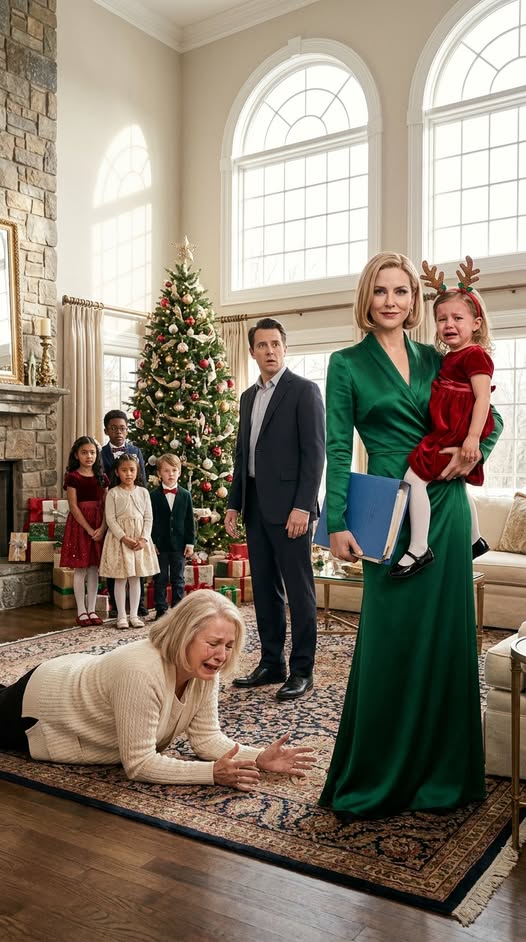
flat as a dial tone. “Open it after the toast.” Then, I escorted my child back to my car, drove us home through the swirling snow, and made her hot cocoa with the miniature marshmallows she loved. Vivien Callaway sliced that envelope open at exactly 11:47 PM. By dawn, my smartphone
screen displayed seventy-nine missed calls. Not a single one of those desperate voicemails contained an apology. This is the anatomy of a line drawn in the snow. Because eventually, you learn a brutal truth: some doors aren’t worth battering down. Sometimes, the most devastating move
you can make is to simply stop paying the mortgage that keeps those doors standing.
To understand the payload inside that envelope, I need to rewind eight months, back to the genesis of my careful records.
I operate a boutique bookkeeping and tax consultancy out of a repurposed dining room on Maple Street. It sits exactly two miles away from the affluent, manicured zip codes of this town, but it might as well be in a different solar system. I constructed this practice from scratch in the wake of a messy divorce, armed with a two-year-old Lily, a folding card table, and exactly nine hundred dollars to my name.
When the local business owners tangle their numbers into a Gordian knot, they call me. I locate the discrepancy. I quietly repair the damage. And crucially, I never humiliate them for the financial graves they’ve dug for themselves. That is the service I provide.
Somewhere along the line, that professional ethos bled into my personal psychology. I became a chronic fixer. It was the only dialect of love I genuinely trusted, because a balanced ledger, unlike a human being, never suddenly changes its mind about your worth. My ex-husband used to complain, “You’d rather solve an equation than be comforted.” He wasn’t entirely off the mark. I possessed a savant-like ability to diagnose other people’s catastrophic errors, yet I was tragically blind to my own.
Lily was the sole, radiant exception to my calculations. She was seven that winter, missing a lateral incisor, and possessed a heart so painfully open she genuinely waved at strangers at traffic lights. Her favorite activity was drawing houses with cheap crayons. She always drew the front doors wide open, crowding every stick-figure family member into the threshold. In Lily’s world, no one was ever left outside.
I accumulated those crude drawings in a manila folder thicker than most corporate tax returns. I convinced myself I was constructing a stable, impenetrable life for her. I hadn’t yet realized that an obsession with stability can induce a dangerous myopia. The people who eagerly allow you to carry their burdens are rarely the same people who will offer you a shoulder when you stumble.
I collided with Mark Callaway at a local Chamber of Commerce mixer I had actively debated skipping. He was thirty-nine, moved through the crowded room with effortless, unearned grace, and possessed the rare talent of remembering how you took your coffee after one meeting.
But it wasn’t his polished charm that disarmed me; it was his interaction with Lily. On our third date, he sprawled out on my cheap rug and allowed my daughter to ruthlessly demolish him at checkers four consecutive times. He narrated his own humiliating defeats like an overly dramatic sports announcer, making Lily laugh so hard she developed hiccups.
That evening, as I tucked her in, she tested out the phrase “almost-dad,” whispering it sideways into her pillow. God help me, I let myself want it. I let the armor slip.
We dated for eighteen months. He was remarkably consistent with the superficial gestures: unexpected bouquets of tulips, taking my car in for an oil change when I was drowning in tax season. But there was one specific topic that caused his easy, baritone voice to constrict into a tight wire: his family’s estate.
The Callaways were legacy wealth in a town severely lacking it. The epicenter of their perceived aristocracy was a towering, pristine white Victorian situated on Cedar Hill. It boasted a wraparound porch and a heavy brass plaque beside the double doors bearing his late father’s name. Mark referenced that house the way retired athletes talk about a Super Bowl ring. Yet, whenever the subject arose, a microscopic tension hijacked his jawline—the subtle bracing of a man anticipating a collection agency call.
I am professionally trained to detect when a number feels artificial. Human beings operate on the same principle. I casually inquired once if the estate was a massive financial drain to maintain.
“It’s handled,” he replied. He used the exact, defensive monotone clients adopt when a situation is the furthest thing from handled.
I let the inquiry drop. I was falling in love, and Lily had started meticulously adding a fifth, taller stick figure to her crayon doorways, the new addition firmly holding her hand.
My initial visit to Cedar Hill instantly illuminated Mark’s clenched jaw. The property was undeniably breathtaking, but it radiated the sterile, unwelcoming chill of a museum. Every mahogany surface gleamed with a polish that practically screamed, Look, but do not touch.
Vivien Callaway awaited us in the cavernous front hall, positioned strategically beneath a massive oil portrait of her deceased husband. She was sixty-three, her silver hair styled as if she were permanently anticipating a photographer from Architectural Digest.
She accepted my outstretched hand with the ginger distaste one might use when handed a damp, unfamiliar coat. “So, this must be Mark’s… friend,” she declared, her eyes performing a rapid, dismissive audit of my attire.
When Mark gently corrected her—“Fiancé, Mom”—she repeated the word as if it were coated in ash. “Fiancé. Of course.”
Then, her gaze drifted downward to Lily. My daughter was proudly extending a slightly bruised dandelion she had carefully preserved from the driveway. Vivien offered a smile that resembled a razor blade.
“We aren’t really a dandelion family, dear,” she purred, effortlessly bypassing Lily and steering us toward the parlor.
That was also the day I was introduced to Mark’s sister, Brooke. Thirty-six, perpetually exhausted by her two children, and married to a man who lived out of a suitcase. Brooke volunteered to give me a “tour,” which essentially amounted to an aggressive inventory of the home’s most expensive antiques.
When we reached the ornate fireplace mantle, she pointed to the family’s crown jewel of tradition. Displayed with military precision were matching, deep-green gift bags, each tied with identical gold ribbons.
“One for each Callaway grandchild, for every major holiday,” Brooke explained, her tone dripping with reverence. “It’s a tradition my grandmother started. We line them up by age, and Mom distributes them. It means the absolute world to the kids.”
I stared at the row of gold bows. My bookkeeper’s brain instinctively ran the tally. There were exactly enough bags for Brooke’s two children. Not a single extra bag in sight.
Lily stood quietly anchored to my leg, her eyes tracking the way the chandelier light caught the gold ribbons. I swallowed the lump of protective rage in my throat, rationalizing that traditions required time to adapt. Give it time, I lied to myself.
Mark proposed in late October. He orchestrated the event on the wraparound porch of Cedar Hill, because in his universe, no other location held gravity. I said yes. I said yes because the man looking at me was gentle with my child, and because I had spent half a decade acting as the sole load-bearing wall in my own life, and I was bone-tired.
The diamond was a family heirloom, passed down from his grandmother. I happened to glance up during the proposal. Vivien was standing in the parlor window, watching the exchange with the grim, resigned expression of a loan officer who has just been forced to approve a high-risk application.
Following the engagement, the micro-aggressions began to stack up, accumulating like unpaid interest. At Sunday dinners, Brooke’s children, Aiden and Sophie, were loudly praised for their table manners, while Lily was ignored, passed over like a mislaid piece of silverware. During a weekend trip to the family lake cabin, there were plush beds assigned to everyone, save for Lily, who was relegated to a folding cot in the drafty laundry room—an “oversight” no one had bothered to mention prior to arrival.
Each time an incident occurred, I brought it to Mark’s attention. I didn’t yell; I flagged the issue calmly and specifically, mirroring how I would present an audit finding to a CEO.
Each time, he deployed the same deflecting shield: “Mom means well, Tess. You’re overanalyzing it.”
One evening, returning from the powder room, I caught the muffled sound of voices drifting from the kitchen.
“We’ll see how long this phase lasts,” Vivien was murmuring to Brooke.
Brooke let out a low, conspiratorial laugh.
I stood paralyzed in the shadowed hallway, pressing my palm against the cool plaster, forcing my lungs to expand. Then, I plastered on a serene smile, walked back into the dining room, and passed the dinner rolls. I did it because Lily was seated at that massive table, a smudge of chocolate frosting on her chin, looking happier than she had in months.
That is the insidious, unspoken reality of motherhood. You don’t endure the disrespect for your own sake. You swallow the glass because a tiny human you love is finally getting a seat at a bright, warm table, and you will endure almost any indignity to ensure she isn’t asked to leave.
But the foundation of Cedar Hill was rotting from the inside out. And to understand the envelope, I have to reveal the secret Mark brought to my door in the dead of night.
Chapter 2: The $91,000 Secret
To fully comprehend the mechanics of that Christmas Eve, we must rewind to a damp Tuesday night the previous spring.
Mark arrived at my Maple Street door at 11:00 PM. His face was the color of wet cement, and he was clutching a thick, manila folder to his chest as if it contained a live grenade.
“Tess,” he choked out before I even unlatched the screen. “I need you.”
I brewed a pot of dark roast and sat silently while he paced the length of my linoleum kitchen floor. I opened the folder. It was a financial massacre.
The late patriarch, the man enshrined in oil paint in the foyer, had spent the final decade of his life aggressively borrowing against the equity of Cedar Hill to fund a lifestyle he could no longer afford. He had hidden the paper trail masterfully. There were years of delinquent property taxes, a massive secondary mortgage that Vivien was completely oblivious to, and a suffocating mechanic’s lien that had quietly, lethally matured.
The county clerk had officially established a timeline. In exactly eleven weeks, the pristine white Victorian—the epicenter of the Callaway identity—was scheduled to be auctioned off on the courthouse steps for uncollected debt.
“Mom is completely detached from reality,” Mark confessed, dragging his hands down his face. “She honestly believes that if she pawns a few pieces of antique silver, the county will just back off. It doesn’t work like that. You do this for a living, Tess. You’re the only person I trust who can even decipher this mess.”
I read the documents a second time. The arithmetic was gruesome, but it wasn’t unsolvable. Approximately $90,000 stood between this arrogant family and absolute, public ruin.
And I had it.
Sitting in various high-yield accounts was the slow, agonizing accumulation of my savings. It was the armor I had built, dollar by dollar, swearing I would never again be ninety thousand dollars away from disaster.
Mark stopped pacing and looked at me. It was the desperate, hollow stare of a man standing on a window ledge. “Please,” he whispered. “I will never ask you for another thing as long as I live.”
A rational woman would have paused. She would have asked herself why a family that prioritized social optics above basic oxygen had allowed a crisis to fester until the eleventh hour. But my rationality was compromised. I saw the man I loved, terrified of watching his mother’s world disintegrate.
So, I agreed to intervene. But I agreed to do it strictly on my terms.
Here is the fundamental dichotomy of my personality that people fail to grasp: I am dangerously soft regarding human emotion, but I am titanium when it comes to paperwork. That specific combination is the only reason I am still standing today.