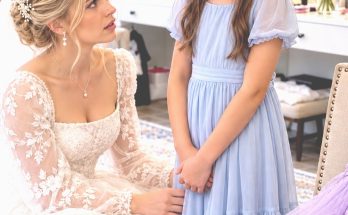
I stood at the kitchen window and watched them on the front lawn. Her biological mother slid the corsage onto Michelle’s wrist, adjusting it just so. Michelle laughed at something. They posed cheek to cheek while a neighbor took photos on her phone. I waited for Michelle to glance toward the house. To wave me out. To remember me. She never looked back. I sat down at the kitchen table. The camera was still in the other room, untouched, its strap coiled neatly beside the corsage box I had spent twenty minutes choosing. I stared at it until my vision blurred. My phone buzzed.
A photo from the neighbor appeared in the family thread. Michelle and her biological mother on the lawn, my hydrangeas blooming behind them, the other woman’s flowers bright on her wrist. I stared at it until my vision blurred. The front door opened and closed. Heels clicked across
the wood. Then a car door, an engine, the slow fade of tires. The house went quiet in the particular way it only goes quiet when you are the one left in it. I did not cry. I had promised myself, years ago, that I would never make Michelle responsible for my feelings about her mother. I was not going to start tonight. And one afternoon, I had not been enough.
I just sat there.
I went back through the years in my head, item by item. The lost tooth at seven. The science fair volcano at nine. The fever the night before her eighth-grade graduation. The first heartbreak at fifteen.
Eleven years of every ordinary, exhausting, beautiful thing.
And one afternoon, I had not been enough.
“What did I do wrong?” I whispered to the empty kitchen.
Eleven years of small, ordinary love. And one afternoon I had not been invited into.
The kitchen did not answer. The corsage on the entry table did not answer either.
Hours dragged by. I stayed at that kitchen table while the sun moved across the floor, scrolling through old photos on my phone.
There was Michelle, six years old, missing her front tooth. There was the science fair volcano we built at midnight. There was the prom dress, after three fittings, her laughing in the mirror.
Eleven years of small, ordinary love. And one afternoon I had not been invited into.
I picked up my phone and opened a blank message to her biological mother.
I started thinking about all the small things I had brushed aside. The text messages on Michelle’s phone that lit up more often lately. The lunch she had mentioned a month ago, almost in passing. The way she went quiet whenever her mother’s name came up at the dinner table.
I had told myself it was nothing.
Maybe I had been wrong.
I picked up my phone and opened a blank message to her biological mother. My thumbs hovered over the keys.
Then I deleted every word.
I typed, “You disappeared for years. You don’t get to walk back in for the pretty pictures.”
I stared at it. I read it three times.
Then I deleted every word.
Eleven years ago, I had made a promise to myself and to Michelle. I would never be the woman who spoke badly about her mother. Not in anger. Not in jealousy. Not ever.
I set the phone face down on the counter.
She placed it in my hands and folded my fingers around it.
I was still sitting there when headlights swept across the front window.
A car door shut. Heels clicked up the walkway. The front door opened.
Michelle stepped inside, still in her prom dress, her makeup smudged at the corners of her eyes, her hair falling out of its pins. She looked as if prom had ended before it ever really began.
She did not say hello. She did not smile. She walked straight to me, reached into her small clutch, and pulled out a sealed white envelope.
She placed it in my hands and folded my fingers around it.
I sat on the edge of the bed and tore it open.
“This is why I chose her,” she said quietly.
She looked at me with something I could not name. Grief, maybe. Or love too heavy to carry alone.
“Read it alone.”
I carried the envelope upstairs with shaking hands, certain I was about to read the words that ended us.
I sat on the edge of the bed and tore it open.
It was not Michelle’s handwriting.
She wrote about a diagnosis two years ago.
It was her biological mother’s.
“I am writing this because I owe you the truth I could not give my daughter,” the letter began.
She wrote about a diagnosis two years ago. About hospital stays disguised as absences. About the old disappearances that had turned into something far more final. About months, not years, left.
“I begged Michelle for one afternoon,” she wrote. “I asked her not to tell you. I did not want your pity. I wanted a photograph she could hold when I am gone.”
I pressed the letter against my chest and let myself cry.
A second envelope slipped out, this one in Michelle’s careful handwriting.
I opened it slowly.
“You have been my mother every single day for eleven years,” she wrote. “You were the one who stayed up with me. You were the one who held me when boys broke my heart. You are the one I will call from college every Sunday.”
“I gave her the afternoon because she has weeks. I gave you my life because you gave me yours.”
“I chose her for the picture. I chose you for everything.”
I pressed the letter against my chest and let myself cry, this time without holding anything back.
My throat tightened.
When I came downstairs, Michelle was waiting on the bottom step, still in her prom dress.
“I should have told you,” she whispered.
“No,” I said. “You did exactly the right thing.”
Her face crumpled. “I hated hurting you.”
“I know.”
“She asked me for one normal memory,” Michelle said. “One where she didn’t look sick. One where I wasn’t scared.”
For a moment, we just looked at each other.
My throat tightened.
“And I thought if I told you,” she continued, “you’d make it easier for me to do the right thing. But I didn’t want it to be easy. I wanted to choose it myself.”
I stepped closer. “You were carrying too much alone.”
“So were you.”
For a moment, we just looked at each other. Eleven years stood between us, not as a distance, but as a bridge. Every lunch packed, every fever checked, every late-night talk, every quiet sacrifice neither of us had named out loud.
The word broke something open in me.
Then she stood, and I opened my arms.
She folded into me the way she had when she was seven and afraid of thunder.
“I love you, Mom,” she said.
The word broke something open in me.
“I love you too, baby.”
We stood there a long time, holding on to everything that had never needed a photograph to be real.