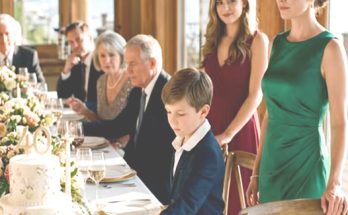
He carried it with both hands and set it on the entryway table in front of his father. Gabriel smiled. Already reaching for the lid. Expecting something handmade, probably. A card. A joke. Something a kid puts together on an afternoon when he’s feeling sentimental. He opened it. The smile stopped. I watched the color leave Gabriel’s face the way water leaves a glass. His hands, I noticed from across the hallway, had begun to shake. I watched the color leave Gabriel’s face. People drifted in from the kitchen. The music from Clara’s playlist kept playing for a few more seconds
before someone reached over and turned it off. Inside the box were dozens of items, sorted neatly, each labeled with a date in Michael’s careful handwriting. First were the unanswered birthday invitations: Maya’s fourth in October, Lena’s seventh in December, and Michael’s own from six
months ago. That last envelope was still sealed and stamped, never mailed because Michael hadn’t known where to send it. Inside the box were dozens of items, sorted neatly.
Beneath those lay two semesters of report cards. School photos. A blue ribbon from a regional science fair. A program from the spring concert where nine-year-old Clara had cried from nerves in the parking lot, only to play her recorder solo perfectly once she hit the stage.
A soccer schedule from the fall season was tucked further down. Looking closer, I saw Gabriel’s name highlighted in yellow marker next to every home game.
Then came the younger kids’ drawings. Crayon animals, unsteady handwriting, and family portraits where one figure was left as a blank outline. That outline was labeled Dad.
I saw Gabriel’s name highlighted in yellow marker.
At the very bottom was a newspaper clipping with Michael’s name in the headline. A regional mathematics competition he had won in February.
He hadn’t mentioned he’d kept that one.
Michael started lifting items out one by one. Not dramatically. Not with any performance in his voice. He just named them quietly, held each one up for a moment, and set it on the table beside the box.
“This was Maya’s birthday. She asked me three times if you were coming.”
“This was the fall soccer season. We made it to the semifinals.”
He hadn’t mentioned he’d kept that one.
“This was Clara’s concert. She was really good.”
“These are my last two report cards. I made honor roll both times.”
He kept his voice level throughout. Not cold, just steady. The steadiness of someone who had rehearsed this not as a confrontation but as a simple presentation of facts.
Here is what happened. Here is what you missed. Here is the year.
Gabriel stood there and received it. He didn’t interrupt. He didn’t explain himself. He didn’t look at me.
Gabriel stood there and received it.
He just stood in the middle of his son’s birthday party and held item after item that proved an entire year had continued without him.
Near the bottom of the box, Michael reached for something and handed it to his father separately from the rest.
A card. Handmade, folded construction paper with Michael’s marker handwriting on the front: Dad.
Gabriel opened it slowly.
Item after item proved an entire year had continued without him.
Inside, in Michael’s handwriting:
Happy Father’s Day. Maybe you’ll be here next year.
The hallway was completely silent.
Gabriel stared at the card for a long time. When he finally looked up, his eyes were red and his jaw was set in the tight, rigid way of a man trying very hard not to come apart in front of 20 people.
“Michael,” he started.
“I’m not angry,” Michael said. His voice was still even. “I want you to know that first.”
When he finally looked up, his eyes were red.
He paused, the way he always does when he’s choosing his words carefully.
“I saved them because I didn’t know if you’d ever come back. And I wanted you to have them either way. So you’d know what happened while you were gone.”
No ultimatum. No raised voice. No tears.
Just a 13-year-old boy who had spent a year quietly collecting proof that his family kept living, growing, and showing up for each other. Somewhere along the way, he decided his father deserved to know exactly what he had chosen to miss.
“I didn’t know if you’d ever come back.”
Gabriel left that evening with the box tucked under his arm.
Michael had asked him to take it.
I stood at the front door and watched Gabriel walk to his car in his expensive suit, the ordinary cardboard box under one arm, the LEGO set still sitting unopened on our entryway table where he’d set it down and never picked back up.
He didn’t ask if he could call. He didn’t make a promise on his way out.
Neither did Michael.
That felt more honest than anything Gabriel had said to me in the last two years of our marriage.
He didn’t make a promise on his way out.
Later that night, long after the cousins had gone home and the younger kids were in bed and the streamers had been pulled down, Michael sat with me at the kitchen table over two mugs of hot chocolate.
I asked him how long he’d been putting the box together.
“Since last March,” he said. “About three weeks after he stopped calling.”
I did the math quietly and didn’t say anything.
“Were you hoping he’d come back?” I finally asked.
Michael wrapped both hands around his mug and thought about it for a moment.
“Were you hoping he’d come back?”
“I think I was hoping he’d want to,” he said. “That’s different from hoping he would.”
I had nothing to add to that.
At just 13, he already understood how to walk away—a distinction between loving someone and chasing them that had taken me two decades to learn.
My son didn’t give his father a box full of anger.
He gave him a box full of moments he could never get back.
He gave him a box full of moments.