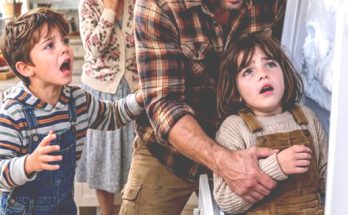
Leo, a ten-year-old boy, was making his way home from the local flea market. Earlier that day, he’d tried to sell an old skateboard he had found at a landfill a few days before. It wasn’t unusual for him to do things like that—any extra money he earned helped his family get by. His mother, Amanda, was a 32-year-old widow. After her husband’s death, medical bills and debt had taken nearly everything they owned. The only thing she had left was her late mother’s aging house, a place that seemed to need repairs in every room. Despite the challenges, she was doing her best to
raise Leo and his younger sister, Tina, there. As Leo walked home, he spotted an elderly woman standing alone at a busy intersection. She appeared to be around sixty-five years old, wore dark sunglasses, and looked completely lost. Concerned, he approached her and asked if she needed
help. She didn’t respond right away and seemed unable to focus on him. That’s when Leo realized she was blind. “Where are you trying to go?” he asked kindly. “No, thank you. Just help me cross the street,” the woman replied. “I can’t just leave you here, ma’am. Let me walk you home,” Leo insisted. The journey took nearly thirty minutes. Along the way, Leo told her about his family and how he was trying to help his mom however he could. The woman shared that she had gone out for a walk, but her sons had forgotten about her, and she ended up losing her way.
When they finally arrived at the address she provided, Leo stopped in disbelief.
A huge three-story mansion stood before them.
Moments later, two young men in their twenties came outside.
The woman smiled with relief, but one of the men immediately pointed at Leo.
“Who is this kid?” he demanded.
Then his expression hardened.
“And why did you bring this beggar here? Get off our property!”
Startled and embarrassed, Leo turned and ran all the way home.
When he burst through the front door, he was in tears. He told his mother that he hadn’t managed to sell the skateboard after all.
Amanda hugged him tightly. Even though they had no money, she couldn’t have been prouder. Her son had shown more compassion than many grown adults ever would.
That night, Leo went to bed.
The next morning, he was jolted awake by his mother’s voice shouting from outside.
“LEO! WAKE UP! THERE’S SOMEONE HERE TO SEE YOU!”
Still half asleep, he hurried outside.
He had no idea that karma was about to catch up with those rude brothers—and change his own life in the process.
Parked in front of their house were several black SUVs.
As Leo stepped onto the porch, a man in a black suit, around thirty years old, walked toward him.
People looked at us like we were invisible, as if we didn’t matter. But I guess that’s how it goes when you live in an old, rust-stained trailer on the side of an old highway that barely sees traffic. My name is Leo. I was 10 years old in the year everything changed.
That morning had started like all the others: bare feet on cold linoleum, a whiff of instant coffee, and Mom humming to herself even though there was nothing much to smile about. The wallpaper had long peeled off, and the refrigerator wheezed as if it were on life support. Still, it was home.
My little sister, Tina, was five at the time. She was still asleep on the fold-out mattress when I crept past her with my backpack slung over one shoulder and an old skateboard tucked under my arm.
I’d found the board behind the dump a few days earlier. The grip tape was worn, and the wheels were mismatched, but I figured maybe someone at the flea market would toss a couple of dollars my way for it.
My mom, Amanda, 32, kissed my forehead as I stood by the door. Her eyes had that soft sadness I’d gotten used to, but she forced a smile.
“Be safe, baby,” she said. “Don’t let anyone cheat you out of what it’s worth.”
“I won’t,” I promised, even though I wasn’t sure what it was worth at all.
The walk to the flea market took almost an hour. We lived on the outskirts of town, past where the sidewalks ended. It was the same road my dad used to drive down before he was killed in a logging accident.
That was when everything fell apart.
The company he worked for barely covered funeral costs. What followed was a mountain of debt and no one to lean on. Mom lost the house, and then the car. Eventually, all we had left was the trailer — a place where everything needed fixing — that had belonged to Grandma before she passed away.
Selling things, collecting cans, odd jobs — I did whatever I could to help out. It made me feel like I was doing my part, even if it wasn’t much.
That day, though, the market was dead. A few people glanced at the skateboard, and one guy offered me fifty cents, but I said, “No thanks,” because I knew it was worth more.
On my way back home, dragging my feet past cracked sidewalks and empty lots, I saw her.
She was standing alone near the intersection across from a pawnshop.
She appeared to be about 65, maybe older, wearing a long beige coat and dark sunglasses. Something about the way she stood — rigid and uncertain — made me stop. I don’t know what it was, but something made me walk up to her, and that’s when I noticed that she seemed scared and confused.
So, I asked if she needed help.
“Ma’am? Are you okay?” I asked.
She didn’t move immediately. Just kept facing forward, straight past me like I wasn’t even there.
Then she said quietly, “Could you help me cross the street?”
I stepped closer and realized her eyes weren’t focused on anything. That’s when it hit me — she was blind.
“Sure,” I said. “But where are you headed? Maybe I can walk you there.”
She hesitated. “No, it’s fine. I don’t want to trouble you. Just help me across.”
“I insist, ma’am,” I said. “I can’t leave you out here like this. I’ll walk you.”
The woman finally relented and told me where she wanted to go.
I didn’t know the place, but I figured I could follow street signs and ask people, so we started walking. Her hand trembled slightly as it found my elbow. She moved slowly, cautious with every step, and I matched her pace.
As we walked, she asked me my name, and I told her. I’d never met her before, but something about her made me comfortable enough to open up. I told her about Tina and Mom, and how I’d tried to sell a beat-up skateboard but struck out.
She listened quietly, then said, “I was just going for a walk. My sons were supposed to pick me up, but they forgot. And that’s how I got lost. Happens more than I’d like to admit.”
“That’s awful,” I said.
“Yes, well,” she sighed, “sometimes people only care when they need something.”
The address she gave had us walking for what felt like over half an hour. I didn’t mind, though. I liked talking to her. She told me her name was Eleanor, and that she had been a music teacher before her vision started to fade.
She liked a French composer named Claude Debussy, hated the way coffee tasted now, and missed the days when her boys used to care.
When we got to the place, I stopped in my tracks.
A massive, modern three-story mansion rose in front of us. It had white stone, tall glass windows, and polished brass fixtures on the front gate. It didn’t look like something from our town. It looked like something out of a movie.
As if they’d been waiting anxiously, two men, probably in their 20s, came rushing out of the mansion. They wore designer clothes and appeared to have never worked a day in their lives.
“Who’s this beggar with you?” one of them barked.
“GET OUT OF HERE!” the other one shouted, his eyes full of disgust.
I froze. Eleanor flinched. I looked at her, then at them, then back again.
“I uh — sorry,” I stammered, panicked, and I turned and ran as fast as I could.
By the time I got home, my legs were shaking. I burst into the trailer, threw down the skateboard, and burst into tears.
“I didn’t sell it,” I told Mom between sobs. “I didn’t make a dime.”
She knelt and wrapped her arms around me tightly.
“You came home safe and sound. That’s worth more than any money,” she said, tears brimming in her eyes. “You did well, my Leo.”
I didn’t sleep well that night. I kept thinking about Eleanor, but couldn’t bring myself to tell my mom about the encounter. I couldn’t get the way her sons looked at me — like I was dirt — out of my mind. The way she stood so quietly after I left, alone again.
The sandman must have eventually come for me, because the next morning, Mom’s voice pulled me from sleep.
“Leo!” she shouted. “Wake up! Someone’s here for you!”
I stumbled out of bed, rubbing my eyes. Tina peeked from behind the curtain, then gasped.
“Look!” she whispered. “Black cars!”
Outside, several sleek black SUVs were lined up in front of our home. I stepped out barefoot onto the dusty ground. A tall man, probably in his 30s, in a dark suit, approached, his steps calm and deliberate.
He knelt slightly to meet my eye level.
“Leo,” he said with a kind smile, “I’m here to invite you and your family into the car.”
I blinked. “Why? Who are you?”
“My name’s Victor,” he said. “I work for Eleanor.”
My heart skipped.
“She asked me to find you. Said you helped her yesterday and didn’t even tell her where you lived. She was determined to track you down, so we checked security footage and traced your direction. It took a few hours and some help from your neighbors and others, but we found your home.”
I stared at him, stunned. Mom stepped outside, shielding her eyes from the sun.
“What’s going on?” she asked.
Victor turned to her with a polite nod.
“Ma’am, Eleanor would like to invite you and your children to her home for dinner. She has something important she wants to share.”
Mom looked at me, confused, but I just nodded.
“Let’s go, Mom. She’s really nice. You’ll like her.”
The ride to Eleanor’s house felt like something out of a dream. The inside of the SUV smelled like leather and oranges, and Tina giggled every time the car went over a bump. Victor sat up front, calm and quiet, while Mom and I exchanged glances that said, What is happening right now?
I finally filled my mom in on what had happened the day before, but when we pulled up to that same mansion, my stomach twisted. I hadn’t forgotten how those men had spoken to me, like I was trash. I held onto Mom’s hand as we stepped out.
But this time, they didn’t come to the door. Eleanor did.
She stood between the tall columns, a smile stretched across her face, her sunglasses still on, but her head tilted in our direction like she was trying to see us through the dark.
“Leo,” she said softly, opening her arms.
I stepped into her hug, and she held me close.
“You found us,” I said, still in disbelief.
She chuckled. “I have a very persistent staff. You forgot to tell me your last name, but we were able to pull some camera footage from nearby shops and worked backwards. The security team even asked around town. One man remembered a boy trying to sell a beat-up skateboard.”