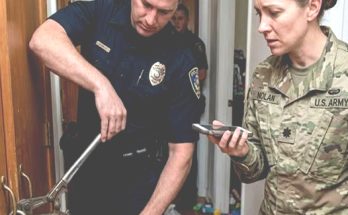
“What is the meaning of this?!” Barbara screeched, her matriarchal facade shattering as two large officers roughly wrenched her arms behind her back. The cold steel handcuffs clicked shut with a harsh, metallic finality. “Get your hands off me! I am the lady of this house! My daughter-in-law is a doctor!” “Yeah, we saw the video of what you did to the doctor,” one of the cops muttered in disgust, reading her Miranda rights as they dragged her struggling, barefoot form toward the waiting cruiser. David, visibly sweating, rushed to the doorway. “Officer, wait, there’s a misunderstanding! My wife is just hysterical, she’s overworked, it was an accident!” Before David could take another step onto the porch, a man in a sharp gray suit stepped out from behind the police line. He pressed a thick, heavy stack of manila folders directly into David’s chest. “David
Lin? You are hereby served,” the process server said flatly. “Served? With what?” David gasped, clutching the files. “Your wife is suing you and your mother for ten million dollars for loss of future earnings, medical damages, and emotional distress,” the server recited. “Furthermore, you are holding an emergency ex parte restraining order and immediate divorce papers. Per the judge’s signature on page three, you have exactly ten minutes to pack a single bag and vacate these premises, or you will be arrested for trespassing.” David’s mouth opened and closed like a dying fish.
He scrambled to pull out his phone. “I… I need to call my lawyer. I have money. We have joint accounts.” Diana leaned closer to the iPad on my hospital bed, a wicked smile playing on her lips. “Check your app, David,” she whispered to the screen. On the camera feed, David frantically tapped his banking app. His shoulders slumped. He let out a strangled gasp. Diana had successfully filed an emergency injunction at 8:00 AM sharp, freezing all joint assets pending the civil litigation. We watched in real-time as David realized his available balance had dropped from $450,000 to $0.00.
He was utterly, comprehensively destitute in a matter of seconds.
The police gave him no quarter. Ten minutes later, a hyperventilating, sobbing David was escorted down the long, paved driveway of the mansion he used to claim as his own, clutching a single gym bag of clothes.
As he reached the wrought-iron gates, he stopped.
Parked across the street was a black Lincoln Town Car. I had checked myself out of the hospital an hour prior, against medical advice, specifically for this.
The tinted passenger window hummed downward.
David looked across the asphalt, his eyes meeting mine. I sat in the plush leather seat, my left arm bound in a heavy sling against my chest. I didn’t smile. I didn’t gloat. I just stared at him with the cold, detached eyes of a surgeon who had successfully excised a malignant tumor from a healthy body.
He opened his mouth, perhaps to beg, perhaps to curse me. But before he could utter a single syllable, the tinted window rolled back up, sealing him out of my life forever.
I leaned back against the seat, taking a deep, shuddering breath. It was over. I had won.
But as the car pulled away, heading toward a rehabilitation clinic, my phone rang. It was my physical therapist, Dr. Evans. He had just reviewed my post-op MRI.
“Maya,” Evans said, his voice heavy with hesitation. “The fasciotomy was successful… but the scarring around the flexor tendons is severe. I need you to prepare yourself. You might never have the micro-motor control to operate again.”
The victory turned to ash in my mouth. I had destroyed the monsters, but they might have taken my soul with them.
Chapter 5: Phantom Limbs
Revenge is a cold meal, but it doesn’t nourish you. The ensuing months were a study in extreme, bifurcated realities.
For the parasites, the descent was absolute. Barbara was denied bail. The judge, having viewed the unedited 4K footage of the unprovoked, brutal attack, deemed her an extreme flight risk and a danger to society. She sat in a bleak, concrete cell in the Twin Towers Correctional Facility, stripped of her cashmere and her pride, facing a mandatory minimum of seven years.
David’s reality was arguably more pathetic. With his assets frozen and the civil suit pending, he was entirely unable to afford a defense attorney. His extended family, having seen the viral police report and the leaked audio of his sociopathic indifference, blocked his number. I received occasional updates from private investigators I hired to monitor the restraining order. David was living out of his repossessed BMW on the streets of downtown Los Angeles, eating cold, stale gas station sandwiches in the rain, staring blankly at divorce decrees he couldn’t afford to fight. He was homeless. Exactly as I had silently promised.
My reality, however, was an agonizing crucible.
Every morning at 5:00 AM, I was in a brightly lit physical therapy clinic in Beverly Hills. The pain was no longer sharp; it was a deep, nauseating ache that settled into the marrow of my bones.
I sat at a sterile white table, my forehead beaded with cold sweat. My left hand, now free of the cast, was a roadmap of angry, jagged pink scars. It trembled violently as I held a pair of delicate surgical tweezers.
On the table sat a small plastic cup and a single, tiny glass bead, no larger than a grain of sand.
“Take a breath, Dr. Lin. Don’t force it,” Dr. Evans encouraged gently, hovering over my shoulder. “Let the neural pathways find the bridge.”
I gritted my teeth. My brain was sending the signal to pinch, but the scarred tendons felt like they were moving through thick mud. The tweezers snapped shut early, missing the bead entirely. Frustration boiled over, hot and suffocating. I wanted to scream. I wanted to sweep the table clean. I was a top-tier neurosurgeon, and I couldn’t pick up a piece of glass.
I closed my eyes. I didn’t think about David. I didn’t think about Barbara’s sneer or the heavy metal tenderizer. I banished them from my mind. Instead, I visualized the intricate, beautiful neural pathways of a child’s brain. I thought about the families pacing in waiting rooms. I thought about the pure, unadulterated purpose that defined my life.
I opened my eyes. I steadied my breathing, exhaling slowly through my nose.
With an agonizing, deliberate flex of my scarred fingers, I commanded the muscle to obey. The tweezers lowered. They pinched the bead.
My hand shook, but I held the grip. I moved the tweezers over the plastic cup, and with a micro-release of tension, the bead dropped inside with a satisfying, microscopic clink.
I slumped back in the chair, exhausted. A small, victorious smile touched my lips—the first genuine smile I had worn in years. I no longer sought validation from a toxic family. I had found profound, unbreakable strength in my own resilience.
I walked out of the clinic that morning feeling the warm California sun on my face, a sense of cautious optimism blooming in my chest.
As I unlocked my car, my cell phone rang. The caller ID flashed: Dr. Aris Thorne, Chief of Surgery.
“Maya,” Dr. Thorne said, his voice clipped and urgent. “I just got your PT clearance forms. Are you in the car?”
“I am. I just finished my session,” I replied, my pulse accelerating.
“Good. Turn around and get to the hospital. A medevac is inbound from San Diego. Seven-year-old boy. Massive astrocytoma intertwined with the cervical spine. It’s incredibly complex. The board is nervous.” Thorne paused, the silence on the line hanging heavy. “They want to know if Dr. Lin is truly ready to hold a scalpel again, or if we need to permanently transfer your cases. I need an answer right now. Are you ready, or is your career officially over?”
Chapter 6: The Golden Thread
The bright, halogen surgical lights reflected sharply off my protective loupes. The operating room was dead silent, save for the rhythmic, reassuring beeping of the pediatric heart monitor and the soft hiss of the ventilator.
Eighteen months had passed since Thanksgiving Day.
The legal wrap-up had been a bloodbath. Barbara had taken a plea deal to avoid trial, accepting a decade in a state penitentiary. David, having defaulted on the civil suit by failing to appear, was legally bound by a court order. If he ever managed to secure a paycheck, seventy percent of his wages would be garnished and deposited directly into a charity fund I set up for pediatric trauma victims.
But none of that mattered to me now. The past was dead tissue.
“Closing,” I said, my voice firm and unwavering in the chill of the OR.
My left hand, bearing a faint, jagged white scar across the knuckles, deftly held the delicate tissue forceps. It didn’t tremble. It didn’t hesitate. It perfectly assisted my dominant right hand as I executed a flawless, microscopic suture on the infant’s delicate dural sac. My brilliance was never just in my fingers. It was in my mind, my spirit, and my absolute refusal to be broken.
“Beautiful work, Doctor,” the attending anesthesiologist murmured as I stepped back from the table, peeling off my bloody gloves.
Later that evening, the Los Angeles sky was painted in strokes of bruised purple and burning gold. I stood in my quiet, pristine kitchen, pouring myself a glass of expensive, heavy red wine.
The house was peaceful. The toxic echoes of complaints, belittlement, and entitlement had been scrubbed clean.
I took a sip of the wine and glanced across the granite island toward the smart-refrigerator. I looked at the faint, blinking green LED light. Then, I looked down at my scarred left hand, resting gently on the cool stone.
They had tried to break my spirit by destroying the very tools of my trade. They had thought my worth was tied to my ability to serve them. Instead, with one violent swing of a hammer, they had only managed to smash the invisible chains that bound me to their miserable, parasitic existence.
I was free.
As I looked out over the sparkling, sprawling Los Angeles skyline from a home that was now truly and entirely mine, the silence was interrupted by a sharp, electronic chirp.
My emergency hospital pager buzzed on the counter.
I didn’t sigh. I didn’t complain about the hour. I set my wine glass down, grabbed my car keys, and walked out the front door, ready to save another life, leaving the ghosts of my past permanently locked in the dark.
If you want more stories like this, or if you’d like to share your thoughts about what you would have done in my situation, I’d love to hear from you. Your perspective helps these stories reach more people, so don’t be shy about commenting or sharing.