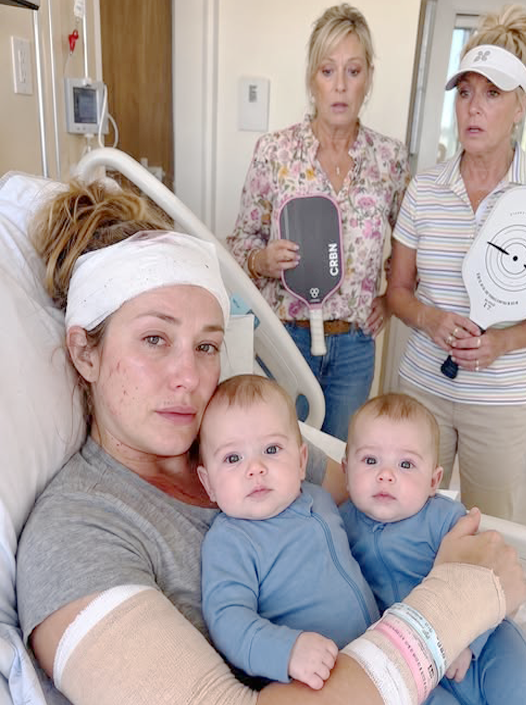
Part 1: The Day My Family Chose Pickleball Over My Children… The first thing I remember after the crash was the sound of metal folding around me. The second thing I remember was my mother saying, “Brenna, I have pickleball this afternoon. I can’t just drop everything because you had an accident.” For a few seconds, I thought I was still confused from the pain medication. I was lying in a hospital bed with a fractured pelvis, two broken ribs, and a body that felt like it no longer belonged to me. The doctors had told me I was lucky to be alive. The car had spun across the
highway after another driver ran a red light, but my one-year-old twins, Caleb and Sophie, survived because their car seats protected them. They were shaken, but they were alive. That was all I cared about. My husband, Daniel, had died eleven months earlier from a sudden illness. Since then, I had learned how to be both parents. I worked during the day, rocked babies at night, paid bills, packed lunches, and smiled even when grief sat so heavily on my chest that breathing felt difficult. I never expected to need help. But when I woke up in that hospital room and realized I
couldn’t even sit up by myself, I knew I couldn’t do this alone. The hospital staff had arranged for someone to watch the twins temporarily, but only for twenty-four hours. After that, they needed family. So I called the one person I believed would never let me down.
My mother.
“Mom,” I whispered into the phone. My voice was barely strong enough to hear. “I need you and Dad. Just until I can walk again. The doctors said it could take weeks.”
There was silence on the other end.
Not shock.
Not worry.
Just silence.
Then she sighed.
A deep, irritated sigh.
“Brenna, I don’t know what you expect me to do.”
I closed my eyes.
“I expect you to help me take care of your grandchildren.”
“Your father and I have our own life.”
“Mom, I was almost killed.”
“And you survived.”
The words hit harder than I expected.
I stared at the ceiling, trying to convince myself I had heard her wrong.
“I have two babies who need someone,” I said quietly.
She lowered her voice like I was asking for something unreasonable.
“We are not built-in babysitters. You need to figure something out.”
“Mom—”
“I have my pickleball league this week. I already paid for it. I can’t cancel everything because you made a mistake.”
A mistake.
That was what she called the accident that almost killed me.
Before I could respond, she added one more thing.
“Your sister never puts this kind of pressure on us.”
Then she hung up.
I didn’t cry immediately.
That surprised me.
For years, I had cried over my mother’s criticism. I had cried when she compared me to my younger sister Paige. I had cried when she told me I was too serious, too responsible, too focused on work.
But lying there, unable to move, with my children depending on me, something inside me changed.
I stopped feeling hurt.
I started seeing clearly.
For eight years, I had been the person my family called whenever they needed something.
When my parents wanted a newer SUV, I helped with the down payment.
When their health insurance became too expensive, I covered the difference.
When my father needed repairs on the house, I paid the contractor.
When Paige opened her boutique and ran out of money six months later, I quietly covered her debts because my mother said, “Family helps family.”
I believed that sentence.
They repeated it so often that I thought it was a promise.
I never realized they only meant it when they were the ones receiving help.
Outside my hospital room, I heard a small cry.
“Sophie.”
My daughter’s voice was soft and scared.
I tried to sit up.
Pain exploded through my body.
I couldn’t move fast enough.
A nurse rushed in and gently placed a hand on my shoulder.
“Don’t try to get up yet.”
“But my daughter…”
“She’s okay,” the nurse said. “She just wants her mother.”
Those words broke something in me.
My baby wanted me.
My parents didn’t.
A nurse named Rosa stayed with me after that. She had noticed I kept staring at my phone but wasn’t calling anyone else.
“You have someone you trust?” she asked.
I looked through the glass wall toward the small area where my twins were resting.
They were asleep in temporary hospital cribs, their tiny hands curled around blankets that weren’t theirs.
I thought about all the times I had sacrificed everything for my family.
All the birthdays I attended because my mother wanted a perfect family photo.
All the vacations I paid for.
All the emergencies I fixed.
And now, when I was the one lying broken in a hospital bed, they couldn’t give me one week.
“No,” I whispered.
Then I looked at my phone.
“There is one person.”
I called Andrew, the attorney who had helped me with my late husband’s estate.
He answered immediately.
“Brenna? Are you okay?”
I looked at my children.
“No,” I said honestly. “But I’m going to be.”
I explained what happened.
Not just the accident.
Everything.
The money.
The years of helping.
The way my family suddenly disappeared when I needed them.
Andrew was quiet for a moment.
Then he asked, “What do you want to do?”
I looked down at my hands.
For the first time in years, I wasn’t thinking about what would make everyone else comfortable.
“I want everything I pay for to stop.”
“Everything?”
“Yes.”
“Brenna, are you sure?”
I watched Caleb sleeping peacefully.
“They chose pickleball over my children.”
My voice shook.
“So they can learn what life looks like without me fixing it.”
Andrew handled everything carefully.
The first thing he found was something I had almost forgotten.
The house my parents lived in.
They always called it “their home.”
They told relatives they had built their life there.
But the truth was different.
Years earlier, when my father lost his job, they couldn’t qualify for a mortgage. Daniel and I had purchased the house as an investment property and allowed them to live there while they got back on their feet.
Somehow, eight years later, they stopped saying they were staying there.
They started saying it belonged to them.
Andrew reviewed the paperwork.
“They have been treating your generosity like ownership,” he said.
I looked at my children.
“That seems to be a pattern.”
That night, the automatic payments stopped.
The extra insurance coverage.
The country club membership.
The car payment I had helped maintain.
The monthly money I sent Paige to keep her boutique open.
Everything.
At first, I felt guilty.
Then my phone started ringing.
My mother’s name appeared.
Six calls.
Then ten.
Then a message.
What did you do? My card was declined.
Another message came from Paige.
My rent payment failed. Call me now.
Then my father:
This is not how family behaves. Fix this immediately.
Not one message asked:
How are you?
Are the babies okay?
Do you need anything?
I placed the phone face down.
For the first time in eight years, I let them experience the consequences of living without my support.
The next morning, my mother finally called from a different number.
When I answered, I expected anger.
I expected an apology.
Instead, I heard panic.
“Brenna, your father’s car payment didn’t go through.”
I stayed silent.
“Your sister is having problems with her business.”
Still silent.
“You need to reverse whatever you did.”
I looked at Caleb and Sophie sleeping beside me.
The two people she refused to help.
“Mom,” I said softly.
“What?”
“You had one chance to be there when I needed you.”
She didn’t answer.
“And you chose pickleball.”
The silence on the phone was different this time.
This time, she understood.
And for the first time in my life, I wasn’t the daughter begging to be loved.
I was the mother protecting my children.
Part 2: The Secret They Never Expected Me To Find
The first week after the accident was the hardest week of my life.
Not because of the pain.
The doctors had warned me about the physical recovery. They told me my pelvis would take months to heal, that I needed patience, therapy, and rest. I expected that.
What I didn’t expect was the emptiness that came from realizing the people I trusted most had chosen convenience over my children.
I had spent years believing my family was my safety net.
Then, when I fell, I discovered there was nothing underneath me.
Thankfully, I wasn’t completely alone.
Andrew arranged for a temporary caregiver through a service he trusted. Rosa helped coordinate a private recovery room where Caleb and Sophie could stay close to me. It wasn’t the family help I had begged for, but it was something better.
It was reliable.
Every morning, I woke up and saw my children beside me.
Every night, I listened to them breathe.
And slowly, I began rebuilding.
Meanwhile, my family was falling apart.
My mother called every day.
But she never called to ask about my recovery.
She called because another payment had disappeared.
“Your father’s gym membership was canceled.”
“My friends are asking questions.”
“The country club said there was an issue with the account.”
Each time, I waited for her to say something about Caleb and Sophie.
She never did.
Finally, one afternoon, I asked her.
“Mom, do you want to know how your grandchildren are doing?”
There was a pause.
Then she said, “Of course I do.”
But her voice sounded like someone saying the correct answer, not someone who felt it.
“How are they?”
I looked at my twins playing on the floor beside my hospital bed.
“They miss their grandmother.”
Silence.
Then:
“Well, once this misunderstanding is over, things can go back to normal.”
Normal.
That word stayed with me.
Because she was right.
She wanted normal.
She wanted the version of our relationship where I paid, fixed, rescued, and stayed quiet.
But that version of me was gone.
A few days later, my sister Paige came to visit.
I almost didn’t recognize her behavior at first.
She wasn’t angry like my mother.
She was careful.
Sweet.
The same way she acted whenever she wanted something.
She walked into my room carrying flowers.
“Brenna, I’m worried about you.”
I looked at her.
The same sister who had ignored every message about the twins.
The same sister whose boutique I had saved twice.
“Are you?”
She frowned.
“Of course.”
“Then why was the first message you sent me about your rent?”
Her expression changed for half a second.
Then she smiled.
“You’re emotional right now.”
There it was.
The phrase people used when they wanted to make you doubt yourself.
“You’re recovering from a major accident. You’re on medication. You’re hurt.”
She stepped closer.
“You don’t want to destroy your relationship with Mom and Dad because of one bad moment.”
“One bad moment?”
I laughed quietly.
“My children needed somewhere safe to go.”
Paige crossed her arms.
“Mom said you were being dramatic.”
That sentence told me everything.
Not because it surprised me.
Because it confirmed they had been talking about me while I was lying in that hospital bed.
“She called it dramatic when her grandchildren needed help?”
Paige looked away.
Then she changed tactics.
“Brenna, let’s be practical.”
I already knew that sentence meant trouble.
“What does that mean?”
“It means you need people.”
She glanced at Caleb and Sophie.
“You can’t raise twins alone forever.”
The way she said it wasn’t concern.
It was a warning.
“You need Mom and Dad.”
I looked at her carefully.
“No. I needed them when I was trapped in a hospital bed.”
Her smile faded.
Then she reached into her bag.
“I actually came here because there is something important.”
She placed a folder on my blanket.
I stared at it.
“What is that?”
“Just paperwork.”
I didn’t touch it.
“What kind of paperwork?”
Paige sighed.
“You’re making this harder than it needs to be.”
The same sentence my mother used.
The same sentence people used when they wanted me to stop asking questions.
“Paige.”
“What?”
“Why would you bring paperwork to a hospital room?”
She avoided my eyes.
“It’s just temporary.”
I opened the folder.
The first page looked harmless.
A temporary management agreement.
The second page made my stomach tighten.
Authorization to access business accounts.
The third page was worse.
A document giving Paige control over certain financial decisions if I was unable to manage them.
I looked up slowly.
“What is this?”
She immediately became defensive.
“It’s protection.”
“For who?”
“For the family.”
I almost smiled.
Because there it was again.
That word.
Family.
The word they used whenever they wanted something from me.
“I’m injured, Paige. I’m not unconscious.”
“You’re taking medication.”
“I’m recovering.”
“You’re emotional.”
I closed the folder.
“No.”
Her face changed.
“No?”
“No, I am not signing anything.”
For the first time, her fake concern disappeared.
“Brenna, don’t make this difficult.”
“You already did.”
She leaned closer.
“You really think you can handle everything alone?”
I looked at my children.
Then back at her.
“I handled everything when everyone else was comfortable.”
Her jaw tightened.
“That’s not fair.”
“No. What wasn’t fair was leaving my children with strangers while you went on with your lives.”
She stood up.
“You’re punishing us.”
I shook my head.
“I’m protecting myself.”
She grabbed the folder.
“You’re making a mistake.”
After she left, I sat there thinking about how strange it was.
My family had spent years convincing me I was too sensitive.
Too emotional.
Too dependent.
But the moment I stopped giving them what they wanted, suddenly I was dangerous.
That evening, Andrew came to the hospital.
I handed him the folder.
His expression changed as he read it.
“Where did you get this?”
“Paige brought it.”
He turned another page.
“Did she explain what she wanted you to sign?”
“She said it would help the family.”
Andrew became quiet.
Then he placed the folder on the table.
“Brenna, I need you to listen carefully.”
I sat up.
“What?”
“This isn’t normal family paperwork.”
My stomach tightened.
“What is it?”
“Someone prepared documents that would give Paige access to your assets.”
I stared at him.
“She wanted me to sign this?”
“Yes.”
“Why?”
Andrew looked at me.
“Because they thought you were vulnerable.”
That word hurt.
Not because it was true.
Because they saw my pain as an opportunity.
The next morning, Andrew called me with information he had found.
Something about Paige’s documents bothered him.
The signatures.
The dates.
The way the paperwork was prepared.
Then he discovered something even worse.
Paige had already contacted a lender.
She had been asking questions about using my business assets as collateral.
My hands started shaking.
“She was planning this before she came to the hospital.”
“Yes.”
I closed my eyes.
The accident hadn’t created their betrayal.
It had simply revealed it.
Then Andrew said something that changed everything.
“Brenna, there is more.”
“What?”
“Your mother and Paige have been communicating about this.”
He sent me screenshots.
At first, I couldn’t understand what I was seeing.
Then I read the messages.
My mother’s words appeared on the screen.
Don’t rush her. Wait until she gets desperate.
Another message from Paige:
Once she signs, everything becomes easier.
My heart felt heavier than any pain medication could touch.
They hadn’t just failed me.
They had planned for me to break.
They wanted me weak.
They wanted me scared.
They wanted me to need them.
But they forgot one thing.
I wasn’t fighting for myself anymore.
I was fighting for Caleb and Sophie.
I looked at my children sleeping peacefully beside me.
Then I looked at Andrew.
“Set up a meeting.”
He frowned.
“With them?”
“Yes.”
“Are you sure you’re ready?”
I looked toward the hospital window.
Outside, the sun was setting.
A week earlier, I had been lying in this bed wondering how I would survive without my family.
Now I knew the truth.
I wasn’t losing my family.
I was losing the people who had been using me.
“Let them come,” I said.
Andrew studied my face.
“What are you planning?”
I looked down at the folder Paige had brought.
The one she thought would save her.
“The truth.”
Because my family had spent years believing I was the person they could take from forever.
They were about to learn what happened when the person they underestimated finally stopped giving.
Part 3: The Day They Lost Everything They Took For Granted
A week after I left the hospital, I returned to the house where my parents had lived for eight years.
Not as the daughter coming home.
Not as the person who was there to fix another crisis.
I came back as the owner of my own life.
The doctors had not wanted me walking too much yet. I still needed a wheelchair for longer distances, and every movement reminded me that my body was still healing.
But my mind had never been clearer.
Andrew drove me there with a folder sitting beside him.
Inside were years of financial records, copies of agreements, messages, and the documents Paige had tried to make me sign.
For years, I had walked through that front door believing it was a place where I was loved.
That day, I realized it was simply a place where people had become comfortable taking from me.
When we arrived, my parents and Paige were already waiting.
The moment my mother saw my wheelchair, her expression changed.
Not concern.
Not sadness.
Annoyance.
“You really brought a lawyer?”
I looked at her.
“After what happened, yes.”
She shook her head.
“I can’t believe you are doing this to your own family.”
I almost laughed.
Because that was always her favorite word.
Family.
She said it whenever she wanted forgiveness.
Never when she needed responsibility.
Paige stood beside her with her arms crossed.
She looked nervous, but she was trying hard not to show it.
“I think everyone needs to calm down,” she said.
Andrew placed the first folder on the table.
“No one needs to calm down. Everyone needs to understand.”
My father leaned forward.
“What exactly is this?”
Andrew opened the folder.
“The first document is the termination notice for your occupancy agreement.”
My mother blinked.
“What?”
“The agreement allowing you to live in this property.”
She stared at him.
“This is our home.”
I looked around the room.
The furniture.
The decorations.
The expensive paintings my mother loved showing guests.
Everything suddenly looked different.
“No,” I said quietly.
“This was a home I provided.”
My father’s face hardened.
“You’re throwing us out?”
“No.”
I looked at him.
“I’m asking you to stop pretending something belongs to you when it was never yours.”
My mother stood up.
“You would really do this to us after everything we’ve done for you?”
I looked at her.
Everything they had done for me?
I wanted to ask her when exactly she had been there.
When I worked through pregnancy alone?
When Daniel died?
When I spent nights crying while rocking newborn twins?
When I was lying in a hospital bed unable to move?
But I didn’t need to ask.
She knew.
Everyone in that room knew.
Andrew opened the second folder.
“This contains a review of financial transfers over the past several years.”
Paige’s expression changed.
“We already talked about that.”
“No,” Andrew said calmly.
“You explained it. Now we are documenting it.”
He began listing the information.
Money transferred to Paige’s boutique.
Payments categorized as consulting fees.
Expenses charged to accounts.
Amounts that had been described as temporary but never repaid.
My mother interrupted.
“She was struggling. Brenna wanted to help.”
I nodded.
“Yes. I wanted to help.”
Then I looked at Paige.
“But helping someone is different from allowing them to build their life on your sacrifice.”
Paige looked away.
Andrew continued.
“The total amount is significant.”
My father swallowed.
“How significant?”
“Over three hundred thousand dollars.”
The room went silent.
Paige immediately became defensive.
“I was going to pay her back.”
I looked at her.
“With what?”
She said nothing.
“The boutique you opened with my money?”
Silence.
“The rent you paid with my money?”
Silence.
“The salary you gave yourself from a business that couldn’t survive without my support?”
Her eyes filled with tears.
“I’m your sister.”
I nodded.
“Yes.”
Then I said the sentence I had needed to say for years.
“And I was your sister before I was your bank account.”
My mother started crying.
But this time, I didn’t rush to comfort her.
That was the hardest part.
For my entire life, her emotions controlled the room.
If she cried, everyone apologized.
If she was upset, everyone adjusted.
But I finally understood something.
Someone crying doesn’t automatically mean they are the victim.
Andrew placed the final folder on the table.
“This concerns the documents Paige brought to the hospital.”
The room changed.
My father looked at Paige.
“What documents?”
She looked nervous.
“It’s nothing.”
Andrew opened the folder.
“It was an attempt to obtain control over Brenna’s financial accounts while she was medically vulnerable.”
My mother immediately turned toward Paige.
“What are you talking about?”
The same woman who had supported Paige suddenly looked afraid.
Paige’s face turned pale.
“You said she would forgive us.”
My heart sank.
Because those words revealed everything.
My mother stared at her.
“What did you do?”
Paige looked around the room.
And for the first time, she realized nobody was protecting her.
Not even the people who helped create the plan.
Andrew continued.
“We also recovered messages between the three of you.”
My father froze.
“What messages?”
Andrew handed him the printed pages.
My mother read the first one.
Her face changed.
Because she recognized her own words.
Let her struggle a little. She needs to learn she can’t always expect us to fix everything.
Then another message.
Once she realizes she needs us, she’ll sign whatever we put in front of her.
The room became completely silent.
I watched my parents read the words they had written when they thought I would never see them.
My mother looked at me.
“Brenna…”
I shook my head.
“No.”
She stopped.
“I don’t want an explanation.”
“But we are your parents.”
I looked at her.
“And I am your daughter.”
My voice cracked.
“I called you because I was afraid I might never walk again. I called you because your grandchildren needed somewhere safe.”
I pointed toward the door.
“And you were more worried about pickleball and country club payments.”
My father lowered his eyes.
For once, he had nothing to say.
Paige started crying.
“I made a mistake.”
I looked at her.
“No. You made a choice.”
She wiped her face.
“I thought you had everything. I thought you wouldn’t miss it.”
That sentence hurt more than anger.
Because it explained how they saw me.
Not as a person.
As a resource.
A place where money came from.
A solution to every problem.
I slowly turned my wheelchair toward the door.
Behind me, my mother whispered:
“Are you really leaving us?”
I stopped.
For a moment, the old version of me wanted to turn around.
The daughter who wanted her mother’s love.
The little girl who still hoped one day her family would choose her.
But then I thought about Caleb and Sophie.
About their small hands reaching for me.
About the night I lay broken in a hospital bed and realized I was the only person they truly had.
“Yes,” I said.
“Because I already learned what it feels like to be abandoned by my own family.”
I looked back one last time.
“I refuse to let my children learn that lesson from me.”
The consequences came slowly.
Paige eventually admitted what she had done. The forged paperwork, the attempts to access accounts, and the financial misuse became impossible to deny.
She lost her boutique.
She was ordered to repay what she had taken.
My parents moved out of the house months later and had to rebuild their lives without the comfort they had taken for granted.
My father apologized first.
Not with excuses.
Not with blame.
Just regret.
I accepted his apology, but forgiveness did not mean returning to the way things were.
Some doors close because they are meant to protect you.
Almost a year after the accident, I walked across my backyard without assistance.
Caleb and Sophie chased bubbles across the grass, laughing so loudly that the neighbors could hear them.
Rosa, the nurse who had stayed with me when I had no one else, visited often. She later helped me create a small family support program for single parents recovering from emergencies.
Because I knew what it felt like to need help and hear silence.
One evening, my phone buzzed.
A message from my mother.
I miss you. I miss the children. Can we try again?
I stared at the screen for a long time.
Then I looked at my twins.
The two little people who taught me what unconditional love actually looked like.
I typed one sentence.
You can start by becoming someone they can feel safe loving.
Then I put the phone down.
The silence afterward wasn’t painful anymore.
It was peaceful.
For years, I thought losing my family would break me.
I was wrong.
The accident didn’t destroy my life.
It showed me exactly who was willing to stand beside me when I couldn’t stand on my own.
And once I knew the truth, I finally stopped trying to earn love from people who had already chosen not to give it.