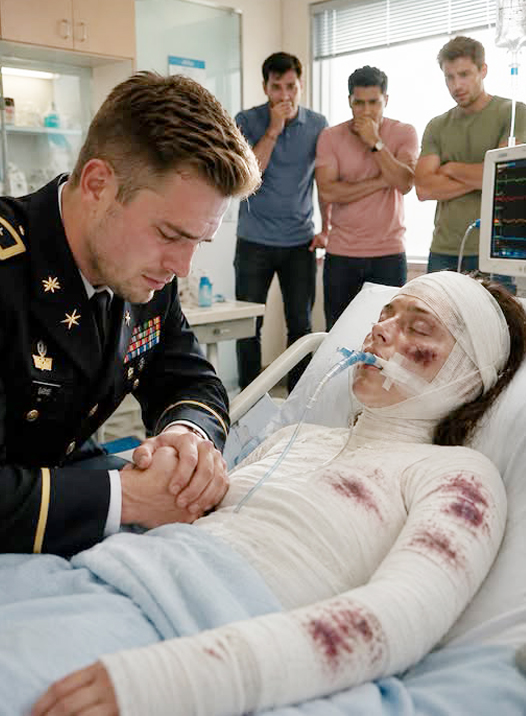
The plain green hospital gown looked too large on Lily’s thin shoulders, the stiff cotton fabric bunching around her collarbone like a shroud. I sat in the brown vinyl chair by the bedside, holding a heavy blue knit blanket in my lap to keep my fingers from twitching. Every four seconds, the hospital heart monitor gave a low, green-tinged hum that vibrated in my teeth. A plastic cup of lukewarm black coffee sat on the bedside table, bought from the lobby machine for three dollars. The coffee had a thin skin of dust on the top, and I had not touched it. Lily’s hair was damp,
sticking to her forehead in dark, sweat-matted strands. I used a paper tissue to wipe a smear of dried blood from the shell of her ear, my hands as steady as they had been in the desert. Her fingers twitched on the white sheet, her knuckles scraped raw and painted with yellow antiseptic. At ten past midnight, her eyelids finally fluttered. She looked at me, her eyes clouded with the heavy dose of morphine they had given her at ten. She tried to open her mouth to speak, but her jaw was wired shut with silver metal brackets that caught the light. A muffled, wet sound escaped her
throat. I leaned closer, resting my hand on the mattress near her arm. “Do not try to move, Lily,” I said. “The doctor is coming back.” She fidgeted with the silver medical wristband on her left wrist, her fingers scraping against the plastic tag. Her eyes held a sudden, sharp panic that I had only seen in men behind enemy lines. I reached into my trousers pocket and let my thumb rub over the silver skull coin I always kept there when the world went loud.
The cold metal always helped me think.
Lily closed her eyes again, her breathing slowing as the medication pulled her under.
I stood up and pulled the blue knit blanket over her chest, tucking the edges under the mattress.
Her small leather backpack was resting on the floor by the bedside chair.
The strap was torn, and the zipper was jammed with dry gray dirt from the plaza floor.
I picked it up and set it on the table next to the cold coffee.
Doctor Avery was waiting near the nurses’ station, his white coat stained with a drop of blue ink near the pocket.
He was looking at the glowing X-ray board, where six distinct white cracks showed on the gray film of Lily’s skull.
He tapped the middle crack with the tip of a cheap blue ballpoint pen.
“Three fractures on the left, three on the right,” Avery said, his voice flat.
“Are they clean?” I asked.
“Clean enough for a surgeon, not for a father,” he said, turning to look at me. “She is nineteen, Mr. Walker. Her bones are resilient, but this took a great deal of force.”
“What kind of force?”
“The impact came from a heavy object, Walker. Or a steel-toed boot. Multiple strikes while she was on the ground.”
“Any other injuries?”
“Bruises on her shoulders and ribs,” Avery said. “Defensive wounds on her forearms. She fought them.”
He tapped the pen against the plastic frame of the light board.
“This was not a random campus fight, Colonel Walker,” Doctor Avery said.
I did not blink.
“I am a security consultant, Doctor,” I said.
“I was at Bragg in ninety-eight,” Avery said, adjusting his glasses. “I saw what your boys did in the valley. I know the signature of a professional strike.”
“She is nineteen,” I said again, my voice flat.
“And she was carrying something they wanted,” Avery said. “This was not a robbery, Walker. Her purse was still on her shoulder when they brought her in. Her phone was in her pocket.”
“What are you saying?”
“They did not want her money,” Avery said, turning off the light board. “Get her out of this town when she can walk.”
I left the hospital through the side doors, where the autumn air smelled of wet asphalt and rotting leaves.
I drove the three blocks to the university campus in my old sedan.
The tires did not make a sound on the wet asphalt, which was littered with damp yellow leaves.
I parked near the library and walked toward the science building plaza where the freshman had found her.
The autumn wind was cold, carrying the smell of damp earth and river water from the valley.
The concrete plaza was dark.
Every single safety light on the high poles was dead, their black glass bulbs reflecting nothing but the gray clouds above.
I walked to the center of the plaza, my boots clicking softly on the paving stones.
I found the spot near the concrete planter.
The university maintenance crew had tried to wash the stone, but a dark, star-shaped stain remained near the edge of the concrete.
I knelt down on one knee, my trousers soaking up the cold moisture from the pavement.
There was a small, torn corner of green paper caught in the drain cover three feet away, but I left it.
I stood up and walked to the brick wall of the science building.
I looked up at the dome camera mounted fifteen feet above the plaza entrance.
The camera was a gray model, its serial number printed in small white letters on the casing: TX-four-eight-zero.
The small red LED light at the base of the camera was completely dark.
I followed the black conduit pipe down the wall to the main power junction box.
The heavy iron latch of the junction box was hanging open, its brass padlock gone.
Inside, the three heavy copper switches had been pulled down into the off position.
The black challenge coin I had carried since my days with Task Force Specter sat in my left pocket, heavy and solid.
I pulled it out and held it against the cold metal of the box.
The switches had been wiped clean of grease, but there were fresh silver scratches on the brass terminals where a tool had been used to short the secondary circuit.
Someone had known exactly which breaker to pull to blind the cameras on the east wall.
The campus security office was located in the basement of the administration hall.
The air inside smelled of stale popcorn and floor wax.
Officer Gregory Vance sat behind a grey metal desk, his uniform shirt unbuttoned at the collar.
He was nervously flipping through an empty aluminum clipboard, his thumb leaving greasy marks on the clean white paper.
“I need the camera logs for the science plaza,” I said, standing in front of his counter.
Vance did not look up.
“We had an equipment failure,” he said, his voice dropping into a tired, defeatist sigh. “We recorded nothing.”
“The junction box was opened manually,” I said.
Vance stopped flipping the pages of the empty clipboard.
“We have a lot of kids on this campus, Mr. Walker,” he said, finally looking at my chin. “Pranks happen. Someone probably thought it would be funny to turn off the lights.”
“They beat my daughter until her jaw was in six pieces,” I said.
“We are looking into it,” Vance said. “But without the cameras, we do not have much to go on.”
He picked up a yellow pencil and began to sharpen it with a small plastic sharpener, the shavings falling into his palm.
“You should let this go, for Lily’s sake,” Officer Vance muttered.
“You were on duty at nine fifteen,” I said.
“I was patrolling the north lot,” Vance said, his eyes shifting to his empty coffee mug.
“The north lot is a mile from the science building,” I said.
“That is where the call came in,” Vance said. “A broken window at the athletic center. Turned out to be a false alarm.”
“And who called it in?”
“An anonymous tip,” Vance said, looking down at his desk. “It was dark, there are no witnesses, and the cameras are down.”
I knew he was lying because the green indicator light on the wall behind him was flashing, showing the western server was still online and receiving data.
But I did not tell him that.
I turned and walked out of the office, the heavy glass doors swinging shut with a quiet hiss.
I walked back to the science plaza, the cold air clearing the smell of the security office from my lungs.
The streetlights on the main road a block away cast long, yellow fingers of light through the bare oak trees.
I stood in front of the open junction box again, my fingers tracing the fresh scratches on the brass switches.
Nineteen years of quiet civilian life, of lawnmowers and parent-teacher conferences, had just ended.
I stared at the empty padlock loop and realized my quiet life had just shattered.
The blue knit blanket was still draped over the vinyl chair when I returned to room four twelve at nine the next morning. Lily was asleep, her breathing shallow, the wired metal in her jaw casting small shadows under the harsh overhead light.
Her canvas backpack sat on the bedside table, smelling of damp earth and rain from the campus plaza pavement. I unzipped the main compartment, careful not to let the metal slider clink against her plastic water pitcher.
Inside, nestled beneath her biology textbook and a pack of blue pens, was her green university sweatshirt, torn at the left shoulder. I pulled it out, the fabric stiff where the mud had dried in patches.
As I unfolded the heavy cotton, my fingers brushed against something stiff in the front pouch pocket. It was a jagged scrap of white paper, torn from a spiral notebook, with dark brown smears drying across its surface.
I flattened it on the tray table, my thumb tracing the rough edges. Three hand-written names stared back at me in Lily’s neat, slanted print: Ethan, Brandon, and Tyler.
I turned the scrap over to see if anything else was written on the back, but the reverse side was blank. I reached into my pocket and took out my parking receipt, checking the digits I had scribbled down in the dark at one in the morning.
The serial number of the campus security camera, Model TS-four hundred, serial number eight-eight-four-two-one, was written in my own block print right next to the time of the stamp. That camera had been pointed directly at the spot where Lily fell, and someone had turned off the power before she got there.
Lily stirred in the bed, her fingers twitching against the white sheet, but her eyes remained closed. I folded the bloodstained scrap of paper and slipped it into my shirt pocket, right against my chest.
Officer Vance was sitting on the bench outside the double doors at half past nine, chewing on the end of a yellow wooden pencil. His uniform shirt looked like he had slept in it, the collar curled and damp with sweat.
“We need to talk about the plaza,” I said, standing over him until he looked up from his empty clipboard.
Vance sighed, a long, tired sound that smelled of peppermint and stale tobacco. “Mr. Walker, I told you last night. The cameras went down. Main power surge.”
I pulled the folded scrap of paper from my shirt pocket and held it three inches from his nose. “My daughter wrote these down before they hurt her. Ethan, Brandon, and Tyler.”
The pencil stopped moving. Vance looked at the paper, then at my face, his cheeks losing what little color they had under the hallway fluorescent tubes.
He closed his black notebook with a sharp snap and slid it into his side pocket. “Without witnesses to place them in that courtyard at midnight, there is nothing the police can do.”
“The camera serial number is eight-eight-four-two-one,” I said. “The power box was unlocked from the inside.”
Vance stood up, his leather belt squeaking against his holster as he adjusted his stance to block the doorway.
“You should let this go, for Lily’s sake,” Officer Vance muttered.
“She is nineteen,” I said.
“Then she has a lot of life left to live,” Vance said, his eyes darting toward the elevators at the end of the hall. “Do not make it harder for her than it already is.”
The cafeteria was nearly empty at ten, save for a nurse in green scrubs sleeping in a corner booth. I bought a cup of black coffee for three dollars, the paper cup thin enough to burn my palm.
I sat at a plastic table near the tray return and took out my phone, typing the first two names into the search bar. Ethan Cole was the sophomore president of the university business club, his face smiling from a local news article about a new science building.
His father was Thomas Cole, the owner of Cole Construction, the company currently finishing the three-story concrete plaza where Lily had been found.
The second name, Brandon, led me to a campaign website with a banner of red, white, and blue. Brandon Hale was a student representative, and his mother was Senator Margaret Hale, who chaired the state capital finance committee.
I scrolled down the page, my thumb rubbing the silver skull coin in my pocket as the connection clicked into place. The state finance committee had approved the fifteen-million-dollar grant for the university’s new science hall three months ago.
The third name was Tyler, whose last name was Miller, the son of the university’s largest private athletic donor.
These were not boys who spent their weekends in local holding cells. They were the children of the people who owned the bricks, the land, and the police who patrolled them.
I took a sip of the lukewarm coffee, the taste bitter and flat on my tongue. I had spent nineteen years believing I could raise a daughter in a quiet town where the rules applied to everyone.
At eleven, I stood by the glass doors of the main lobby, watching the rain begin to pool on the concrete driveway outside.
Officer Vance walked through the lobby, his head down, his thumb hooking into his utility belt. He did not look at the reception desk or the security guard sitting behind the counter.
He pushed through the heavy glass doors into the gray morning air. A black sedan with tinted windows was idling by the yellow curb, its exhaust rising in white plumes against the wet brick wall.
The rear door opened before Vance even reached the curb. A man in a dark, tailored suit sat in the back, his face half-hidden by the shadow of the doorframe.
Vance leaned in, spoke for ten seconds, and then slid onto the leather seat beside him. The door clicked shut, the locks falling into place.
I watched the black sedan speed away from the hospital curb.
The tires of the black sedan had left dark scuff marks on the hospital curb, but the street was empty by the time I reached my truck. I drove back to my small brick house on Elm Street, the silence in the cab heavier than the autumn air.
By two in the afternoon, Raymond Reyes was sitting at my kitchen table. He was a broad, weathered man who looked like he had been carved out of a pine log, his gray hair cropped close to his skull.
A single black challenge coin lay between us on the yellowed Formica, its tarnished edges catching the gray light from the window. Raymond picked it up, his thick, grease-stained fingers turning the heavy metal over and over.
He adjusted his plain black wristwatch, the cheap rubber strap clicking against his wrist. His gravelly voice sounded like dry stones sliding down a hill.
“You kept this,” Raymond said.
“I kept it,” I said.
“Lily is nineteen, Daniel. She is not part of the unit.”
“She is in room four twelve with her jaw wired shut.”
Raymond placed the coin back on the exact center of the table, lining it up with a deep scratch in the laminate. He looked at my hands, then down at his own.
“How is she doing?” he asked.
“She tried to speak this morning,” I said, my voice flat. “But they have her on a liquid diet, and she cannot move her mouth.”
“She is tough,” Raymond said, his voice softening slightly. “She always had her mother’s stubborn streak.”
“The three names on her paper are Ethan Cole, Brandon Hale, and Tyler Vance,” I said. “I need to know everything about their families.”
Raymond stared at the black coin, his thumb tracing the worn insignia of our old command. He did not look up.
“If we dig this grave, Colonel, we both go back under,” Reyes said.
“The shovel is already in the dirt,” I said.
Raymond let out a low, raspy sigh that sounded like sandpaper on pine. He reached into his flannel shirt pocket, pulled out a small notepad, and wrote down the names.
“Cole is the contractor’s boy,” Raymond said. “Hale’s mother is the state senator. What about Tyler Vance?”
“He is the campus detective’s nephew,” I said.
Raymond stopped writing, his pencil hovering a fraction of an inch above the paper. He tapped the lead against his thumb.
“We need to check the school’s money,” I said. “Start with the new science building.”
Raymond stood up, his heavy boots creaking on the old linoleum. He did not say yes, but he did not leave the coin behind. He slid it into his pocket and walked out to his truck.
I watched him back down the gravel driveway, his exhaust leaving a thin trail of blue smoke in the damp air.
At four in the afternoon, the smell of copper wire and cold grease filled my nose inside Raymond’s metal salvage shed. The corrugated tin walls rattled as a truck rumbled past on the state highway outside, and the wind whistled through the gaps in the wooden ceiling.
A single computer terminal hummed in the corner of the workspace, casting a pale green light over several rusted engine blocks. Raymond stood over it, his broad shoulders hunched as he scrolled through rows of financial logs.
“The university science building fund is public record, but the sub-accounts are locked behind three firewalls,” Raymond said. “I had to route the query through an old server in Toledo.”
He tapped the keyboard with two thick fingers, bringing up a ledger of outgoing transactions. The screen flickered, reflecting green lines across his calloused hands.
“Look at the dates,” I said.
“August twelve, September three, and October fifteen,” Raymond said. “Three transfers of exactly two hundred thousand dollars each.”
“All going to the same place?”
“An offshore account registered to a holding company called Great Lakes Logistics,” Raymond said. “But the authorization came from inside the administration building.”
He pointed his grease-stained finger at a string of letters and numbers stamped next to the October transfer.
“A private bank transfer code,” I said. “Zero nine four two delta.”
“That code requires two separate digital signatures to clear the university’s main bank,” Raymond said.
“Whose name is on the second line of the bank transfer?” I asked.
Raymond clicked the mouse, but the screen went dark. A solid red warning box flashed twice in the center of the monitor.
“The Toledo server just went offline,” Raymond said, his jaw tightening.
“Did they trace the query?”
“No,” Raymond said, looking at the dead screen. “But someone just pulled the plug on the campus side.”
“Then we go to the campus,” I said.
I parked my truck near the campus quad at five in the afternoon. The damp yellow leaves on the pavement stuck to the soles of my boots as I walked toward the red brick administrative offices, passing students holding paper coffee cups and laughing.
The lobby was quiet, smelling of floor wax and old paper. A young clerk with wire-rimmed glasses sat behind a high oak counter, sorting a stack of blue folders.
“I need the academic and disciplinary records for Ethan Cole, Brandon Hale, and Tyler Vance,” I said.
The clerk stopped sorting. He looked at my face, his eyes darting to my jaw and then back to my eyes.
“Those records are private under federal law, sir,” the clerk said.
“I am Lily Walker’s father,” I said. “Two of those boys are suspect in her assault.”
The clerk’s collar looked tight against his neck. He glanced toward a heavy wooden door to his left, where a campus security guard stood with his arms crossed over his chest.
“I cannot help you without a formal request from the dean,” the clerk said.
“Is the dean in?”
“The dean is at a conference in Columbus until Thursday,” the clerk said.
He slid a blue guest log across the counter toward me, his hand slightly unsteady.
“You have to sign in anyway,” the clerk said. “Visitor policy for after-hours inquiries.”
I picked up the heavy metal pen, the cold steel hard against my fingers. I wrote my real name, Daniel Walker, and my home phone number on the empty line.
The clerk took the log back, his eyes lingering on my name before he quickly closed the leather binder. The security guard stepped six inches closer to the counter, his hand resting near his belt.
“You should leave now, sir,” the guard said.
I turned and walked out of the office, the heavy oak doors clicking shut behind me.
By five thirty, the sky was turning a dark, bruised purple. I sat in the driver’s seat of my car, watching the students walk past the library, their faces illuminated by the screens of their phones.
My old phone vibrated in my jacket pocket, the screen lighting up with Raymond’s number. I pulled it out and answered without greeting him.
“Go,” I said.
“I found the transfer route,” Raymond’s voice rasped through the speaker. “The private bank transfer code zero nine four two delta is linked directly to a local construction account.”
“Whose account?” I asked.
“It is registered to Cole Construction,” Raymond said. “But there is a second line on the transfer. A recipient line.”
“Name it,” I said.
“The system is heavily encrypted on that end,” Raymond said. “But the transaction went through the day before the safety lights on the campus plaza were turned off.”
“Who authorized the transfer?”
“I am still digging,” Raymond said. “Be careful, Daniel. They are already looking for you.”
I hung up the phone and placed it on the dashboard. Across the parking lot, the tall metal poles of the campus safety lights began to hum.
I dialed a number on my old phone and watched the campus lights flicker on.
Reyes did not say hello. He just listened to the hum of the line.
Reyes cleared his throat, the sound like dry gravel sliding down a chute.
“They are at the Oak Ridge Country Club,” Reyes said. “The Cole boy has a lunch reservation at one.”
“I will go talk to him,” I said.
“Be careful, Daniel,” Reyes said. “The Coles own half the county. They have the local judges on retainer and the chief of police in their pocket. If you push them, they will push back with everything they have.”
“I only need five minutes,” I said.
“Five minutes is enough time to bury a man,” Reyes said. “Just remember who you are now. You are Daniel Walker. You are not the Colonel anymore.”
I hung up the phone and watched the campus lights burn steady against the dark.
The next morning, I drove my old blue sedan north, past the sprawling estates where the grass was kept short by private crews. The oak trees along the avenue were turning gold, their leaves dropping onto the clean black asphalt.
The Oak Ridge Country Club sat behind two miles of white picket fence that had been painted so many times the wood looked smooth like white plastic. I parked in the back lot, between two shining European SUVs.
The dining room smelled of lemon wax and toasted pecans. Tall windows looked out over the eighteenth green, where three men in white visors were watching a ball roll toward the cup.
A young woman in a black apron asked for my member card at the door. I did not stop, walking past her into the main room.
Ethan Cole sat at a corner table by the terrace doors. He was twenty years old, wearing a light blue polo shirt with the collar turned up. Two other boys sat with him, passing a basket of warm rolls.
They laughed at something Ethan said.
I walked across the carpet, my boots making no sound on the thick green wool.
Ethan did not look up until I stood directly over his salad plate, blocking the light from the tall window.
“Ethan Cole,” I said.
He blinked, his fork hovering over a cherry tomato. He had clean skin and bright teeth.
“Do I know you?” Ethan asked.
I took my phone from my pocket and tapped the screen. I set it on the white tablecloth next to his crystal water glass.
The screen showed Lily in room four twelve, her face swollen, the steel wires holding her teeth in place.
Ethan looked at the screen, then looked up at me. He cracked his knuckles, one by one, under the edge of the table.
“I do not know who that is,” Ethan said.
The boy to his left stopped chewing his roll and stared at the photo.
“Her name is Lily Walker,” I said. “She was in the plaza on Tuesday night.”
Ethan pushed the phone away with the tip of his silver butter knife.
“You have the wrong table, mister,” Ethan said. “We do not know any state school girls.”
He looked back at his friends and smiled, a tiny twitch of his lip.
“And we do not like people interrupting our lunch,” he added.
I reached down and picked up my phone, my thumb rubbing the silver skull coin in my pocket.
“She has six fractures in her jaw,” I said.
“Then she should have watched where she was going,” Ethan said.
His friend laughed, a quick snort into his water glass.
“You were wearing white sneakers on Tuesday,” I said. “Where are they now?”
Ethan’s smile faded. He set his fork down on his plate with a sharp clink.
“I do not have to talk to you,” Ethan said. “Get out of here before I call security.”
I turned and walked toward the lobby.
The oak panels on the wall were polished to a mirror finish, reflecting the light from the brass chandeliers.
Before I reached the double glass doors of the entrance, a man stepped out of the private card room.
He was fifty-six, with thick silver hair and a heavy gold signet ring on his pinky. He wore a gray wool blazer and smelled of expensive cedarwood and cigar smoke.
“I am Thomas Cole,” the man said.
He did not offer his hand.
“Mr. Cole,” I said. “Your son was in the plaza.”
“My son was at a study group,” Thomas Cole said. His voice was quiet, but it filled the small lobby. “And you are trespassing on private property.”
“There are security logs,” I said.
“There is nothing,” Thomas Cole said. He took a step closer, his eyes narrowing. “I know your name, Walker. I know you run a small-time security outfit out of a brick house on Elm Street.”
He reached into his pocket and pulled out a small gold cutter, placing it on the wooden reception desk.
“If you speak to my son again,” he said, “I will have your county business license revoked before sunset.”
“Is that a threat?” I asked.
“It is a business decision,” Thomas Cole said. “Now get off my grass.”
I looked at the gold cutter on the desk. It had a sharp, circular blade designed to clip the ends of expensive cigars.
“The police will want to see his sneakers,” I said.
“The police work for the county,” Thomas Cole said, his voice dropping to a whisper. “And I own the county. You have three minutes to get your car out of my parking lot.”
Two men in green club blazers appeared from the office behind the desk.
They did not touch me, but they stood close enough that I could smell their laundry detergent.
“This way, sir,” the taller one said.
They walked me through the double glass doors.
My boots clicked on the concrete steps.
I walked to my sedan, the heat of the autumn sun warming the roof.
I parked near a small flower stand on the corner of Main Street. The florist was tying a yellow ribbon around a bundle of chrysanthemums, nodding to a regular customer.
I watched them for a moment, remembering when Lily was that small, her hands sticky with sugar.
The state senator’s local office was located in a restored red-brick bank on Main Street. The glass doors had gold lettering that read State Senator Margaret Hale.
Margaret Hale sat behind a desk made of dark walnut. A silk scarf with a green leaf pattern was knotted around her neck.
“Mr. Walker,” she said, her voice smooth and even, practiced for the cameras. “Please, sit.”
I remained standing.
“I want an independent state investigation into the campus security lights,” I said.
Senator Hale smoothed her silk scarf with her thumb and forefinger.
“I heard about your daughter’s accident,” she said. “It is a terrible tragedy. Truly. Every parent in this district is praying for her recovery.”
“It was not an accident,” I said. “The lights were shut off from the junction box.”
She shook her head, her face settling into an expression of sympathy that did not reach her eyes.
“Campus administration has complete authority over their own grid,” she said. “The state senate has no jurisdiction over university grounds. Our hands are legally tied.”
“The board of trustees votes on your new science building funding on November twelfth,” I said. “Your husband’s firm is the primary contractor.”
Senator Hale did not blink. Her hand remained still on her scarf.
“My son has a bright future, Mr. Walker, and your daughter does not concern us,” Senator Hale said.
The room went completely silent.
“She was a sophomore,” I said.
“And she should have been studying,” Senator Hale said. “Good afternoon, Mr. Walker.”
She looked down at her desk calendar, clicking her pen twice.
“We have a lot of work to do before the election,” she said to her secretary, who stood by the door.
“Your son Brandon was with Ethan Cole,” I said. “He was there.”
Senator Hale’s hand tightened on her pen.
“My son was at his dormitory, Mr. Walker,” she said. “And I suggest you stop making accusations you cannot prove.”
“We will see what the security logs say,” I said.
She smiled, but her fingers were white around the pen.
“The logs are public record,” she said. “Or rather, they would be, if they existed.”
“They exist,” I said.
“You are welcome to try to find them,” she said. “But I think you will find this town is very small when you do not have any friends.”
“I have enough friends,” I said.
“We will see about that,” she said, her voice dropping its warm tone completely.
I turned and walked out of the office.
The lobby was cool, but the air outside was thick with the smell of damp asphalt.
The sun was low behind the brick buildings when I walked out into the gravel lot.
My old blue sedan was parked near the brick alley wall.
Two men in black windbreakers stood near the driver’s side door. They had short haircuts and wore small earpieces.
One of them stepped forward, blocking my path to the handle.
“Mr. Walker,” he said.
“Step aside,” I said.
“We have a message from the county commissioner’s office,” the man said. “Your state security consultant certification is under review. Some paperwork went missing from your file.”
“What paperwork?” I asked.
“The kind that keeps you in business,” the man said. “You should take a long vacation. Out of the state.”
I did not answer.
“Your business license suspension notice,” the second man said, leaning against the fender. “It would be a shame if you couldn’t pay your bills.”
“My license is current,” I said.
“Not anymore,” the first man said.
I did not answer.
I reached past him, unlocked the door, and got into the driver’s seat.
The two men watched me through the glass as I started the engine.
I looked at my hands on the steering wheel, realizing the law was never designed to protect me here.
The rain had stopped by the time I pulled into the gravel lot of Reyes’s salvage yard, the dark shapes of stacked cars rising like broken teeth against the night sky. The light in the metal shed was blue and sharp, casting long shadows across the oily concrete floor.
Raymond Reyes sat on a steel stool, his deep frame hunched over a heavy computer monitor. He adjusted his plain black wristwatch with a quick, nervous flick of his thumb before looking up.
“Close the door behind you,” Reyes said, his voice a gravelly rasp.
I slid the heavy metal door shut, the latch dropping with a heavy clank. The room smelled of copper wire and cold oil, a familiar combination that always made my shoulders tighten. On the workbench lay a heavy silver hard drive with its casing partially exposed.
“Where did it come from?” I asked, keeping my words short.
“A contact in the campus IT department who still owes me a favor,” Reyes said, tapping the grey casing of the drive with a yellowed fingernail. “Someone tried to wipe it twice, but they used a standard university delete command instead of a military-grade overwrite.”
He hit a key, and the monitor flickered, displaying a dark, grainy view of the campus plaza. The timestamp in the corner glowed in bright green digits, showing the exact date of Lily’s attack.
“This drive has the original timestamp, Daniel. They cannot bury this,” Reyes whispered.
On the screen, three figures in heavy jackets walked across the stone tiles of the courtyard. The overhead safety lights were dark, but the camera itself was running on an independent battery back-up, its lens catching the pale reflection of the city lights in the distance. The boys were not hurried, their movements loose and confident as they waited near the edge of the shadows.
I rubbed my thumb over the silver skull coin in my pocket, the cold metal edges pressing into my skin. The figures on the screen were clear enough to identify if we had the right software to clean up the resolution.
“Who else has seen this?” I asked.
“Just us,” Reyes said, turning his head to look at the dark window. “But the local police department is already asking questions about why the server room log showed an external download at noon today.”
The screen went black as Reyes cut the feed, the silence in the shed suddenly feeling much heavier.
We walked out of the shed and into the main yard, our boots crunching on the wet gravel. The rows of rusted car frames stretched into the darkness, smelling of damp iron and rotting upholstery. A cold breeze came off the river, rattling a loose sheet of tin on the roof above us.
Reyes reached into his canvas jacket and pulled out a small plastic bag containing a black keycard with a gold-plated chip. He held it out to me under the pale light of a single exterior bulb.
“I found this in a desk drawer when I visited the campus security office after hours,” Reyes said, his gravelly voice dropping even lower. “It belongs to Officer Vance.”
I took the bag, the plastic crinkling in my palm. The card had a small university logo printed on the front, but the magnetic strip on the back was marked with a red marker.
“What does it open?” I asked.
“It is a master key for the athletic department facilities,” Reyes said, adjusting his watch again. “But it has a customized digital signature that bypasses the standard logging system.”
The implications of the card in my hand were clear, yet the risk of carrying it was a weight I had not planned on taking. If Vance noticed it was gone, he would know exactly who had been digging into his desk.
“We need to know what he was keeping in those facilities,” I said.
“Then we need the old gear,” Reyes said, looking at me with a steady, unblinking gaze. “The stuff you swore you would never touch again.”
We drove back to my house in separate cars, parking two streets away to avoid leaving a pattern for anyone watching the driveway. The brick house was dark, the front porch light casting a yellow circle on the empty concrete.
We went straight to the basement, where the air was cool and smelled of dry earth. I walked past the shelves of old paint cans and garden tools to the heavy steel locker in the far corner behind the water heater. My fingers felt stiff as I turned the combination dial, the clicks sounding unusually loud in the quiet house.
Inside the locker was a black nylon case that had not been opened in nineteen years. I lifted it onto the wooden workbench, unzipping the heavy teeth of the fastener to reveal the gray metal tracking receiver and the directional antenna.
Reyes plugged the receiver into a portable battery pack, the small screen glowing to life with a low, rhythmic hum. I slid the keycard into the analyzer slot on the side of the unit, my hands moving with a precise, mechanical memory that had never really left me.
The screen began to scroll through lines of hexadecimal code, the blue light reflecting off Reyes’s lined face as he leaned closer.
“The signature is active,” Reyes said, pointing a thick finger at the scrolling text. “It was used three times on the night of the attack, all of them at the campus athletic center.”
“Which building?” I asked.
“The main gymnasium basement,” Reyes said, his voice flat. “The locker rooms are restricted after eight in the evening, but Vance’s card logged into the utility corridor underneath the pool.”
The code on the screen settled, displaying a specific locker number assigned to the security staff. It was locker eighty-four, located in the private staff changing area.
“He hid something there,” I said, looking at the blinking cursor.
“The backup drive,” Reyes said, his eyes meeting mine. “The one that holds the unedited logs from the entire week of the incident.”
Using the receiver was a direct violation of my agreement with the federal oversight committee, a decision that could end my retirement in a federal cell if the signal was intercepted. I reached down and shut off the power, the blue screen fading to gray.
I arrived at Mercy General Hospital just before eleven, the corridors quiet except for the distant squeak of a nurse’s rubber-soled shoes on the linoleum. Room four twelve was dim, the only light coming from the streetlamp outside the window.
Lily was awake, her head propped up on two white pillows. Her jaw was still wired shut, her skin pale under the harsh fluorescent light of the bathroom down the hall. She looked at me as I walked in, her fingers immediately starting to fidget with the silver medical wristband on her left arm.
I sat down on the vinyl chair beside her bed, taking her hand. Her skin was cool, and she gave a weak, tight squeeze that told me more than any words could.
“I found some of the records, Lily,” I said softly.
She reached down to the small bedside table and picked up her phone with a slow, deliberate movement. Her thumb hovered over the screen for a moment before she turned the display toward me.
It was a draft email addressed to the university dean of administration, dated two days before the attack. The text was short, asking for a formal meeting to discuss safety violations and budget discrepancies in the construction of the new science building.
“You sent this?” I asked.
Lily shook her head slowly, pointing to the word “Draft” at the top of the screen. Her lips moved slightly behind the silver wires, her breath catching as she tried to form a syllable.
“They saw,” she whispered, her voice muffled and strained.
She tapped the screen again, showing a system notification that the draft folder had been accessed from an unauthorized IP address belonging to the campus network. The access had occurred less than three hours after she wrote the message.
The puzzle pieces were fitting together, but the picture they formed was far larger than a simple campus dispute. The people who had hurt my daughter had not been acting out of sudden anger; they had been protecting a multi-million-dollar secret.
“I have the keycard,” I said, showing her the small black plastic card inside its protective sleeve. “We are going to find the rest of the files tonight.”
Lily looked at the card, her eyes widening slightly as she recognized the university crest printed on the corner. She reached out and touched my sleeve, her expression a mixture of fear and a fragile, desperate hope.
“Be,” she started, but the effort of speaking made her wince, her hand dropping back to the blue knit blanket.
“I will be careful,” I said, leaning down to kiss her forehead.
I stood up and slid the keycard into a small protective sleeve, pocketing it as I walked toward the heavy wooden door of the room.
The plastic sleeve slid easily into my breast pocket, the snap of the button sounding loud in the quiet room where Lily slept. I watched her for another hour before I finally went home to catch a few hours of uneasy sleep, knowing the next day would bring the meeting we had been waiting for.
By two the next afternoon, I was back in the lobby of Mercy General Hospital, waiting near the glass doors. The lobby was filled with the low hum of voices and the heavy scent of floor wax. I adjusted the lapel of my gray wool jacket, ensuring the small silver oak leaf pin was secure. The tiny microphone hidden in its hollow backing was already live, feeding a digital signal to the small recorder in my inner pocket. The device was a military-grade unit Reyes had salvaged from our old tactical gear, sensitive enough to catch a whisper from ten feet away.
Senator Margaret Hale was waiting near the bank of elevators, her cream-colored coat draped elegantly over her arm. She wore a tailored blue suit beneath it, her silk scarf perfectly knotted around her neck. When she saw me, she stepped forward with a warm, concerned smile that looked entirely natural, the kind of smile she used on campaign posters.
“Daniel, thank you for meeting me,” she said, extending a hand.
I shook it briefly, her skin dry and cool.
“Your office called four times,” I said. “I figured you had something to say.”
“I wanted to speak with you before things became more complicated,” she said, looking around the open lobby. She led me toward an alcove near the gift shop, where two empty vinyl armchairs stood. “This is a difficult time for your family, and I want to make sure you have what you need.”
She opened her leather clutch and withdrew a slip of blue paper. She held it by the corner, her fingers steady.
“This is for Lily,” she said, holding it so I could see the printed numbers.
It was a cashier’s check for fifty thousand dollars.
“The insurance covers her medical bills,” I said.
“Insurance never covers everything, Daniel,” she said, her voice dropping to a smooth, confidential register. “There are rehabilitation costs, physical therapy, and the simple trauma of the event. A young woman needs a cushion when she recovers.”
I looked at the blue paper, then at her face.
“Whose money is this, Margaret?” I asked.
“It is a private fund, established by friends of the university,” she said, her smile remaining perfectly in place. “We want to ensure Lily’s recovery is as comfortable as possible.”
“These friends have very deep pockets, then,” I said.
“They are supporters who believe in the institution,” she replied. “They do not want to see a single unfortunate event overshadow the progress we are making with the new facilities.”
“The new science building, for instance,” I said.
She did not blink, but her fingers tightened on the strap of her bag.
“The university is expanding rapidly,” she said. “We must protect that momentum.”
“Does this come from Thomas Cole?” I asked.
She did not answer, but her eyes narrowed slightly before she turned and gestured toward the lower level.
“Let us go where we can speak more quietly,” she said.
We walked down the corridor toward the basement level, where the hum of the ventilation system grew louder. The hospital cafeteria was mostly empty at two thirty, save for an orderly wiping down a beverage station. We sat at a laminate table near the back corner, away from the glass doors.
She set the check between us, right next to a small plastic salt shaker.
“The university administration is deeply saddened by what happened to Lily,” she said, leaning her elbows on the table. “They want to make things right, beyond just the immediate medical bills.”
“The university hasn’t reached out to me directly,” I said.
“They prefer to handle these matters through intermediaries to avoid any unnecessary public mess,” she said. “They are prepared to offer Lily a full graduate scholarship, starting next autumn.”
I looked at the light reflecting off the shiny laminate table.
“She is only a sophomore,” I said. “She has two years of undergraduate study left.”
“This would cover her current tuition, housing, and a guaranteed slot in the graduate program of her choice,” she said. “It also includes a monthly stipend of two thousand dollars for her living expenses.”
“A full graduate scholarship is a major commitment,” I said, leaning back in my chair. “Usually, that goes through the academic senate.”
“The administration has discretionary funds for special circumstances,” she said. “We want to ensure Lily does not have to worry about the future. A young woman with her talents should be focused on her goals, not on a prolonged, painful legal battle.”
“A battle you seem very eager to avoid,” I said.
“I am eager to protect this community from unnecessary division,” she said. “The boys involved are from prominent families, yes, but they are also young. Mistakes were made, but ruining multiple lives will not restore Lily’s health.”
“A mistake,” I said, keeping my voice level. “My daughter has six fractures in her jaw, Margaret.”
“And this fifty thousand dollars will ensure she has the best specialists in the state,” she said, pushing the check closer to me. “No waiting lists, no insurance delays. Just immediate, premier care.”
“We only want what is best for Lily’s future, Daniel,” Senator Hale said.
I watched her hand, noting how her thumb lightly stroked the edge of her silk scarf.
“We should go up and see her,” I said.
She hesitated, her smile faltering for a fraction of a second, then she stood up and smoothed her coat.
We took the elevator to the fourth floor in silence. I stood with my hands in my pockets, the keycard in its protective sleeve pressing against my thigh, a constant reminder of what Officer Vance had hidden.
Lily was awake when we entered Room four twelve, sitting up against three white pillows. Her jaw was wired shut, and she was fidgeting with her silver medical wristband. The blue knit blanket was pulled up to her waist.
Senator Hale stepped to the side of the bed, her face instantly transforming into an expression of deep, maternal sympathy.
“Hello, Lily,” she said gently, reaching out to pat Lily’s bandaged leg.
Lily’s eyes darted from the Senator’s face to mine, her breathing shallow but steady. The blue knit blanket rose and fell with her chest. She did not reach out to touch the Senator’s hand, instead keeping both of her hands flat against the mattress.
I stood at the foot of the bed, my eyes fixed on the Senator’s face. The room was quiet, the only sound the low hiss of the wall-mounted oxygen valve.
Senator Hale looked up toward the upper corner of the room, near the television mount.
A small security camera was positioned on a swivel bracket, its green power light glowing steadily.
The Senator’s eyes lingered on the glass lens, and for a brief second, her composure cracked. Her jaw tightened, a sudden flicker of panic crossing her face, and she pulled her hand away from Lily’s leg.
“They have cameras in the recovery rooms now,” she said, her voice slightly higher than before.
“For safety,” I said. “The hospital installed them last year.”
She smoothed her silk scarf, her eyes darting once more to the lens before she looked back down at Lily.
“You look very strong, dear,” she said, though her smile was thinner now.
Lily did not nod, nor did she make a sound, her fingers remaining clamped on her silver wristband.
“We should let her rest,” I said, opening the heavy wood door.
We stepped back into the quiet of the hallway, where the afternoon light through the high windows was pale and thin.
“She is very quiet,” Senator Hale said, her voice dropping to a whisper.
“She has a wired jaw,” I said.
“You know what I mean, Daniel. She is frightened. A public trial will only prolong that fear. If you reject this offer, you are forcing her to stand in front of a courtroom and relive that night.”
“She is stronger than you think,” I said.
“No one is that strong,” she said. “The Cole family has resources you cannot possibly match. They will hire investigators. They will dig into Lily’s life, her friends, her academic records. They will make her out to be the one who initiated the conflict.”
“Is that a threat, Margaret?” I asked.
“It is a reality,” she said. “The offer stands, Daniel. The fifty thousand and the graduate track. It is more than enough to secure her future.”
“Lily wants a full investigation,” I said.
She stopped walking, her expression hardening as she looked at me.
“You are being stubborn, Mr. Walker,” she said. “This is a generous resolution.”
“The police will find what they find,” she said, her tone losing its warmth entirely. “But a father should think about his daughter’s long-term safety.”
“I am thinking about her safety,” I said.
She looked at me for several seconds, her media-trained eyes scanning my face for any sign of hesitation.
“This is your last opportunity to settle this quietly,” she said.
“I will see you in court, Margaret,” I said.
She turned on her heel and walked toward the elevators, her heels clicking against the linoleum. She left the unsigned check lying on the little plastic table near the visitor seating.
I watched her go, my hand reaching up to touch the silver oak leaf pin on my collar.
The drive back to my brick house on Oak Street was quiet, the cold morning air clearing the scent of the hospital from my coat.
By eight, Raymond Reyes was already sitting at my kitchen table, his large frame making the wooden chair look small. He adjusted his plain black wristwatch, his deep, gravelly rasp cutting through the hum of the old refrigerator.
“I ran the decryption on the drive we got from the athletic center,” Reyes said, not looking up from his rugged laptop.
He tapped the spacebar, and the screen flickered to life with grainy, gray-toned footage.
The campus plaza appeared on the screen, illuminated only by the faint spill of light from the chemistry building basement window. Three figures stood near the shadow of the brick archway, their faces obscured, but it was the fourth shape moving from the left that made me lean in close.
The fourth man wore the distinctive dark windbreaker of the campus security force, a silver badge catching the light on his chest.
“That is not Ethan Cole,” I said, pointing to the screen.
“No,” Reyes said, pausing the frame as the security guard raised a heavy heavy-duty flashlight and stepped directly toward the path where Lily had been walking. “The three boys were there, Daniel, but they did not touch her. They watched.”
The screen showed the guard swinging the metal cylinder, his movements precise and practiced, before the camera feed abruptly cut to static.
“Who is he?” I asked.
“The ID badge on his shoulder says Miller,” Reyes said, sliding a printed personnel roster across the table. “But the system has him listed as a temporary night watchman hired three months ago.”
I looked at the name on the paper, then at the black challenge coin sitting on the kitchen counter.
“We need his hiring file,” I said.
Reyes shut the laptop with a sharp click. “The administrative office keeps physical backups in the basement of the main hall, but they do not let civilians wander through the archives.”
“I am not going as a civilian,” I said.
The basement office of the campus administrative building smelled of old toner and damp carpeting.
A young clerk with thick glasses sat behind a counter, her fingers hovering over a beige keyboard as she looked up at me.
“I need the emergency contact and background file for a temporary guard named Marcus Miller,” I said, keeping my voice low and flat.
“Personnel records are restricted to department heads, sir,” she said, her eyes shifting to the security desk by the double doors.
I reached into my pocket, pulled out my old security consultant credential, and laid it on the counter alongside a slip of paper with the date of the plaza incident.
“This is part of the active liability assessment for the board of trustees,” I said. “If the file is not verified by noon, the university’s insurance rider for the new science complex will be suspended.”
She hesitated, her mouse hovering over the database screen, before she clicked twice and a PDF file opened on her screen.
“He was hired under a fast-track program,” she whispered, looking over her shoulder. “The reference waiver was signed by the campus security division.”
“Whose signature is on the approval line?” I asked.
She tilted the monitor slightly so I could see the scanned document, the blue ink sharp against the gray background.
“Gregory Vance,” she said. “And the emergency contact phone number listed for Miller matches Detective Vance’s home address.”
I memorized the ten-digit number, took my credential back from the counter, and walked out into the cold October air.
The old boat dock at the edge of the campus lake was deserted, the wooden planks creaking under the weight of my boots.
Officer Gregory Vance stood near the rusted winch at the end of the pier, his collar turned up against the wind as he stared at the gray water. He did not look at me when I stopped two feet behind him, his hands stuffed deep into his uniform pockets.
“You should not have come here, Walker,” Vance said, his voice carrying a tired, defeatist sigh.
“Marcus Miller is your nephew,” I said.
Vance stiffened, his shoulders rising as he looked down at the dark water lapping against the green pilings.
“He is twenty-two,” Vance said. “He had some trouble in Columbus. I was just trying to get him a clean start.”
“He did not start clean,” I said. “He disabled the campus security lights on the night of the attack, and he was the one who used the flashlight in the plaza.”
Vance closed his eyes, his breath coming in a ragged fog.
“I had no choice,” Vance said. “The Senator called me herself. She said your girl had found the audit logs for the structural steel on the new science building.”
“The safety fraud reports,” I said, the words cold in my throat.
“They told me she was going to destroy our lives, Walker,” Vance sobbed, his head dropping as his hand went to his notebook. “The Senator said if the audit got out, the funding would be canceled, the school would go under, and my nephew would go to state prison for his old warrants.”
“Who gave the order to turn off the lights?” I asked.
“I did,” Vance whispered, his hand shaking as he wiped his nose. “Under direct orders from Senator Hale. She told me to make sure the plaza went dark at eleven fifty.”
“Where is the file Lily took?” I asked.
“I do not have it,” Vance said. “Hale’s people took everything from her backpack before they brought her to the hospital.”
I turned away from him without another word, my boots echoing on the damp wood of the dock as I walked back to my car.
I sat in the driver’s seat of my sedan, the heater blowing warm air against my cold face.
Through the windshield, the gray water of the lake rippled under the autumn wind, the empty dock looking small against the tree line.
The attack on Lily had nothing to do with a college rivalry or three wealthy boys acting out.
She had found the financial records proving Thomas Cole’s firm was overcharging the university for substandard steel, and Senator Hale had signed the approval forms.
Lily had been targeted because she was brave enough to write down the truth, and I had spent nineteen years believing my silence would keep her safe.
I gripped the steering wheel, my knuckles turning white against the worn leather.
The blue light from the county cruiser reflected off my living room wall at exactly three in the afternoon.
I did not move from my wooden kitchen stool. Through the screen door, the autumn air carried the smell of wet soil and rotting oak leaves.
Two deputies walked up my front path, their heavy duty belts clinking with every step. The older one, Deputy Collins, had a blue paper folder tucked under his arm.
“Daniel Walker,” Collins said through the screen door.
“I am here,” I said.
I unlatched the door and let it swing open. Collins did not look me in the eye. He looked at the floorboards, his hand resting near his belt.
“I have a temporary restraining order here, along with a search warrant for your residence,” Collins said.
The second deputy, a younger man named Miller, was already looking past my shoulder into the hallway.
“The warrant specifies all computers, storage devices, and digital files,” Miller said.
“Under whose authority,” I asked.
Collins handed me the papers, his thumb marking the bottom of the second page.
“Judge Arnett signed it at noon,” Collins said. “A complaint of corporate espionage was filed by the university board’s legal counsel this morning.”
I looked at the signature on the blue paper. The ink was still fresh enough to smear under my thumb.
“I need to call my daughter’s room,” I said.
“No phone calls until we secure the hardware, Mr. Walker,” Collins said.
He stepped past me into the hall, his boots heavy on the pine floorboards. Miller went straight for the small desk in the corner where I kept my old desktop tower.
I stood by the coat rack and watched him pull the blue internet cable from the wall. He did not ask for the password. He simply lifted the gray metal box and set it on the dining table.
“Where is the laptop,” Miller asked.
“In the kitchen, by the microwave,” I said.
He walked into the kitchen and returned with the machine under his arm, its power cord trailing behind him like a dead snake. He had also searched the kitchen drawers, bypassing the silverware and the old recipe cards Lily had written in middle school, to find three black flash drives.
My thumb went to my pocket, searching for the silver skull coin I usually kept there, but it was sitting in my top drawer. I had left it there after returning from the lake.
“We need all external drives as well,” Collins said, opening the drawer of the side table.
He bypassed a stack of old utility bills and pulled out two black backup drives. My chest felt narrow, though I kept my breath steady. Those drives contained nineteen years of my civilian tax records and my security consulting client list.
“Is this everything,” Collins asked, looking at the empty space on the desk.
“That is all of it,” I said.
He did not know that Major Reyes had visited the house two hours earlier while I was still out by the water. Reyes had taken the critical backup drive containing the original campus security footage and moved it to his salvage yard. I did not know this either, assuming the deputies had just taken every piece of evidence I possessed.
“We have to take the router too,” Miller said, reaching behind the television.
He yanked the small black box with its blinking green lights, and the room went silent.
Outside, the air had turned cold, and the first drops of rain were hitting the glass of the front window. I followed them onto the porch at half past three.
Mrs. Gable, who lived across the street, was standing on her porch with a yellow broom in her hand. She did not sweep. She had lived across from us since Lily was a baby, and she knew how quiet our lives had been.
She held her cardigan closed with one hand, looking from the cruiser to my face.
“Is everything all right, Daniel,” Mrs. Gable called out.
“Just some paperwork, Mrs. Gable,” I said.
Two more neighbors down the block had stopped near their mailboxes, their coats pulled tight against the wind.
“Keep your hands where we can see them while we load the trunk, Mr. Walker,” Collins said.
I stood on the wet wood of the porch and kept my arms at my sides. The neighborhood was quiet, except for the hum of the cruiser’s engine running on the street. They placed my life into the trunk of a white sedan and clicked the latch shut.
“You have twenty-four hours to secure legal representation,” Collins said before he got into the driver’s seat.
They backed out of the driveway, leaving two dark wet tracks on the asphalt. I walked to my car and turned the key.
The local bank branch was six blocks away, on the corner of Elm and Fourth. The lobby smelled of wet wool and floor wax.
The bank manager, Mr. Henderson, was a man I had known for twelve years. We had served on the volunteer fire board together. He did not look up from his desk when I walked into his glass office at four o’clock.
“Daniel,” he said, keeping his hands flat on his desk blotter. “I was hoping you wouldn’t come in today.”
“My card didn’t work at the pump,” I said.
“We received a formal notice from the state attorney’s office at two o’clock,” Henderson said. “Your business accounts are frozen under an active investigation.”
“That is my payroll,” I said. “And Lily’s tuition.”
“I can’t override a state order, Daniel,” he said, finally looking at me. “The flag on the account is for suspicious foreign transactions related to your security firm.”
“I run a local physical consulting office,” I said. “There are no foreign transactions.”
“The paperwork came from the capital,” Henderson said, sliding a thin white slip across the desk. “You’ll have to dispute it with them.”
The slip had a phone number with an area code from Columbus.
“How much is locked,” I asked.
“The entire balance,” Henderson said. “Fourteen thousand eight hundred dollars.”
“We have a loan payment on your truck coming up on the fifteenth, Daniel,” Henderson added. “I can’t even deduct it from the account automatically. The system has a hard block.”
“How long,” I asked.
“Usually ninety days,” Henderson said. “Unless the court drops the inquiry.”
Ninety days meant the university board vote would be long over, and Lily’s medical bills would be past due. I took the paper and walked back out into the rain.
I sat in my car for five minutes, staring at the Columbus number on the slip.
I dialed it, but the line went straight to a recorded message about administrative delays.
I hung up after the third repetition of the tone and drove toward the hospital.
The hospital was a ten-minute drive, but the traffic on the bridge was backed up to the river. I parked in the auxiliary lot because my monthly pass for the main garage had already been deactivated at the gate.
The glass doors of Mercy General slid open, and the heat of the lobby hit my face. A security guard I had not seen before was standing near the information desk. He was a large man with a shaved head and a gray uniform that did not fit his shoulders. His name tag read Barnes.
He stepped in front of the elevators before I could reach the button.
“Mr. Walker,” the guard said, reaching into his breast pocket.
“I am going to room four twelve,” I said.
“Not today, sir,” he said, pulling out a folded white paper. “I have a formal notice here from the administration.”
“My daughter is in that room,” I said.
“Your visiting privileges have been suspended,” Barnes said. “The restraining order filed by the university includes the campus and all affiliated properties, including this clinic.”
He held the paper out, but I did not take it.
“I have a court order here, Mr. Walker. You need to step off the property,” the guard said.
I looked at the elevators. The metal doors opened, and a nurse in green scrubs walked out, pushing an empty wheelchair. The receptionist, a woman named Sarah who had smiled at me every morning for three weeks, kept her head down, typing rapidly on her keyboard.
“Who authorized this,” I asked.
“The hospital legal counsel,” Barnes said. “They don’t want any trouble here.”
I looked down at my hands. They were empty. My computer was in a police locker, my accounts were dead, and my daughter was six floors above me with no one to watch her door.
I turned toward the glass exit. The rain was coming down harder now, turning the parking lot into a gray sheet. I did not have an umbrella.
I walked out past the security desk, the heavy glass doors closing behind me with a soft hiss. The streetlights on the boulevard were turning on, casting long yellow lines across the wet concrete.
I stood on the wet pavement outside the hospital gates, watching the rain fall on my old boots.
The heater in Raymond’s salvage shed hummed like an old furnace, throwing the scent of kerosene and scorched metal into the cold corners of the room.
A paper map of the Oak Ridge campus lay flat across the heavy oak workbench, held down on the corners by grease-stained iron gears.
I traced the blue line of the campus perimeter road with my index finger, stopping at the eastern gate.
Raymond stood on the other side of the table, his deep, gravelly voice a familiar rasp in the quiet room.
He adjusted the strap of his plain black wristwatch, his eyes fixed on the hand-drawn pencil marks I had made.
“These are the original municipal schematics from ninety-eight,” Raymond said, tapping a yellowed corner of the paper.
“The basement conduits haven’t changed,” I said.
“No,” Raymond said. “They just built the new science complex on top of the old foundation.”
“And Hale approved the overcharges,” I said.
“Twelve million dollars,” Raymond said. “Most of it went to her campaign account through a shell company called Oak Valley Logistics.”
“The deputies did a clean sweep of my brick house,” I said.
“They took the desktop computer and three external drives,” Raymond said.
“They think they got everything,” I said.
Raymond reached into his jacket pocket and pulled out a small, gray plastic case, placing it on the map.
“They missed the duplicate backup drive I pulled from Vance’s desk before the police arrived,” Raymond said.
I rubbed my thumb over the silver skull coin in my pocket, feeling the cold, smooth metal of the skull’s jawline.
“We need to get this inside the administration building,” I said.
“The board of trustees meets on the third floor on Tuesday morning,” Raymond said.
“The funding vote is scheduled for exactly ten,” I said.
Raymond nodded slowly, his fingers tracing the outline of the building on the map.
“There are four campus guards on the day shift, plus the two deputies Hale has watching the lobby,” Raymond said.
“They will be expecting me to try the front doors,” I said.
“They will have a copy of the restraining order at the desk,” Raymond said.
“We need the exact shift rotation for the side doors,” I said.
“I can watch the western perimeter,” Raymond said.
I pointed to the western edge of the map, where the campus plaza met the main road.
“The cameras in that sector are still down,” I said.
“Vance did a thorough job when he cut the lines,” Raymond said.
“We use the blind spots,” I said.
Raymond looked at the map, then back at me, his eyes dark under his grey eyebrows.
“Task Force Specter is fully operational, Colonel. We are ready,” Reyes said.
His words hung in the quiet of the shed, a ghost from nineteen years ago that neither of us could put back in the ground.
The cost of this night was already paid; there was no going back to the quiet life of fixing gate locks.
An hour later, the rain had turned to a thin, cold mist that hung low over the long stacks of crushed cars in the salvage yard.
Raymond opened the trunk of a beat-up gray sedan that smelled of dry rot, motor oil, and old newspapers.
“Nobody looks twice at a fifteen-year-old Buick,” Raymond said, patting the rusted rear fender.
“The plates are clean,” I said.
“Registered to an old construction company in Toledo that went under three years ago,” Raymond said.
We carried three plain cardboard boxes out from the dry warmth of the shed.
The cardboard was soft from the humidity, and the corners pinched into my palms as we lifted them.
Inside the first box were three grey surveillance receivers, wrapped in thick green felt to keep them from clinking.
“These are the surveillance receivers you kept in your basement,” I said, looking at the black metal casing of the middle unit.
“I kept them greased,” Raymond said. “Never knew when the world would spin sideways again.”
“They still run on the old tactical frequencies?” I asked.
“The local sheriff’s department doesn’t even have the scanners to pick these up,” Raymond said. “They are entirely off the digital grid.”
My shoulder, stiff from the damp night, ached as we lowered the second box into the trunk.
“These receivers will pull the audio from the third-floor boardroom,” I said.
“We need to be within forty yards for the signal to carry through the concrete walls,” Raymond said.
“The parking lot behind the administration building is thirty-eight yards from the south window,” I said.
Raymond closed the trunk lid with a dull, heavy thud that did not carry beyond the perimeter fence of the yard.
He adjusted his watch strap again, the black plastic buckle clicking in the dark.
“What about Lily?” he asked, his voice low.
“The hospital security guards have my photo at the front desk,” I said.
“They can keep you out, Daniel. But they cannot keep Senator Hale from sending another representative.”
“The senator thinks she won when she had the police freeze my business accounts,” I said.
“She has the whole county in her pocket,” Raymond said.
“She does not have this car,” I said.
Raymond nodded and tossed me the brass key to the Buick’s ignition.
“The Pine Crest Motel on Route Four,” Raymond said.
“I will be there in twenty minutes,” I said.
The room at the Pine Crest Motel smelled of stale tobacco and cheap carpet cleaner that had long since given up.
A single sixty-watt bulb hummed inside the plastic shade of the laminate desk near the bathroom door.
I sat on the edge of the stiff mattress, the springs groaning under my weight as I spread the papers out.
On the left were the printed bank logs showing the direct transfers to Senator Hale’s campaign fund.
On the right lay the safety audit reports Lily had pulled from the university database before they broke her jaw.
In the center was the encrypted flash drive containing the raw, unedited footage of the attack.
I placed each page into a clear plastic sleeve, smoothing the plastic down with the flat of my palm.
My nineteen years of quiet civilian life were on this bed, turning into something cold and tactical.
I was no longer Daniel Walker, the quiet father who spent his Saturdays mowing the lawn.
I was the man who knew how to dismantle a target from the inside out.
I slid the plastic sleeves into a thick binder, aligning the edges until they were perfectly straight.
The local police would be watching my brick house, waiting for me to return for my personal records.
They would not be looking for three paper copies of a state senate bribe in a twenty-dollar-a-night motel.
I looked at a photo of Lily on my phone, her jaw wired shut, her silver medical wristband catching the fluorescent lights of the ICU.
That wristband was the only thing she had left of her normal life.
I put the phone face down.
The faucet in the bathroom leaked a steady, rhythmic drip onto the stained porcelain.
I counted the seconds between each drop, keeping my mind clear of the anger that wanted to take over.
The upcoming board of trustees meeting on November twelfth was the only window we had.
Once the vote passed, the state funding would move, and the evidence would be buried under ten layers of legal protection.
I zipped the binder shut and slid it under the mattress.
The mist had thickened into a heavy fog by four in the morning, obscuring the streetlights along the campus edge.
I parked the Buick two blocks from the main administration building, beneath the wide branches of a dying oak..
I walked the remaining distance along the damp grass of the perimeter fence, keeping my boots off the concrete path.
The campus administration building loomed out of the gray dark, its tall arched windows dark and silent.
At exactly ten past four, a white security cruiser rolled up to the side entrance.
The headlights cut through the fog, revealing the wet leaves on the pavement.
A guard in a black nylon jacket stepped out of the vehicle, carrying a stainless-steel thermos.
The side door of the building clicked open, and the night guard stepped out into the cold air.
They stood under the yellow halogen light for precisely three minutes, exchanging a clipboard and a short conversation.
There was no third guard on the schedule.
The back entrance would remain unmonitored during this exchange.
I watched the white cruiser drive away toward the athletic center, its red taillights disappearing into the mist.
I walked back to the sedan, my damp trousers clinging to my shins.
By twenty past four, I was back in the warm room of the Pine Crest Motel.
I sat at the laminate desk and wrote the times down on a grid.
Four-ten to four-thirteen.
A three-minute gap in the security perimeter of the administration building.
The binder sat beside the desk lamp, a silent threat to the people who had hurt my daughter.
The board of trustees would meet in less than thirty hours.
I closed my tactical black notebook and checked my watch in the dim motel light.
The keycard Reyes had taken from Detective Vance’s desk fit into the electronic slot of locker 114 at the campus athletic center. It was eight in the morning, and the heavy smell of pool chlorine and wet concrete drifted through the empty changing room. I pulled the locker door open with a quiet metallic scrape that seemed too loud in the early morning quiet.
Inside Vance’s blue nylon gym bag, wrapped in a damp gray towel, sat the silver-and-black backup drive. I slipped the drive into my coat pocket next to my old phone. I walked past the front desk without looking at the student assistant, who was busy sorting plastic swim tags on a metal ring. My old boots clicked on the tile floor as I exited into the cool autumn air.
The campus was quiet at this hour, with only a few students walking toward the library with their coats pulled tight against the damp wind. I walked past the science building plaza, where the yellow leaves lay flat against the wet pavement. I could see the light on in the third-floor administrative office, where the future of the university’s funding was about to be decided.
By ten, the double doors of the third-floor boardroom in the university administration building were locked from the inside. I stood in the corridor for a moment, listening to the muffled voice of the university president discussing the state construction grant with the trustees. I did not knock. I gripped the heavy brass handle, turned it, and pushed the door open until the latch clicked loudly against the doorframe.
Fourteen members of the university board of trustees sat around a mahogany table that stretched thirty feet under the recessed ceiling lights. Senator Margaret Hale sat at the right hand of the president, her silk scarf perfectly smooth, her face freezing as the door swung open. Beside her sat Thomas Cole, tapping a gold pen against a leather-bound folder containing the construction blueprints.
“This meeting is closed to the public, Mr. Walker,” the president said, half-rising from his leather chair. “You have no standing to be here, and we are in the middle of a voting session.”
I walked to the center of the room, my boots making no sound on the deep carpet. I reached into my coat pocket and pulled out two objects, placing them side by side on the polished wood.
The first was the backup drive from locker 114, its serial number facing the Senator. The second was my old black challenge coin.
Senator Hale looked at the coin, her fingers immediately twitching toward the knot of her silk scarf. Her eyes drifted from the metal skull on the coin to the silver drive, and then up to my face.
“This coin represents a promise that cannot be bought, Senator,” I said.
“I don’t know what this is,” she said, her voice dropping into her practiced, media-trained cadence. “But you are trespassing on private university business, and I suggest you leave before we involve the authorities.”
Thomas Cole stood up, his heavy chair scraping the wood floor behind him. “Get this man out of here before I have campus security drag him to the county jail.”
“I would not call campus security, Mr. Cole,” I said. “Detective Vance is currently being questioned by state investigators, and he has already told them where he hid this backup drive.”
The room went completely quiet, the board members looking between Cole and me. The president slowly sat back down, his pen hovering over his notepad.
“What is the meaning of this, Margaret?” one of the trustees asked, looking at the Senator.
Senator Hale did not answer him, her gaze locked on the silver drive on the table.
I walked to the presentation console at the end of the table and plugged the backup drive into the main port. The wall-sized projection screen behind the president flickered, then filled the room with a bright, cold blue light.
“On October twelfth, at midnight, the campus security lights were manually disabled from the main junction box,” I said. “This is the original, uncompressed footage.”
I tapped the console, and the original video of the campus plaza appeared on the screen. The footage was sharp, showing the dark plaza lit only by the distant moon.
Three young men walked into the frame, their faces clearly visible under the digital enhancement Reyes had run. Ethan Cole was in the lead, his hand raised as he approached my daughter.
“This is camera four,” I said, pointing to the glowing screen. “The serial number is 884-Delta, which matches the university’s asset registry from last summer.”
Thomas Cole looked at the screen, his hand tightening around his gold pen until the plastic cracked and ink began to seep onto his fingers. He did not look at his son’s face on the screen.
“This is fabricated,” Senator Hale said, her voice rising slightly. “That footage was cleared by campus security weeks ago.”
“The original files were deleted by Detective Vance under your direct instructions, Senator,” I said.
I tapped the console again, switching the feed to an audio file. The speaker system in the ceiling hummed, and then Senator Hale’s voice filled the boardroom.
“We only want what is best for Lily’s future, Daniel,” her recorded voice said. “The university wants to offer her a full graduate scholarship to avoid any public mess.”
The board members sat in complete silence, one woman near the end of the table covering her mouth with her hand. The president looked down at his desk, his face turning a deep shade of red.
“You recorded me,” Senator Hale whispered, her face pale under the fluorescent lights.
“The state of Ohio allows single-party consent for audio recordings, Senator,” I said.
I tapped the console once more, bringing up a series of financial logs that Lily had uncovered before the attack.
“These are the private transfer records from the university’s building fund ledger,” I said. “They show three transfers of fifty thousand dollars each, sent directly to Senator Hale’s campaign fund on the day the science building contract was approved by her office.”
The president gasped, looking up at the screen. “We had no knowledge of these transactions.”
“My daughter did,” I said. “And that is why she was targeted by your son, Mr. Cole, and the Senator’s son.”
The university president looked at the screen, then at the black challenge coin still resting on the table. He turned to the school’s legal counsel, who was already typing frantically on a phone.
“Who are you, Mr. Walker?” the president asked, his voice very quiet. “This coin is not civilian issue.”
I did not answer him. I let the silence hang in the room, knowing that by tomorrow, my real name, Colonel Daniel Voss, would be on every desk in the state capital.
Two men in dark suits entered the boardroom, followed by the university’s legal counsel. The first man showed a gold shield from his coat pocket, his face grim.
“Federal prosecutor’s office,” the man said. “We need everyone to remain seated while we secure the digital records.”
The president looked up, his hand shaking slightly as he closed his folder. “We are suspending the vote on the construction funding indefinitely.”
By eleven, the wide marble lobby outside the boardroom was filled with campus police and state investigators. I stood near the heavy glass entrance doors, watching the rain beat against the courtyard pavement.
Thomas Cole was standing near the elevators, his coat unbuttoned, speaking rapidly to a man who was writing in a small notebook. He looked ten years older, his expensive suit suddenly looking too large for him.
Senator Hale walked out of the boardroom, her silk scarf slightly crooked, two investigators walking on either side of her. She stopped when she saw me, her eyes hollow.
“What will happen to my son?” she asked, her voice barely a whisper.
“The federal prosecutor has the files, Senator,” I said.
She did not reply, her head dropping as the investigators led her toward the elevator.
I saw Major Reyes standing near the glass doors, adjusting his plain black wristwatch as he watched the federal agents carry the locked folders out of the elevator. He gave me a brief nod, knowing the cost of what we had just done.
I turned toward the main exit, where the local press had already gathered near the steps.
I walked out into the cold morning, Daniel walking past the flashing cameras of the local press, leaving the board members in stunned silence.
The second-floor hallway of the county courthouse was quiet at two in the afternoon. The tall, narrow windows faced north, letting in a gray, flat light that made the polished marble floor look like river ice.
Senator Margaret Hale stood near the brass water fountain, her back to the courtroom doors. She was not wearing her silk scarf today. Instead, she wore a high-collared black coat that she kept buttoning and unbuttoning with her right hand.
“Daniel,” she said as I walked toward the wooden directory board.
I stopped near the directory.
“The prosecutor’s office is refusing my calls,” she said, her voice dropping to a low whisper that barely carried over the hum of the old radiator.
“They have the original security drive,” I said.
“My son did not touch your daughter,” she said, her fingers tightening around the top button of her coat. “Brandon was yards away. He was a spectator, nothing more. If you tell the prosecutor that you cannot positively identify him from the footage, the conspiracy charge drops.”
“The video from the athletic center locker shows the hand-off,” I said.
“It shows a security guard giving my son a manila folder,” she said. “That is not a crime, Mr. Walker. It is an administrative oversight. We can settle this without destroying three families.”
I reached down and adjusted the collar of my tweed jacket, where the tiny silver pin was still fastened to my lapel.
“The audio from the hospital cafeteria is already in the state’s case file,” I said.
She went very still, her hand dropping from her collar.
“The recording,” she said.
“The twenty-five minutes where you offered fifty thousand dollars to settle her medical bills,” I said. “And the offer of the graduate scholarship.”
“That was a gesture of goodwill,” she said, her voice rising slightly.
“The state investigator did not see it that way,” I said.
She looked toward the tall windows, her jaw tight.
“You are ruining my son’s life for a political point,” she said.
“I am protecting my daughter,” I said, and walked toward the courtroom door.
Inside, the air smelled of floor wax and old paper. Lily sat in the third row of the gallery, wearing her blue knit sweater and a pair of dark trousers. Her jaw was no longer wired, and she did not fidget with her silver medical wristband as she had in the hospital.
She looked at me and gave a small, quiet nod.
I sat down beside her as the bailiff called the court to order.
The three boys sat at the defense table with their lawyers. Ethan Cole kept cracking his knuckles, the sharp pops sounding like dry twigs snapping in the quiet room. Thomas Cole sat directly behind his son, his face red and his eyes fixed on the judge’s bench.
Judge Vance, the presiding magistrate, adjusted her glasses and looked down at the documents in front of her.
“We are here for the entry of pleas in the matter of state versus Cole, Hale, and Miller,” the judge said.
The state prosecutor, a young man with a sharp, quick delivery, stood up and held up a small plastic evidence bag.
“Your Honor,” the prosecutor said, “we have the physical evidence recovered from the victim’s clothing on the night of the incident.”
I stood up when the prosecutor signaled me, walking to the witness stand to verify the item.
“Mr. Walker,” the prosecutor said, “can you identify the object inside this bag?”
“It is a torn scrap of paper,” I said. “I found it in the pocket of my daughter’s sweatshirt.”
“And what is written on the reverse side of that paper?” the prosecutor asked.
“The digital access code to Lily’s student research folder on the university server,” I said. “It reads LW0942SECURE.”
Ethan Cole leaned forward, his elbows on the table, his shoulders dropping.
“This code was used three hours before the attack to delete her safety audit files from the administrative database,” the prosecutor said, handing the bag to the bailiff.
The defense attorney did not object. He sat back, his pen rolling slowly across his legal pad.
Judge Vance looked at the three boys, her expression flat.
“The court will note the entry of the digital forensics,” she said.
Lily watched from the gallery, her hands resting quietly in her lap, her face calm for the first time in six weeks.
At half past three, the gravel of the parking lot was damp from a light afternoon mist. Major Raymond Reyes stood beside his old blue pickup truck, his hands deep in his canvas jacket pockets.
He pulled out a manila folder and held it out to me.
“The contact at the state treasury just sent this over,” Reyes said, his gravelly voice quiet.
“Is it the wire transfer?” I asked, taking the folder.
“The complete log from the campus construction account,” Reyes said. “Look at the second line.”
I opened the folder against the side of the truck.
The paper showed a transfer of ninety-four thousand dollars from the university building fund to a private account on the second of October.
The recipient’s name was printed in clear black ink: Senator Margaret Hale’s reelection campaign.
“This was the payment for approving the science building funding,” I said.
“And your daughter’s research folder had the original receipts,” Reyes said. “That is why they needed her computer.”
“She found the discrepancy in the steel invoices,” I said, closing the folder.
“What will you do with the security company now, Colonel?” Reyes asked. He adjusted his black wristwatch, his eyes scanning the empty street beyond the parking lot.
“I am closing the office on Oak Street,” I said. “The business license expires at the end of the month.”
“You have a lot of clients who trust you,” Reyes said.
“They trusted a man who did not exist,” I said. “I am going to help Lily finish her semester.”
Reyes nodded, his hand resting on the driver’s side door of his truck.
“If you need anything else from the old files, Daniel, they are in the metal shed,” he said.
“Burn them, Raymond,” I said.
The courthouse steps were slick with gray water when I walked back toward the main entrance. Senator Hale was waiting near the bottom of the concrete ramp, her driver standing several yards away by the black sedan.
Her hair was wet from the rain, and the media-trained cadence of her voice was entirely gone.
“Daniel,” she said, stepping in front of me. “Please.”
“There is nothing left to discuss, Senator,” I said.
“I am going to announce my resignation tomorrow morning,” she said, her voice shaking. “My political career is finished. I have already drafted the letter to the governor.”
I stood on the step above her, looking down at her wet coat.
“That is between you and the state,” I said.
“I will plead guilty to the campaign finance charges,” she said, her fingers gripping her leather purse so hard the seams groaned. “But I need you to talk to the prosecutor about Brandon. If you ask for leniency, they will offer him a suspended sentence. He is only twenty years old.”
“My daughter was nineteen when your son’s friends cornered her in the plaza,” I said.
“It was a mistake,” she whispered. “A terrible mistake.”
“The law will take its course, Senator, just as it should have from the start,” Daniel said.
She looked at me, her mouth working but no words coming out, her eyes flat and dark under the gray sky.
She turned slowly and walked toward the sedan, her boots clicking softly on the wet pavement.
The heavy oak doors of the courthouse opened, and Lily came out, her hand sliding into mine as we stood on the top step.
Below us, the side doors of the basement opened, and two deputy sheriffs emerged.
They led the three boys toward the white transport van parked at the curb.
Ethan Cole had his head down, his wrists bound in shiny steel cuffs that glinted in the gray light.
Brandon Hale walked behind him, his shoulders hunched against the damp wind.
I stood on the wet stone steps, watching the three boys being led out of the courtroom in handcuffs.
The kitchen smelled of toast and orange peel.
Lily sat by the window in the high-backed wooden chair, the blue knit blanket pulled tight around her shoulders. She held her mug with both hands, letting the steam rise toward her face.
“The peppermint is good,” she said. Her voice was clear, the wired jaw finally a thing of the past.
“I can put some honey in it,” I said.
“No, it is fine just like this.” She looked out at the backyard where three blue jays fought over the feeder.
I wiped the counter with a clean rag, tracing the edge of the laminate. The quiet in the house was different now, lighter than the heavy silence that had hung over us for six weeks.
“Your mother used to say the birds only came when they knew the wind was changing,” I said.
Lily smiled, her cheeks showing the small pale scars near her jawline. She touched the edge of the blue blanket, running her thumb over the soft wool yarn.
“I remember that,” she said. “She always wanted to put out the expensive seed.”
“She did.” I set the kettle back on the cold stove.
“Do you think they will stay in Ohio?” she asked.
“The boys are going to a federal facility in Michigan,” I said. “Their lawyers tried to argue for a minimum security camp, but the judge signed the order for the medium facility.”
Lily took a slow sip of her tea. Her silver medical wristband clinked against the ceramic of the mug, a light, metallic sound.
“And the Senator?” she asked.
“She resigned her seat at eight this morning,” I said. “Her statement was short.”
“I do not want to read it,” Lily said.
“You do not have to,” I said. “It is over.”
She looked back out at the grass, her shoulders dropping an inch as she leaned into the chair.
We sat without speaking for twenty minutes. The tea went cold, but neither of us moved to heat it.
At ten, the heavy rumble of a diesel engine sounded in the driveway.
I went out to the front porch, letting the screen door click shut behind me. Major Raymond Reyes was already standing by the fender of his old blue truck, his hand resting on the rusted metal.
“Morning, Colonel,” Reyes said. His voice was the same deep rasp that had carried over tactical radios in twelve different coordinates.
“Raymond,” I said.
He held a small wooden box under his left arm. The wood was cedar, stained dark, with a brass latch that had grown dull over twenty years.
“I cleared out the back office at the yard,” Reyes said. He adjusted his black wristwatch, pulling the strap one notch tighter. “Everything from the old storage lockers in Virginia is in here. The unit logs, the roster from Task Force Specter, the deployment maps.”
I stepped down the porch stairs. The morning air was cool, carrying the smell of damp earth and fallen maple leaves.
“You did not have to bring them here,” I said.
“I am closing the yard down, Daniel,” he said. He did not look at me, keeping his eyes on the road. “I sold the scrap contract to a firm out of Columbus. They take possession on Monday.”
“Where are you going?” I asked.
“Georgia,” he said. “My sister has a place near Savannah. She needs help with the orchards.”
He handed me the cedar box. It was heavier than it looked, the corners smooth from years of being moved from one steel locker to another.
“There is nothing left in the digital files,” Reyes said. “I ran the overwrite three times. Nobody is looking for Colonel Voss anymore.”
“Thank you, Raymond,” I said.
“We did what we had to do,” he said. He reached out and shook my hand once, his grip dry and solid. “Take care of her.”
“I will,” I said.
He climbed into the cab of the truck. The engine coughed once, then settled into a steady, smoky idle. I watched him back down the driveway, his tires crunching on the gravel until he reached the main road and turned south.
Inside my home office, the desk was completely bare.
The local police had returned my computer three days ago, but I had not plugged it back in. It sat on the floor in the corner, still wrapped in the clear plastic bags the sheriff’s deputies had used.
I set the cedar box on the desk.
I reached into my pocket and pulled out the black challenge coin. The metal felt cold against my palm. I rubbed my thumb over the raised skull on the face, remembering the night in Kabul when we had first carved the die for it.
The coin had been a reminder of a life I had tried to bury under nineteen years of lawn fertilizer and parent-teacher conferences.
I opened the bottom drawer of the desk.
It was a heavy steel drawer with a dual-pin lock. I placed the coin inside, right next to the silver skull coin I had carried since my first command.
I pushed the drawer shut until the latch clicked.
I turned the key twice and pulled it out. The metal key went into my pocket, but I knew I would not need to turn it again.
The room was perfectly still. The desk phone, which had once rung three or four times an hour with security queries from the university and local businesses, was silent.
I had resigned my consulting contract the night of the board vote. The university president had accepted it without a single question.
I stood up and walked to the window. Lily was already waiting on the porch, her green wool coat buttoned to her chin.
“Ready?” I asked, opening the front door.
“Ready,” she said.
The campus plaza was quiet under the two o’clock sun.
The yellow leaves of the maples had begun to drop, carpeting the concrete walk where Lily had been found six weeks before. A few students passed us carrying backpacks, their voices low as they talked about midterms.
The safety lights along the science building plaza were fully lit.
The black metal poles stood straight, the high-pressure sodium bulbs casting a clear, bright light even in the afternoon shadows. The main junction box was closed, secured with a new heavy brass padlock.
“They fixed the sensors,” Lily said.
“They did,” I said.
We walked past the library where she had spent her nights studying. The building looked smaller now, its brick facade showing the dampness of the autumn air.
“The dean called this morning,” Lily said. “My research folder was returned to the department.”
“The whole folder?” I asked.
“Everything,” she said. “The new committee is using the construction logs for the audit. They said they are going to name the new lab after the original architect.”
“That is good, Lily,” I said.
“It feels strange,” she said. She stopped near the edge of the fountain, watching the water rise and fall in the stone basin. “Seeing everyone just walking to class. Like nothing happened.”
“People forget quickly,” I said. “That is how it works.”
“I will not forget,” she said.
She reached out and took my hand. Her fingers were warm, her grip firm and steady.
“We are finally home, Daddy,” Lily whispered.
I held her hand as we walked past the bright campus courtyard, the sun catching the yellow leaves as they fell around us.