PART 1: “Sir, we’re going to move you and your child to the back,” the gate agent announced, loudly enough that nearly everyone in the cabin could hear. What he didn’t realize was that my veteran ID was tucked behind my boarding pass, my unit challenge coin was attached to my carry-on, and the flight manifest already carried my last name beside the name of the one person aboard that aircraft who would understand exactly what I had sacrificed. My daughter Maya looked up at me with that small, puzzled expression children wear when adults suddenly make the world
seem unfair. “Daddy,” she whispered, “I thought these were supposed to be our special seats.” That hurt more than losing the leg. More than depending on the cane. More than having hundreds of passengers look at us as though we were an inconvenience they wanted pushed aside. My name is Marcus Vance. I’m forty-one years old, a widower, a single father, and a veteran who came home from his final deployment missing most of his left leg below the knee. I don’t tell strangers about that at airport gates. I don’t carry my history around like a medal. Most days, I’m simply
the exhausted dad in a flannel shirt trying to keep pace with a second-grader who still asks whether her mother can see her from heaven.
That morning, Maya and I were traveling to the Carolina coast. It wasn’t a vacation. It wasn’t meant to be a fun trip. We were going to the beach where Elena and I had fallen in love, the same beach she had asked me to bring Maya to before cancer took her from us two years earlier.
Inside the carry-on I held tightly against my chest was the small container I had packed before sunrise. Elena was going home to the ocean.
It had taken me two years to save enough for those first-class tickets. During that time, a coffee can sat on top of our refrigerator with “Mama’s Beach Fund” written across it in Maya’s uneven handwriting. Some Fridays, I put twenty dollars inside. Other Fridays, I could only spare two. Maya used to drop pennies from her pink purse into it as though she personally had to make the trip happen.
A child should never have to save pennies just to say goodbye to her mother. But she did.
And when we finally boarded the plane, when she saw those wide leather seats and whispered, “Daddy, are these really ours?” something inside me finally loosened after months. For ten precious minutes, I felt like I had kept my promise to her.
Then the gate agent came onto the aircraft with a tablet in his hand, followed closely by a man wearing a navy suit. The man had arrived late. He was an important corporate passenger traveling on a company account, and apparently he needed a first-class seat.
That was the word they used. Required. Not wanted. Not requested. Required.
The agent looked at my cane, my worn boots, Maya’s hand-me-down coat, and apparently decided we would be the easiest passengers to relocate. People rarely become invisible all at once. Usually, it happens after they have been useful too many times, remained quiet too many times, and said thank you too many times.
I reached for our tickets. “These seats belong to us,” I said. “I paid for them.”
He gave me the kind of polished professional smile that held no warmth whatsoever. “I understand, sir. Please don’t make this more difficult than necessary.”
Maya’s fingers tightened around mine.
I could have argued. I could have raised my voice. I could have told him about the coffee can, the ashes, the hospital room, and the way my wife had looked at me when she asked me to take our daughter to the ocean someday.
But my little girl was watching.
So I smiled at her. “You know what, sweetheart?” I said. “Maybe the best seats are in the back. We’ll get to see the whole plane from there.”
She nodded, but tears were already forming in her eyes. That was what nearly broke me. It wasn’t the seat. I had slept in places far worse than the last row of an airplane. It was seeing my daughter understand, right before me, that some people could look at her father and decide he wasn’t important enough to matter.
So I carefully rose. The left side of my body burned. The aisle suddenly felt impossibly narrow. I lifted the carry-on as though it held something sacred, because it did, and reached for Maya’s hand.
The entire cabin became quiet in that terrible way people fall silent when they know something is wrong but don’t want to get involved. We began walking.
Then the cockpit door opened.
The captain stepped out. He had gray at his temples, a perfectly pressed uniform, and a calm expression. He didn’t look toward the gate agent first. He looked directly at me.
Then his eyes shifted to the challenge coin clipped to my bag. To my cane. To the veteran ID still partly visible beside my boarding pass.
Something changed in his expression. Recognition. Not because he knew my face, but because he recognized my story.
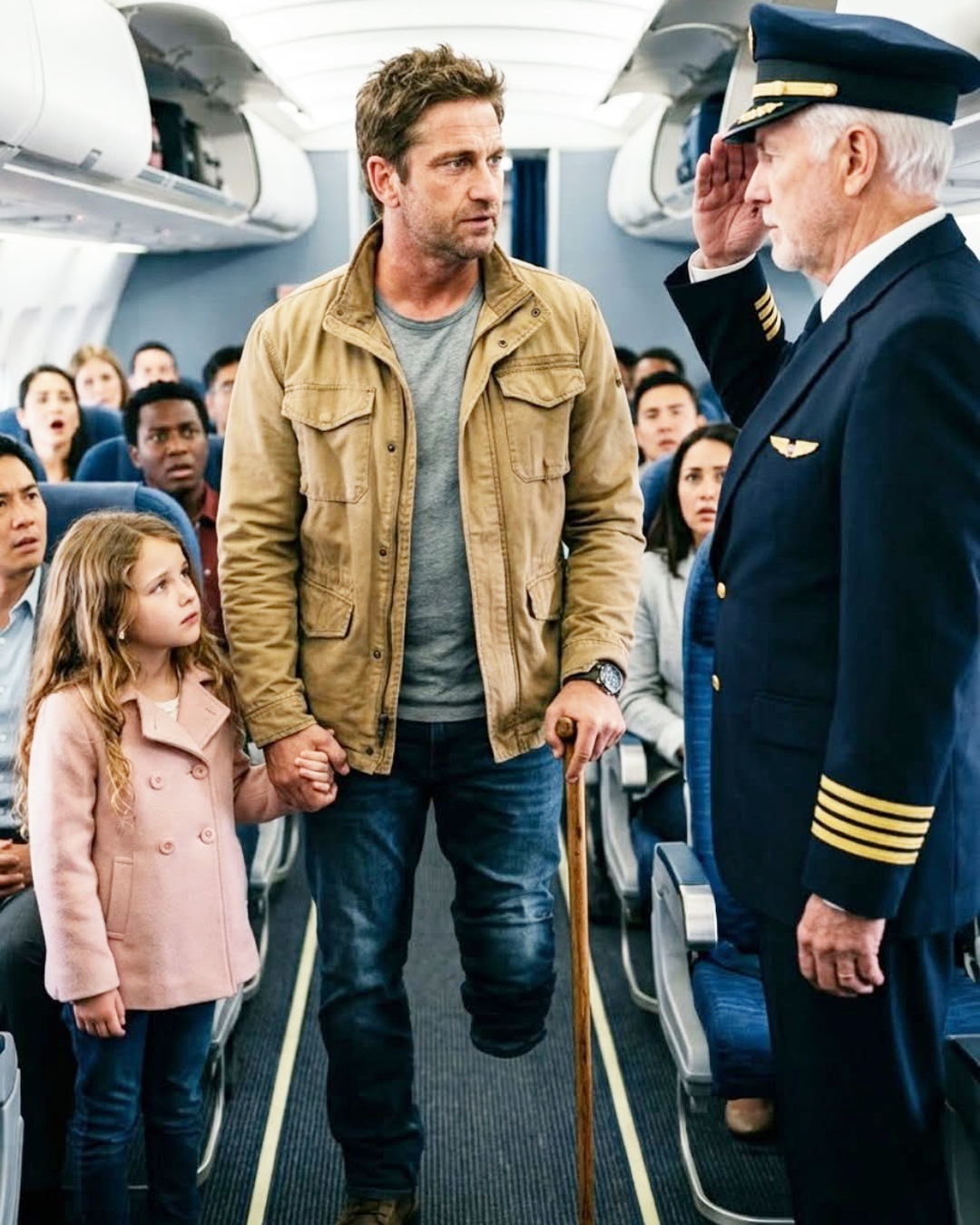
He stepped fully into the aisle, came to attention, and slowly raised his hand in a crisp salute.
The entire plane went silent. My bag nearly slipped from my hand.
For two years, I had been the widower limping through school pickup. The quiet father people noticed at the grocery store. The man strangers stepped around whenever I moved too slowly.
And now the captain of the aircraft was standing in front of everyone and saluting me. I straightened as much as my body allowed, then returned the salute.
Maya stared up at me as though she were seeing a part of her father she had never been allowed to see before.
The captain lowered his hand and approached us. “Sir,” he said loudly enough for everyone in first class to hear, “it is an honor to have you aboard my aircraft.” Then he turned toward the gate agent. “This man and his daughter are not going anywhere. They are exactly where they belong.” The gate agent’s face drained of color. The man in the navy suit suddenly seemed very interested in staring at the floor.
But the captain wasn’t finished. He glanced at the tablet in the gate agent’s hand, then toward the flight manifest clipped beside the galley. That was when his expression shifted again—not anger, but something deeper, something personal.
He looked back at me and said one word that sent a chill through my chest.
“Vance?”
The cabin stayed completely silent.
PART 2
“Sergeant Vance,” he said quietly, his voice trembling slightly, “I need to tell you something, and ever since I saw your full name on our passenger manifest, I’ve been struggling to find the right words.”
I tightened my grip slightly around my wooden cane. “What is it, Captain?”
He drew a deep breath before continuing. “Three years ago, in the eastern province,” he began, “a military convoy was struck by a massive roadside explosive. One particular soldier kept going back into heavy enemy fire to pull trapped men from a burning vehicle.”
The air around me suddenly felt thin and difficult to breathe.
“That soldier was you,” Captain Sterling said softly.
I said nothing, because it was true. That was exactly what happened when I lost my lower leg. It was the terrible day behind the distinguished service cross sitting inside a dark dresser drawer at home, a medal I hadn’t looked at in years because it felt less like an honor and more like a permanent receipt from the worst afternoon of my life. People who have never served often think bravery medals are trophies to proudly display. To many of us who earned them, they carry something far more complicated—permanent evidence of a day you wish had never happened in human history, representing a list of names, some who returned to their families and others who never made it home.
“Captain,” I said quietly, “that was a long time ago.”
“Not to my family,” Captain Sterling answered, his eyes shining with unshed tears. He reached inside his jacket and pulled out a small, framed photograph, extending it toward me.
It showed a young lieutenant in full uniform, smiling broadly beside a young woman and a newborn baby.
“The driver of that lead humvee,” Captain Sterling whispered, his voice breaking. “The boy you pulled through the flames just before the fuel tank detonated. That was my son, Daniel.”
A collective gasp moved through the front rows of the cabin. The gate agent stood motionless, his face completely pale, while the corporate passenger in the navy suit slowly lowered himself into a nearby coach seat, staring at his shoes in complete shame.
Captain Sterling moved closer and placed a warm hand on my shoulder. “For three years, my son has spoken about the sergeant who refused to give up on him, the man who lost his own limb to make sure my boy could come home and raise his daughter. My family prays for you every night, Sergeant Vance. And today, by some miracle of Providence, you walked onto my plane.”
Maya squeezed my hand tightly, looking first at the captain and then at me. “Daddy… you saved his boy?”
I swallowed hard, knelt down despite the sharp ache in my residual limb, and pulled my daughter close against my chest. “I just did my job, sweetheart. Just like I’m doing my job taking care of you.”
Captain Sterling turned toward the cabin crew. “Upgrade this entire row. Sergeant Vance and his daughter get whatever they need for the duration of this flight. And clear the tarmac—we have a hero on board, and he has a promise to keep to his family.”
The entire cabin erupted into spontaneous applause. Passengers stood, clapping and wiping away tears as Maya and I settled into our spacious first-class seats once again.
For the first time in two long years, the heavy weight inside my chest lifted. I held the carry-on containing Elena’s ashes against my lap and watched through the window as the engines roared to life.
We were finally taking her home to the ocean, and my daughter knew, without any doubt, exactly who her father was.
PART 3
The applause throughout the cabin slowly faded into a warm, respectful hum as the flight attendants finished their final safety checks. At the front of the aircraft, the gate agent quietly disappeared down the jetbridge without looking at anyone. The corporate passenger who had demanded my seat sat buried three rows back in economy, staring down at his lap, thoroughly subdued beneath the collective glare of the entire first-class cabin.
Beside me, Maya pressed her nose against the oval window, watching the runway lights streak past as the twin engines came alive. Her little hand remained firmly wrapped around mine.
“Daddy?” she whispered over the rising hum of the jet turbine. “Is the captain’s son happy now?”
I looked down at her and adjusted the blanket over her knees. “He’s very happy, Maya. He gets to be home with his little girl, just like I get to be here with you.”
She thought about that for a moment, her bright eyes reflecting the sunlight glinting across the wing as we rose smoothly into the cloud cover. “Mama would be really proud of you,” she said softly. “Not just because of the plane seats, but because you were brave.”
A quiet knot formed in my throat. I pulled the worn canvas carry-on closer against my ribs. Inside, protected by its velvet wrap, was the small brass urn. “Your mama always knew who I was, Maya,” I said, my voice thick with emotion. “Even when I forgot.”
For the next two hours, the flight was unlike anything I had ever experienced. The lead flight attendant, a kind-faced woman named Sarah whose brother served in the Marines, insisted on bringing Maya a platter of fresh fruit, warm cookies, and a pair of plastic pilot wings gently pinned to her flannel collar. Every time I tried to pay or politely refuse, Sarah simply smiled and shook her head. “Captain’s orders, Sergeant. You just sit back and rest.”
As we began descending toward the coastal airport, the flight deck door opened briefly. Captain Sterling stepped out, adjusting his uniform cap. He said nothing at first; he simply walked toward our row, reached into his pocket, and placed a pristine, gold-embossed challenge coin directly onto Maya’s tray table. One side carried the insignia of his commercial fleet, while the other displayed the crest of his son’s former infantry division.
“For the young lady,” Captain Sterling said, his eyes meeting mine with profound warmth. “To remind you of today.”
“Thank you, Captain,” I said, offering him a firm, steady handshake.
“No, Sergeant,” Sterling replied, holding my hand for a moment longer. “Thank you. My son, Daniel… he works as a high school history teacher now in Raleigh. His daughter just turned two last month. If you ever find yourself up that way, there’s a place at our dinner table with your name on it for the rest of your life.”