The thick, heavy square of ivory paper sat on my scratched Formica kitchen table, its gold lettering raised so high it looked like brass. The postmark in the corner showed it had cost fifteen dollars just to mail, which was exactly five dollars more than I had left in my checking account. Ethan stood by the refrigerator, his arms crossed over his chest, watching me. He did not ask what was inside the envelope, though we both knew the return address in Dallas belonged to his father’s law firm. He was still wearing his school uniform, the blue polo shirt slightly frayed at the collar,
his dark hair combed straight down. “Is that from Daniel?” he asked. He had started calling his father by his first name six months ago, after the child support check stopped arriving on the first of the month. I had not corrected him, though my former mother-in-law, Eleanor, always frowned when she heard him say it. “It is,” I said. I slid my butter knife under the heavy gold wax seal, trying to keep my hand steady. My bare left ring finger felt cold, and I rubbed the pale band of skin where my wedding ring used to sit. The wax split with a sharp crack that sounded too loud in the
quiet kitchen. Inside was a folded sheet of vellum, thick as cardboard, announcing the wedding of Daniel and Madison. The ceremony was set for the twelfth of November at the Stonebriar Country Club in Frisco. There was a smaller card inside, printed on both sides, listing the registry at a boutique in Highland Park where a single crystal water goblet cost ninety-five dollars. Ethan watched my face, his dark eyes steady behind his glasses. He did not reach for the paper.
“Is it an invitation for both of us, Mother?” he asked.
His formal voice always made him sound like my late father, Thomas, who had spent forty years surveying the dry county lines of West Texas. He had that same way of standing with his feet wide apart, as if he were waiting for the ground to shift beneath him.
“It has both our names on the front,” I said, keeping my voice level as I slid the card back into its sleeve. “But Frisco is a long drive for a Saturday afternoon.”
He did not reply, but his right foot began to tap a steady, slow rhythm against the linoleum.
“He promised he would take me to the sporting goods store this weekend,” Ethan said. “For the baseball cleats.”
“Madison is very pretty,” Ethan said, pointing to the name on the card. “Is she a lawyer too?”
“She is,” I said. “A senior associate at the firm.”
“Does she know we live here?”
“I do not think she knows much about us, Ethan,” I said.
“I am sure he is just very busy with the wedding arrangements,” I added.
I set the envelope down near the salt shaker. The gold foil caught the light from the small window over the sink, where a single blue plastic child support ledger sat on the ledge, its pages blank for the last three columns.
By five o’clock, the autumn air had turned cool enough to make my knuckles ache as I unscrewed the oil cap on the Buick. Ethan stood beside the front bumper, holding the heavy yellow flashlight exactly where I needed it, his small fingers wrapped tight around the plastic handle. The car was parked in our narrow gravel driveway, right beneath the pecan tree that dropped its hard green hulls onto the roof every night.
“The dipstick is dry, Ethan,” I said, wiping the metal rod with an old rag that had once been one of Daniel’s monogrammed hand towels. “We need another quart of ten-thirty.”
“I can walk to the auto parts store on Highway Fifteen,” Ethan said.
“No,” I said, reaching into the backseat for the spare quart I kept behind the driver’s seat. “The highway is too busy at this hour, and the shoulder is narrow. Hold the light right there.”
He tilted the beam down into the dark engine bay. He was growing so fast that his wrists showed beneath the sleeves of his jacket, thin and pale. I looked at his hands, already shaping into the long, blunt fingers of his grandfather.
“Father said he would show me how to change the spark plugs when he came for his weekend,” Ethan said.
“Spark plugs are simple,” I said, pouring the dark oil through the plastic funnel. “I can show you how to do that on Saturday.”
“He said he had a special set of tools for it,” Ethan said, his voice flat. “The ones with the red handles. He said he bought them in Dallas.”
I did not tell him that those tools had been sold at our garage sale six months ago to pay the water bill. I simply tightened the cap and let the heavy steel hood drop with a metallic clang that made the flashlight beam jump.
“We will do it ourselves,” I said.
He clicked the flashlight off, the sudden gray dusk of Plano settling over the driveway. He looked down at his sneakers, then up at the dark windows of our neighbors’ houses, where families were sitting down to dinner.
“He is not going to buy the cleats, is he?” Ethan asked.
“We will get them tomorrow after my shift,” I said.
The next morning, the medical clinic was already full by eight forty-five. I sat behind the high reception desk, balancing three different patient charts on my lap while the phone rang on line two. The screen showed twelve patients waiting in the queue, their names flashing in red, each one representing a child with a fever or a senior citizen waiting for blood pressure results.
I spent forty minutes sorting through the patient schedules, trying to squeeze in a last-minute appointment for an infant with an ear infection while ignoring the quiet panic in my own chest. The utility bills were due on Tuesday, and my paycheck would not be deposited until Friday afternoon.
Sarah, our receptionist, was busy on the other phone line, trying to explain a billing code to an insurance representative who refused to listen. She looked up at me and gave a small, tired shrug.
The morning rush finally slowed down around eleven, leaving a quiet lull in the waiting room. I spent the time filing paper charts into the wooden cabinets by the wall, the smell of dust and old manila folders filling the narrow corridor.
Dr. Vance, who had run the family practice for thirty years and still wore a faded tweed jacket under his white coat, leaned over the counter. He had a yellow legal pad in his hand, scribbled with weekend emergency calls.
“Rachel, did we get the shipment of flu vaccines from the county?” he asked.
“They are in the second refrigerator,” I said, not looking up from the scheduling screen. “I cleared out the old tetanus vials to make room. The delivery driver signed for them at seven.”
He stood there for a second, watching me click through the digital calendar.
“You look like you are carrying the weight of the whole county,” he said, his voice dropping so the patients in the first row of chairs wouldn’t hear. “Is everything alright at home?”
“We are doing fine, Dr. Vance,” I said, my finger automatically finding my bare ring finger to rub the dry skin. “Just the usual school expenses.”
“I have some extra administrative hours on Saturday if you want them,” he said. “We need someone to audit the Medicaid files before the state inspector comes. It is quiet work, just you and the folders.”
“I can do that,” I said immediately. “I can start at seven.”
“Do not overwork yourself,” he said. “But the hours are there if you need them.”
“Thank you,” I said.
I went back to the keyboard, my mind already calculating the hours. It would mean sixty-two dollars after taxes, enough to pay the gas company before they sent the second notice.
That evening, the gold-embossed invitation sat on the corner of the laminate counter in the dining room, catching the dim light of the stove. I had tried to tuck it behind the breadbox, but Ethan had moved it back to the center of the table before we sat down to our plates of macaroni.
He did not eat his food. Instead, he ran his index finger over the raised gold letters of his father’s name, tracing the sharp angles of the calligraphy.
“We should go to this,” Ethan said.
“It is a very formal event, Ethan,” I said, setting my fork down. “We do not have the right clothes for a country club, and your father will have many guests from his office. People who do things differently.”
“I have my school suit,” he said. “The navy one.”
“The navy one is too small in the shoulders,” I said. “And we were only invited as a courtesy. Your father has a new life now, and it is best if we let him have his day.”
Ethan looked at the heavy paper, his face completely expressionless. He did not look angry, which made me more uneasy than if he had thrown a fit.
“I want to see if he acts different when everybody is watching,” Ethan said.
The sentence hung in the small dining room, cold and deliberate.
I stared at him, my hand moving to my bare ring finger. I had spent two years trying to shield him from his father’s empty promises, trying to make excuses for every missed weekend and every forgotten birthday. I had thought he was too young to understand the theater of Daniel’s public life.
But looking at him now, tapping his right foot in that slow, steady cadence, I realized he was not asking to go because he wanted to be near his father. He was asking to go because he wanted to see the truth.
“It will not be a pleasant afternoon, Ethan,” I said softly.
“I know,” he said.
“If we go, we will be sitting in the back,” I said. “We will not be part of the main group.”
“I do not mind where we sit,” Ethan said, his voice steady. “As long as we are in the room.”
I looked down at my own hands, worn from the clinic and the oil changes, and then at the gold-embossed invitation sitting on the laminate kitchen counter, catching the dim light of the stove.
“Alright,” I said. “We will go.”
The gold-embossed invitation sat on the laminate kitchen counter, catching the dim light of the stove.
The medical clinic lobby smelled of lemon bleach and old magazines when the mail carrier dropped the stack on the counter. Sarah, our receptionist, sorted through the insurance forms and bills with her usual rhythmic slap of paper. She stopped on a thick, glossy booklet and slid it toward me.
“Look who made the front page,” Sarah said, tapping the paper with her acrylic nail.
It was the autumn newsletter for the law firm of Vance, Sterling, and Harlow. On the cover, Daniel stood between two senior partners, his chin tilted up and his hands resting on his belt. The fabric of his charcoal suit looked thick and expensive, completely free of the creases that came from sitting in a car or a hard courtroom chair. He looked like a man who spent his days in air-conditioned rooms where people listened when he spoke.
The headline below the photograph announced his promotion to senior trial partner. I turned the page, my thumb catching on the high-gloss paper, and found the brief biography detailing his recent victories in court. The text mentioned his record-setting settlement in a construction dispute, followed by a sentence about his expanded role in the firm’s executive compensation structure.
I looked at the number listed under his projected quarterly billing target. It was twice what he had been making when we finalized the divorce in the spring.
“He looks very successful,” Sarah said, leaning over the counter to see the page.
I closed the newsletter and dropped it into the recycling bin beneath my desk.
“He works very hard,” I said, my voice flat.
My left ring finger felt cold, and my hand moved automatically to rub the bare skin where my wedding band had lived for ten years. There was a faint, pale line still visible under the fluorescent lights of the office, a mark that refused to fade even though the marriage had been over for eighteen months.
Dr. Vance called from the back hallway, asking for the chart for the eleven o’clock patient, and I stood up before Sarah could ask any more questions.
The light inside the kitchen was dim when I opened the laptop at eight o’clock that evening. Ethan sat across from me at the laminate table, his bowl of Corn Flakes making a dry, scraping sound against the wood every time he moved his spoon. He ate slowly, his eyes fixed on the salt shaker in the center of the table.
I logged into the state child support portal, the blue screen reflecting in the kitchen window. The ledger showed the monthly obligation of nine hundred and fifty dollars, with the status listed as pending.
“Is the bank machine working tonight, Mom?” Ethan asked.
“It works fine,” I said, keeping my eyes on the screen.
“We usually go to the grocery store on Tuesdays,” he said.
He did not look up from his cereal, but his right foot began to tap a steady, slow rhythm against the leg of his chair. It was a habit he had taken from my father, a quiet way of waiting for an answer he already knew.
The transaction history on the screen showed no deposits since the previous month. The payment was five days late, leaving sixty-four dollars in our checking account until my next paycheck on Friday.
“Your father has been very busy with his new position at the office,” I said, closing the browser window before the screen could log out automatically.
“He has three assistants,” Ethan said.
“They do not do his legal work for him, Ethan.”
“He told me he has a calendar on his computer that rings when he has an appointment,” Ethan said, his spoon hovering over the milk.
I reached across the table and touched his shoulder, but he did not lean into the touch. His shoulder felt narrow and thin under his cotton shirt, the bones of a boy who was growing faster than his clothes could keep up with.
“I’m sure your father just got caught up in court, Ethan,” I said.
He did not answer. He pressed his spoon against the bottom of the bowl, releasing a single bubble that popped on the surface of the milk.
The lobby of the downtown bank branch was quiet at three o’clock the next afternoon. The teller, a young woman named Maria with a small gold cross around her neck, took the personal check I slipped through the glass partition. The check was signed in Daniel’s bold, looping handwriting, the amount written out for nine hundred and fifty dollars.
“I need to cash this, please,” I said.
Maria scanned the check and typed on her keyboard, her eyes moving rapidly across the screen. The rhythmic clicking of her keys seemed to fill the quiet room.
“I can’t cash this today, Ms. Miller,” she said, her voice dropping to a low whisper.
“Is there an issue with the signature?” I asked.
“The issuing account does not have sufficient funds to cover the amount,” she said.
She did not look at me as she spoke, her hand sliding the check back across the black counter. The paper felt crisp and new, the ink of his signature dry and permanent.
“Are you sure?” I asked. “He just received a promotion. It was in the legal journal last week.”
“The system is showing the balance is currently below the draft amount,” she said, her voice gentle. “I can try to run it again tomorrow morning if you’d like.”
“No,” I said, taking the check and folding it twice before putting it into my purse. “Thank you for your help, Maria.”
I walked back out to the parking lot, the heat of the Texas afternoon rising from the asphalt in waves. The steering wheel of the Buick was hot to the touch, and I sat there for three minutes before turning the key, my hand resting on the folded paper in my purse.
The school courtyard was empty of teachers when I pulled into the pickup lane at four o’clock. Most of the yellow buses had already departed, leaving only a few cars idling near the main entrance.
Ethan was sitting on the concrete bench near the bike racks, his backpack resting between his feet. His hands were tucked into his pockets, his chin tucked down against the collar of his shirt.
I parked the Buick and walked over to the bench, the sound of my heels loud on the concrete.
“Did your father call the school?” I asked.
Ethan looked up, his expression perfectly still. His eyes were the same pale gray as his grandfather’s, showing nothing of the thoughts behind them.
“The office secretary said he had an emergency hearing in Fort Worth,” Ethan said.
He stood up and picked up his backpack, his movements slow and deliberate.
“He was supposed to take you to the sporting goods store for your cleats,” I said.
“He said we will go next week instead,” Ethan said.
“We can go on Saturday, Ethan. I can take you after my morning shift at the clinic.”
“The cleats are sixty dollars, Mom,” he said.
He began walking toward the car, his posture straight and his head up. He did not look back at the school or the empty parking spaces where the other parents had parked.
I followed him to the Buick, the heat inside the car thick and heavy. We pulled out of the school lot and turned onto the main road, the traffic moving slowly toward the highway.
The route home took us past the downtown high-rise where Daniel had purchased his condominium three months ago. The building was a tall column of blue glass that caught the afternoon sun, its balconies looking out over the city park. A silver sports car was parked in the circular driveway near the main entrance, its polished metal shining in the bright light.
Ethan turned his head to watch the building as we drove past. His face was reflected in the passenger window, a quiet profile against the glass.
“He has a balcony on the twentieth floor,” Ethan said.
“I know,” I said.
“You can see the whole city from there,” he said.
He did not say anything else for the rest of the drive, his eyes fixed on the road ahead as the blue glass tower disappeared behind the tree line.
We turned left onto Park Boulevard, the high-rise fading into the gray afternoon haze behind us. Ethan did not look back, his fingers tracing the seam of his jeans in a slow, steady line.
The silence in the Buick was heavy, the kind that usually followed a mention of his father. I kept both hands on the steering wheel, my bare ring finger cold against the plastic grip.
We pulled into the driveway of Eleanor’s brick home in Plano just before two. The lawn was perfectly green, bordered by small white stones that looked as if they had been scrubbed with a toothbrush.
The front door was already open. Eleanor stood behind the screen in a cream-colored cardigan, her palm flat against her white hair as she watched us walk up the concrete path.
She did not look at me first. Her eyes went straight to Ethan’s face, searching for the lines of her husband’s family in his jaw.
“Come inside out of the sun,” Eleanor said, her soft drawl low and dry. “I have some sweet tea on the counter.”
The living room smelled of lemon wax, dried lavender, and the faint, sweet scent of old stationery that always hung around Eleanor’s desk. It was a house where nothing had changed since 1982, from the heavy velvet curtains to the brass coal bucket by the fireplace.
Ethan stood in the center of the Persian rug, his hands hanging straight at his sides. He looked smaller in this room, surrounded by the heavy cherrywood furniture that Daniel had always promised we would inherit one day.
Eleanor did not offer us the tea. Instead, she went straight to the small mahogany writing desk in the corner.
She reached behind the porcelain lamp and pulled out a package wrapped in thick brown shipping paper, bound tightly with several rounds of rough kitchen twine.
“Your grandfather wanted you to have this when you were ready, Ethan,” Eleanor said, her voice dropping to a whisper as she placed the heavy bundle into his hands.
Ethan took the package, his fingers spreading across the rough paper as if he were trying to guess the shape of whatever was hidden inside. He did not shake it or try to loosen the knot.
“What is it, Grandmother?” Ethan asked, his voice carrying that formal, serious tone he had learned from listening to his grandfather speak at Sunday dinners.
“It belongs to you now,” Eleanor said, her hand reaching out to pat his shoulder, her palm lingering there for a long moment. “That is all you need to know today.”
I watched them from the edge of the sofa, my fingers rubbing the bare skin of my left ring finger. The silence in the room felt heavy, loaded with the things Eleanor was not saying about her own son.
“We should be going, Eleanor,” I said, looking at the brass clock on the mantelpiece. “I have the late shift at the clinic starting at four, and Dr. Vance has a full schedule.”
Eleanor nodded, but she did not move her hand from Ethan’s shoulder immediately.
“He was a good man, Ethan,” Eleanor said, looking back at me with a look of quiet exhaustion. “He knew who to trust with his things.”
We walked back to the Buick, the heavy package resting on Ethan’s lap like a sleeping pet. He kept his hands flat on the brown paper all the way home, his right foot tapping a tiny, silent rhythm against the floorboard.
Two days later, the dining room table was completely covered in old black-and-white photographs and yellowed newspaper clippings from the Plano Star-Courier. Ethan sat in the center of the mess, a blue three-ring binder open in front of him, surrounded by glue sticks and a small pair of black scissors.
The smell of dry paper and old cardboard filled the small space between the kitchen and the hallway. As I walked in from the kitchen with a glass of water, Ethan quickly shut the blue binder with a sharp click of the plastic rings.
His hand rested flat on the plastic cover, hiding whatever page he had been working on.
“What are you working on, honey?” I asked, setting the glass down on the wood.
“Just some school things,” Ethan said, his voice flat and even.
He slid a loose photograph of his father at age ten under the edge of his science textbook. He was not fast enough to keep me from seeing the faded polaroid of Daniel standing by a red bicycle, smiling.
“I didn’t know you had those pictures,” I said.
“Grandma Eleanor gave them to me,” Ethan said, looking down at his desk lamp.
The brown paper package from Eleanor sat empty on the floor beside his chair, the kitchen twine neatly coiled next to it.
“If you need help with a history project, I have some old documents in the filing cabinet,” I said.
“No, thank you,” Ethan said, his right foot starting its rhythmic tap against the chair leg. “I have what I need right here.”
I wanted to press him, but the quiet determination in his face made me step back. He was twelve, and there were parts of his mind that were beginning to lock against me.
He picked up a small bottle of black ink and carefully set it inside the empty brown paper box, his movements deliberate and slow.
The next afternoon, the phone at the clinic reception desk rang three times before I could reach it, my hands full of patient files for Dr. Vance’s afternoon physicals.
“Vance Family Practice, this is Rachel,” I said, balancing the receiver between my ear and shoulder.
“Rachel, it is Madison,” the voice on the other end said, high and fast, like she was reading from a legal brief. “I am finalizing the seating chart for the twelfth, and your RSVP card is three days late.”
I held my breath, my finger automatically tracing the pale circle on my left hand.
“The invitation only arrived last week, Madison,” I said, keeping my voice low so the patients in the waiting room would not hear.
“We have a caterer deadline, Rachel,” Madison said, her tone sharp and thin. “Daniel said you would probably do this, but I need a definitive yes or no for you and Ethan by five today.”
“Ethan wants to go,” I said, swallowing the tight knot of anger in my throat. “We will both be there.”
“Fine,” Madison said, and I could hear the tap of her fingernails on a glass desk through the line. “I will put you at table seventeen.”
“Is that near the front?” I asked.
“It is where there is room,” Madison said, and the line went dead before I could reply.
I stood there with the quiet dial tone in my ear, the plastic receiver cold against my cheek. Sarah, our receptionist, looked up from her computer with a sympathetic frown, but I kept my eyes on the patient files in my hands.
That evening, the kitchen was quiet except for the low hum of the refrigerator and the scrape of Ethan’s spoon against his bowl of oatmeal.
“Grandpa Thomas used to say something about time,” Ethan said, looking up from his bowl. “What was it, Mom?”
I stopped wiping the laminate counter, the damp sponge still in my hand.
“He had a lot of sayings, Ethan,” I said, sitting down across from him. “He was an old-school Texan.”
“The one about what you give people,” Ethan said, his eyes steady on mine.
“Grandpa used to say time is what we give the people we love,” I said, my voice softening as I remembered the old man sitting in his cherrywood chair. “He said you can always make more money, but you can never make more minutes.”
Ethan nodded slowly, his fingers tracing the edge of his spoon.
“Did Dad ever hear him say that?” Ethan asked.
“Many times,” I said.
Ethan got up from the table, carrying his empty bowl to the sink, and then walked back toward the dining room without another word.
The sound of the dining room drawer sliding shut, hiding Ethan’s project from view, echoed through the quiet house.
The limestone pillars of the Stonebriar Country Club rose up like monument stones against the gray November sky.
Ethan kept his thumb hooked under the strap of his canvas backpack, his navy blazer smelling faintly of the cedar chest where Eleanor had stored it. The sleeves were short enough to show his thin wrists, but he stood with his shoulders squared and his chin up.
My own dress, a cream wrap I had bought on sale at Foley’s three seasons ago, felt thin under the draft from the lobby’s air conditioner.
The lobby smelled of beeswax polish and the white gardenias floating in a low copper bowl near the registration desk.
Two large ice sculptures shaped like interlocking rings stood on a side table, melting slowly into a silver tray.
Madison stood near the grand piano, surrounded by women in identical peach silk dresses. She was checking her reflection in her phone screen, her thumb moving in quick, sharp strokes across the glass.
When she looked up and spotted us, her hand dropped to her side.
She did not say anything to her bridesmaids, but she walked toward us with a quick, hard stride that made her silk train hiss against the marble.
“I’m surprised you actually came, Rachel,” she said, her voice high and thin, carrying over the hum of the crowd.
“We wanted to be here for Ethan,” I said, choosing my words with the same slow care I used when a patient complained about a billing error.
Madison looked down at Ethan, her gaze resting on his scuffed brown dress shoes before she looked back at me.
“Well, the guest list was strictly managed,” Madison said, her fingers tightening around her silver clutch. “I had to approve every single seat myself.”
“Eleanor said it was taken care of,” I said.
“Eleanor doesn’t manage the seating chart,” Madison said, her lip curling slightly as she glanced toward the double doors.
An usher in a black tuxedo stepped between us, holding a silver tray of programs.
“The ceremony is starting in ten minutes, ma’am,” he said to Madison, then looked at me with a polite, empty smile.
“We need to find our seats,” I said.
Madison turned her back on us without another word, her silk gown rustling as she walked back toward her bridesmaids.
The usher looked down at his clipboard, his finger tracing a column of highlighted names until he found ours.
“Row twenty-two, on the left,” he said, not looking up.
“Is that near the front?” Ethan asked.
“It is the last row before the exit,” the usher said.
The chapel was cool and dimly lit, the light filtering through stained-glass windows that cast long purple shadows across the carpeted aisle.
We walked down the center, passing rows of people I recognized from our old neighborhood, people who quickly turned their heads to study their programs as we walked by.
Ethan did not look at them; he kept his eyes on the altar where his father stood.
Daniel looked older in the dim light, his dark hair touched with silver at the temples, but his suit was tailored to look like he had never known a hard day in his life. He was adjusting his gold cufflinks, his fingers moving in that familiar, rhythmic twist that meant he was calculating something.
When he looked up and saw Ethan walking toward the back row, his hand stopped mid-motion.
His mouth opened slightly, his eyes widening as he looked from Ethan to me.
He looked down at his program, then back at us, his face tightening into a hard mask before he turned to whisper something to his best man.
“He didn’t think we’d show up,” Ethan whispered, sliding into the wooden pew.
“He invited us, Ethan,” I said, though my voice felt thin in my throat.
“No, Grandma Eleanor invited us,” Ethan said, his right foot starting to tap a steady beat against the wooden kneeling bench.
The organ music began, a heavy, vibrating chord that shook the floorboards beneath our feet.
Guests turned their heads as the bridal party began their walk down the aisle, their silk dresses whispering against the carpet.
I watched Daniel’s face as Madison walked toward him, his smile returning with a sudden, practiced warmth that seemed meant for the cameras positioned in the corners of the room.
He did not look back at our row again during the vows, even when the minister asked the congregation to stand.
Ethan stood straight, his grandfather’s silver watch tucked into his pocket, his hand resting flat against his thigh.
When the ceremony ended and the guests began to file out, we waited in our pew until the aisle was empty.
The silence of the emptying chapel felt heavier than the music had been.
“We should go to the reception,” I said, touching Ethan’s shoulder.
“He’s going to try to talk to us out there,” Ethan said, his eyes still fixed on the empty altar.
The afternoon heat had begun to rise from the concrete steps outside the chapel, smelling of damp earth and car exhaust from the valet circle.
Madison was standing near the stone balustrade, her silk train gathered in one hand as she posed for a photographer.
Daniel was several feet away, surrounded by three men in dark suits who were laughing loudly at something he had said.
As Ethan and I descended the steps, Madison paused, her eyes narrowing as she looked at my dress.
“Rachel, I didn’t think you’d stay for the actual reception,” she said, her voice carrying over the sound of the camera shutter.
“We came for the whole ceremony,” I said, keeping my hands clasped in front of my purse.
“The seating is very tight,” Madison said, her fingers tightening around her bouquet of white roses until the stems groaned. “We had to make some adjustments for family.”
“We don’t mind where we sit,” I said.
Madison looked at Ethan, her gaze lingering on his blazer.
“I hope he has some nicer clothes for school,” she said, her voice dropping so only the guests nearest us could hear.
Ethan did not flinch; he simply stared at her with a calm, steady look that made her turn her head away first.
“He looks exactly like his grandfather,” I said, my voice steady.
Madison did not answer; she turned back to the photographer, her smile snapping back into place as the flash went off.
I saw Daniel look over at us then, his hand going back to his cufflink, but he did not move toward us.
He turned back to his colleagues, his booming laughter rising above the chatter of the crowd.
“Let’s go inside, Mom,” Ethan said, pulling gently at my sleeve.
“We don’t have to stay if you don’t want to,” I said.
“I want to see where they put us,” Ethan said.
The ballroom was a vast expanse of white and gold, the air thick with the smell of roasted garlic and expensive champagne.
A large seating chart on an easel stood near the double doors, its glass frame reflecting the sparkling chandeliers.
I found our names near the bottom of the last column, written in a small, cramped script that looked different from the elegant calligraphy on the other cards.
“Table seventeen,” I said, looking toward the back of the room.
We walked past the head table, where Daniel and Madison were already seated, their gold-rimmed glasses catching the light.
We walked past the tables of the senior partners, decorated with tall arrangements of white lilies and silver candles.
Our table was located in the dark corner near the kitchen service doors, where the air was cold from the industrial air conditioning.
The table was set with plain white plates and did not have a floral centerpiece, only a small glass cup with a single tea light.
Three people were already seated there: two young women in black trousers who looked like the florists’ assistants, and an older man in a polyester suit who was staring at his hands.
As we sat down, the young women stopped talking and began adjusting their silverware, refusing to make eye contact with us.
The older man looked up, his eyes tired.
“You here for the firm?” he asked, his voice low.
“No,” I said. “We’re family.”
He nodded slowly, then looked back down at his water glass without another word.
A waiter brushed past my shoulder, carrying a tray of dirty glasses that rattled as he entered the kitchen.
I looked across the room at Daniel, who was laughing with a man in a gray suit, his hand resting on Madison’s shoulder.
He wanted everyone to see exactly where we belonged in his new world.
The swinging double doors of the kitchen brushed against the back of my chair.
A tray of dirty glasses rattled on the other side of the wood.
I adjusted my posture, pulling my shoulders away from the draft of the kitchen corridor. The noise from the dishwashing area was a steady hum, punctuated by the occasional scrape of silver against porcelain.
Then a shadow fell over the white tablecloth, smelling of lavender and expensive soap.
Eleanor stood there in her pale blue silk dress, her pearls catching the dim light of our corner. She did not look at the swing doors behind me or the busboys squeezing past with heavy trays.
Instead, she pulled out the empty metal chair next to Ethan and sat down, her silk skirt rustling against the cheap legs. The people at table sixteen, all junior associates from Daniel’s firm, stopped talking to stare. One of them, a young man with a slicked-back haircut, quickly sat up straight and adjusted his tie, but Eleanor ignored them completely.
She reached out and squeezed Ethan’s hand, her palm flat against his knuckles.
“I wanted to sit with my favorite young man,” Eleanor said, her voice carrying that soft, slow Texas drawl that always made people stop and listen.
Ethan did not pull away, though he usually disliked being touched in public.
“Grandma,” he said.
He tapped his right foot twice against the carpet, a silent rhythm I had seen him use all morning whenever he was trying to steady himself.
Eleanor looked across the table at me, her eyes steady behind her thin gold-rimmed glasses.
“You look lovely, Rachel,” she said.
I looked down at my simple grey dress, the one I had bought on sale at Foley’s three years ago, its hem slightly frayed at the back.
“Thank you, Eleanor,” I said, choosing my words with care.
“I know this is not where you belong,” she said, nodding toward the swinging kitchen doors.
She patted her white hair with her palm, her classic gesture when she was trying to keep her composure in an awkward room.
From the head table fifty feet away, Madison was watching us, her phone held screen-up in her palm, her face tight with something I couldn’t quite read.
“I belong wherever Ethan is,” I said.
Eleanor squeezed Ethan’s hand once more before releasing it.
“Come walk with me outside for a moment, Rachel,” Eleanor said, her voice dropping to a whisper.
She stood up, her silk dress rustling again as she smoothed her skirt.
“Ethan, stay right here,” she added.
The boy nodded, his eyes dropping to the brown paper package tucked safely between his feet.
We walked through the side exit onto the stone patio, where the late afternoon sun was beginning to dip behind the live oak trees. The air was cooler out here, smelling of dry grass, cedar mulch, and the expensive cigars the older men were lighting by the fire pit.
Eleanor leaned against the stone balustrade, looking out over the manicured green of the ninth hole.
“I am sorry about the seating,” she said.
“Daniel handles the arrangements,” I said, rubbing my bare ring finger.
“Daniel handles what he wants people to see,” she said, her voice carrying a rare edge of bitterness.
She turned her head to look at me, her face lined but elegant in the golden hour light.
“Thomas always said you were the strongest one in this family,” she said.
My chest tightened at the mention of her late husband, who had been the only one to call me after the papers were signed.
“Thomas was always very kind to me,” I said.
“He was honest,” Eleanor said. “There is a difference.”
She reached into her small silver clutch and pulled out a linen handkerchief, turning it over in her fingers.
“I gave Ethan his grandfather’s watch today,” she said.
I stared at her, my hand dropping from my finger.
“The silver one?” I asked.
“The silver one,” she said. “The one Thomas wore every day of his life, from the day he passed his bar exam.”
I wondered why she would give a twelve-year-old boy something so valuable now, at his father’s wedding.
“He is very young for such a responsibility,” I said.
“He is exactly the age he needs to be,” Eleanor said, her gaze shifting back to the glass doors of the ballroom.
She rubbed the smooth silver edge of her clutch, her fingers perfectly manicured.
“Your grandfather always believed that time was the only thing you couldn’t buy back,” she said. “He spent his life making sure everyone knew they were worth his time.”
“Madison thinks she knows this family,” Eleanor said.
“She seems very focused on the details,” I said, trying to remain neutral.
“She is focused on what Daniel tells her,” Eleanor said.
She looked at me with a sadness that made me want to look away.
“I told Ethan the truth about his grandfather,” she said.
I waited for her to tell me what that truth was, but she closed her clutch with a sharp click.
“We should get back inside before they start serving,” she said.
The lobby was carpeted in deep green, with high gold mirrors reflecting the crystal chandeliers. I stepped away from the patio doors and headed toward the ladies’ room to wash my hands.
“Rachel?” a voice called out.
I turned to see Evelyn Vance, the wife of the doctor I worked for, who used to live three doors down from us on Pecan Street. She was wearing a dark plum dress and holding a glass of white wine, her expression warm.
“Evelyn,” I said, forcing a smile.
“I thought that was you,” she said, stepping closer.
She looked me over, her eyes kind and entirely free of the pity I had expected.
“I was so glad when I saw your name on the guest list,” she said.
“I wasn’t sure if I should come,” I said.
“You have every right to be here,” Evelyn said.
She set her wine glass down on a mahogany console table near the entrance.
“Everyone knows who did the real work in that house,” she said.
I looked at her, surprised by her directness.
“Thank you,” I said.
“How is Ethan?” she asked.
“He is growing up fast,” I said. “He is here with me.”
“Good,” Evelyn said. “Let them see him.”
Evelyn looked toward the ballroom, her expression darkening slightly.
“I saw the seating chart,” she said quietly. “It’s petty, Rachel. Everyone in our old neighborhood knows what you went through while he was building his practice. Don’t let them make you feel like a guest at your own life.”
She reached out and touched my arm, her hand warm and steady.
“Do not let them make you feel small, Rachel,” she said.
“I am trying,” I said.
“You don’t have to try,” she said. “You just have to stand there.”
She picked up her wine glass again as another couple approached.
“I must find my husband,” she said. “But I am glad you are here.”
I watched her walk toward the main bar, her shoulders back.
My hands were no longer cold as I walked back into the ballroom.
Table seventeen was still vibrating from the kitchen traffic.
Ethan was sitting exactly as I had left him, his hands folded in his lap. The brown paper package was still visible between his feet, the corner of the wrapping slightly creased. It looked completely out of place on the plush green carpet of the country club, yet Ethan guarded it like a treasure.
“Are you hungry, Ethan?” I asked, sitting back down.
“The bread is cold,” he said.
“We can get pie afterward,” I said.
He rested his hand on his knee, his fingers tapping the fabric of his trousers. I looked at his shoes, polished to a mirror shine, the same shoes we had bought for his middle school graduation ceremony.
He looked up at the head table, where Daniel was laughing at something a man in a gray suit had said.
“Grandma told me about the watch,” Ethan said.
“It is a very special watch,” I said.
“She said Grandpa Thomas never missed a single one of Dad’s games,” Ethan said.
I looked at my son, his face serious and calm.
“Your grandfather was a very committed man,” I said.
“She told me Dad missed fifteen of mine last year,” Ethan said.
I felt a cold spot in my stomach.
“Ethan,” I began.
“She kept the calendar, Mom,” Ethan said.
He reached down and touched the brown package under his chair.
“We are doing fine, Mom,” he said.
His voice was steady, too steady for a boy his age.
I wanted to ask him what else was inside that package, but Eleanor appeared at the edge of our table again.
She looked down at Ethan, then at me, her expression soft.
“I must go back to my seat now,” Eleanor said.
She reached down and patted Ethan’s shoulder.
“Be brave, my boy,” she whispered.
She turned and began the long walk back across the ballroom floor.
I watched her navigate the space between the round tables, her head held high.
The guests at the wealthy tables stood up to let her pass, nodding with deep respect.
She did not stop to speak to any of them.
She kept her eyes fixed on the empty chair next to her son at the front of the room.
We watched her go, the space around our table suddenly feeling colder.
Eleanor returned to the head table, leaving a lingering warmth in her wake.
The scent of Eleanor’s lavender soap still hung in the air when the shadow of a dark tuxedo fell across our bread plates.
Daniel stood there, his hair perfectly parted, the gold cufflinks catching the light of the crystal chandelier overhead.
“Well, look who finally made it,” Daniel said, his voice carrying easily over the clatter of silverware.
He did not look at me, keeping his eyes locked on Ethan, who was sitting up straight with his hands flat on his thighs.
“Come here, son,” Daniel said, stepping forward with his arms wide open.
He wrapped his arms around Ethan, pulling him off the chair in a hug that looked deep and desperate, though Ethan remained as rigid as a fence post.
Two men at table sixteen, both wearing matching silk ties, paused their conversation to watch the embrace.
“I missed you, buddy,” Daniel said, loud enough for the neighboring table to hear every syllable.
He finally released Ethan, patting him on the shoulder three times before looking down at me with a tight, polite smile.
“Rachel, you look nice,” he said, though his eyes lingered on the hem of my skirt for only a fraction of a second.
“Thank you, Daniel,” I said, my hand instinctively finding my bare ring finger.
“Come on,” Daniel said, reaching down to grab Ethan by the elbow. “There are some people you need to meet.”
Ethan looked back at me, his eyes wide and completely unreadable, before he stood up and smoothed his trousers.
I pushed my chair back and followed them toward the center of the ballroom, where the carpet transitioned to polished oak.
The room was filled with the low hum of expensive small talk and the clinking of champagne flutes.
Daniel stopped beside three men who stood near the ice sculpture of a rising swan, their posture rigid and professional.
“Gentlemen,” Daniel said, his voice booming with a confidence that seemed to command the entire floor. “I want you to meet my son.”
The tallest of the three men, a partner named Mr. Henderson with graying temples and a gold watch that looked older than my car, turned with a polite smile.
“This is Ethan,” Daniel said, putting a hand on the boy’s shoulder and squeezing it gently. “The smartest kid in his class.”
“Good to meet you, Ethan,” Mr. Henderson said, extending a hand that Ethan shook with his usual formal grip.
“Ethan is already studying algebra,” Daniel said, looking around the circle as if he had solved the equation himself. “He gets his brains from my side of the family, of course.”
The men laughed, a polite, dry sound that echoed in the high ceiling of the country club.
“He is looking at schools in Austin already,” Daniel added, his hand still resting heavily on Ethan’s shoulder.
I stood a step behind them, my purse clutched against my stomach like a shield.
“We are very proud of him,” I said, my voice softer than Daniel’s, almost lost in the noise of the crowd.
Daniel did not turn his head to acknowledge me, but his grip on Ethan’s shoulder tightened slightly.
“I always tell him, sky is the limit,” Daniel said, looking directly at Mr. Henderson. “He has the talent for the law, if he wants it.”
“A chip off the old block,” Mr. Henderson said, nodding as he took a sip of his drink.
Ethan did not say a word, his face perfectly still, his eyes fixed on the silver tray of a passing waiter.
“Go on back to the table, son,” Daniel said, giving him a gentle pat on the back. “I will be over in a minute.”
Ethan turned without a word and walked back toward the kitchen doors, his stride slow and deliberate.
I stayed for a brief second, watching Daniel laugh at something Mr. Henderson whispered in his ear.
When I reached table seventeen, a young waiter in a white jacket was already placing a large, square plate in front of Ethan’s empty chair.
“What is this?” I asked, looking at the six jumbo shrimp resting on a bed of crushed ice with a small bowl of dark red sauce.
“From the groom, ma’am,” the waiter said, adjusting the edge of the plate with white-gloved fingers. “A special selection.”
The other guests at our table, three women from the administrative pool and their husbands, stopped talking to look at the dish.
“That looks delicious, Ethan,” one of the women said, her voice carrying a hint of surprise.
Ethan looked at the shrimp, then up at me, his right foot beginning its steady, rhythmic tap against the carpet.
“I do not think I should eat this,” Ethan whispered, his hand resting near his fork.
“It is fine, Ethan,” I said, sitting down and pulling my chair in closer to the table. “Your father sent it.”
I watched him pick up the small fork, his movements precise, almost clinical, as he took a small bite.
Maybe I had been wrong about Daniel’s motives all along, letting my own anger blind me to his actual feelings.
Perhaps the wedding was simply a stressful milestone, and now that it was happening, he was trying to rebuild what he had broken.
A father does not brag about his son to his boss unless he truly cares, even if he does it with too much noise.
Daniel walked back to our table a few minutes later, his hand resting on the back of Ethan’s chair as he leaned down.
“Did you like the shrimp, buddy?” Daniel asked, his voice warm and filled with a sudden, easy affection.
“Yes, sir,” Ethan said, looking up into his father’s face. “Thank you.”
Daniel smiled, a broad expression that seemed to light up his entire face, and looked at me as if we were sharing a private joke.
“I always make sure my boy has the best of everything,” Daniel said, his voice carrying to the next table.
He straightened his posture, adjusted his gold cufflinks, and turned back toward the main floor.
I watched him go, wanting so desperately to believe the warmth in his voice was real this time.
He walked away with a smooth, practiced smile that did not reach his eyes.
The empty chair beside me did not stay vacant for long. Eleanor slid into it, her lavender silk skirt rustling against the metal legs of our table. She reached out and patted her white hair with her palm, her eyes darting toward the head table where Daniel was now laughing with a group of men in dark suits.
“He does that laugh when he is nervous,” Eleanor said, her soft Texas drawl barely louder than the clinking of water glasses from the kitchen doors.
“He did not look nervous to me,” I said, my finger automatically tracing the pale circle of skin where my wedding band used to sit.
Eleanor leaned closer, the scent of lavender and old paper moving with her. She gripped my wrist with surprising strength for a woman of sixty-six.
“Rachel, you need to know what he has been saying to his partners,” she whispered.
I looked at her, my hand freezing on my bare ring finger.
“He told everyone you would not let him see the boy.”
The words did not make sense at first. I looked across the room at Daniel, who was now gesturing widely as he spoke to a man in a gray three-piece suit.
“He said what?” I asked.
“For the last twelve months,” Eleanor said, her voice trembling slightly as she glanced around our table. “He told Madison and his partners at the firm that you legally blocked his access. He told them you were hiding Ethan from him so he could not build a relationship.”
A cold sensation started at the back of my neck and spread downward. All the late child support checks, the missed weekend visitations, the hours Ethan spent sitting on the concrete bench at school waiting for a car that never arrived. Daniel had turned those empty afternoons into a story of maternal spite.
“Why would they believe that?” I asked, my voice barely a whisper.
“Because Daniel is a very good lawyer, Rachel,” Eleanor said, her hand dropping back to her lap. “And because people prefer a clean story. They want to believe their new senior partner is a victim of a bitter ex-wife rather than a father who simply does not show up.”
She patted her white hair again, her eyes filled with a quiet distress.
“I only found out last week when Madison asked me why we did not invite Ethan to the rehearsal dinner,” Eleanor whispered. “She thought you would refuse to let him come anyway. She thought you were using the boy as a shield.”
My chest felt tight, the air in the country club ballroom suddenly too thick to breathe. I needed to get away from the table, away from the ice sculptures and the silver-plated chafing dishes.
“I will be right back,” I said, standing up so quickly my chair scraped against the polished floorboards.
The hallway leading to the restrooms was carpeted in thick, emerald green wool that muffled my footsteps. I leaned against the patterned wallpaper, trying to steady my breathing.
A door clicked open behind me. Madison stepped out of the ladies’ lounge, her ivory bridal train gathered in one hand. She stopped when she saw me, her fingers immediately reaching for the phone tucked into her beaded clutch to check her reflection in the dark screen.
“I did not expect to find you lurking out here,” Madison said, her high-pitched voice bouncing off the narrow walls.
“I was just getting some air,” I said, keeping my hands flat against the wallpaper.
Madison let go of her train and let the silk pool on the carpet. She stepped closer, her chin tilted upward, her eyes scanning my simple navy dress.
“Let us not do this, Rachel,” she said, her sentences coming in rapid, defensive bursts. “I know why you are here. You came to make a point, but it is not going to work.”
“I came because Ethan wanted to see his father,” I said, my voice steady despite the pounding in my ears.
“Ethan wants to see his father because you have spent a year keeping them apart,” Madison said, her eyes flashing. “Daniel told me how you used the custody agreement to punish him. You should stop using Ethan as a weapon to get more money.”
The hallway seemed to tilt. Every cold look Madison had given me since we arrived, the dismissive phone call to my office, the worst table by the kitchen doors, it all fell into place. She was not just being cruel. She believed she was protecting her new husband from a vindictive ex-wife.
“Is that what Daniel told you?” I asked.
“We know about the court dates you threatened,” Madison said, her fingers tapping rapidly against her clutch. “But Daniel is a senior partner now. His income is public record in the firm’s newsletter, and no amount of emotional blackmail is going to change his custody rights.”
“I have never blocked a single visit,” I said.
Madison let out a short, sharp laugh that sounded like dry paper tearing.
“Of course you would say that,” Madison said, tucking her phone back into her clutch. “Just do not ruin his night, Rachel. He has worked too hard to let your bitterness ruin this.”
She turned on her heel, her silk train sweeping the carpet as she walked back toward the double doors of the ballroom.
I stood in the corridor for three long minutes, watching the spot where she had disappeared.
When I returned to Table Seventeen, Eleanor had gone back to the family table near the stage. Ethan was sitting quietly, his hands folded in his lap. The brown paper package Eleanor had given him was resting securely on the floor between his feet.
“Are you okay, Mom?” he asked, his dark eyes studying my face.
“I am fine, sweetie,” I said, though my fingers were rubbing my bare ring finger again.
Before I could sit down, a tall man with silver hair and a gold signet ring stepped away from the bar and stopped at our table. I recognized him from the law firm’s quarterly newsletter. It was Richard Miller, the senior managing partner who had signed Daniel’s promotion letter.
“Rachel, is it not?” Miller said, his voice deep and practiced.
“Yes,” I said, remaining on my feet.
“I am Richard Miller,” he said, offering a hand that felt dry and scrubbed. “I worked with Daniel on the Henderson acquisition.”
“I know who you are,” I said.
Miller looked down at Ethan, then back at me, his expression softening into a look of professional sympathy.
“It is a beautiful wedding,” Miller said, lowering his voice as he looked around the room. “We are all very glad Daniel could have his son here tonight. Family is important to the firm.”
“Thank you,” I said.
Miller leaned in slightly, his signet ring catching the light of the chandelier.
“I know things have been difficult for you financially, Rachel,” he said quietly. “Daniel has mentioned how hard the transition has been on everyone. But if I could offer a small piece of advice.”
I waited, my jaw clenched so tightly my teeth ached.
“For the boy’s sake,” Miller whispered, gesturing toward Ethan. “You really should let Daniel see him more often. A boy needs his father, especially at this age. Letting go of the anger is the first step toward healing.”
“Mr. Miller,” I began, but the words caught in my throat.
“Just think about it,” Miller said, giving my shoulder a brief, heavy pat before turning back toward the bar.
I sank into my chair, the plastic back bending slightly under my weight.
The heavy swinging doors of the kitchen behind us opened, and a waiter emerged carrying a tray of coffee cups. The smell of roasted beans and warm sugar spilled into the air, but I could not stomach the thought of eating or drinking anything.
I looked at Ethan. He was staring at the tablecloth, his right foot tapping a steady, quiet rhythm against the carpet.
“Ethan,” I whispered.
He did not look up immediately. He kept his eyes on the white linen, his fingers tracing the edge of his grandfather’s silver wristwatch, which was tucked half-visible inside his jacket pocket.
“I heard them, Mom,” Ethan said, his voice flat and formal.
“Heard what, sweetie?” I asked, though I already knew the answer.
“The people at the table behind us,” Ethan said, his foot continuing its steady beat. “They were talking about how you would not let Dad come to my baseball games. They said you made up rules so he could not see me.”
My throat felt dry, like sand. I had spent twelve weeks trying to protect him from the truth, trying to find gentle excuses for why his father’s chair at the kitchen table was empty and why the child support ledger remained blank month after month.
“Ethan, that is not true,” I said, reaching across the table to cover his small hand with mine.
“I know it is not true,” Ethan said.
He looked up then, and his eyes did not have the confusion of a twelve-year-old child. They were calm, clear, and filled with a cold, steady anger that made him look exactly like his grandfather Thomas.
“He told them those things because he did not want them to know he forgot,” Ethan said.
“We can leave right now,” I said, my voice shaking. “We do not have to stay for the speeches.”
“No,” Ethan said, his foot suddenly stopping its rhythm. “We are staying.”
He reached down and placed his hand on the brown paper package resting by his shoes.
Across the ballroom, Daniel was standing near the main microphone, adjusting his expensive gold cufflinks as the band stopped playing.
I gripped the edge of the table, my knuckles turning white as I looked at Daniel.
Daniel stepped onto the center of the wooden riser, his hand reaching for the black metal shaft of the microphone stand. The feedback whistled once through the four corner speakers before he adjusted the height with a sharp, metallic click.
He looked over the three hundred guests, his chest expanded beneath his dark wool lapels, his posture resembling the promotional photos on his firm’s website.
Madison sat at the long bridal table just below him, her fingers tracing the silver rim of her plate while her father leaned over to whisper in her ear.
I looked down at my own plate, where the remaining half of my chicken breast had gone cold, the white sauce beginning to congeal into a pale skin.
“May I have your attention for just a moment,” Daniel said, his voice coming through the speakers with a deep, artificial warmth.
The murmuring at the nearby tables did not stop immediately, but rather dissolved in stages, like salt in water, until only the clinking of dessert spoons remained.
Ethan did not shift his position. He sat with his hands flat on his thighs, his legs perfectly straight, his gray trousers hanging neatly over his black dress shoes.
“I know we have a long night of dancing ahead,” Daniel said, smiling down at Madison’s parents. “But I would be remiss if I did not thank the people who made this evening possible.”
A low murmur of approval rose from the table closest to the stage, where three of his junior associates sat with their spouses.
I reached for my water glass, but my hand was unsteady enough that the ice cubes rattled against the glass, a tiny, sharp sound that seemed too loud for Table seventeen.
Did he see us sitting here by the kitchen doors?
He did not look our way. His eyes swept across the room, catching the light of the chandeliers, bright and focused on the front rows.
“First, to my new father-in-law, Arthur,” Daniel said, raising his hand toward the older man. “Thank you for welcoming me into your family with such open arms.”
The crowd applauded, a polite, synchronized patter that filled the high-ceilinged room before dying out.
“And to my mother,” Daniel added, turning his head slightly toward the left side of the room.
Eleanor did not smile. She kept her palm pressed against her white hair, her chin tilted up as she looked at her son from her seat at the family table.
She looked smaller than she had in her living room, her pale blue dress draped over her shoulders like a shawl she had forgotten to take off.
“Thank you, Mom, for always reminding me of where I came from,” Daniel said.
The words sounded right, but his voice carried the flat, practiced tone he used when reading a deposition into the record.
I looked at the silver butter knife resting on the bread plate, its edge dull and smudged with a greasy fingerprint.
Ethan’s right foot began to tap. It was a slow, deliberate rhythm against the carpet, three beats then a pause, then three beats again.
“How long is this going to take?” Ethan asked, his voice low and clear under the noise of the room.
“Not much longer,” I whispered, though I had no way of knowing.
Daniel cleared his throat, the sound sharp through the microphone, causing one of the speakers near our table to feedback with a short, high whistle.
He adjusted his gold cufflinks, his fingers lingering on the left sleeve for a second before he let his hands fall back to his sides.
“Many of you in this room have known me for a long time,” Daniel said, his gaze settling on the senior partners at the front table.
One of them, a man with a heavy red face and gold-rimmed spectacles, raised his wine glass in a silent toast.
“You know that my career has been the focus of my life for the past decade,” Daniel continued. “But you also know that the road here was not always a straight line.”
He paused, letting the silence hang in the air for five full seconds, a courtroom trick he had perfected during his first year of defense work.
“There are chapters in every man’s life that he wishes he could rewrite,” he said.
My thumb went to my left ring finger, my skin dry and bare where the band had lived for fourteen years.
“We make choices when we are young,” Daniel said, his voice dropping into a lower register that felt meant for a smaller room. “We take on responsibilities before we have the maturity to handle them.”
The junior associate sitting to my left shifted his weight, his chair leg scraping against the wooden floor with a short, dry screech.
“But a man cannot spend his life looking backward,” Daniel said.
He looked down at Madison, his expression softening in a way that looked almost natural.
“He has to look at what is in front of him,” Daniel said. “He has to choose the future.”
Madison reached out and touched his hand where it rested on the edge of the riser, her fingernails painted a pale, glossy pink.
“When I met Madison,” Daniel said, “I was carrying a lot of old weight.”
The room went completely still now, even the waiters by the kitchen doors stopping with their trays of clean silver.
“Leaving that trash behind was the best decision of my life,” Daniel said, his voice clear and untrembling through the speakers.
A sudden, sharp laugh broke from the senior partner’s table, followed quickly by a wave of chuckles that rolled back through the center of the ballroom.
It was the kind of laughter that people offered when they wanted to show they were in on the joke, even if they did not fully understand it.
The woman next to me at Table seventeen, a young legal assistant with a silver clip in her hair, turned her face toward the kitchen doors.
She did not look at me directly, but her eyes lingered on the space just above my shoulder, her mouth set in a thin, tight line.
I felt a coldness spread from the small of my back up to my neck, my face burning under the yellow light of the chandelier.
Ethan did not move. He sat as straight as a post, his eyes fixed on his father’s face, his expression entirely blank.
“To Madison,” Daniel said, lifting his glass of champagne high enough to catch the light from the stage lamps.
The guests rose their glasses in unison, a forest of crystal catching the reflections of the room.
“To Madison,” they repeated, their voices joining together in a low, rumbling chorus that seemed to fill every corner of the ballroom.
I looked at Eleanor. She had lowered her hand from her hair and was staring down at her lap, her lips pressed together so tightly they had gone white.
She did not raise her glass.
The man at the table next to ours, a guest in a grey suit who had been quiet all evening, leaned over to whisper to his wife.
She turned her head, her eyes locking onto my blue dress for three long seconds before she turned back to her husband with a nod.
My knuckles were still white where I gripped the edge of the laminate table, the wood cold against my skin.
Daniel took a small sip from his glass, his eyes bright as he smiled down at the applause.
“Thank you all,” he said, stepping back from the microphone with a smooth, practiced bow.
The applause grew louder, some of the younger lawyers standing up to clap while Madison leaned over the table to kiss him.
I stood up.
My knees felt weak, like water, but I forced my weight onto my feet, my handbag slipping from my lap to the floor with a soft thud.
“Ethan,” I said, my voice thin and dry. “We are leaving.”
He did not look at me. He was staring at the stage, his hand resting on the brown paper package that sat on the chair beside him.
“Get your coat, Ethan,” I said, my hand reaching down to retrieve my purse from the carpet.
The strap had twisted around the chair leg, and I had to yank it twice to get it free, the leather scraping against the metal.
“Mom,” Ethan said, his voice quiet but remarkably steady.
“Now,” I said, my chest tight, the air in the room suddenly too hot to draw in.
A waiter with a tray of chocolate tortes stepped between our table and the aisle, his eyes scanning the empty plates.
“Excuse me,” I said, my voice shaking as I tried to step around him.
He did not hear me over the din of the clapping, his tray balancing precariously on his palm as he reached for a water pitcher.
Daniel was still at the microphone, laughing at something Madison’s father had said as he climbed onto the stage.
Ethan did not pick up his coat. He stood up, his height reaching just to my shoulder, his face pale but composed.
He reached down and lifted the brown paper package from the chair, tucking it under his left arm.
“I’m going to speak to him,” Ethan said.
“No, Ethan,” I said, reaching out to grab his sleeve, but my fingers only caught the edge of his cuff before he stepped away.
He did not run. He walked with a slow, measured stride, his grandfather’s posture evident in the way he kept his shoulders back.
He moved past the waiter, past the table of junior associates, and out into the center aisle that led straight to the stage.
I took two steps after him, but my heel caught on the edge of the carpet, and I had to reach out to Table seventeen to steady myself.
Nobody was looking at me anymore. All eyes had turned to the twelve-year-old boy walking steadily toward the microphone.
Last Updated on August 19, 2026 by Robin Katra
My hand reached out, my fingers brushing the stiff, dark wool of his suit jacket. I tried to close my fingers over his sleeve, but he was already moving past the corner of our table before I could get a grip.
“Ethan, wait,” I whispered, but my voice was swallowed by the chatter of two hundred wedding guests and the loud clinking of silverware against china.
He did not look back, pulling his arm away with a quiet, steady pressure that I had never felt from him before. He kept his eyes fixed ahead, his steps measured and deliberate as if he had rehearsed this walk a hundred times in his head.
The brown paper package was tucked tight under his left arm, the sharp corners of the cardboard box inside pressing against the wrapping paper. He held it close to his side, shielding it from the gaze of the curious onlookers.
He kept his chin up, his eyes fixed on the bright lights of the elevated stage where his father stood. The glare from the spotlight reflected off his small polished dress shoes, making him look exceptionally small against the grand scale of the room.
I took two steps after him, my heels sinking into the thick carpet of the country club ballroom. I reached out again, but the gap between us was already growing too wide to close without making a scene.
A waiter carrying a heavy silver tray of empty champagne flutes stepped between us, blocking my path for a single second. The smell of cold alcohol and yeast drifted from the glasses, mixing with the heavy scent of gardenias.
By the time I cleared the gap, Ethan was already past the circular tables of the senior law partners, his right foot tapping a silent, steady rhythm with every step. I saw one of Daniel’s junior associates set down his fork, his eyes tracking the brown paper package under my son’s arm.
Daniel saw him coming from twenty feet away, his hand instantly rising to adjust his heavy gold cufflinks. His smile remained fixed on his face for the benefit of the room, but his eyes narrowed slightly as he watched the boy approach.
The gold-embossed ivory invitation that had arrived in our mailbox twelve weeks ago had cost fifteen dollars to mail, a detail that kept running through my head as I watched my son walk away. It had sat on my kitchen counter for weeks, a quiet threat to the peace I had worked so hard to build after the divorce.
Around us, the scent of expensive white lilies and roasted garlic hung heavy in the air, a world away from the smell of antiseptic and old paper in the medical office where I worked. This room belonged to a life of privilege and curated appearances that I had left behind.
I wanted to run after him, to grab his hand and drag him back to our table near the swinging kitchen doors, but my legs felt heavy, as if the carpet had turned to wet clay. I was frozen in place, paralyzed by the sudden shift in the room’s energy.
Eleanor, sitting beside me at table seventeen, did not move to stop him. She sat perfectly erect in her chair, her hands folded quietly in her lap as if she had known this moment was inevitable.
Her white hair gleamed under the crystal chandeliers, her face pale but perfectly still as she watched her grandson. She seemed to possess a calm that I could not begin to understand.
“Let him go, Rachel,” she said, her soft Texas drawl barely reaching my ears over the din. Her voice was remarkably steady, carrying no trace of the anxiety that was tightening my chest.
“He shouldn’t be up there, Eleanor,” I said, my thumb rubbing the bare skin where my wedding band used to sit. My skin felt cold and sensitive under the blast of the air conditioning.
“He is Thomas’s grandson,” Eleanor said, her voice carrying a quiet weight that made me stop. “He has the same stubborn streak his grandfather had when he saw something that needed fixing.”
Ethan reached the base of the stage steps, his small polished shoes looking tiny against the wide oak risers. He did not look at the people staring at him, keeping his focus entirely on the platform above.
The low hum of conversation in the room began to taper off, starting at the tables closest to the stage and rippling toward the back. The silence followed him like a physical wave, leaving only the clink of a single glass somewhere in the distance.
Daniel took a small step backward, his polished leather shoes catching the glare of the spotlight. He shifted his weight from one foot to the other, his free hand clenching into a fist inside his pocket.
“Well, now,” Daniel said into the microphone, his booming voice echoing off the high plaster ceiling. The sound was far too loud for the sudden quiet that had settled over the room.
He let out a short, nervous laugh that sounded thin through the speakers. He looked down at Ethan, trying to project the image of a proud, amused father to the partners watching from the front rows.
Madison, standing beside him in her white gown, checked her reflection in her phone screen before slipping it into her clutch. Her jaw was tight, the perfect lines of her makeup doing nothing to hide her irritation at the sudden disruption.
She did not look at Ethan, her eyes scanning the room instead as if looking for the coordinator to handle the situation. Her gaze lingered on our table for a second, sharp and cold.
Ethan reached the first of the three wooden steps leading up to the platform. He paused for a heartbeat, adjusting the brown paper package under his arm to keep it from slipping.
He did not hesitate, placing his foot squarely on the polished oak and climbing without looking down. His posture was as straight as a soldier’s, his grandfather’s quiet determination visible in every movement.
A partner from Daniel’s firm, a tall man in a grey suit who had smiled at us earlier, leaned over to whisper to his wife. His wife kept her eyes on Ethan, her expression a mix of curiosity and concern.
Daniel shifted the microphone to his left hand, his face tightening into a practiced, public grin. He took half a step toward the steps to meet his son, attempting to control the physical space.
“Looks like my son wants the last word,” Daniel said, his voice carrying over the quiet room. He reached out a hand to place it on Ethan’s shoulder, a gesture meant to signal dominance disguised as affection.
Several guests at the front tables laughed, a polite, expectant sound that quickly died away when Ethan did not smile back. The silence returned, heavier and more awkward than before.
The boy stopped exactly three feet from his father, his eyes level with Daniel’s silk tie. He did not lean into his father’s touch, remaining perfectly upright and independent.
I sank back into my chair at table seventeen, the swinging doors of the kitchen brushing against my shoulder every time a waiter passed. The cold draft from the kitchen hit the back of my neck, carrying the scent of stale grease.
The smell of roasted garlic and dish soap drifted out from the kitchen, a sharp contrast to the gardenias on the tables. The hum of the industrial dishwashers was a low background noise that seemed to vibrate through my chair.
“He has the watch with him,” I whispered to Eleanor, my eyes never leaving the stage. I remembered the ancient cherrywood box it had lived in for so many years on Thomas’s dresser.
“I know,” she said, her voice soft but steady. “He asked for it before we left the house this morning, and I couldn’t find a reason to say no.”
“Did you tell him to do this?” I asked, turning to look at her. I needed to know if this was a coordinated plan or if my son was acting entirely on his own.
Eleanor patted her white hair with her palm, her face lined with a deep, quiet exhaustion. Her rings caught the light as she moved her hand, flashing briefly in the dimness of our corner.
“I told him the truth, Rachel,” she said. “I told him about his grandfather, and I told him what his father had been saying to Madison and the partners. The rest is his decision.”
On the stage, Daniel reached out to pat Ethan’s shoulder again, but Ethan moved just enough to let the hand slide off his back. It was a subtle, polite evasion that left Daniel’s hand hanging in the air for a second.
I watched my son’s profile under the bright lights, realizing how much of his grandfather’s quiet determination he had in his jawline. He looked older than twelve, stripped of the soft, childish edges he had carried only months ago.
The blue child support ledger in my kitchen cabinet felt a thousand miles away, yet every unpaid utility bill seemed to weigh on my chest. I had spent so long trying to protect him from his father’s neglect, only for him to face it here.
“He shouldn’t have to carry this,” I whispered. “He is only a child, Eleanor.”
Eleanor squeezed my wrist, her other hand coming up to rest on mine. Her touch was remarkably firm, offering a steady anchor in the middle of my panic.
“We don’t always choose the weight, Rachel,” she said. “We only choose how we carry it, and he is carrying it with his grandfather’s strength.”
A lady at the next table turned around, her eyebrows raised in a silent request for us to be quiet. I ignored her entirely, keeping my eyes fixed on the stage where my son stood alone.
Daniel cleared his throat, the sound a loud pop through the sound system that made several people in the front row flinch. He adjusted his stance, trying to regain control.
“Ethan, buddy, we’re right in the middle of toasts,” Daniel said, though he kept his face turned toward the crowd. His voice had a sharp, warning edge that was barely masked by his smile.
He offered a warm, toothy smile to the photographer who had lined up a shot near the stage steps. The camera flashed, illuminating the tight line of Daniel’s jaw and the sweat starting to bead on his forehead.
Ethan did not look at the camera. He stood perfectly still, his boots planted on the wooden stage as if he were anchored to the spot.
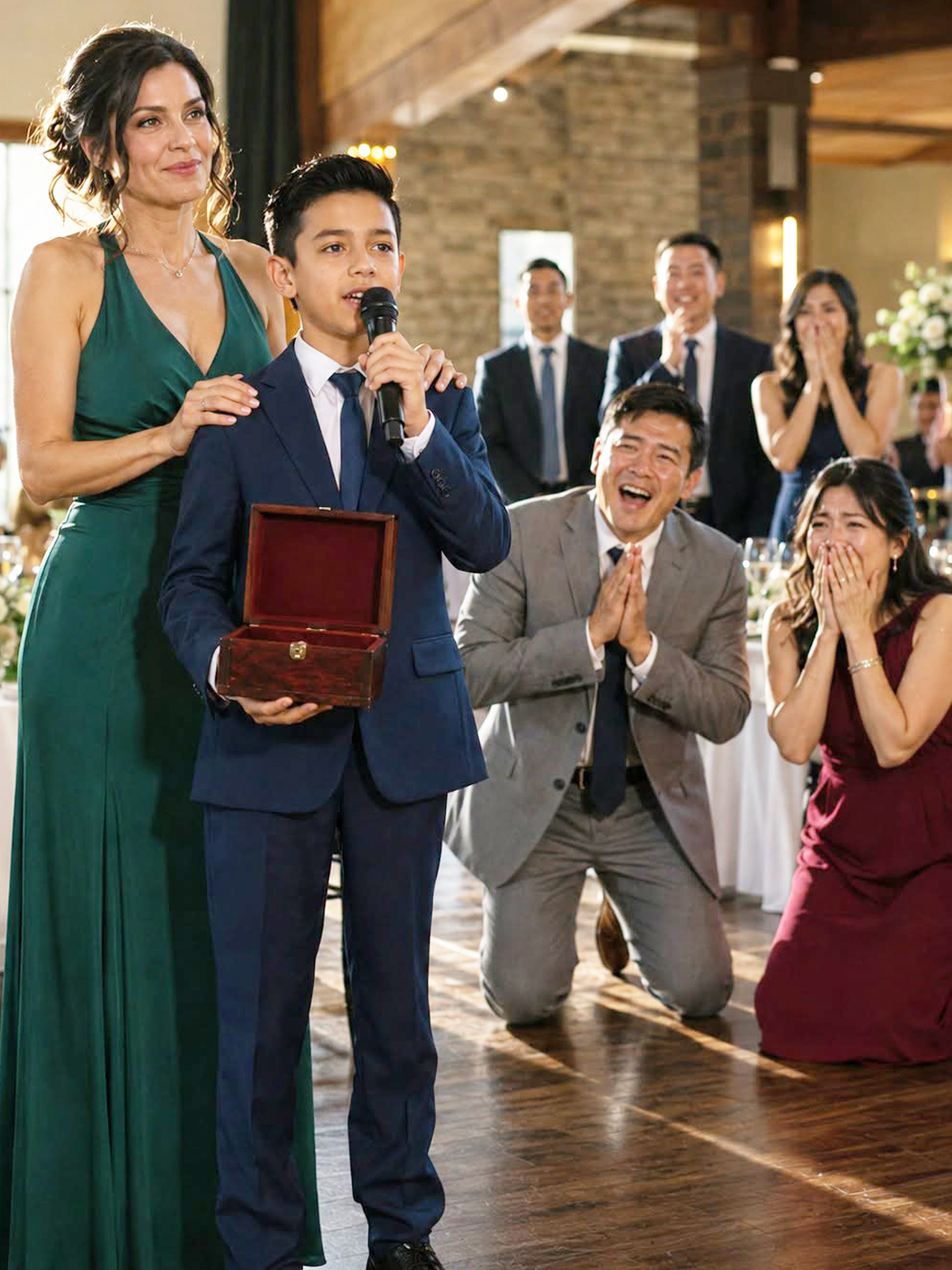
He reached out his hand, his fingers curling around the silver shaft of the microphone. His grip was firm and steady, showing no sign of the hesitation I felt in my own chest.
Daniel did not let go immediately, his grip tightening for a fraction of a second. He stared down at his son, a look of quiet warning passing over his features before he realized how it would look to the room.
The two of them stood in the center of the stage, locked in a silent tug of war that only those close enough could see. Nobody in the audience spoke, the tension stretching tight between the tables.
Madison took half a step forward, her high-pitched voice rising slightly as she spoke to the maid of honor. Her cheeks were flushed red under the heavy wedding makeup.
“Is this part of the program?” Madison asked, her eyes darting to her phone screen. She looked around the room for the wedding coordinator, her voice carrying a note of rising panic.
Nobody answered her. The silence in the ballroom had grown heavy, almost suffocating, as the guests realized this was not a planned toast.
Ethan kept his hand steady, his eyes locked on his father’s face until Daniel’s fingers finally uncurled. The transition was silent and complete.
The microphone slid into Ethan’s palm, small against his wrist but held with absolute certainty. He pulled it close to his chest, taking a slow, deep breath.
Daniel stepped back, his hands going into his pockets as he tried to look like an encouraging, indulgent father. He nodded slowly at the crowd, attempting to signal that everything was under control.
“Go ahead, son,” Daniel said, his voice unamplified now, thin and dry. “Tell them what you’ve got.”
Ethan turned slowly to face the two hundred people sitting in the dimness of the country club. He looked small against the vast backdrop of the ballroom, but his posture did not waver.
He did not look at me, and he did not look at his grandmother. His focus was entirely on the room in front of him, his expression calm and determined.
He reached into his jacket pocket, his fingers finding something small and metallic before he stopped. He pulled his hand back out, empty for now, and adjusted his grip on the microphone.
A low, sharp squeal of feedback rang through the high-ceilinged ballroom, making several people in the front row wince.
The high-pitched hum died away, leaving only the sound of Ethan clearing his throat. He stood beside his father on the raised platform, his twelve-year-old shoulders square under his navy blue blazer.
Daniel reached out a hand, his palm flat and his fingers twitching, trying to take the microphone back with a tight, public smile. Ethan did not let go of the metal stand.
“I brought something to show everyone,” Ethan said, his voice deep and clear through the black speakers hanging from the high rafters of the ballroom.
He set the brown paper package on the wooden lectern, the dry paper scraping against the polished oak. He pulled the thick packaging tape off with a sharp rip that sounded like a dry branch snapping in the quiet room.
The heavy brown paper fell away to reveal a cherrywood box with polished brass corners.
Daniel adjusted his gold cufflinks, his fingers moving fast and frantic. “Ethan, buddy, we have a tight schedule tonight with the band starting in five minutes.”
Ethan did not look at him. He opened the brass latch of the cherrywood box, the small click carrying over the sound system.
He lifted out the silver wristwatch, holding it by the leather strap so the polished steel casing caught the light of the chandeliers.
The silver band threw a small, dancing white reflection across the linen tablecloth of table seventeen, where I sat with my hand pressed against my collarbone.
“My grandfather, Thomas, left this to me in his will,” Ethan said into the microphone. “He wrote a letter inside the cherrywood box lid, and he asked me to read it when I was old enough to understand.”
He took out a folded sheet of yellowed paper, unfolding it with one hand while holding the microphone close to his chin.
“My grandfather wrote that a watch does not just tell you what hour of the day it is,” Ethan read, his voice steady and formal, the exact tone of my father-in-law when he used to sit at our kitchen table.
He paused, his right foot tapping a slow, rhythmic beat against the stage floor.
“He wrote that time is the only thing we have that we cannot buy back with all the money in Dallas,” Ethan read. “He wrote that time is the ultimate gift of love you give to the people who actually matter to you.”
He looked down at the paper, then directly at the head table where Madison sat.
“He gave the watch to me because he said I was the only one in the family who already understood that.”
Daniel shifted his weight, his black patent leather shoes squeaking against the varnished wood of the stage. He looked toward the front tables where his senior law partners sat, his practiced smile beginning to slip.
“We all know Thomas was a sentimental man,” Daniel said, his voice boisterous but thin as he leaned toward the microphone. “But we should probably let the guests get back to their drinks.”
Ethan did not move an inch. He set the letter down and reached back into the brown paper wrapping, lifting out a heavy, black-bound scrapbook.
“My father told everyone here tonight that his past was just baggage he had to leave behind,” Ethan said.
He opened the first page of the scrapbook, the heavy cardstock making a dry, heavy rustle against the wooden lectern.
“I kept a record of the baggage,” Ethan said.
A woman at table four put her wine glass down, the stem clinking sharply against her salad plate.
“This is April fourteenth,” Ethan said, his voice flat. “My tenth birthday. The cake was chocolate, and my mother bought it with the grocery money. We waited until eight o’clock for him to arrive.”
He turned a page, the sound magnified by the microphone.
“This is June second,” Ethan continued. “The district championship baseball game at the park. There is an empty space in this photograph where we saved a seat on the third row of the bleachers.”
Daniel took a half-step forward, his hand twitching toward Ethan’s shoulder, but Eleanor stood up from our table in the back.
She did not walk toward the stage, but she raised her chin, her palm pressed flat against her white hair as she stared at her son with a cold, quiet intensity.
Daniel stopped, his arm falling back to his side, his face turning a dark, blotchy red.
“This is September ninth,” Ethan said, turning another thick page. “The Friday night of the weekend he was supposed to pick me up for our trip to the lake. My mother worked a double shift at the medical clinic to cover the rent, and I sat on the concrete bench in the courtyard until nine o’clock.”
He turned three more pages in steady succession, the white paper edges catching the stage lights.
“These are the child support ledger pages from the county clerk,” Ethan said, pointing to the blue columns pasted on the black paper. “Seven of them are marked late. Three of them are blank.”
At the front table, Madison sat perfectly still, her phone held halfway to her face, her eyes wide as she stared at the stage.
Ethan looked directly at her, then back to the room of defense attorneys and corporate partners.
“My father told you my mother kept me from him,” Ethan said.
The ballroom was so quiet I could hear the low hum of the air conditioning vents in the ceiling and the distant clink of a spoon in the kitchen.
“She never did,” Ethan said, his voice rising slightly but remaining perfectly calm. “She was the one who bought the baseball gloves. She was the one who drove the old Buick with the bad transmission. She stayed up until midnight helping me with my science projects after working nine hours at the front desk.”
He turned to look at Daniel, who stood with his chin tucked into his collar, his fingers gripping his gold cufflinks so hard his knuckles were white.
“You were laughing at the person who picked up all the pieces he left behind,” Ethan said.
The line landed in the room like a heavy weight, the words hanging in the warm air above the linen tables.
Daniel tried to speak, his mouth opening, but no sound came out.
Ethan closed the scrapbook with a firm, solid thud that the microphone carried to every corner of the ballroom.
“I don’t need a father who only remembers I exist when there is a photographer in the room,” Ethan said.
He reached up and set the black microphone back into its silver clip on the lectern.
The silence that followed was heavy and absolute, stretching from the crystal chandeliers down to the plush green carpet.
Ethan picked up the cherrywood box in his left hand and the heavy black scrapbook in his right, cradling them against his chest.
He walked down the three wooden steps of the stage, his black dress shoes making a rhythmic, quiet sound on the carpet.
I stood near table seventeen, my bare ring finger raw from where I had been rubbing it, my hand gripping the back of an empty chair.
Eleanor stood right beside me, her breathing shallow, her eyes fixed on her grandson as he crossed the floor.
None of the law firm partners looked at Daniel now; they stared down at their half-eaten cake or their water glasses, suddenly very interested in their silverware.
Ethan did not look back at the stage where his father stood alone under the spotlights.
He walked straight past the ice sculpture of the two swans, his head held high, directly to the bridal table.
Madison sat rigid in her white silk dress, her hands clasped tightly in her lap, her face pale under the heavy reception makeup.
Ethan stopped right in front of her, his shadow falling across her gold-rimmed plate.
Without saying a single word, he set the heavy black scrapbook down on the white linen, right between her silver dessert spoon and her tall glass of champagne.
On top of the scrapbook, he placed the open cherrywood box, leaving the silver wristwatch shining under the bright ballroom lights.
Our exit from the ballroom was quiet, the heavy double doors swinging shut behind us with only a soft whoosh of air that smelled faintly of prime rib and expensive perfume.
We walked down the long carpeted hallway toward the brass-trimmed exit doors, our footsteps completely muffled by the thick green wool beneath our shoes.
The hallway was lined with oil paintings of the golf course, their gold-leaf frames catching the low light of the brass sconces.
Eleanor was waiting by the umbrella stand, her beaded evening bag clutched against her lace dress with both hands.
She did not say a word as we approached, but she stepped directly into Ethan’s path and reached out her arms, her diamond rings catching the light.
Ethan stopped and let his grandmother pull him into a tight embrace, his shoulders finally losing some of their rigid posture as he buried his face in her shoulder.
Eleanor rested her cheek against his hair, her shoulders shaking with quiet tears of pride and relief that she didn’t try to hide from us.
“You have your grandfather’s heart, Ethan,” she whispered, her soft Texas drawl thick with emotion as she held him close.
I stood back, my hands folded over my purse, watching the two of them under the bright chandelier of the empty lobby.
She looked up at me over his shoulder, her palm patting her white hair in that familiar, distressed gesture she always made when she was overwhelmed.
“I am so sorry, Rachel,” Eleanor said, her eyes rimmed with red and her mascara slightly smudged at the corners.
“You don’t have to apologize for him, Eleanor,” I said, choosing each word with deliberate care.
“I wanted him to know the truth, but I never imagined he would have to stand up like that,” she said, releasing Ethan but keeping her hands on his shoulders.
She looked down at him, her fingers brushing a speck of gray lint from the lapel of his small black suit jacket.
“Your grandfather would have stood up just like that, with the exact same look in his eyes,” she said.
Ethan nodded once, his expression solemn as he looked back at her, his right foot tapping a quiet rhythm against the tile.
“I just wanted to give him his book back so everyone could see it,” Ethan said, his voice flat and direct.
Eleanor squeezed his hands one last time, her fingers lingering on his wrist where his bare skin showed beneath his sleeve.
“Go on home now,” she said, her voice dropping to a gentle murmur. “You’ve done enough for one night, sweetheart.”
She turned and walked back toward the ballroom doors, her head held high, though her steps were slower than they had been when we arrived.
We stepped out into the cool October night, the humidity of the Gulf long gone, replaced by a sharp Texas autumn breeze that rattled the dry oak leaves along the driveway.
The parking lot was mostly dark, the long rows of luxury sedans reflecting the pale light of the tall security poles.
I was reaching into my black purse for the keys to the Buick when a shadow moved near the side of the country club building.
Madison was walking fast, her white satin train bunched up in one hand to keep it from dragging on the oil-stained asphalt.
She stopped about ten feet away from us, her phone still held tightly in her other hand, the screen dark.
“Rachel,” she said, her voice high and thin, completely stripped of the cold authority she had used on the phone three weeks ago.
I stood by the driver’s side door, my fingers wrapping around the cold metal of the key, my left ring finger rubbing the bare skin where my wedding band used to sit.
“We were just leaving, Madison,” I said, keeping my voice even.
She looked down at her white silk shoes, then back up at me, her face pale under the purple glare of the mercury vapor lights.
“I’m sorry if I believed things without asking questions,” Madison said, her rapid-fire sentences slowing down for the first time.
The silence stretched between us, filled only by the distant hum of the tollway a mile to the west and the wind through the pines.
Ethan stood by the passenger door, his arms crossed over his chest, watching her without any anger on his face.
“He told me you blocked him from every birthday and holiday,” Madison said, her eyes shifting toward the dark clubhouse behind us.
“I have the blue child support ledger in the glove box right now if you ever want to see the dates,” I said.
She shook her head slowly, her expensive diamond earrings catching the pale light and throwing tiny reflections across her cheeks.
“I don’t need to see it,” she said, her voice dropping to a whisper. “I saw the scrapbook.”
She looked at Ethan, then back at me, her hands trembling slightly as she let go of her white satin train.
“He told me he spent every weekend trying to reach him,” she said, her voice cracking. “But the book has all the dates he was in Cabo and Aspen.”
“He was busy,” Ethan said quietly from the other side of the car. “But he told everyone we were the ones who didn’t want him.”
Madison didn’t answer, her eyes darting to the clubhouse windows where the music was still playing softly.
“I hope you have a good night, Madison,” I said, opening my door.
She turned and began the long walk back to the entrance, her white dress dragging slightly on the dark pavement.
I unlocked the Buick, the heavy door creaking as I pulled it open and the interior light flickered twice before staying on.
“Are you okay, Mom?” Ethan asked as he climbed into the passenger seat and buckled his seatbelt.
“I am,” I said, starting the engine.
The old car rumbled to life, the headlights cutting through the darkness of the country club parking lot.
We drove out past the manicured lawns and the stone gates without looking back at the lighted windows of the ballroom.
The digital clock on the dashboard showed eleven o’clock by the time we reached the highway exit near our neighborhood.
“Are you hungry?” I asked, looking over at his profile against the passing streetlights.
“A little,” Ethan said, his hand resting on his knee.
I pulled into the parking lot of the twenty-four-hour diner, the gravel crunching under the tires as we slid into a space near the door.
The neon sign in the window flickered in bright pink and blue, casting long colored shadows across the empty pavement.
We walked inside, the small brass bell above the door chiming to announce our arrival in the warm, brightly lit room.
The diner was quiet, with only an old man in a yellow trucker hat sitting at the far end of the counter, nursing a cup of tea.
We took a booth in the corner, our formal wedding clothes looking strange against the cracked brown vinyl of the seats.
The waitress, a woman named Betty who had worked there since I was in high school, brought us two glasses of water.
“You two look like you just came from a movie,” Betty said, setting down the plastic menus.
“Just a family gathering,” I said, offering her a small, tired smile.
“We have fresh apple pie,” she said, wiping her hands on her apron.
“Two slices, please,” I said.
When she walked away, Ethan leaned back against the high vinyl seat, his shoulders dropping another inch.
The quiet of the diner felt clean, a sharp contrast to the crowded ballroom and the loud whispers of Daniel’s colleagues.
“You did a hard thing tonight, Ethan,” I said, reaching across the table.
“He shouldn’t have said those things about you,” Ethan said, his voice direct and formal.
“I know,” I said, my fingers tracing the edge of my water glass.
“He thought nobody was keeping track,” Ethan said.
He looked out the window, his right foot tapping a slow, steady rhythm against the metal base of the table.
“Grandpa Thomas was right about the watch,” Ethan said.
“What do you mean?” I asked, watching his face.
“Time doesn’t belong to the person who makes the most money,” he said.
“He wanted me to have it because I was the only one who remembered the dates,” Ethan said.
“What dates?” I asked.
“The days he said he would come and didn’t,” he said. “The days you had to stay up late working because the child support check didn’t show.”
I looked down at the paper placemat, my throat tight as I realized how much he had carried in silence.
“You didn’t have to do that for me, Ethan,” I said.
“Yes, I did,” he said, looking me straight in the eyes. “Someone had to tell them.”
Betty returned with two thick slices of apple pie on thick white plates, steam rising from the golden-brown cinnamon crust.
We ate in silence, the tension of the last twelve weeks slowly leaving our shoulders with every bite.
For the first time in months, my mind wasn’t running through the utility bills or the calendar at the medical clinic.
We finished our pie, and I paid the four dollars and fifty cents at the register, the coins clinking in the metal drawer.
When we got back to the house, the porch light was casting a pale yellow circle on the front steps.
Inside, the kitchen was quiet, the laminate counter clean and empty where the invitation had sat for so long.
I set my purse on the counter and kicked off my heels, the cold linoleum feeling good against my tired feet.
Ethan went to the sink to pour himself a glass of water, his black suit jacket already draped over the back of a kitchen chair.
“We need to get some sleep,” I said, looking at the microwave clock.
It was half past eleven.
My phone, resting inside my purse, gave a short, double buzz against the leather.
I reached in and pulled it out, the screen lighting up the dark corner of the kitchen.
There was a text from Daniel’s number.
“I need to speak with you privately tomorrow,” the message read.
I stood there by the counter, holding the phone, looking at the words on the screen.
Ethan looked over from the sink, his glass held halfway to his mouth.
“Is it him?” he asked.
“Yes,” I said.
I did not reply to the message, but instead set the phone face down on the Formica table.
I walked over to the kitchen window and pulled back the thin yellow curtain.
From our window, I could see past our small backyard and the neighbor’s fence, all the way to the edge of the highway.
The warm glow of the diner’s neon sign reflecting in the dark window.
The white paper of the envelope was the only clean thing on the yellow Formica table at ten in the morning. Daniel sat with his hands flat on his thighs, his shoulders rounded forward in a way I had never seen in all our years in the Plano courthouse. He did not look at the copper salt shaker or the pencil marks on the pantry door frame where Ethan’s height stopped in August.
“I put the full amount in there,” Daniel said.
His voice was dry, stripped of the legal jargon he usually carried like a shield.
“Four thousand eight hundred dollars,” I said.
“Yes,” he said. “The bank teller cleared the transfer from my personal account before I drove over. You will not have to wait for it to clear.”
I did not touch the paper. The blue plastic child support ledger was still in the drawer behind me, its columns of empty lines finally answered by the figure written on the slip inside the envelope. This was the money that would cover the unpaid utility bills on my dresser and the grocery tabs I had kept on the back of old envelopes.
“You told Madison I was keeping him from you,” I said.
Daniel adjusted his collar, but his fingers slipped off the top button. He did not touch his gold cufflinks.
“I made you the villain because it made what I did easier to live with,” he said.
The clock on the wall gave its dry, plastic click as the minute hand dropped toward the half-hour.
“It was easier to tell Madison you were vindictive than to admit I was not showing up,” he said. “If she thought you were the one blocking the visits, she did not have to ask why I was spending my Saturdays at the office or on the golf course.”
He looked at the small tear in the vinyl seat of the chair he had sat in during our first year in this house.
“I did not want her to see me that way,” he said. “I did not want anyone at the firm to see it either.”
“They saw it anyway,” I said.
He nodded once, slowly. The bravado that had carried him through the country club ballroom was gone, leaving only the thin gray lines around his eyes.
“Ethan is twelve, Daniel,” I said. “He knows how to count the days.”
“I know,” he said.
He stood up without pushing the chair back, his leather dress shoes silent on the linoleum. He did not ask to see Ethan, and he did not ask me to tell Ethan he had been there. He simply walked to the screen door and let himself out, his steps slow as he crossed the gravel drive.
I sat at the table for a long time after the sound of his car faded. I took the check out of the envelope and ran my thumb over the signature. It was real, and it was signed on the correct line. I walked to the refrigerator and pulled down the blue ledger, writing the numbers in the final column before sliding the notebook into the desk drawer where we kept the spare lightbulbs.
With the child support paid, the weight that had sat on my shoulders since the divorce began to lift. I did not have to choose between the electric bill and the grocery list.
Three days later, the blue sedan pulled into the driveway at exactly twenty past five.
Ethan was already sitting on the porch steps, his leather glove resting on his knees and his baseball cleats tied in tight double knots. He did not stand up when the car stopped.
Daniel got out of the driver’s seat, his tie loosened and his white sleeves rolled up to his elbows. He stopped at the bottom of the wooden steps.
“I am twenty minutes late,” Daniel said.
Ethan looked at the silver watch on his left wrist, then back at his father.
“Twenty-two,” Ethan said.
“I did not leave the office when I should have,” Daniel said. “I did not plan for the lane closure on the parkway. It was my fault, and I am sorry.”
He did not offer an excuse about a client holding him up, and he did not blame the traffic lights. He stood there on the grass, waiting.
Ethan stood up, lifting his canvas gear bag by the strap.
“We have ten minutes before the coach starts the warm-ups,” Ethan said.
“Then we should get in the car,” Daniel said.
I watched from the kitchen window as the passenger door closed. The sedan did not roar down the street; it moved at the speed limit, its red brake lights glowing at the corner of the avenue before it turned toward the park.
The next afternoon at the medical clinic, Dr. Vance looked up from his chart when I walked into the file room.
“You look like you slept, Rachel,” he said.
“I did,” I said.
“We have the seasonal flu clinic starting next month,” he said. “I will need extra hours on the schedule if you want them.”
“Thank you, Dr. Vance,” I said. “But I think I will keep my regular hours for now.”
It was the first time in three years I could say no to an extra shift without calculating the cost of milk and gasoline.
On Friday evening, the kitchen was quiet except for the low hum of the refrigerator. We sat in silence for a moment, the hum of the kitchen refrigerator filling the space between us. It was the same refrigerator we had bought together when we first moved to Plano, back when we thought we had all the time in the world.
The shared parenting calendar was stuck to the freezer door with two round magnets from the medical clinic. Daniel’s initials were written in blue ink on every second weekend, the letters small and careful, without the grand flourishes he used on his law firm correspondence.
I had the brown paper package on the counter next to the bread box. Inside was the scrapbook Ethan had made, the one with the blank pages and the neat, typed dates of every missed Saturday.
Eleanor had called me from her house in Austin the night before.
“He is trying, Rachel,” she had said, her soft Texas drawl quiet over the line. “It is the first time in his life he has had to look at his own ledger.”
“I know,” I said.
“You could have sent that scrapbook to his managing partner,” she said. “Everyone at that firm would have seen what he did.”
“I kept it here,” I said.
“Thank you,” she said.
I hung up the phone and looked at the package. It was a record of cold facts, but it was also a record of the past. I carried it to the bottom drawer of the desk in the hall, sliding it behind the old tax folders and the manuals for the kitchen appliances. It did not need to be a weapon anymore. I chose to let go of my resentment, allowing Daniel to build a quiet, consistent relationship with Ethan on the baseball field.
Ethan came into the kitchen, his hair still damp from the shower. He took a glass from the cupboard and filled it with water from the pitcher.
“Did he call?” Ethan asked.
“He confirmed the pickup for Sunday morning,” I said. “Nine o’clock.”
Ethan took a slow drink, his eyes fixed on the blue marks on the calendar.
“He was on time yesterday,” Ethan said.
“He was,” I said.
“Grandpa Thomas used to say that people only give you their time when they have nothing left to hide,” Ethan said.
He set the glass down, the water rippling against the side.
“We are doing fine, Mom,” Ethan said, looking down at the steady hands.
The watch on his wrist was clean, the silver links catching the yellow light from the stove. It was too big for his arm, but he had refused to let me take any links out. He said he would grow into it soon enough.
At the school field on Saturday, the air carried the dry smell of Bermuda grass and the dust from the infield.
The sun was low behind the press box, casting long, thin shadows across the dirt. I sat on the third row of the aluminum bleachers, my sweater pulled tight against the late afternoon breeze.
Daniel was there.
He was not sitting in the front row, and he was not wearing his suit. He sat three sections away, on the bottom plank of the bleachers near the green equipment shed. He had a paper cup of coffee in his hand, and he did not look at his phone screen.
Ethan was standing near shortstop, his knees bent and his glove open as the coach hit ground balls.
Every time the ball cracked against the wooden bat, Daniel’s head moved, following the white speck as it flew across the grass. He did not shout encouragement, and he did not try to coach from the sidelines. He simply sat there, watching his son.
When the practice ended, the boys gathered near the dugout to pack their gear.
Ethan walked toward the bleachers, his face red from the heat and his gray pants stained with red clay at the knees. He stopped in front of me, his breathing shallow.
“Did you see the play at second?” he asked.
“I did,” I said. “You stayed right with it.”
Last Updated on August 19, 2026 by Robin Katra
He looked over my shoulder toward the bottom bench near the shed. Daniel was standing up, setting his empty paper cup in the wire trash bin. He gave Ethan a small, brief nod, then waited by the gate.
There was no grand speech, and there was no sudden family dinner scheduled. There was only the schedule on the refrigerator and the child support that paid the electric bill.
Ethan reached into his pocket and pulled out his batting gloves, tossing them into his canvas bag.
The silver wristwatch resting on Ethan’s wrist as he grips his baseball bat, its steady ticking quiet against the afternoon breeze.