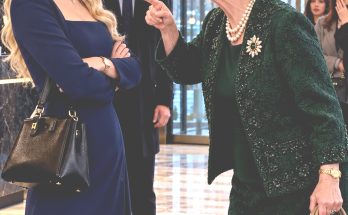
The soup spoon made a small, sharp click against the English porcelain. Richard did not look up from his plate, but his left hand rose, his heavy gold signet ring tapping twice against the edge of the mahogany table. The formal dining room of the marble mansion was cold, despite the fire burning in the hearth. The cold marble floor tiles under Adam’s leather shoes felt like solid ice through his thin socks. Diana sat perfectly straight, her silver hair catching the glow of the crystal chandelier, though her eyes remained fixed on the centerpiece of dried autumn leaves.
She smoothed her skirt with her palms down, a quiet movement that she repeated whenever the room grew too quiet. “We have carried you through three separate boutique funds, Adam,” Richard said, his voice flat and dry. “Each one returned less than four percent.” Adam adjusted the metal strap of his watch, sliding it a fraction of an inch up his wrist. He kept his shoulders back, refusing to lean toward his father. He preferred to use formal, measured sentences when the family gathered. “The market was down across the entire sector, Father,” Adam said. “The capital
remains secure.” “Secure is for retired widows,” Richard said, his voice cutting through the quiet room. “We require growth. More importantly, we require alignment.” A maid moved silently around the table, clearing the soup bowls with a soft clatter of porcelain against the heavy silver tray. She walked with her head down, avoiding eye contact with any of them. Richard reached into his breast pocket and pulled out a small black leather notebook, flipping it open to a page covered in tight, penciled figures. He did not let Adam see the numbers, but his thumb lingered on a column that had been heavily underlined in red. The suburban commercial development was not mentioned, but Richard’s hand remained tense.
“Your thirty-first birthday is on the twelfth of November,” Richard said, looking directly at him now. “That is exactly nine weeks from today.”
Adam watched his mother. Diana did not look at either of them, her fingers still lightly smoothing the pale blue silk of her skirt, palms flat against her thighs.
“The trust dictates that the principal remains under my control until you show a stable partnership,” Richard continued, tapping the signet ring once more against the mahogany. “If you are not married by the morning of your birthday, Gregory will execute the amendment.”
“An amendment,” Adam repeated.
“You will be removed from the estate entirely,” Richard said. “The shares will revert to the main holding company.”
The word holding hung in the warm air of the dining room. Adam looked at the heavy velvet drapes, then back at his father’s face, searching for some sign of a negotiation that had not yet begun. He had spent thirty years waiting for some indication that his parents saw him as more than a ledger entry.
“You are an investment, Adam, and we expect a proper return,” Richard said.
“And if I refuse to participate in this arrangement?” Adam asked.
Richard closed the leather notebook with a sharp snap. “Then you will find out how cold the wind blows when you do not have our coat.”
The next morning, the sun did not warm the mansion study, which smelled of lemon oil and old leather bindings. Diana stood by the French doors, holding a thick sheet of faded blue linen paper.
“The Henderson girl has just returned from her year in Geneva,” Diana said, her voice breathy and light, masking the absolute coldness beneath. “Her family has substantial holdings in the north suburb developments.”
Adam stood by the desk, his hand resting on the cold brass of the desk lamp. “I have never met her, Mother.”
“That is a detail of no consequence,” Diana said, turning to face him and smoothing her skirt with both palms down. “She understands what is expected of her. Her mother and I have already discussed the date.”
She held out the paper, her fingers steady. On it were six names, written in her elegant, sloping hand, each followed by a family net worth estimate.
Adam looked down at the list, feeling a familiar tightness in his throat. He adjusted his watch strap again. “Is this how you and Father decided on your own life?”
Diana smiled, a tiny movement of her lips that did not reach her pale blue eyes. “We did what was necessary to ensure we remained where we belong.”
“I will not marry a balance sheet,” Adam said.
“Then you will marry no one,” Diana said, her voice dropping to a whisper that carried across the quiet room. “And you will watch Gregory sign the papers that make you a stranger to this house.”
She set the list on the mahogany desk and walked out, leaving the scent of lavender behind her.
Adam picked up the paper, his fingers tightening until the faded blue linen sheets began to crease.
At noon, the gravel of the Lake Forest Country Club parking lot crunched under the tires of Richard’s black sedan. Richard did not turn off the engine, leaving the air conditioning to hum against the midday heat.
“The board is meeting on Tuesday,” Richard said, staring straight through the windshield at the green of the ninth hole. “They are asking questions about our liquidity.”
Adam looked at his father’s profile, noting the slight grayness in the older man’s cheeks that had not been there a month ago. “Is there a problem with the suburban development?”
Richard’s hand tightened on the steering wheel, his heavy gold signet ring catching the bright autumn sun. “There is no problem that cannot be solved by a demonstration of family solidarity.”
“You want me to marry for the board,” Adam said.
“Our partners expect a stable family man at the helm,” Richard said, his voice dropping to its usual commanding tone. “They do not trust a bachelor who lives in a downtown loft and plays with index funds.”
“I am thirty years old,” Adam said.
“And you have exactly nine weeks to prove you are one of us,” Richard said, shifting the car into gear. “Gregory has the documents ready. Do not make me ask you again.”
The car pulled away, leaving a small cloud of white dust over the manicured grass of the country club.
By ten that evening, Adam was back in his own apartment downtown. The loft was quiet, the only sound the hum of the refrigerator and the distant rumble of the elevated train three blocks away. He sat at his desk under the single light of a brass lamp.
A heavy leather-bound photo album lay open before him. It was a chronicle of his first twelve years, filled with stiff portraits and carefully staged holiday gatherings.
He turned the thick black pages, his fingers brushing the glossy edges of the photographs. Most of them showed him standing between his parents, always a foot apart, never holding hands.
On the fourth page, there was a square gap where a picture had been torn away, leaving only a few white fibers of paper glued to the black cardboard.
He leaned closer, squinting in the dim light. The glue marks showed the outline of a smaller, older photograph, the kind taken with a cheap camera rather than the professional portraits that filled the rest of the book.
He remembered the backyard pool from his childhood, the blue water glittering under the summer sun, but he could not remember who had been standing beside him in that missing frame.
He touched the empty space, his fingers tracing the torn edges.
The room was cold, the radiator knocking once before falling silent again.
Adam looked at the vacant space in his family photo album, wondering who took the picture of the backyard pool.
The silver fork clinked against the porcelain plate as Victoria Vance outlined the zoning variations of her family’s commercial properties in Naperville. She did not look up from her endive salad, her eyes scanning the printout she had laid beside her brass water goblet.
“My father says the retail strip on Route Fifty-Nine is poised to double its yield by the third quarter,” she said, tapping her manicured index finger against the linen table runner. “We are already negotiating the anchor leases for the adjacent lot.”
Adam adjusted his metal watch strap, the small clicks of the steel links lost beneath the low murmur of the dining room. He had not touched his ribeye, which had grown cold under the soft amber light of the chandelier.
“It sounds like a highly structured portfolio,” Adam said, keeping his voice even.
“It is efficient,” Victoria said, finally looking at him with eyes that seemed to calculate the square footage of the restaurant. “Marriage should be the same way, don’t you think?”
Adam did not answer, choosing instead to sip his sparkling water as the silence stretched between them.
The waiter cleared her plate, leaving only a single crumb of sourdough on the dark mahogany table.
“We should schedule a weekend in Aspen,” Victoria said, leaning forward to adjust her gold cuff. “Our parents have already discussed the lodge bookings for January, and it would look proper to be seen there together.”
“I have several trust audits to finalize before winter,” Adam said.
“Audits can be delegated,” she said, her voice dry and certain. “Your father told mine that you were looking to settle down before the fiscal year ends.”
Adam felt the metal strap of his watch pinch his wrist as he tightened it by one notch.
“Some things require a personal signature,” he said.
Victoria smiled, a brief, practiced movement of her lips that did not reach her eyes.
“Then we will find a date in February,” she said.
She began typing a note into her phone, her attention fully captured by the glowing screen.
Adam watched her fingers fly across the glass, wondering how much his father had promised her family in the secret suburban deal.
The afternoon sun cut through the heavy venetian blinds of his office the next day, casting long, gray bars across the mahogany desk. Gregory, the family attorney, cleared his throat and adjusted his wire-rimmed spectacles as he turned a page.
“Your father was very specific about the date, Adam,” Gregory said, placing a thick blue folder on the desk. “The terms are absolute.”
Adam looked at the label on the folder, which read *The Richard Vance Revocable Trust*.
“He has the authority to amend the distribution schedules at any time before November twelfth,” Gregory continued, his dry voice rustling like the paper under his hand.
“And if I do not comply with the marriage clause?” Adam asked.
Gregory cleared his throat again, a dry, raspy sound that filled the quiet room.
“The entire principal defaults to the foundation,” Gregory said, pointing a manicured finger at page forty-two of the document. “You will be removed as trustee and beneficiary.”
“It is a business contract,” Adam said, his voice flat.
“It is your inheritance,” Gregory corrected, leaning back in his leather chair and folding his hands over his waistcoat. “Your father believes a stable marriage is the cornerstone of family leadership.”
Adam adjusted his watch strap, feeling the cold steel slide against his skin.
“Richard is facing liquidity issues with the new suburban development,” Adam said, keeping his eyes on the paper. “He wants the Vance name associated with stability.”
Gregory did not deny it; he simply tapped his gold pen against his notepad.
“Your father’s personal investments are separate from the trust,” Gregory said. “But your compliance is not.”
“Is there any room for negotiation on the deadline?” Adam asked.
“None,” Gregory said. “He wants a signed marriage certificate on my desk by five o’clock on your thirty-first birthday.”
The attorney stood up, buttoning his charcoal suit jacket with slow, deliberate movements.
“Do not let pride cost you thirty million dollars, Adam,” Gregory said.
He walked out, leaving the blue folder open on the desk.
Adam stared at the signature line on the last page, where his father’s bold, black handwriting had already been dried for years.
The rain began as a light drizzle by the time Adam reached the brick pavement of the downtown district later that evening. He bypassed the white-tablecloth establishments and stopped outside a small cafe with a chipped wooden sign.
Inside, the air smelled of roasted beans and cinnamon.
Adam chose a corner table near the back, pulling his coat collar down as he sat.
A young woman with dark hair tied back in a loose bun was clearing a table near the window. She laughed at something an elderly customer said, her shoulders relaxing as she wiped the wood with a clean cloth.
Her warmth seemed to fill the narrow space between the tables.
Adam watched her carry a tray of empty mugs to the counter, her movements quick and unhurried.
She did not wear jewelry, and her simple blue apron was faded at the seams.
When a young mother dropped a toy spoon from a high chair, the waitress knelt instantly to retrieve it, washing it at the counter before returning it with a soft word.
The mother thanked her, her face reflecting a relief that Adam rarely saw in his family’s circle.
The waitress turned toward the kitchen, her eyes sweeping over the quiet dining area.
Adam looked down at his empty hands, his fingers resting on the edge of the laminate table.
He had spent three weeks meeting women his mother had selected, each encounter feeling like a prospectus review.
Here, the noise of the street faded behind the gentle clink of ceramic plates.
The waitress stepped behind the counter and spoke to the barista, her voice a low, pleasant melody that did not carry across the room.
She picked up a glass pot of water and a clean mug, turning her steps toward his corner.
The clock on the wall chimed nine times, the deep brass tone vibrating through the wooden floorboards.
The cafe had emptied, leaving only Adam and a student reading a thick textbook by the window.
The waitress approached his table, holding a fresh pot of dark coffee.
Before she set the mug down, she rolled her sleeves up to her elbows, revealing strong, pale forearms.
“Just coffee tonight?” she asked, her voice clear and direct.
“Yes, thank you,” Adam said.
She poured the coffee, the steam rising between them in a thin, fragrant cloud.
“You look like you’ve had a long day,” she said, offering a genuine smile that reached her eyes.
“I am trying to solve a puzzle,” Adam said, adjusting his watch strap.
She set the glass pot on a trivet at the corner of his table.
“Sometimes the pieces don’t want to fit,” she said.
“They fit,” Adam said. “But the picture they make is not one I want to look at.”
She rested one hand on the back of the empty chair opposite him.
“Is everyone in your world always playing a role?” she asked.
Adam looked up, surprised by the directness of her question.
“Most of them are,” he said. “They have spent their whole lives rehearsing.”
“That sounds exhausting,” she said.
“It is,” Adam said. “It makes me wonder if there is anyone who simply says what they mean.”
She smiled again, her expression softening.
“My name is Claire,” she said, extending her hand.
He took it, noting the strength in her grip and the lack of pretense in her touch.
“Adam,” he said.
“Well, Adam,” she said, drawing her hand back. “If you need more coffee, just let me know.”
She reached into her apron pocket, pulled out a small, plain white card with the cafe’s logo on the front and her hand-written name on the back, and laid it on the table.
“If you ever need a quiet place to think when we’re not so busy,” she said.
She walked back toward the counter, her apron strings swaying slightly as she moved.
Adam picked up the card, turning it over to see the neat, round script of her name.
The idea formed in his mind with the sudden clarity of a cold autumn morning.
He did not want Victoria Vance, nor did he want any of the other socialites his mother had cataloged on her cream-colored stationery.
He wanted a partner who was entirely outside their sphere, someone who would make the transaction so obvious that his parents could not pretend it was anything else.
He would offer her a contract, a straightforward exchange of financial security for one year of her time.
He stood up, leaving a twenty-dollar bill on the laminate table.
Adam walked out of the cafe into the cool night air, holding a business card with Claire name on it.
The card in his hand felt like a heavy weight, but twenty-four hours later, Adam was back in the same corner booth of the downtown cafe at nine in the evening.
Claire sat across from him, her sleeves already rolled up to her elbows. She set a single lemon cookie on a small, white saucer beside his steaming ceramic mug.
“My mother taught me how to bake these,” Claire said, wiping her hands on her blue apron. “They are the only sweet thing on the menu that sells out before noon.”
Adam did not touch the cookie. He adjusted his metal watch strap, tightening it by one notch against his wrist to quiet the rising unease in his chest.
“I am not here for dessert, Claire,” he said, his voice formal and measured. “I have a proposition that requires your absolute discretion.”
She pulled out the chair opposite him and sat down, her posture straight and her gaze direct. “I am listening.”
“My family operates under strict financial parameters,” Adam said. “If I am not married by my thirty-first birthday in November, I will be removed from my father’s estate. I require a wife for exactly twelve months.”
He paused, waiting for her to gasp or scoff, but she only watched him with quiet, clear eyes. The soft hum of the cafe refrigerator filled the space between them.
“The compensation is fifty thousand dollars,” Adam continued, his voice dropping to a whisper. “Half upon signing, and the remainder when the divorce is finalized. We both know exactly what this is, so let us keep it professional.”
Claire looked down at the lemon cookie, then back up at his face. “And what does this professional arrangement require of me?”
“You will have to meet my parents,” Adam said. “You will have to play the part of a woman who loves me, at least when their friends are watching. Can you do that?”
“I can play a part,” Claire said softly. “But you should know that I have a condition of my own.”
Adam tightened his watch strap again. “Name it.”
“I want the first payment in a certified check before we walk into any church,” she said.
He felt a sudden pinch of disappointment. He had hoped she might hesitate, showing some small sign that she was different from the transactional people his mother brought to dinner. But she had jumped straight to the numbers.
“The check will be ready tomorrow morning,” Adam said.
At three o’clock the next afternoon, the scent of boiled cabbage and old wallpaper hung in the narrow stairwell of Claire’s apartment building.
Martha sat at the small, laminate kitchen table, her hands folded quietly in her lap. Her grey hair was pulled back in a neat, simple bun, and her warm, slow eyes followed her daughter as Claire paced the linoleum floor.
“He is offering fifty thousand dollars, Ma,” Claire said, stopping by the window that looked out over the alley. “It is enough to pay off your medical bills and secure your rent for the next five years.”
“You are doing this for me,” Martha said, her voice a low, warm cadence. “But a marriage is not a lease, Claire. Even a fake one leaves a permanent mark on a person.”
“I want to know who he really is,” Claire said, leaning against the radiator. “If he is like Richard and Diana, he will treat me like a servant he bought for a year. But if there is any of the boy you used to tell me about left in him, he will find his way out of that family.”
Martha looked down at her folded hands, her face softening with a memory she did not share. “He was a very lonely child, Claire. He used to sit on the kitchen steps just to watch me pare apples because nobody else in that house had time for him.”
“Then we will see if the money has completely ruined him,” Claire said, picking up her coat from the back of a wooden chair. “The lawyer is waiting for us downtown.”
Martha reached out, her fingers catching Claire’s sleeve for a brief second. “Follow your heart, daughter. But do not lose yourself trying to save a boy who might not want to be saved.”
“I have the photo,” Claire said, patting her leather shoulder bag. “I will know when it is time to show him.”
At ten in the morning, the light in Gregory’s office was grey and sterile, filtered through high windows that overlooked the financial district.
Gregory cleared his throat, the sound dry and precise in the quiet room. He adjusted his spectacles and laid three copies of the marriage contract on the mahogany desk.
“This agreement is highly irregular, Adam,” Gregory said, his voice carrying the weight of thirty years of family secrets. “Your father would not approve of the financial waiver clauses.”
“My father does not need to see the private ledger,” Adam said. He sat perfectly still, his hands resting on his knees.
Claire sat beside him, her simple wool coat draped over the back of her chair. She had rolled her sleeves up to her wrists, exposing the pale, bare skin of her forearms.
Gregory slid a heavy black pen across the desk toward Claire. “Miss Kelly, you understand that by signing this, you waive all future claims to the family trust, the Lake Forest property, and any personal assets held by Adam?”
“I understand,” Claire said. She did not look at the pen. “I am only interested in the agreed sum.”
Adam felt a sharp prick of shame. He was buying a wife in a lawyer’s office, using his family’s wealth to secure his own inheritance. He was doing exactly what his father had always done, reducing human worth to a line item on a balance sheet.
“The first check is attached to the final page,” Gregory said, pointing a manicured finger at the document. “Twenty-five thousand dollars, drawn from Adam’s personal account.”
“Let us get on with it,” Adam said, his voice tighter than usual.
Gregory cleared his throat again. “Very well. Sign on the blue lines.”
The wind in the small park near the courthouse was cold, scattering dry maple leaves across the concrete pathways at noon.
They walked in silence until they reached a green iron bench near the empty fountain.
Claire stopped and unzipped her leather shoulder bag, pulling out the thick blue document Gregory had given them.
“We need to sign the witness page,” Claire said, her voice clear and calm.
Adam pulled a silver pen from his breast pocket and handed it to her. “This is the point of no return, Claire. Once the court registers this, we are legally bound.”
“I know,” Claire said. She leaned over the back of the iron bench, using it as a desk, and signed her name with quick, steady strokes.
She handed the pen back to him, her fingers brushing against his for a fraction of a second. Her hand was warm, despite the autumn wind.
Adam signed beneath her name, his signature formal and neat, the ink black and permanent.
“Our wedding is scheduled for next Tuesday at the registry office,” Adam said, capping his pen. “My parents will expect us to attend dinner at the estate immediately afterward.”
Claire did not answer. She reached into her leather bag and pulled out a small, white envelope, sliding the signed contract inside.
The envelope was worn at the edges, its surface slightly yellowed with age.
Claire places the signed contract into her leather bag next to a faded envelope.
The drive to Lake Forest took forty minutes, the autumn trees along the highway showing only bare, dark branches against a gray sky. Adam adjusted his metal watch strap as they walked up the wide stone steps of the mansion. He held the heavy oak door for Claire, who wore a simple blue cotton dress that reached just below her knees. Her leather shoes made no sound on the thick wool runner in the entrance hall.
Diana sat on the cream velvet sofa in the parlor, her fingers resting on her tea cup. Richard stood by the tall window, his heavy gold signet ring tapping against the mahogany sill.
“So this is the young woman,” Diana said, her soft, breathy voice barely carrying across the room. She looked Claire up and down, her eyes lingering on the plain hem of the blue dress.
“This is Claire,” Adam said, standing beside her. He adjusted his watch strap again, the metal clicking softly in the quiet parlor.
Diana did not stand up. She smoothed her skirt with palms down, a slow, deliberate movement that took several seconds. “Blue is a very practical color. It must be easy to clean.”
“It is,” Claire said, her voice direct and clear. “I find it works well for almost any day.”
Richard turned from the window, his gold ring catching the dull afternoon light. “The contract is signed then. Gregory confirmed the details this morning.”
“We are here to introduce Claire, Father,” Adam said, his sentences formal and measured. “We hoped to begin on a more personal note.”
Richard tapped his ring twice against the mahogany. “The terms are met. That is what matters for the estate.”
“Of course,” Diana said, her smile small and tight. “We must make sure everyone understands their place in this house, even if it is only temporary.”
“The arrangements are temporary, but the family expectations remain the same,” Richard said, walking over to the fireplace. He adjusted a small silver clock on the mantelpiece, setting it exactly to four o’clock.
“Claire has agreed to all the terms,” Adam said. “There should be no confusion about her role.”
Diana reached for her teacup, her fingers perfectly steady. “A role is a very easy thing to play when the reward is significant.”
“The coffee shop must have been very demanding,” Diana continued, looking at Claire’s hands. “All those hours on your feet, serving people you do not know.”
“It is honest work,” Claire said, her hands folded quietly in her lap.
“Honesty is a very flexible word in some circles,” Diana said, her voice dropping to a whisper. “We have found that people of a certain background often have very different definitions of what belongs to them.”
Adam shifted his weight, his formal composure slipping slightly. “Mother, there is no need for that.”
Diana took a sip of her tea and set the cup back on the saucer without a sound. “I am merely making an observation, Adam. One must be realistic about these things.”
“The coffee shop will not be a part of her life going forward,” Adam said, his voice tightening. “We have already discussed the transition.”
“Of course,” Diana said. “A change of clothes is easily managed. But other habits are harder to break.”
Richard looked at his watch. “The board members will expect to see you both at the club next week. I expect you to look the part, Claire.”
“I will do what is required,” Claire said.
“Good,” Richard said. “We do not tolerate non-compliance in this family.”
At five in the afternoon, Adam left the parlor to retrieve a folder of papers from his car. Claire walked out into the long marble hallway, where the portraits of past family business partners stared down from the paneled walls. The air in the hallway was cold, smelling of floor wax and lemon oil.
Diana stepped out of the parlor right behind her. She walked slowly toward a glass display case that housed her collection of antique silver spoons.
“It must be quite a shock to see a home like this,” Diana said, her breathy voice echoing slightly on the cold marble floor tiles.
“It is very large,” Claire said, her hands still folded quietly in front of her.
Diana stopped near a small mahogany side table. She reached up to touch her throat, where a thin gold chain sat. “One has to be so careful with beautiful things. I learned that lesson the hard way many years ago.”
Claire did not answer, but her shoulders went rigid.
“I used to keep my grandmother’s silver bracelet in the drawer right there,” Diana continued, pointing a manicured finger at the table. “Until we had to dismiss a housekeeper fifteen years ago. Some people simply do not have the breeding to resist temptation.”
Claire looked at the small drawer, her face pale. “Perhaps it was misplaced.”
“We do not misplace things in this family,” Diana said, smoothing her skirt again. “The woman took it. It was the only logical explanation for its disappearance, and we had to protect our reputation.”
“Did you find it later?” Claire asked, her voice very quiet.
“Of course not,” Diana said, her tone sharp for a fraction of a second before returning to its soft whisper. “Once a person of that class decides to steal, they do not bring things back. We had to let her go immediately, without a reference.”
“That must have been very hard for her,” Claire said.
“It was a necessary correction,” Diana said, turning back toward the parlor. “One cannot allow dishonesty to linger under one’s roof.”
“Did she have a family?” Claire asked, her eyes fixed on the antique side table.
“I never inquired,” Diana said, her back to Claire. “Their private lives do not concern us once their service is terminated.”
“I see,” Claire said.
“It is always a matter of character,” Diana added, her voice trailing off as she walked back into the parlor. “Some people simply do not have the breeding to resist temptation.”
Adam’s footsteps sounded on the stairs as he returned from the driveway, holding a black leather portfolio. He looked between the two women, sensing the coldness in the air but saying nothing.
By half past five, the shadows of the oaks stretched long across the manicured lawn. Claire walked out through the double glass doors of the conservatory and stood near the edge of the empty swimming pool. The blue tiles at the bottom of the pool were cracked in several places, green moss growing in the seams.
Adam found her there, her back to the house. She was looking down at the concrete patio surrounding the blue water, her arms crossed tight against her chest.
“My mother has a way of testing people,” Adam said, stepping up beside her. “You should not let her comments about the dress affect you.”
“It wasn’t the dress,” Claire said. She rolled her sleeves up twice, exposing her wrists to the cool autumn air.
“Then what is it?” Adam asked. “You look as though you are somewhere else entirely.”
“Just looking at the pool,” Claire said softly, her eyes fixed on the gray concrete near the deep end. “It is very quiet out here.”
Adam watched her profile, puzzled by her sudden distance. “She mentioned a housekeeper. It was an old family matter from when I was a teenager. I barely remember the woman, though I recall she left rather suddenly.”
Claire did not look at him. “Your mother seemed very sure of her story.”
“My mother is always sure of her stories,” Adam said. “She uses them to keep people at a distance. I wanted to protect you from that.”
“You don’t need to protect me from the truth, Adam,” Claire said. She kept her eyes on the concrete where her mother had once spent hot summer afternoons sweeping up dry oak leaves.
“I remember her a little,” Adam said, looking at the water. “She used to make lemon cookies on Fridays. My mother stopped that when she left.”
Claire’s hand moved to her side, where her purse hung. “She must have been very lonely after she was let go.”
“I suppose so,” Adam said. “But in this family, we do not discuss those who leave.”
“Is that why you wanted to marry me?” Claire asked, looking up at the high brick walls of the estate. “To find someone who would just follow the rules?”
“I wanted someone who was not part of their world,” Adam said. “I thought you understood that.”
“I do,” Claire said. “But their world has a very long reach.”
“We will not have to spend much time here,” Adam said. “Once the year is over, you will have your money and your own life.”
“And what will you have?” Claire asked.
Adam did not answer. He adjusted his metal watch strap, the quiet click of the metal the only sound between them.
“She used to sing when she worked out here,” Claire said, her voice almost lost to the autumn wind.
Adam looked at her, his brow furrowed. “Who did?”
“The housekeeper,” Claire said, her tone steadying. “In a house this size, it must have been very quiet without any music.”
“I don’t remember any singing,” Adam said. “My mother preferred the house to be silent during the day.”
“I’m sure she did,” Claire said.
At six o’clock, Richard called Adam into the library. The room smelled of old leather and pipe tobacco, though no one had smoked in it for years.
Richard sat behind the massive oak desk, his heavy gold signet ring resting on the green leather blotter. He did not invite Adam to sit.
“She is not what your mother had in mind,” Richard said, his voice flat and commanding. “A waitress from a downtown cafe is a disappointment to this family.”
“She is my wife under the law,” Adam said, his voice formal. “The agreement did not specify her social background.”
“It satisfies the letter of the agreement,” Richard said, tapping his ring once. “But do not expect us to pretend this is a real union. We will show her to our friends because we must.”
“I do not expect you to do anything other than respect the contract,” Adam said.
“We have a reputation to maintain, Adam. Especially now.” Richard looked down at a ledger on his desk, his brow furrowing slightly.
Adam noticed the corner of a bank statement sticking out from under the ledger, showing a red balance line. He adjusted his metal watch strap, the links clicking in the quiet room.
“We will be leaving before dinner,” Adam said.
“That would be best,” Richard said, not looking up. “Your mother has already had enough excitement for one afternoon.”
“I will see to it that Claire is ready for the rehearsal dinner next week,” Adam said.
“Make sure she is,” Richard said, his voice cold. “The board members will be watching us very closely. Any sign of instability could be costly.”
“I understand,” Adam said.
“You have always understood the business, Adam,” Richard said, finally looking up. “I expect you to remember what is at stake.”
Adam turned and walked out of the library, his leather soles clicking on the hardwood. He found Claire still standing by the pool, the sky turning a deep, bruised purple.
Claire stood by the pool, looking down at the concrete patio where her mother once worked.
At nine the next morning, the blue vinyl booth in the corner of the diner smelled of maple syrup and old grease. A low hum of conversation from two truck drivers at the counter rose over the sound of a rattling refrigerator unit. Adam watched Claire slide a paper napkin across the laminated table, her movements deliberate and calm. She rolled her sleeves up to her elbows before she sat down, her forearms bare and pale in the morning light.
“My mother wants to take you to the jeweler on Michigan Avenue,” Adam said, adjusting his metal watch strap to relieve the tightness. “She mentioned a platinum band with three diamonds.”
Claire shook her head, her gaze steady on the laminated menu. “Tell her no.”
“It is part of the appearance,” Adam said, keeping his voice formal and measured. “She expects a certain standard for anyone standing beside me.”
“I do not want any of your family jewelry,” Claire said. Her voice was flat, without any anger or pretense. “Or the luxury gifts she will try to buy to show off to her friends.”
Adam looked at her hands, which were clean and completely bare of ornaments. “The contract allows for these expenses, Claire. The trust pays for them, so they cost you nothing.”
“I want nothing from your family that does not belong to me,” she said.
She picked up her fork and turned it over, studying the small scratch near the tine. Adam watched her, trying to find the angle he had missed. Every woman his mother had introduced to him over the last three years had spoken of trusts and properties in terms of leasehold values, but Claire sat here as if the Connor family fortune were nothing more than a draft in an old room.
“They will think you are trying to make them look bad,” Adam said.
“They can think what they like,” Claire said. She looked directly at him, her blue eyes clear. “We agreed on a salary for my time. That is the only money I will touch.”
Adam looked at her hands, which were clean and completely bare of ornaments. “The contract allows for these expenses, Claire. The trust pays for them, so they cost you nothing.”
“I want nothing from your family that does not belong to me,” she said.
She picked up her fork and turned it over, studying the small scratch near the tine. Adam watched her, trying to find the angle he had missed. Every woman his mother had introduced to him over the last three years had spoken of trusts and properties in terms of leasehold values, but Claire sat here as if the Connor family fortune were nothing more than a draft in an old room.
“They will think you are trying to make them look bad,” Adam said.
“They can think what they like,” Claire said. She looked directly at him, her blue eyes clear. “We agreed on a salary for my time. That is the only money I will touch.”
Adam adjusted his watch strap again, the metal links clicking in the quiet booth. For nine weeks, he had worked under the assumption that everyone had a price, and that Claire had simply named hers quickly to escape her shifts at the cafe.
“My father will ask questions if you refuse the ring,” Adam said. “He believes every transaction must have a visible receipt.”
“Then let him ask,” Claire said.
She laid the fork down beside her paper napkin, the metal making a small, sharp clink against the thick white plate.
At noon, the sun through the leaded glass windows of the country club lounge threw long, amber diamonds across the Persian rug. The air smelled of expensive leather, furniture polish, and the faint, sweet scent of pipe tobacco from the library next door. Richard sat in a green leather armchair, tapping his heavy gold signet ring against the mahogany armrest with a steady, rhythmic click.
“We will host the reception in the main ballroom,” Richard said, not looking up as Adam sat down across from him. “Your mother has already spoken to the catering manager about the menu.”
“Claire prefers a small ceremony,” Adam said, his voice flat.
“What she prefers is of no consequence to our guests,” Richard said, his voice dropping into its usual short, commanding delivery. “The public must see a proper wedding. We have three board members from the suburban development trust attending, and they expect stability.”
Adam tightened his grip on the leather folder in his lap. “The contract is signed, Father. The deadline is met, and the family will remain intact.”
“A signature on a piece of paper does not secure our standing,” Richard said. He tapped the ring twice more, his knuckles white. “A quiet, hasty wedding looks like an apology. We do not apologize to Lake Forest.”
“And if we refuse the ballroom?” Adam asked.
Richard leaned forward, his face hardening in the amber light. “Then Gregory will draft the amendment to the trust before five o’clock today, and you will find your own clients for the investment fund.”
The threat was not new, but the cold certainty in his father’s voice felt heavier than usual, like a door sliding shut. Adam looked past his father’s shoulder toward the golf course, where two men in beige trousers were walking toward the ninth green under the autumn sky.
“The club ballroom is available on the Saturday before your birthday,” Richard said. “I have already paid the deposit, and the invitations are at the printer.”
“I will tell Claire,” Adam said.
“See that you do,” Richard said, leaning back and picking up his financial journal. “And make sure she wears something that does not look as though it came from a clearance rack.”
By three in the afternoon, the air in Gregory’s third-floor office was warm and dry, smelling of old leather bindings and paper dust. The tall windows overlooked the gray stone library across the street, where the first leaves of October were gathering in the gutters. Gregory cleared his throat, a dry and precise sound, before he laid the three-page addendum on the desk between them.
The document sat on the green leather blotter, its white pages crisp under the brass desk lamp. Gregory picked up his silver fountain pen and laid it parallel to the margin.
“This is highly unusual,” Gregory said, looking over his half-glasses at Claire, who sat straight in her chair. “An estate waiver of this scope is typically drafted at the request of the family, not the incoming spouse. The Connor family trust is quite substantial, Mrs. Connor.”
“I am aware of its size,” Claire said. She sat with her hands folded quietly in her lap, her simple gray dress contrasting with the heavy walnut panels of the room. “And I want it in writing.”
“I am waiving any claim to the family estate, the residential properties in Lake Forest, and any future trust disbursements,” she added, her voice clear and without hesitation.
Adam turned to her, his brow furrowing. “Claire, the original contract already limits your inheritance rights. This is redundant, and it leaves you with no protection if the monthly payments are delayed.”
“The original contract leaves room for court challenges,” Claire said, keeping her eyes on Gregory instead of Adam. “I want it impossible for anyone to say I married Adam for his parents’ money. I want the waiver to be absolute.”
Gregory cleared his throat again, a soft rasp in the quiet office as he adjusted his spectacles. “From a legal perspective, Mrs. Connor’s concerns are valid. This addendum completely isolates the marriage contract from the family trust. It ensures that the marriage has no bearing on the distribution of the primary estate.”
“If Adam is disinherited, or if he inherits fifty million dollars, you receive exactly the sum specified in the monthly service agreement,” Gregory continued, sliding a thin finger down the page to point at the final clause. “Nothing more, nothing less. It is a total waiver of marital property rights.”
“Sign it,” Claire said.
She took the heavy silver pen from Gregory’s desk without hesitation. Adam watched her hand as she wrote her name on the bottom of the third page, her signature small, neat, and lacking any decorative flourishes.
“Now you, Adam,” Gregory said, sliding the paper across the mahogany desk.
Adam took the pen, his fingers feeling cold against the polished metal. “You are giving up a significant amount of security, Claire.”
“I have my own security,” she said, her voice quiet and even.
Adam signed the document, his watch strap clicking against the edge of the desk. He slid the paper back to Gregory, who placed it immediately into a thick manila folder labeled with the family name.
“Will this satisfy your father?” Gregory asked, his voice dropping its formal tone for a brief second as he looked at Adam.
“It will remove his primary argument,” Adam said.
“We shall see,” Gregory said, closing the folder with a firm snap.
At eight that evening, the cardboard boxes in Adam’s living room were stacked four high against the bare plaster wall. The apartment was quiet, save for the hum of the refrigerator and the distant rumble of the elevated train three blocks away. Claire knelt by the lowest shelf of the bookcase, her sleeves already rolled to her elbows. She took three heavy volumes on estate tax law and stacked them on a sheet of gray newspaper.
“You do not have to do this,” Adam said, sitting on the arm of the sofa. “The movers will be here on Wednesday morning. I can pay them to pack the library.”
“The movers charge by the hour,” Claire said without looking up, carefully lifting a stack of leather-bound biographies. “And they do not care if your pages get bent or if the spines are damaged.”
She wrapped a thick book with practiced, efficient movements, folding the corners of the newsprint with sharp, clean creases. Adam watched her hands, noting the steady, calm rhythm of her work, a complete lack of the nervous hurry that seemed to govern every person in his parents’ circle.
“Why did you sign the waiver today?” Adam asked. “Even Gregory thought it was unnecessary, and he is paid to be cautious.”
Claire paused, a roll of brown packing tape in her hand. “Because you still look at me as if you are waiting for the second bill to arrive.”
Adam shifted his watch strap, the metal links cold against his skin. “My family does not sign agreements without expecting a hidden clause. It is how I was raised to view partnerships.”
“I am not a partnership,” Claire said. She pulled a long strip of tape, the sharp sound tearing through the quiet room. “And I am not an investment.”
“I am beginning to see that,” Adam said.
He stood up and picked up a stack of small, green volumes from the side table. They were his grandfather’s journals, their gold lettering faded to a dull yellow, and he handed them down to her.
“Your father called my cell phone an hour ago,” Claire said, placing the journals at the bottom of the box. “He wants to know if my mother is attending the dinner on Friday. He said he needed to finalize the seating chart with the club manager.”
Adam felt a cold tightening in his jaw. “What did you tell him?”
“I told him she was busy,” Claire said. “She has no interest in country clubs, and she does not like crowds.”
“He will think she is being difficult,” Adam said. “He expects compliance from everyone.”
“Let him,” Claire said.
She reached for a chipped ceramic mug that sat on the corner of the desk. It was a simple thing, blue with a small white border, the handle slightly loose from years of use.
“This one does not go in the big box,” Claire said, looking up at him. “It will break if you let the movers handle it.”
“It is just an old mug,” Adam said.
“It is the only thing in this room that looks like it belongs to you,” she said.
Claire carefully wrapped the ceramic mug in newspaper, leaving the apartment tidy.
The drive to Lake Forest took forty minutes in the heavy autumn twilight. Adam watched the yellow leaves catch in the windshield wipers of his sedan, their wet stems clinging to the glass before being swept away. Beside him, Claire sat in her simple blue dress, her hands resting quietly on her lap. She did not speak, but her gaze remained fixed on the dark outline of the oak trees lining the highway. They had signed the papers in the park only hours ago, and already the weight of the contract seemed to fill the quiet space between them.
The tall wrought-iron gates of the estate stood open when they arrived, the gravel driveway crunching beneath the tires. Diana had insisted on a small rehearsal dinner, inviting six of their closest neighbors to fill the long mahogany table. The house was brightly lit, every window casting a sharp yellow square onto the cold marble terrace. It was an exhibition, Adam knew, designed to show the neighborhood that the family remained unified and prosperous despite the quiet nature of the wedding.
In the formal dining room, the scent of roasted duck and beeswax candles filled the warm air. Richard sat at the head of the table, his heavy gold signet ring tapping against the polished wood with a steady, impatient rhythm. He had not greeted Claire when they entered, choosing instead to discuss the autumn municipal bond yields with Mr. Gable, who sat to his right.
“The market is shifting,” Richard said, his voice carrying the short, commanding declaration that allowed no disagreement. “But those who plan ahead will always protect their assets.”
Diana sat opposite him, her smile perfectly straight. She wore three strands of heavy, luminous pearls that caught the light of the crystal chandelier above. Each pearl was perfectly round, selected from a jeweler in London during their anniversary trip five years ago.
Claire rolled her sleeves up twice before she sat down, her forearms bare against the white linen tablecloth. Diana watched the movement, her eyes narrowing for a fraction of a second before she smoothed her skirt with both palms down.
“We wanted to keep this intimate,” Diana said, her voice soft and breathy as she looked across the table. “Just a few people who have known Adam since he was a young boy. We felt a larger wedding might be overwhelming for you, Claire.”
“This is very nice,” Claire said, her voice even and clear.
A maid in a black uniform placed a silver tray on the sideboard, carrying a small, square box wrapped in grey paper. Diana reached for it and slid it across the table toward Claire, her fingers trailing over the polished mahogany.
“A small welcome to the family,” Diana said, her voice dropping to a near whisper. “Every bride in our circle deserves something classic for her wedding day. It has been a tradition in our family for three generations.”
Claire untied the grey ribbon with steady fingers. Inside the box lay a single strand of pearls, but they were small, unevenly matched, and lacked the deep luster of Diana’s own jewelry. The silver clasp was thin and grey, like cheap alloy that would tarnish before the year was out. It was a clear statement of her place in this house, wrapped in the guise of generosity.
Adam adjusted his metal watch strap, the links pinching his skin. He recognized the box from a discount jeweler near the train station downtown, a place where people bought gifts for schoolteachers and junior clerks.
“They are very light,” Claire said, lifting them from the velvet insert.
“We must show our friends that we are a welcoming family, regardless of the circumstances,” Diana said, her chin tilting upward as she met Claire’s gaze.
“Thank you,” Claire said, her voice even. She did not put them on, but laid them gently beside her water glass.
Diana turned to Mrs. Gable, her soft voice carrying easily across the silver candlesticks. “I had to be very careful with my jewelry selection tonight. Ever since that unfortunate business years ago with the silver bracelet, I keep the good pieces locked in the vault. One simply cannot be too careful.”
Adam looked down at his plate. He remembered the silver bracelet, a heavy piece with sapphire settings that his mother claimed had vanished from her dressing table fifteen years ago. He had always believed the housekeeper had taken it, just as his mother had said. He had felt a quiet disappointment in Martha back then, though he had been too young to understand the details.
“It is a shame,” Mrs. Gable murmured. “One expects honesty from those we employ.”
“Exactly,” Diana said, smoothing her skirt again. “Some people simply do not have the breeding to resist temptation.”
Richard cleared his throat and looked at his watch. “The caterers need to clear the plates by eight. We have a busy morning tomorrow at the country club.”
By eight o’clock, the guests had drifted toward the drawing room for coffee. Adam went to retrieve a glass of water from the pantry, taking the narrow service hallway behind the main stairs to avoid the crowd. The walls here were lined with portraits of ancestors he had never met, their painted eyes staring down in silent judgment.
Through the half-open door of the pantry, Diana’s soft voice carried clearly over the low murmur of the house.
“It is a very quiet affair,” Diana was saying to Mrs. Gable. “Her family is quite ordinary, of course, but we must make the best of it. One cannot choose who our children fall in love with, but we can manage the presentation.”
“Of course,” Mrs. Gable replied. “And the mother?”
“We did not think it necessary to burden her with a large social gathering,” Diana said. “She is a very private woman. Quite content to stay in her own sphere, where she belongs.”
Adam stood still in the dim hallway. The metal watch strap felt heavy on his wrist, a cold band of steel that offered no comfort. He had hoped, even after everything, that his mother might show some small sign of genuine grace for the sake of his future. Instead, she had reduced Claire’s family to a social inconvenience to be managed.
He turned back toward the drawing room, his shoes making no sound on the thick oriental rugs. He found Claire standing by the glass doors that led to the terrace, looking out at the dark swimming pool where the water reflected the stars.
“Are you ready to leave?” he asked.
“Your father wanted to speak with you in the library first,” she said.
They walked together down the wood-panelled corridor. The library was filled with the scent of old leather and pipe tobacco, though Richard had not smoked in ten years. Gregory, the family attorney, sat in one of the green leather armchairs, clearing his throat before he spoke.
Richard stood by the fireplace, holding a crystal tumbler of scotch.
“Sit down, Adam,” Richard said, his voice a brief, commanding declaration. He did not look at Claire as she entered, keeping his eyes on the amber liquid in his glass.
“We have an early start at the club,” Richard said, tapping his heavy gold signet ring against the marble mantelpiece. “The photographer arrives at eleven. The board members from the commercial development will be there for the reception.”
He raised his glass toward the two of them, his face tight with a practiced smile that did not reach his eyes.
“To the future,” Richard said. “A stable family is the foundation of every successful venture. I am glad to see my son is finally understanding his responsibilities.”
“The contract is fully executed,” Gregory said, looking up from his leather ledger. “All parties have signed, and the terms are set for the twelve-month duration.”
“Then we have nothing more to discuss tonight,” Richard said, setting his empty glass down with a sharp click. “Get some rest. I expect everyone to perform their roles perfectly tomorrow.”
Adam adjusted his watch strap again, the metal cold against his skin. “We will be there.”
Outside in the driveway, the autumn wind rustled the dry oak leaves along the gravel path. The air was cold enough to show their breath in the headlights of Adam’s car as he unlocked the doors.
They got into the front seats, the engine turning over with a low hum that filled the quiet night. Claire held the grey cardboard box in her lap, her fingers resting on the lid.
She opened the glove compartment, sliding the box into the far corner behind the leather car manual and the spare tire pressure gauge.
“You do not want to keep them with you?” Adam asked.
“No,” Claire said.
She closed the glove box door with a firm, quiet click.
The pearl necklace sits in the dark glove box, cold and unwanted.
The country club ballroom was mostly empty by six in the evening, the high plaster ceilings reflecting only the dim autumn light from the tall windows overlooking the sixteenth green.
Adam adjusted his metal watch strap, the cold links clicking against each other in the quiet space of the alcove where they had stood to say their vows.
The ceremony had lasted less than ten minutes, witnessed only by Gregory, the family attorney, who had cleared his throat twice before signing the registry as their legal witness.
Gregory had offered a brief, dry nod of congratulations before slipping the documents into his leather briefcase, his mind already on his evening commute back to the city.
His parents had already left for the dining room downstairs, their heels clicking sharply on the marble stairs as if they were escaping a tedious obligation.
Claire sat at the small round table near the piano, her simple blue dress looking slightly out of place among the heavy velvet draperies and the gold-leaf molding of the private room.
She rolled her sleeves up to her elbows before reaching for her glass of water, her movements deliberate and calm despite the silence of the empty ballroom.
“It is over,” Adam said, sitting in the chair beside her and looking at the blank registry page Gregory had left on the table. “We are legally husband and wife.”
“For twelve months,” Claire said, her voice even and clear in the large, echoing room.
“The business associates downstairs seemed satisfied with the announcement,” Adam said, looking at the double doors where his father had vanished ten minutes ago.
“Is that all this was for?” she asked, her glass resting against her palm.
“My father needed the appearance of stability,” Adam said, using his formal, measured sentences. “And I needed to secure my place in the firm before my thirty-first birthday next week.”
Claire set her glass down, the condensation leaving a wet ring on the white linen tablecloth.
“We should go,” she said.
“We have to say goodbye to my mother first,” Adam said, though he knew the gesture would be met with nothing but a cold nod.
“She is already in the main dining room with the charity committee,” Claire said. “She will not miss us, Adam.”
“You are probably correct,” Adam said, his fingers brushing the cold metal of his watch strap once more.
They walked out through the side entrance of the country club, avoiding the main lobby where the members were gathering for the Saturday night dinner.
The cool October wind met them at the glass doors, carrying the scent of damp leaves and the lake.
They did not speak on the way to the car, nor did they look back at the grand stone portico of the club.
The drive back to the city was quiet, the headlights cutting through the dark suburban roads before merging onto the interstate.
Adam watched the white lines on the pavement slip under the car, his mind returning to the contract they had signed only days before.
At ten that night, they stood in the narrow doorway of Adam’s downtown apartment, the key still turning in the lock.
The small hallway was silent, smelling of dry wood and the old leather books Adam kept on his shelves.
Claire did not step inside immediately; she stopped on the threshold, blocking the path with her small leather bag held tightly in both hands.
“Before we go in, I need you to make a promise,” she said, her voice dropping to a lower register.
Adam paused, his hand still resting on the brass door handle. “A promise about what, Claire?”
“Promise me that you will not react until I have finished explaining everything,” she said.
“That is an unusual request for a wedding night,” Adam said, his voice measured.
“Just promise me,” she said, her eyes steady as she waited in the dim light of the corridor.
“Very well,” Adam said. “I promise.”
She stepped past him into the quiet hallway, her heels clicking softly on the hardwood floor.
The apartment felt cold, the radiator in the corner clicking twice before falling silent again.
Claire set her bag on the wooden console table and turned to face him, her hands folded quietly.
“We need to talk about the contract,” she said.
“Is there a clause you wish to alter?” Adam asked. “Gregory can make the adjustments tomorrow morning if you feel the terms are unfair.”
“No,” Claire said. “The contract is exactly what it needs to be.”
“Then what is the difficulty?” Adam asked, hanging his coat on the brass peg by the door.
“It is not a difficulty,” Claire said. “It is an explanation.”
She walked into the living room, her movements slow as she took in the layout of the small space.
Adam followed her, turning on the brass floor lamp that cast a warm circle of light over the armchair.
By eleven, the small living room was dark except for that single circle of light, the city sounds outside muffled by the thick glass windows.
Claire sat on the edge of the sofa, her leather bag resting on her knees as she opened the brass clasp.
Her fingers moved slowly as she reached inside the zippered compartment, bypassing her wallet and keys.
She pulled out a faded blue paper envelope, its edges worn soft from years of handling.
“Do you remember the photo album on your desk?” she asked, sliding the envelope out of her bag.
“The one with the missing picture,” Adam said, adjusting his watch strap again. “My mother told me it was lost during the remodel fifteen years ago.”
Claire did not answer; she simply opened the envelope and pulled out a small, square photograph.
She placed it on the wooden coffee table between them, sliding it toward him under the circle of lamplight.
The photograph showed a young girl with dark curls standing next to a tall, warm-faced housekeeper by a familiar concrete swimming pool.
Adam looked at the image, his eyes scanning the blue water of the Lake Forest mansion’s backyard and the brick pool house behind it.
“Where did you get this?” he asked, his voice dropping as he leaned closer to the table.
“It was in my mother’s drawer,” Claire said.
“Your mother had a photo of my family’s home?” Adam asked, looking up at her.
“She had a photo of you, Adam,” Claire said.
“I do not understand,” he said.
“Look at the girl in the picture,” Claire said, pointing a finger at the small child holding the housekeeper’s hand.
“That is you,” Adam said, the realization settling slowly.
“Yes,” Claire said.
The clock on the mantel chimed midnight, the deep tones echoing through the silent apartment.
Adam sat perfectly still, his gaze locked on the photograph of the woman whose quiet face he had not seen in fifteen years.
“My mother always kept it in her cedar chest,” Claire said, her voice dropping to a warm, slow cadence.
“Your mother,” Adam repeated, the words feeling heavy and unfamiliar in his throat.
“The woman your mother accused of stealing was my mother, Martha,” Claire said.
The silence that followed was sharp, the truth hanging in the air between them like a physical weight.
“Martha was your mother?” Adam asked, his formal phrasing slipping for the first time as he stared at the image.
“She raised you when your parents were in Europe,” Claire said, her hand folding quietly in her lap. “She is the one who stayed with you when you had the scarlet fever.”
Adam looked back down at the faded picture, his mind racing through the memories of his childhood in that cold marble house.
He remembered the cool washcloths on his forehead, the low voice singing in the dark hallway, and the sudden, silent disappearance of the only person who had ever made him feel safe.
“My mother told me she was fired for theft,” Adam said, his voice barely a whisper.
“She was fired because your mother lost her silver bracelet and needed someone to blame,” Claire said.
“And you married me to find out,” Adam said.
“I married you to see if you were like them,” Claire said. “Or if you still remembered.”
“You thought I was part of the lie,” Adam said.
“I did not know,” she said. “But I had to find out for her sake.”
“She never spoke of your parents with anger,” Claire said, her voice soft in the quiet room.
“But she spoke of you often,” Claire continued. “She wondered if the boy who used to sit by the kitchen counter had grown into a man who only cared about contracts.”
Adam looked at his watch, the metal strap suddenly feeling heavy and tight against his wrist.
“I did not know about the bracelet,” he said.
“I know,” Claire said. “But now you do.”
“What does she want?” Adam asked.
“She wants nothing from your family,” Claire said. “She only wanted her dignity back.”
Adam’s hand moved slightly as he touched the photograph.
The edges were indeed frayed, the blue paper of the envelope worn thin from years of waiting.
Adam stares at the faded photograph, recognizing the warm face of the woman who held his hand when he was sick.
The grandfather clock in the corner of the study chimed nine times, its heavy brass weights swinging slowly behind the leaded glass.
Diana sat at the writing desk near the tall window, her fingers holding a silver-plated pen as she addressed thick cream envelopes for the upcoming winter gala.
She did not look up when Adam entered the room, though her palms smoothed the front of her gray wool skirt in a slow, downward gesture.
“I assumed you would be at the office by now,” Diana said, her voice carrying that soft, breathy quality that masked the coldness beneath.
Adam did not sit in the leather chair across from her, preferring to stand near the edge of the mahogany desk.
He held the faded photograph Claire had given him the night before, the paper dry and slightly curled at the corners.
He laid it down on the green leather blotter, directly over the address she had just finished writing.
“This was taken fifteen years ago by our pool,” Adam said, his sentence measured and formal.
Diana’s pen paused a fraction of an inch above the paper, the black ink shining under the desk lamp.
She looked at the image of the young boy holding the housekeeper’s hand, but her expression did not soften.
“We do not keep old payroll records in this room, Adam,” she said, her voice remaining perfectly level as she set the pen down on the brass tray.
“You told the police she stole your silver bracelet,” Adam said, his fingers reaching down to adjust the metal strap of his watch. “You told the neighbors, and you told the agency that sent her.”
Diana stood up, her skirt falling into perfect, unwrinkled lines as she faced him.
“We did what was necessary to preserve our family name, Adam.”
“By accusing an innocent woman of a felony?” Adam asked.
“Martha was a domestic employee who had become far too familiar with our private matters,” Diana said, turning to look out the window. “She was filling your head with absurd ideas about how we lived.”
“She was the only person who stayed in my room when I had the scarlet fever,” Adam said.
“She was paid to be in this house,” Diana said, her eyes cold as she watched the gardener clear dry leaves from the lawn. “When an employee begins to think they are irreplaceable, it is time for them to leave.”
“The bracelet was never stolen,” Adam said.
Diana’s hand rose to touch her pearl collar, her fingers turning the small beads in a slow circle.
“A household like ours requires absolute order, and sometimes that order requires a clean break.”
“You ruined her name,” Adam said. “She spent fifteen years working in a diner because no one else in Lake Forest would give her a reference.”
“She was a servant, Adam,” Diana said, her breathy tone drying to a whisper. “Servants are replaceable. Our reputation is not.”
“And the truth?”
“The truth is whatever maintains the stability of this house,” Diana said, turning back to her desk. “Your father has enough to worry about with the suburban commercial development. I will not have you upsetting him.”
“I spoke with Gregory yesterday,” Adam said.
“Gregory is our attorney, and he understands the value of discretion,” Diana said, her hand smoothing her skirt once more. “He knows that some details of family history are best left undisturbed.”
“He knows you lied, Mother.”
Diana’s eyes did not waver, but her fingers pressed slightly harder against her wool skirt.
“Gregory knows how to protect our assets, which is what you should be doing instead of wasting your morning on a fifteen-year-old grievance.”
At ten o’clock, Adam walked out of the study and into the wide marble hallway.
His father, Richard, was coming down the grand staircase, his leather soles clicking sharply against the marble steps.
Richard wore his charcoal wool suit, his heavy gold signet ring catching the light from the clerestory windows above.
“I heard your voice from the stairs,” Richard said, his short, commanding bark echoing in the high space. “Your mother has a great deal of work to finish before the country club luncheon tomorrow.”
Adam stopped at the base of the stairs, the photograph still held in his right hand.
“Mother falsely accused Martha of theft fifteen years ago,” Adam said.
Richard stopped on the third step from the bottom, his hand resting on the polished mahogany banister.
He tapped his signet ring twice against the dark wood.
“That is an old matter, and it is closed,” Richard said.
“It is not closed for Martha,” Adam said. “And it is not closed for Claire.”
Richard’s eyes narrowed, his gaze shifting to the photograph in Adam’s hand.
“Your wife is the daughter of a former housekeeper,” Richard said, his voice dropping to a low, hard register. “You brought her into this family under a contract that Gregory prepared to secure your inheritance.”
“I married her because she is different from everyone in this house,” Adam said.
“She is different because she has nothing,” Richard said, stepping down onto the marble floor. “Dragging up this nonsense about a missing bracelet will ruin our social standing. The board expects absolute stability from the family that manages their assets.”
“The board expects honesty,” Adam said.
“The board expects returns,” Richard said, tapping his ring against the banister again. “If you think your partners will care about a fifteen-year-old employment dispute, you are far more naive than I thought.”
“It was not an employment dispute,” Adam said. “It was a deliberate lie to cover up Mother’s mistake.”
Richard took a step closer, his breath smelling of black coffee.
“We do not use that word in this house,” he said.
“A lie is a lie, Father.”
“A family is a business, Adam,” Richard said, his eyes drilling into his son’s. “We protect our brand. If you cannot understand that simple rule, you have no business managing our investments.”
By eleven o’clock, the wind had grown colder, chasing dry maple leaves across the gray gravel of the driveway.
Richard’s black sedan was waiting near the stone steps, its engine idling with a low, steady thrum.
Richard stood by the rear door, his heavy cashmere overcoat buttoned to his chin.
“You will drop this matter immediately,” Richard said, his voice cutting through the wind.
Adam stood on the gravel, his hands deep in his coat pockets, his fingers tracing the cold edges of his office keys.
“I am going to tell the board the truth,” Adam said.
Richard’s hand clamped onto the door handle of the sedan, his gold ring dull in the gray autumn light.
“You think the board will side with you?” Richard asked, his voice low and dangerous. “They have millions of dollars tied up in our commercial developments. They do not care about a missing bracelet from fifteen years ago.”
“They will care about the integrity of the people managing their funds,” Adam said.
“They care about their dividends,” Richard said, stepping closer. “They care about the name on the door.”
“The name on the door is built on a theft,” Adam said.
Richard’s face went rigid.
“If you say one word of this to anyone outside this family, I will remove you from the trust before the banks close today,” Richard said.
“You would disinherit your only son to keep a fifteen-year-old lie quiet?” Adam asked.
“I would do it to protect the firm,” Richard said. “You will have nothing, Adam. No trust, no office, and no future in Lake Forest.”
The wind whistled through the iron gates at the end of the drive.
“Claire does not care about your money,” Adam said, his fingers tightening on the keyring in his pocket.
Richard let out a short, harsh laugh that died instantly in the wind.
“She is a waitress from the city, Adam. She signed that contract because she wanted a share of what we have. The moment you are cut off, she will walk away.”
“You do not know her,” Adam said.
“I know what people do when the money runs out,” Richard said, opening the car door. “Tell her you are penniless. See how long she stays.”
He got into the back seat, and the driver closed the door, the heavy latch clicking shut with a solid, metallic sound.
Adam stood on the gravel as the sedan pulled away, its tires crunching on the stone as it disappeared past the iron gates.
He looked up at the massive marble facade of the mansion, the cold windows reflecting the gray sky.
He walked slowly up the wide stone steps.
He pulled his hand from his pocket, holding the brass keyring that gave him access to the family offices on LaSalle Street.
He laid the keys down on the cold stone of the balustrade, where they sat small and silent.
He turned and walked down the steps, his shoes crunching on the gravel as he headed toward the road.
He got into his car, the engine starting with a low growl that seemed to vibrate through the steering wheel. He did not look back at the stone balustrade or the heavy oak doors of the mansion.
By the time he reached his own apartment downtown, the dashboard clock read twelve.
Claire was sitting at the small dining table, sorting through a stack of utility bills. As Adam entered, she stood up and immediately rolled her sleeves up to her elbows.
“They will not change their minds,” Adam said, his voice flat. He reached down to adjust the metal strap of his watch, tightening it by a single notch.
“My father made it quite clear.”
Claire set the mail down on the wooden counter. “And what did you tell them?”
“I told them the truth about your mother,” Adam said.
Claire looked at him for a long moment, her expression soft but searching. “You know what this means for the contract. The money my mother needs for her retirement, the security we agreed upon. If you walk away, there is no trust fund to pay it.”
“I know,” Adam said, walking over to the window. “But I would rather have nothing than live in a house built on a lie.”
Claire walked over to him, her steps quiet on the hardwood floor. “We do not need their money, Adam. My mother has her dignity, and that is what we are fighting for. We will find another way.”
The radiator in the corner hissed, a puff of steam rising into the cold air of the kitchen.
“My mother will never admit she lied,” Adam said, looking down at his hands. “She has spent fifteen years pretending she is perfect.”
“Then we must make her face it,” Claire said.
“They think I will stay quiet to protect the inheritance,” Adam said. “They believe the money is the only thing that matters to me.”
“We will show them that they are wrong,” Claire said.
At three in the afternoon, the rain began to patter against the tall glass windows of Gregory’s downtown office. Gregory sat behind his mahogany desk, his spectacles sliding slightly down his nose as he cleared his throat.
“You understand the legal implications of this request, Adam?” Gregory asked, his voice carrying its usual dry, precise cadence.
“A formal waiver of inheritance is irrevocable once executed. Your father’s estate is valued in the tens of millions.”
“I am fully aware,” Adam said. He sat straight in the leather chair, his hands resting on his knees.
“I want the papers prepared today.”
Gregory tapped a fountain pen against his blotter, the rhythmic clicking sound filling the quiet room. He looked toward Claire, who sat beside Adam, her face calm.
“And you, Claire? As his wife under the current civil agreement, you are waiving any future marital claim to these assets as well.”
“I never wanted them,” Claire said simply.
Gregory cleared his throat again, a small, nearly imperceptible nod of approval softening his stern face. “Very well. It will take some hours to draft the formal deed of disclaimer. I will have it ready for signature by tonight.”
“We will return at eight,” Adam said.
By six in the evening, the apartment kitchen smelled of toasted bread and tea. Claire set two ceramic mugs on the table while Adam looked over a printed invitation to the annual country club autumn brunch, scheduled for the following afternoon.
“They expect us to be there,” Adam said, pointing to the gold-embossed lettering on the card. “My mother has already arranged the seating. She wants to show her friends that everything is perfect.”
“Then we should go,” Claire said, sitting down across from him. “But not to play our roles.”
Adam looked up from the card. “We expose it there. In front of the board members. In front of the people whose opinion she values more than her own son.”
“It is the only way she will ever face what she did to my mother,” Claire said, her voice steady. “She must see that her silence has a price.”
“We will bring the photograph,” Adam agreed. “And we will let them see the truth.”
“Will she admit the lie when everyone is watching?” Claire asked, her eyes fixed on his.
“We will find out tomorrow,” Adam said.
It was nearly eight when they returned to the quiet office building downtown. The corridors were empty, the cleaning crews starting their rounds on the lower floors. Gregory was waiting for them, a single green-shaded lamp illuminating the documents on his desk.
The papers lay in three neat stacks, the white linen pages looking cold under the lamp light.
“I have drafted the waiver as instructed,” Gregory said, sliding a heavy silver pen toward Adam. “Once you sign, the relinquishment is immediate and absolute.”
Adam looked at the line designated for his signature. The weight of thirty years of family expectation seemed to shrink down to a few drops of black ink. He picked up the pen.
Adam signs the waiver of his inheritance, sliding the document across the desk to Gregory.
The high arched windows of the Lake Forest Country Club dining room looked out over the rolling autumn golf course.
At the large corner table near the bay windows, Richard and Diana sat with several prominent board members.
Diana was laughing, her soft, breathy voice rising above the ambient hum as she patted the arm of Eleanor Sterling, the club president’s wife.
Richard was in the middle of a story, his heavy gold signet ring tapping against the polished mahogany arm of his chair as he gestured toward the green hills outside.
Adam stood at the entrance of the dining room, his metal watch strap tight against his wrist as he watched them.
Beside him, Claire wore her simple blue linen dress, her posture straight and her chin held high.
“Are you sure about this?” Adam asked, his voice low.
“My mother lived under that shadow for fifteen years,” Claire said, her voice calm. “It is time to let the light in.”
She did not wait for him to lead, stepping forward onto the thick green carpet of the dining room.
Adam followed, his hand resting on the small of her back as they navigated between the white-clothed tables.
The dining captain moved to intercept them, but Adam gave him a brief, firm nod that made the man pause.
As they approached the corner table, Diana’s laughter faded, her eyes tracking their arrival with a sudden, sharp intensity.
Richard stopped speaking mid-sentence, his gaze dropping to Claire’s simple shoes before rising to Adam’s face.
“Adam,” Richard said, his voice low and commanding. “We are hosting a private luncheon for the board.”
“We won’t take much of your time, Father,” Adam said, pulling out a vacant chair from an adjacent table for Claire.
Claire sat down, immediately rolling her sleeves up to her elbows before resting her forearms on the white tablecloth.
Eleanor Sterling smiled politely, but uncertainty flickered in her eyes as she looked at Claire’s plain dress.
“Diana, is this your new daughter-in-law?” Eleanor asked, her tone dripping with polite curiosity.
Diana’s palms went flat against her lap, smoothing her skirt with slow, rhythmic strokes.
“Yes, this is Claire,” Diana said, her breathy voice tight. “Though we did not expect them to join us today. Adam, perhaps you and Claire could wait in the grill room.”
“We have something to show you first,” Adam said, pulling out his own chair and sitting down next to Claire.
The waiter approached with two water glasses, but Adam waved him away with a brief motion of his hand.
Richard’s signet ring tapped twice against the mahogany table edge, a warning sound that only Adam truly understood.
“This is highly inappropriate, Adam,” Richard said, his eyes narrowing. “Arthur and Eleanor are our guests.”
“Arthur has known our family for thirty years, Father,” Adam said. “He was here when we lived in the old house on the ridge.”
“You have no standing here, Adam,” Richard said, his teeth clenched. “You left your keys on the balustrade. You are no longer an officer of the firm.”
“I know,” Adam said calmly. “And that is why I have nothing left to lose by telling the truth.”
Claire reached into her small leather shoulder bag and withdrew the faded photograph.
She placed it flat on the center of the table, sliding it past the crystal salt cellar until it rested directly in front of Diana.
The photograph showed a younger Martha, her arm wrapped protectively around a five-year-old Adam by the edge of the blue swimming pool.
Diana did not look down at the picture, her eyes remaining locked on Claire’s face.
“I believe you recognize the woman in the photograph, Mother,” Adam said.
Eleanor Sterling leaned forward, squinting at the image.
“Oh, is that Martha?” Eleanor asked, her voice filled with sudden recognition. “I haven’t thought of her in years. She was so wonderful with the children.”
“She was a thief, Eleanor,” Diana said softly, her voice cool and steady. “We had to let her go. It was a very difficult time for the family.”
“Martha never took a single thing from your house,” Claire said, her voice clear and carrying to the next table.
Richard slammed his palm down on the table, making the champagne flutes rattle.
“That is enough of this nonsense,” Richard barked. “Security can have you removed from these premises in two minutes.”
“Let her speak, Richard,” Arthur Sterling said, his brow furrowed as he looked at the photograph and then at Claire. “If there is some misunderstanding, we should know.”
“There is no misunderstanding,” Diana said, her breathy voice rising slightly in pitch. “The silver bracelet went missing from my vanity drawer. She was the only one who cleaned that room.”
“Some people simply do not have the breeding to resist temptation,” Adam said, repeating his mother’s old words back to her.
Diana’s eyes flared, her fingers digging into the fabric of her skirt under the table.
“You were a child, Adam,” Diana said. “You did not see the inventory reports. You did not see the empty box.”
“Neither did the police, because you never called them,” Claire said, leaning forward. “You just made sure every agency in the county knew her name.”
“The photograph proves nothing,” Diana said, her voice remaining soft. “Anyone can take a picture in a backyard. Martha was paid well, and she was dismissed for cause.”
“The cause was your pride, Mother,” Adam said. “You found the bracelet three days after you fired her, didn’t you?”
“That is an outrageous lie,” Diana whispered, her hand moving to touch the cheap pearl necklace she had given Claire the night before, which was notably absent from Claire’s neck.
“We did what was necessary to preserve our family name,” Richard said, his voice dropping to a harsh whisper. “And we will not have it dragged through the mud by a waitress.”
The heavy oak doors of the dining room opened again, and Gregory stepped inside.
He walked with a dry, precise gait, a black leather folder tucked firmly under his left arm.
The board members watched him approach, their interest now fully piqued by the arrival of the family’s personal attorney.
Gregory stopped at the head of the table, clearing his throat before he spoke.
“Good afternoon, everyone,” Gregory said, his voice flat and professional.
“Gregory, tell these people to leave,” Richard said, his face flush with dark color.
Gregory did not look at Richard; instead, he opened the leather folder and withdrew a single sheet of faded blue linen paper.
“I have the audited asset list from the estate valuation of six years ago,” Gregory said, placing the document directly over the photograph.
He pointed a dry finger to line forty-two of the inventory.
“Six years ago, during the transition of the trust assets, an itemized search of the master bedroom safe was conducted,” Gregory said.
He reached into his jacket pocket and pulled out a small velvet pouch, pouring its contents onto the paper.
A heavy silver bracelet with intricate engraved leaves slid across the document, stopping near Diana’s water glass.
“The bracelet was never stolen, and you knew it for fifteen years,” Adam said, his voice dropping into a cold, measured cadence.
The dining room seemed to lose its warmth as the board members stared at the shining silver object.
“You found it in your own jewelry box, Mother,” Adam said. “But telling the truth would have meant admitting you were wrong to the entire town.”
Diana stared at the silver bracelet on the table, her face pale as her friends looked away.
Richard stood up so fast his heavy gold signet ring scraped the edge of the glass dining table. He did not look at his wife, whose pale face remained fixed on the silver bracelet, nor did he look at the quiet board members who had suddenly found great interest in their water glasses.
“Out,” Richard said, his voice flat and low.
He pointed toward the carpeted archway leading to the main lobby of the country club. He did not wait for Adam or Claire to move before he turned and walked out, his stride short and stiff.
Adam adjusted his metal watch strap, the links cold against his wrist. His hand was steady as he reached down to help Claire with her chair.
“Are you ready?” he asked.
Claire rolled her sleeves up an inch, her eyes calm as she looked at the empty chairs around the table. “I have been ready for fifteen years.”
They walked together past the brass-framed oil paintings of former club presidents. Richard was waiting near the tall grandfather clock in the center of the lobby, his hands stuffed deep into his suit pockets.
“That was a very expensive performance,” Richard said as they approached.
Adam stopped three feet away from his father. “It was not a performance, Father. It was a correction.”
“You have nothing now,” Richard said, tapping his shoe against the polished oak floor. “I am calling the trust office before the bank closes.”
“The papers are already here, Richard,” a dry voice said from the shadow of the cloakroom.
Gregory, the family attorney, stepped forward, holding a black leather portfolio under his arm. He cleared his throat.
“I took the liberty of preparing the dissolution documents as you requested this morning,” Gregory said.
The attorney laid the portfolio on the marble reception desk. The receptionist had conveniently disappeared behind a side door, leaving the lobby empty save for the four of them.
Gregory opened the folder to reveal three copies of a single-page document. The title at the top read, Voluntary Relinquishment of Trust Beneficiary Status.
“If you sign this, Adam, the decision is irrevocable,” Gregory said, his voice dropping its usual dry edge. “You forfeit the Lake Forest property, the investment portfolio, and any future distribution from the estate.”
Richard watched his son, his face tight. “He does not have the courage to sign it.”
Adam reached into his inside pocket for his pen. It was a silver ballpoint his grandfather had given him for his high school graduation, heavy and cold.
“Where do I sign, Gregory?” Adam asked.
The attorney pointed a thick finger at the bottom line. “On the blue line, right there.”
Adam leaned over the desk. He did not hesitate. His signature was large, clean, and exact, just as he had been taught to write it at the academy.
He signed the first copy, then the second, and finally the third. The scratch of the pen on the thick bond paper was the only sound in the high-ceilinged room.
Claire stood beside him, her shoulder lightly touching his. She did not speak, but her presence was a quiet anchor.
Gregory took the pages back and blew on the ink. “The trust is officially amended. You are no longer an heir to the estate, Adam.”
Richard turned his back on them, looking out the tall glass windows toward the golf course. “Get off the property.”
The autumn air in the parking lot was cool, carrying the smell of burning leaves from the estates down the road. Adam walked with Claire toward his sedan, his keys clinking in his palm.
“Adam,” a soft, breathy voice called out from behind them.
Diana was hurried, her heels clicking rapidly on the asphalt. She had left her coat inside, and her shoulders were drawn up against the October wind.
She stopped near the rear bumper of Adam’s car, smoothing her skirt with both palms. Her face was pale, the makeup looking stark in the bright midday light.
“This is absurd,” Diana said, her voice shaking slightly. “We can settle this quietly. There is no need for such dramatic gestures.”
“It is already done, Mother,” Adam said.
Diana reached into her small leather handbag and pulled out a slim, gold-trimmed checkbook. “I can arrange a private account. Ten thousand dollars a month, directly from my personal allowance. You can live in the city, buy a place of your own.”
Claire stood by the passenger door, watching Diana without anger.
“There is a condition, of course,” Adam said, his voice measured.
“You will not mention Martha’s name again,” Diana said, her fingers clutching the checkbook tight. “To anyone. We will tell our friends you wanted to pursue your own independent ventures.”
Adam looked at his mother, seeing for the first time how small she looked against the gray sky. He thought of the decades of quiet lunches, the transactional greetings, the cold marble floors of his childhood home.
“I do not want your money, mother, because it comes with too high a cost,” Adam said.
Diana stared at him, her hand freezing on the pen. “You will regret this when the winter bills arrive.”
“No,” Adam said, opening the driver’s side door. “I do not think I will.”
The car engine started with a low hum. Adam put the vehicle in reverse, backed out of the space, and turned toward the long, winding exit drive.
Claire sat in the passenger seat, her hands folded in her lap. “Are you alright?”
“I feel lighter,” Adam said, though a sudden weight seemed to press against his chest.
It was the grief of losing a home that had never truly been a home. He would never walk through the library again, never sit at the long mahogany table, never see his mother’s cold smile at Christmas.
But as he looked at Claire, he saw her reach down and open the glove box. She pulled out the cheap pearl necklace Diana had given her at the rehearsal dinner.
Without a word, Claire laid it on the console between them. “We should return this too, eventually.”
“We can mail it back from the city,” Adam said.
He turned the sedan toward the main road. The heavy iron gates of the country club, flanked by brick pillars and dead ivy, appeared ahead.
“My mother’s apartment is small,” Claire said softly. “But the kitchen is always warm.”
“I would like that,” Adam said.
He accelerated through the entrance. In the rearview mirror, the tall white pillars of the country club lobby began to shrink.
The country club gates fade in the rearview mirror as Adam drives toward the city.
The tires hummed against the asphalt of the city streets, the noise rising through the floorboards of the sedan until he turned onto the narrow avenue where Claire lived. He parked the car near the curb, right beneath the branches of an old maple tree that was dropping its last dry leaves onto the concrete.
The trunk opened with a soft click. Inside sat the final cardboard box, its corners soft from being dragged through three different moves over his years in the city. He lifted it carefully, the weight of the paper shifting inside.
Adam carried the box up the three flights of wooden stairs, his shoulder pressing against the green plaster wall as an elderly tenant in a wool coat passed him going down. The steps creaked under his boots, a rhythmic, predictable sound that felt entirely different from the carpeted stairs of his childhood home.
He set the box on the linoleum floor of the small kitchen, right beside the old radiator that clicked and hissed in the corner. This was the last of his belongings, mostly financial textbooks and a few leather bound volumes he had bought with his own salary during his first years at the firm.
Martha sat at the small wooden table by the window, her hands folded quietly in her lap. She wore a soft grey cardigan with large wooden buttons, and she looked up at him with the same warm smile he remembered from the afternoons by the pool when he was ten years old.
“That is the end of them,” Adam said, adjusting his metal watch strap against his wrist. He felt the tension of the last nine weeks beginning to lift from his shoulders, leaving a clean, hollow space in its place.
“You have always kept too many books, Adam,” Martha said, her voice slow and steady. “Even when you were small, you had stacks of them under your bed.”
“Most of them are out of date anyway,” he said, slicing the yellow packing tape with his pocketknife. He folded the blade back and slipped the knife into his pocket, his fingers brushing against the copper key to the apartment’s front door.
The cardboard flaps pulled back to reveal the neat rows of paperbacks and the thick binders from his college days. Claire came in from the small hallway, her dark hair tied back with a simple blue ribbon that matched the color of her dress. She rolled her sleeves up to her elbows before she reached into the box to help him stack the volumes on the low pine bookshelf against the wall.
“Gregory called while you were on the interstate,” Claire said, placing a heavy text on the middle shelf. Her movements were calm, without the hurried nervous energy he had grown used to seeing in the women his mother introduced to him.
Adam paused, a thick ledger in his hands. “Did he finish the transfer,” Adam asked.
“It went through at four o’clock,” Claire said, setting three thick volumes of economic history beside the ledger. “He said the documents are officially recorded.”
The money from the marriage contract was officially gone from their accounts, returned to the foundation that Gregory managed. It had been transferred directly into a restricted savings trust that Gregory had established under Martha’s name.
“I do not need a trust, Claire,” Martha said from her seat by the window, though her eyes were soft as she watched her daughter work. She adjusted her cardigan, her hands returning to their quiet resting place.
“You need a retirement, Mother,” Claire said, not looking up from the books. “For fifteen years you worked six days a week at the dry cleaners, and you never complained once.”
“It was honest work,” Martha said.
“But it is finished now,” Claire said, her voice quiet but firm. “Now you can sit in the park and read if you want to.”
Adam set the ledger on the shelf and pushed it back until it met the wall, his fingers catching on the rough pine. The room smelled of cinnamon and fresh paint, a sharp contrast to the damp marble of his parents’ foyer in Lake Forest.
“Your father will never understand why we did it,” Martha said softly, her fingers tracing the edge of her cardigan sleeve. “He thinks everything has a price.”
“He does not have to understand,” Adam said. He sat down on the second wooden chair, the old joints creaking slightly under his weight. His hands were clean, free of the ink from the family ledger sheets he had spent his youth signing.
“Gregory said the board of the country club has already asked for Richard’s resignation,” Claire said, sitting down beside them. She rested her elbows on the table, her sleeves still rolled up to her elbows.
“They do not like public drama,” Adam said. “Especially not when it involves their own board members lying to cover a personal mistake.”
“Did Diana call you,” Claire asked.
“Twice,” Adam said. “I left the phone on the dashboard of the car.”
He had no desire to hear the breathy tone his mother used when she wanted to negotiate a surrender or offer a small private check to ease her own mind. There was nothing left to negotiate, and the disinheritance papers had already been filed with the county clerk.
Martha reached out and placed her hand over Adam’s hand on the table. Her palm was warm and dry, lined with the work of thirty years.
“You did a hard thing today, Adam,” she said.
“It was the only true thing I have done in ten years,” he said.
Claire stood by the small gas stove, matches in her hand. She struck one, the sulfur scent filling the kitchen for a second before the blue ring of flame flared to life under the tin kettle.
“We have tea,” she said. “And we have some of the blue mugs from the cafe.”
She reached into the cupboard and pulled down three chipped ceramic mugs, each one a slightly different shade of blue, their edges showing the grey clay beneath the glaze. They were heavy, thick-rimmed, and worn at the handles from years of use.
Adam watched her set them on the wooden table, the sound of the ceramic against the pine loud in the quiet room.
“My mother would have thrown these away,” he said.
“Your mother only liked things that had never been touched by real hands,” Claire said, setting the sugar bowl between them. She filled the kettle from the tap, the water splashing against the metal sides in a steady rhythm.
“Some things are worth far more than a name on a piece of paper,” she said.
The phrase hung in the small room, quiet and solid, and nobody tried to argue with it. Martha nodded, her fingers tracing the grain of the pine table where the wood had been scrubbed pale over the years.
“The house in Lake Forest was always too large for three people,” Martha said, looking out at the brick wall of the neighboring building. “I spent four hours every Tuesday just dusting the empty bedrooms on the third floor.”
“Nobody ever slept in them,” Adam said. “They were just there to show the neighbors we had the space for guests we never invited.”
He reached into his pocket and pulled out his leather wallet, setting his driver’s license on the table between the mugs. His old address was still printed on the plastic, a street name that belonged to a different life of silent dinners.
“We will need to update your registration,” Claire said, looking over her shoulder as the kettle began to whistle its soft, rising note.
“We can go to the city office on Monday morning,” Adam said. “It takes about twenty minutes if we get there before the doors open.”
He felt no rush, no pressure of a deadline or an impending birthday. The thirty-first birthday would come and go on November twelfth, and the estate would pass to the municipal library foundation, just as Gregory had outlined in the final documents.
He was no longer on the family ledger, and his father’s signet ring would never tap against a desk to demand his presence again.
Claire took the kettle off the stove and poured the hot water into the three mugs, the steam rising in lazy curls toward the ceiling and dampening the small glass window. She reached into her canvas bag, which sat on the counter by the breadbox, and pulled out a small brown paper bag.
The bottom of the bag was slightly dark with grease, and she set it on the table with a soft rustle.
“I brought these from the kitchen at the cafe,” Claire said, folding the top of the paper back twice to reveal the contents. Inside were three round lemon cookies, dusted with coarse yellow sugar that caught the pale light from the window.
“Mother made them this morning before we went to the club,” Claire said.
Adam looked at the cookies, then at Martha, whose eyes were crinkled at the corners with a quiet amusement. The memory came back without any effort, the taste of lemon and butter on a hot July afternoon when his mother had been away in Chicago and he had been left alone in the grand house.
Martha had brought them out to the pool on a small paper plate, sitting with him on the concrete steps until the sun went down.
“You always liked the edges best,” Martha said, her voice dropping to a low, comforting cadence.
“Because they were the crispest,” Adam said.
He reached into the paper bag and took one of the cookies, the coarse sugar rough against his thumb. The tea was hot, the blue ceramic mug warm against his palms as he lifted it from the pine table.
“To the new apartment,” Claire said, raising her blue mug toward the center of the table.
They touched the rims together, a small, dull clink that sounded nothing like the fine crystal of the country club but felt infinitely more permanent.
He sat at the wooden kitchen table, drinking tea from a chipped ceramic mug, feeling the true warmth of a home that required no performance to belong. Adam took a bite of the warm lemon cookie, tasting the quiet kindness of his youth.