The yellow cab bounced hard as it hit the deep pothole by my driveway, but it was the blank space under the front eave that made me sit up. The porch swing was gone, and only the rusted chains remained. They hung straight down from the ceiling hooks, perfectly still in the October air, like two iron plumb lines marking the emptiness of the porch. The driver pulled the handbrake with a loud click that sounded like a rifle bolt sliding into place. He did not get out to help me with the olive-drab duffel bag sitting on the floorboard next to my good leg. “That will be twelve dollars,”
he said, looking at me through the rearview mirror. He had a gray stubble on his chin and a faded ball cap with a local union logo. I reached into my pocket and pulled out my wallet, my fingers clumsy from the chill that always seemed to settle into my joints around five o’clock. I found a crumpled ten and two singles, flattening them against my thigh before passing them through the gap in the plastic partition. “You want me to wait?” he asked, his voice flat. He looked past my shoulder at the dark windows of the house. “No,” I said. “My wife is inside. She is probably putting
the girls down.” The driver stared at my duffel bag for another moment, then reached for his clipboard on the dashboard. He did not say anything else, but his silence felt heavy, full of the kind of unspoken judgment people in town had been offering since my name showed up on the regional casualty list. I did not want his pity, and I did not want his curiosity. The driver looked down at my left trousers leg, where the fabric did not bunch quite right over the ankle. He had seen the leg when I climbed in at the depot, the way I had to hoist it with both hands to get it clear of the door frame. “You sure about that?” he asked. “There is no car in the drive. Usually, Mara has that little red coupe parked right up against the garage door.”
The mention of her name from a stranger made my chest tighten. I did not know this man, but in a town like Oak Creek, everyone knew whose husband had been sent to the clinic in Dayton and whose wife was still driving the red car.
“She might be at her mother’s,” I said, though my mother lived only three miles away and would have told me if they were staying there. “Or the grocery store.”
He grunted, took the bills, and did not offer a welcome home. I turned the handle and pushed the door open, swinging my left leg out first so I could get my heel flat on the gravel.
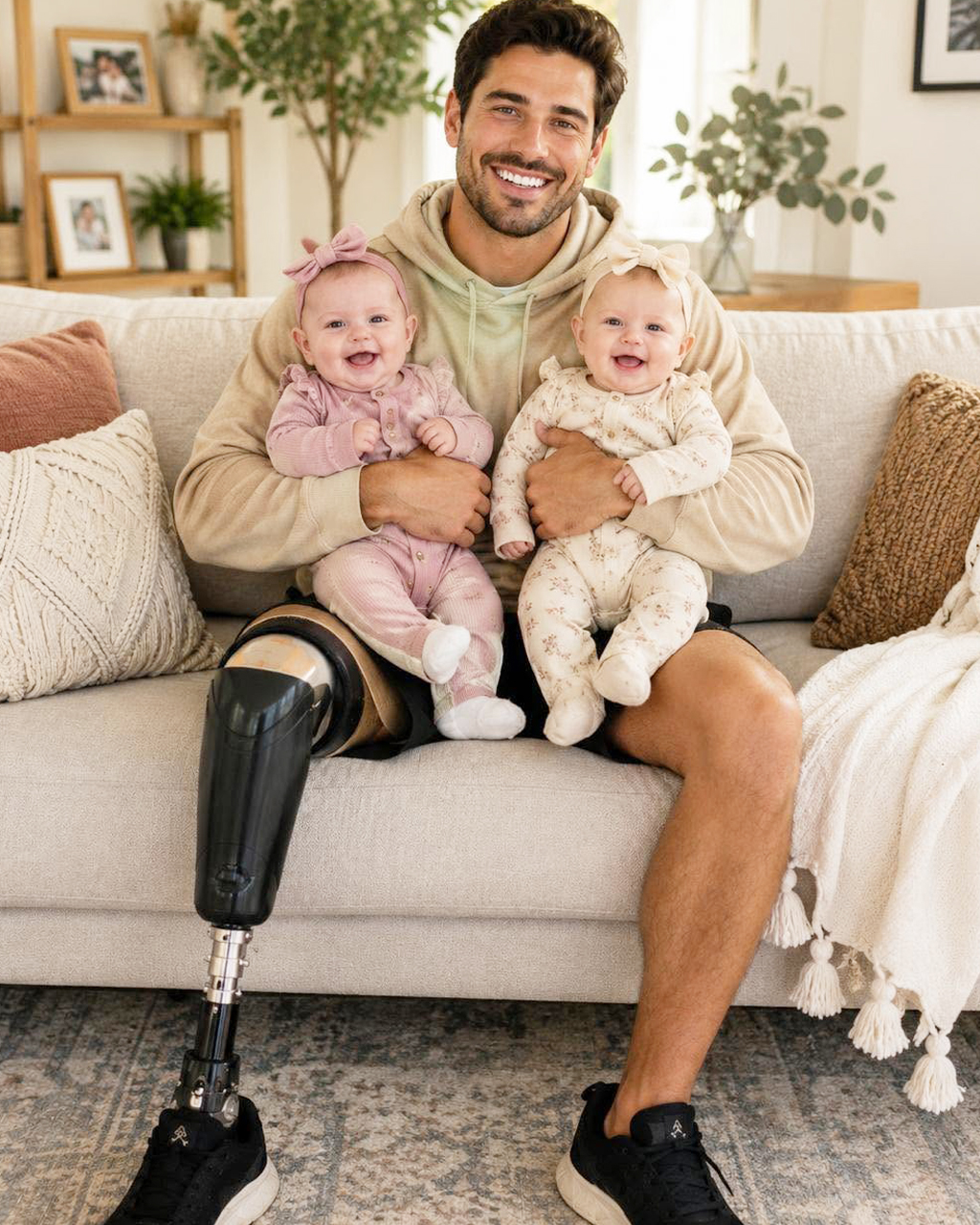
The prosthetic was a new model from the clinic in Dayton, made of black carbon fiber and heavy straps that smelled of synthetic rubber. The doctors had told me it would feel natural by the time the snow fell, but right now it felt like a cedar post strapped to my hip with thick leather belts.
I pulled my duffel bag out after me and shut the cab door. The driver did not waste any time, shifting into reverse and backing down the driveway with a spray of loose stones before turning onto Elm Street.
The red taillights of the cab disappeared behind the high privet hedge at the corner, leaving me alone in the twilight.
The gravel path to the steps looked longer than it had when I left. The weeds had grown up through the stones, dried brown by the first frost and bent over like little ribs across the dirt.
I stood there for a second, letting my eyes adjust to the gray light of the Ohio evening. The house was a simple two-story frame, painted a faded slate gray that always looked blue when the rain hit it.
I adjusted the strap of my duffel bag, shifting the weight to my right shoulder to keep my balance. Every step required a conscious decision, a small command from my brain to my hip to swing the knee forward, waiting for the microchip in the joint to register the angle before I dared to put my weight down.
My left hip ached where the socket met the bone, a deep, throbbing pressure that always worsened when the temperature dropped. The doctors had given me exercises to do, small stretches designed to keep the muscles from tightening around the metal pin, but out here on the gravel, those exercises felt like a distant memory.
The gravel shifted under my boot with a dry, crunching scrape. It was the only sound in the yard, loud enough to feel like an intrusion.
I stopped at the bottom of the wooden steps and looked up at the porch. The gray paint was peeling in long, curling strips near the foundation, revealing the wood underneath.
There were no toys on the steps. Usually, Emma left her yellow plastic bucket near the bottom, and Lily’s rubber blocks were scattered across the doormat.
I lifted my right foot to the first step, gripped the wobbly handrail, and dragged my left boot up beside it. The wood gave a dull groan under my weight, the sound flat and dry in the evening air.
The third step had always had a loose board that Mara asked me to nail down before I left. I avoided it by instinct, stepping wide to the right, my prosthetic knee clicking twice as the joint locked into place.
By the time I reached the front door, the sweat was running down the back of my neck under my collar. I reached into my pocket for my keys, my fingers brushing against the cold metal of the brass ring.
The house looked different from here. The front window was dark, and when I pressed my face to the glass, I could not see any furniture in the hallway, only the pale gray light reflecting off the bare floorboards.
I slipped the key into the deadbolt and turned it. The latch slid back with a light click, far too easily for a door that should have been locked tight against the autumn wind.
I pushed the door open and stepped into the hallway, expecting the smell of roasted chicken or the sweet, heavy scent of baby powder.
Instead, the air was cold and dead, carrying only the faint, sharp odor of ammonia and old floor wax.
“Mara?” I called out.
The word sounded thin, swallowed up instantly by the high ceiling of the hallway. No one answered.
I dropped my duffel bag onto the floor, the heavy canvas hitting the bare oak boards with a loud, hollow thud that echoed into the next room.
I walked to the entrance of the living room and stopped.
The blue sofa we had bought on installment before the deployment was gone. In its place were four dark, rectangular depressions in the beige carpet where the wooden legs had pressed down for three years.
The walls were completely bare. The small framed prints of the Ohio valley we had hung near the window were gone, leaving only the small finishing nails sticking out of the plaster like tiny iron thorns.
I walked into the dining room, my boots clicking loudly on the bare floor.
The table was gone. The four high-backed chairs where my mother used to sit during Sunday dinners were gone.
In the corner, a single white plastic coat hanger lay on its side, its hook pointed toward the empty kitchen.
I pushed the swinging door to the kitchen open, my hand leaving a clean smear in the dust that had settled on the wood.
The room was stripped. The counter was clear of the toaster, the cutting boards, and the green ceramic jar where Mara kept the sugar.
I walked to the refrigerator and pulled the handle. The small light inside flickered on, illuminating an empty wire shelf and a single jar of pickles with the lid screwed on crooked.
I turned the faucet on the sink, but only a dry hiss came out of the spout before the copper pipes behind the wall gave a sudden, loud rattle. The sound died down after a few seconds, leaving the kitchen quieter than before.
I turned around and looked at the wall calendar. It was still showing the page for August, the boxes blank except for a small circle around the sixteenth, which was the day I had been scheduled to leave the clinic.
There was no note on the counter. No folded yellow paper, no telephone messages, no keys left behind on the hook by the door.
I walked back into the hallway, my prosthetic leg dragging slightly against the edge of the linoleum as I hurried.
I walked over to the hallway thermostat and flicked the plastic cover open. The digital display was blank, meaning the battery had died or the furnace had been shut off entirely. The metal casing felt cold to the touch, like the rest of the house.
The door to the basement was shut, but when I turned the knob, it swung inward to reveal a black stairwell that smelled of damp concrete and old coal dust. I shut it quickly, my hand trembling slightly on the latch.
I walked to the small closet under the stairs where we kept the coats. When I pulled the door open, the metal hangers jingled against each other, completely empty.
My winter coat was not there. Mara’s heavy wool coat, the one with the black fur collar I had saved three weeks of pay to buy her for our first anniversary, was gone too.
I stood in the center of the hall, the silence of the house pressing against my ears like a physical weight.
The light from the streetlamp outside finally flickered on, casting long, yellow ribs of light through the bare front window and onto the floor.
I stood there for a long minute, listening to the wind brush against the bare branches of the oak tree outside the window.
Then I heard it.
It was a small, dry sound, coming from the ceiling directly above my head.
It was a high-pitched whimper, followed by a sharp, ragged breath that caught in a tiny throat.
I held my breath, my hand instantly going to the banister to steady myself as my good leg began to shake.
The cry came again, louder this time, joined by a second, softer wail that sounded thin and exhausted.
It was the babies.
They were upstairs in the nursery, crying in the dark.
I stared at the dark stairs as the sound of two babies crying drifted down.
I put my hand on the banister and lifted my left boot onto the first step. The wood groaned under the extra weight of the metal joint.
The crying from upstairs grew louder, two distinct voices rising and falling in the dark. I took the second step, dragging my left thigh up with a slow, deliberate swing.
My stump rubbed against the hard plastic of the socket, a sharp pinch that I tried to ignore as I dragged my weight upward. The sweat on my collar felt cold, and the simple act of climbing felt like a hill I had to conquer yard by yard.
I counted each riser. Seven, eight, nine, then a brief pause to catch my breath in the narrow hallway.
The plaster walls in the stairwell were cold to the touch, and the faded wallpaper was peeling at the seams near the top, revealing the old gray plaster beneath. I kept my eyes on the landing above, where the thin strip of yellow light was the only thing guiding my steps.
I pushed past the pain in my hip and forced my leg up the remaining six steps.
The nursery door was half open, letting out a sliver of yellow light. I pushed it back with my forearm, the metal hinges giving a soft whine.
My mother sat in the corner, her face pale in the glow of a small turtle lamp. She was rocking back and forth in the old maple chair, holding Emma against her chest.
Lily lay in her crib near the window, her tiny fists shaking as she wailed.
The blue plastic baby bottle sat empty on the floor beside her.
My mother did not look up when I entered. She wiped her glasses on her apron with a slow, rhythmic motion.
“She is not coming back, Caleb,” my mother said.
I walked over to the wooden crib, my boots heavy on the floorboards, and lifted Lily up to my shoulder. Her tiny body was warm, and she let out a long, shuddering sigh as she tucked her head into the hollow of my neck.
“Where is Mara?” I asked.
My mother pointed toward the changing table. A single sheet of folded yellow notebook paper lay next to the diaper stack.
“She left two days ago, Caleb, and she took the bank account with her,” she said.
The silence in the room seemed to deepen, heavy and cold, while the small radiator under the window hissed and sputtered. I carried Lily over to the dresser, my boot thudding heavily against the bare oak floorboards where the rug used to lie.
I reached out with my free hand and picked up the paper. It was torn from a legal pad, the edges rough and uneven.
The handwriting was Mara’s, written in her quick, leaning script. I recognized the blue ink from the pen she always kept in her purse.
She had not written my name at the top. The first sentence simply stated that she could not live this way anymore.
“How did you find them?” I asked, my voice barely louder than a whisper.
My mother stopped rocking. Her hand stayed on her apron, her eyes fixed on the floor.
“I had a feeling,” she said. “Mara did not answer her phone yesterday, and when I drove by, the house was dark.”
“And the babies?” I asked.
“They were alone, Caleb.”
A cold, heavy knot formed in my stomach as I looked down at the soft hair on Lily’s head, smelling the faint trace of lavender baby wash. My mother had saved them, but the way she looked at the floor told me there was a deeper truth she was trying to spare me from hearing.
“How long were they by themselves?” I asked.
“Thirty-six hours,” my mother said, her voice cracking slightly. “They had no heat, Caleb. The furnace had kicked off because the thermostat was turned down to fifty degrees.”
I looked at the yellow paper again, the letters blurring slightly before my eyes as the coldness of the house seemed to seep into my bones.
“She just walked out,” I said.
“She did,” my mother said. “She took her clothes, her jewelry, and everything from the safe.”
I turned the paper over. At the bottom, written in a different, bolder hand, was a single sentence.
“We are leaving for Columbus,” it read. It was signed by Mark.
The name stood out against the yellow paper like a physical blow. Mark had been my best friend since the third grade, the man who promised to check on my family while I was gone.
“He was here?” I asked.
“His car was in the drive on Tuesday,” my mother said. “Mrs. Gable saw them loading boxes into his trunk.”
“They planned this,” I said.
“I think they did,” my mother said softly. “The bank called this morning about the joint account. It is empty, Caleb.”
Emma began to stir in my mother’s arms, her small mouth opening as she let out a soft whimpering sound.
“They need to eat,” I said, setting the yellow paper back on the dresser.
“I brought some formula from the store,” my mother said, rising slowly from the rocking chair. “But we only have one bottle.”
“I will go down and wash it,” I said.
I took Emma from her arms, balancing her against my right side while Lily rested on my left. The weight of both girls made my prosthetic leg tremble, the metal joint locking for a second.
“Let me do it, Caleb,” my mother said, reaching out.
“No,” I said. “I have to do this.”
I carried Emma down the stairs, holding her tight against my chest. Every step down was a sharp reminder of the cold iron in my leg, but I did not let go.
In the kitchen, the empty spaces where the furniture had been looked even larger in the moonlight.
I set Emma in the wooden high chair that Mara had left behind, its tray dusty from the draft. The linoleum felt cold through my socks, and the kitchen looked twice as large without the oak dining table that used to sit near the window.
The copper pipes rattled behind the drywall, a familiar, hollow sound that seemed to fill the quiet house.
I washed the blue plastic baby bottle with warm water and dish soap, rinsing the rubber nipple three times to make sure it was clean.
The powdered formula was in a small tin on the counter. I measured out three level scoops, my hands steady despite the cold air coming from the window frame.
I filled the bottle to the six-ounce line with warm tap water.
I shook the bottle until the powder dissolved completely, then held it to my inner wrist to test the temperature against my skin.
I carried the bottle back upstairs, the clicking of my leg the only sound in the house.
I sat in the rocking chair with Emma, holding the blue plastic baby bottle to her lips. She took it immediately, her tiny fingers wrapping around my thumb.
My mother sat on the edge of the twin bed, her eyes fixed on the floor.
“How are we going to pay for the next batch?” she asked softly.
“I will find a way,” I said.
“The doctor said you cannot stand for more than two hours at a time, Caleb.”
“The doctor does not have two hungry babies to feed,” I said.
I looked down at Emma’s face, her long eyelashes dark against her pale skin. She looked so much like her mother, but there was a quietness in her that Mara never had.
“I promise you,” I whispered to her. “I will never leave you behind.”
My mother wiped her eyes with her apron, her shoulders shaking slightly.
“We only have forty-two dollars left in the drawer downstairs,” she said.
“It will have to be enough for now,” I replied.
I kept the bottle tilted until Emma finished the last drop, then lifted her onto my shoulder to burp her. Her warm breath was soft against my neck.
I stood up, my left leg stiffening as I transferred my weight. I carried Emma back to the crib and laid her down next to Lily.
The yellow paper still lay on the dresser, its bright color sharp against the dark wood.
I walked over and picked it up again, my thumb tracing the rough edges.
The ink was dark, the signatures clear at the bottom.
Caleb looked at the yellow paper in his shaking hand, realizing his best friend was gone too.
I folded the paper and slid it into my shirt pocket, right against my ribs.
The kitchen window rattled as the morning wind came off the creek, carrying the scent of dry leaves and cold Ohio mud.
My mother, Ruth, stood by the sink, her shoulders curved under her gray wool sweater.
She reached for a blue plastic baby bottle on the counter, but her knuckles were swollen and white, and she had to use both hands to lift the collar.
“I had to look, Caleb,” she said, her voice thin in the morning quiet.
“I know,” I said.
“Mara stopped answering her phone on Tuesday morning,” she said. “I called three times, then four. By yesterday afternoon, my chest felt tight, and I knew I had to come over.”
She wiped her reading glasses on the edge of her cotton apron, her fingers moving slowly over the glass.
“Thirty-six hours,” I said.
“Yes,” she said. “They were in their cribs. The house was cold because the furnace had clicked off.”
I looked at the bare floor where the dining table had been.
“Did she take the cribs?” I asked.
“No,” my mother said. “Just the living room furniture, the dresser from your bedroom, and the kitchen chairs.”
“And the bank account?” I asked.
“Every penny,” she said. “The clerk at the branch told me she came in with Mark on Monday morning before the doors were fully open.”
I pulled the small wooden drawer by the telephone open.
Inside lay a ball of twine, three rubber bands, and the remaining house money.
I pulled the bills out and counted them on the laminate counter.
Two twenties and two ones.
Forty-two dollars.
“We have enough formula for three days, Caleb, and then the cupboard is bare,” she said.
“I will go to the store after the girls wake up,” I said.
My mother leaned against the counter, her breath coming in a short, shallow sigh.
She looked at her hands, then at the empty spot where our kitchen table used to sit.
“My knees are not what they were,” she said. “I can watch them for an hour, but carrying them up those stairs is more than I can manage.”
I looked at the floorboards, where the gray light of the Ohio morning was beginning to show the dust.
“I will handle the stairs,” I said.
“You have to work, Caleb. You cannot carry two babies and run a shop with that leg.”
“I will find a way,” I said.
She did not answer, but she turned back to the sink, her shoulders tight.
I had to walk past the diner, where the morning regulars were already parked.
The high-set windows of the place were fogged with grease and heat, but I could see the outlines of heads turning as I passed.
They knew my father’s truck was sold, and they knew about the yellow moving van that had backed up to my house.
I kept my eyes on the slushy path, focusing on the rhythmic sound of my left heel hitting the gravel.
It was a dull, hollow thwack that did not sound like a real foot, but it got me down the road.
Inside the store, the air smelled of floor wax and old cabbage.
I found the baby aisle at the back, next to the pet food.
The shelf held only four cans of the powdered formula we used, their blue labels dusty under the fluorescent bulbs.
I took three of them, stacking them in my arm like firewood.
They felt cold against my chest, and the tin rims dug into my shirt.
At the register, the clerk, a woman named Clara who had known my father, stopped running the scanner.
She looked at the three cans, then at the worn hem of my trousers.
“Your mother was in here yesterday,” she said, her voice dropping to a harsh whisper.
“Yes,” I said.
“People are talking, Caleb,” she said. “About how you are going to manage out there on Elm Street. A man alone, with what you brought back from overseas.”
“Forty-two dollars,” I said, sliding two twenties onto the counter.
“The county has services,” she said, her eyes staying on my face. “They have foster homes over in Ravenna. Nice families with two parents.”
“Thirty-four dollars and twelve cents,” she said, pointing to the register screen.
“We all want what is best for the girls, Caleb,” she said, her fingers pausing on the keys. “But you have that leg to think of.”
“I can think of both,” I said.
“You cannot carry a baby and a toolbox at the same time,” she said.
She clicked her tongue and rang the total.
“I am just saying what people are thinking,” she said.
She slid the change across the black mat, her fingers lingering on the coins.
“They are my daughters,” I said.
I took the bag and walked toward the glass doors, my boot clicking against the tile.
Behind the house, the old wooden shed sat under the shadow of a dying oak tree.
The padlock was rusted shut, so I used the flat of a spade to pry the staple out of the rotting frame.
The door swung open to reveal a dark space smelling of motor oil, damp earth, and dry rot.
I dragged a long pine table out onto the grass, letting the uneven legs settle into the dirt.
My mother sat on the bottom step of the back porch, her hands tucked into her sleeves to keep them warm.
“Your father kept his tools in the green chest,” she said.
I went back inside the shed and lifted the heavy iron toolbox, my left thigh burning as I carried it to the table.
I set it down with a heavy thud that shook the pine planks.
Inside, the tools were covered in a thin film of grease that had kept the rust away.
I picked up a heavy, rusty socket wrench and held it in my palm, feeling the weight of the steel.
The selector wheel was stiff, but it clicked when I forced it with my thumb.
“Jim was looking over the fence earlier,” my mother said. “He asked if you were going to sell the house.”
“I am not selling,” I said.
I laid the wrench next to a can of penetrating oil.
“He has that old mower by his garage,” I said. “The one with the red deck.”
“It has not run since the frost,” she said.
“It will run,” I said.
She stood up slowly, her knees making a small clicking sound as she straightened her back.
“I have to go home and lie down, Caleb,” she said. “My back is locked up.”
“I will walk you to the car,” I said.
“No,” she said. “Keep your strength. You have a long night ahead.”
I watched her walk down the gravel drive, her steps short and uneven.
The wind came through the window frame, making the faded pink wallpaper flutter near the radiator.
Emma was crying in the left crib, her small fingers clutching the bars.
In the second crib, Lily lay on her back, her legs kicking at the woolen blanket.
I held the blue plastic bottle for Emma, but my left knee was stiffening, the joint locked in a dull, steady ache.
The sound of their crying seemed to vibrate in the small room, bouncing off the bare plaster walls.
I wanted to sit, but every time I lowered my weight, Emma’s voice rose to a scream.
I lifted Lily with my left arm, balancing her against my collarbone while I held the bottle for her sister with my right.
My thigh joint throbbed, a sharp needle of pain shooting down to my shin with every step I took.
I could feel the heat radiating from the plastic socket where it met my thigh, the skin raw from the walk back from the grocery store.
I walked from the crib to the window, then back to the door.
The room smelled of sour milk and the cold draft from the street.
On the small changing table, next to a stack of clean diapers, lay the yellow envelope from the Ohio Power Company.
It was a second notice, printed on cheap pink paper.
One hundred and twelve dollars, due by the fifteenth.
I had seven dollars and eighty-eight cents left in my pocket.
I sank down to the wooden floorboards, my left leg sticking out straight in front of me.
I pulled Lily close to my chest, her small head resting right below my chin.
She stopped crying, her breath coming in warm, quick puffs against my neck.
Emma dropped her bottle and rolled onto her side, her eyelids heavy in the shadows.
I picked up the utility bill from the floor where it had fallen.
The red numbers seemed to grow larger in the dim light of the streetlamp.
Caleb sat on the floor, holding Lily to my chest, staring at the utility bill.
The red metal deck of Jim’s old mower scraped against the gravel as he dragged it out of the bed of his truck. He lived three houses down, a man who always seemed to have a pocket full of quarters he liked to shake when he talked.
“She won’t pull, Caleb,” Jim said, letting the tailgate slam.
I stood by the bumper, shifting my weight to my right side to take the pressure off my left thigh. The morning air had a bite to it, the kind that made the metal parts in my knee feel like ice.
“Let me take a look at it,” I said.
Jim jangled the loose coins in his trousers, his eyes sliding down to my left boot before coming back up to my face. “I don’t know, Caleb. It’s heavy. Probably needs a new belt and a carburetor clean. I was thinking of just taking it to the place out on the highway.”
“I can do it right here in the garage,” I said, looking at the cracked starter rope hanging loose from the housing. “Thirty dollars. That includes the parts if it’s just the belt.”
Jim squinted at the roof of my house, then back at the mower. “Thirty dollars doesn’t buy much these days. You sure you want to be bending over a deck all afternoon?”
“I do not want a handout, Jim, I just want the chance to fix your mower.”
He let go of his coins and rubbed the back of his neck. “Tell you what. I’ll leave it here by the gravel. If you can’t get to it, don’t worry about it. I’ve got an old fifty-dollar bill in my wallet I was going to throw your way anyway, just for the girls.”
The offer sat between us in the cold air.
“Keep the fifty,” I said, reaching down to grab the front handle of the mower deck. “Just leave the machine.”
I hauled the front end up, my good leg bracing against the gravel while my left thigh strained against the socket. Jim didn’t offer to help with the other end, he just stood there with his hands in his pockets, watching the way my boot slid an inch in the loose stone.
By two o’clock, the sun was high enough to heat the corrugated tin roof of the garage until the space smelled of old grease and dry dust. The mower sat on two wooden sawhorses in the center of the concrete floor.
Jim came back before I had the housing off, walking right into the shade of the doorway without knocking. He had a white paper bag from the bakery in his hand.
“Brought some doughnuts for your mother,” Jim said, setting the bag on a greasy oil drum. “And look, Caleb, I was thinking. With your leg and all, this kind of work is going to wear you down. You don’t have to prove anything to Elm Street.”
“I’m not proving anything,” I said, picking up a flathead screwdriver. “The tension pulley is seized.”
“I can give you thirty dollars right now,” Jim said, reaching for his back pocket. “You don’t have to finish it. Just keep the machine for scrap or whatever. I’ll buy a new one at the big box store tomorrow.”
He held out two ten-dollar bills and two fives, his hand hovering over the disassembled engine.
“The job is thirty dollars when it runs,” I said, not looking up from the rusted bolt. “Not before.”
Jim sighed, the paper bag rustling as he took his hand back. “You’re stubborn, Caleb. Your dad was the same way, but he had two good legs to stand on when the creek rose.”
He left the doughnuts on the drum and walked out, his boots crunching loud on the gravel driveway.
I needed a half-inch drive belt, and the only place that kept them in stock on a Tuesday afternoon was Miller’s Hardware on Main Street. I drove the truck down, the clutch pedal resisting every push of my left foot until my hip burned.
The bell above the door at Miller’s gave a short, high tinny ring as I pushed through. The clerk, a young guy named Toby who used to play football with Mark, was leaning over the counter with a pencil behind his ear.
“Need a four-foot utility belt, half-inch width,” I said, placing the old, shredded rubber piece on the glass counter.
Toby picked up the old belt with two fingers, looking at the cracked edges. “That’ll be twelve-fifty, Caleb. Plus tax.”
I reached into my pocket and pulled out the small roll of bills I had left. Seven dollars.
“Put it on my tab, Toby,” I said, keeping my voice level. “I’ll bring the rest by tomorrow morning when I get paid for the repair.”
Toby looked down at his ledger, then up at the front window where my old truck sat idling with a bad muffler. He shook his head slowly.
“Mr. Miller said no more credit for the Elm Street accounts,” Toby said, his voice dropping so the older woman buying paint at the back wouldn’t hear. “Not since your wife left. He said the risk is too high now.”
My thumb pressed into the rubber of the old belt until my nail turned white. “I’ve paid every bill here for ten years.”
“I know, Caleb,” Toby said, sliding the new belt back onto the shelf behind him. “But things changed. I can’t override the computer.”
I stood there for three seconds, the silence in the store growing until I could hear the hum of the fluorescent lights overhead. I took my seven dollars off the counter and walked out.
Back in the garage, I looked at the seized pulley on Jim’s mower. I didn’t have the twelve-fifty for the new belt, but I had an old leather strap from a horse harness my grandfather had left in the barn.
I spent three hours with a pocket knife and a tin of leather fat, shaving the strap down to the exact width of the pulley groove. My hands were black with old grease and oil by the time I hand-stitched the seam with heavy copper wire.
The sun was dropping below the tree line when I pulled the starter rope on Jim’s mower for the third time. The engine caught with a blue puff of smoke, then settled into a steady, clean roar that vibrated through the concrete floor.
I let it run for five minutes, adjusting the throttle link until the blade spun without a single wobble.
Jim walked up the driveway just as I shut the engine down, the silence settling over the yard like a blanket. He stopped five feet from the mower, looking at the leather belt spinning slowly to a stop inside the guard.
“Is that leather?” Jim asked, bending down to squint at the housing.
“It’ll last longer than the rubber ones they sell at Miller’s,” I said, wiping my hands on a rag. “Start her up.”
Jim reached for the rope, gave it a short pull, and the engine roared to life instantly. He let go of the handle, watching the machine vibrate on the gravel without missing a beat.
He reached into his pocket, his fingers bypassing the loose quarters this time, and pulled out three crisp ten-dollar bills. He handed them to me without looking at my leg.
Caleb watched Jim pull away, the thirty dollars warm in his grease-stained hand.
The truck exhaust lingered in the cold air as the tail lights vanished around the bend of Elm Street. I walked back toward the garage, my left thigh aching where the strap of the prosthetic bit into the skin. I did not stop to rest on the steps, because the wind was coming out of the north now, carrying the scent of early snow.
The thirty dollars went straight into the tin tea canister on the kitchen counter, joining the twelve singles left over from the grocery run. It was a start, but the electric bill on the table was sixty-eight dollars, and the coal bin in the basement was nearly empty.
By eight the next morning, a heavy flatbed truck rumbled into the gravel driveway, its brakes squealing in the cold.
Frank, the local mechanic who ran the auto repair shop three miles out on the highway, climbed down from the high cab. He was a broad man with oil permanently settled into the creases of his knuckles, and he carried a heavy wooden crate in both arms.
He set the box on my workbench with a dull thud that made the loose screws in my magnetic tray rattle.
“Cleaned out the back corner of my shop after the freeze last week,” Frank said, wiping grease from his hands with a frayed red rag.
I looked down at the pile of tarnished metal, greasy gears, and cracked aluminum casings.
“Most of it is junk people abandoned, but there are four good starter motors and three carburetors in there,” Frank said, gesturing to the box.
I picked up one of the starter motors, its casing heavy and cold. The copper terminal was green with corrosion, but the shaft spun freely when I twisted it with my thumb.
“I can clean these contacts up in an hour,” I said.
At the bottom of the crate, a heavy iron tool caught the light, its surface pitted with dark orange spots.
“Take this too,” Frank said, lifting a rusty socket wrench with a chipped handle and sliding it into my palm. “The selector is stuck on it, but it is solid steel.”
I gripped the cold metal, feeling the rough scale of the rust against my fingers, and set it on the wooden shelf above my bench.
“I do not have the money to buy this off you, Frank,” I said.
Frank shook his head, stuffing the red rag into his back pocket.
“Nobody is asking for money,” Frank said. “You fix those carburetors, and we split whatever you get for them, fifty-fifty.”
He paused at the garage door, looking back at the neat rows of screwdrivers I had aligned on the pegboard.
“You have a gift with these old motors, Caleb, and people are starting to talk,” Frank said.
“Who is talking?” I asked.
“Jim, for one,” Frank said. “He told the boys at the feed store that you had his mower running in twenty minutes.”
He left before I could answer, his truck engine roaring as he backed down the drive.
By noon, the damp autumn chill had crept through the gaps in the garage double doors, forcing me to light the small kerosene heater in the corner.
I dragged the wooden playpen I had found at a yard sale into the warmest spot in the shop, right under the hanging utility light.
Emma and Lily sat inside it on a thick wool blanket, taking turns banging green and blue plastic blocks together.
The smell of motor oil from my workbench mixed with the scent of baby powder from the girls’ fresh diapers.
I clamped a ruined carburetor from Frank’s crate into the vise and began to strip the clogged jets.
My left leg throbbed with a dull, rhythmic heat, but I kept my weight shifted to my right heel to avoid the bite of the leather harness.
Every few minutes, Lily would drop her block and look up at me, waiting until I made a low whistling sound to satisfy her before she went back to her toys.
A rebuilt carburetor for a small tractor was worth seventy-five dollars to the farmers out past the county line.
I used a fine wire brush to clear the varnish from the float bowl, working the tiny brass needle until it seated without a whisper of resistance.
The work was slow because my fingers were stiff from the cold draft that blew along the concrete floor.
I had to use a pair of needle-nose pliers to extract a sheared bolt from the throttle body, my knuckles scraping against the cold iron of the vise.
Emma watched me from the playpen, her small fingers gripping the wooden slats as she pulled herself up to a standing position.
“Look at you,” I whispered, setting the pliers down to watch her balance on her tiny feet.
She gave a short, high-pitched laugh and dropped back down onto the wool blanket, scattering her blocks.
I went back to the carburetor, blowing a speck of dust out of the primary nozzle before assembling the body with four new gasket screws.
By four, the gray Ohio sky had turned the color of wet slate, and the slush on the driveway began to freeze into slick ridges.
I carried the girls inside one by one, my boot heels crunching on the frozen gravel as I balanced Lily on my hip.
In the kitchen, the old copper pipes under the sink rattled like dry bones when I turned on the hot water to wash the black grease from my fingernails.
Ruth was already there, standing by the stove with her apron on, stirring a pot of oatmeal for the girls’ dinner.
“You look tired, Caleb,” Ruth said, her soft voice barely carrying over the sound of the bubbling pot.
“I am fine,” I said, though my thigh was burning from the constant standing.
I took the tin tea canister down from the shelf and emptied the bills onto the laminate table.
There were five twenty-dollar bills, three fifties from a farmer who needed his chainsaw serviced, and a stack of crumpled singles.
I aligned the edges of the green paper, smoothing the creases with my thumb.
“Three hundred and fifty dollars,” I said, counting the final ten-dollar bill.
Ruth stopped stirring the pot and looked at the pile of cash.
“That is enough for the electric bill and the coal delivery, Caleb,” she said, wiping her glasses on her apron before setting them back on her nose.
“We still need three more cases of formula by the end of the month,” I said.
“We will get it,” Ruth said, setting two small plastic bowls on the table. “You are earning this, Caleb. No handouts.”
“It is just small engines,” I said. “But the word is spreading.”
“More than you know,” Ruth said, her eyes dropping to the floor. “I saw Beatrice at the grocery store this morning.”
“What did she say?” I asked.
“She asked how you were holding up,” Ruth said. “And she asked if you had heard from Mara.”
I picked up the bills and folded them, putting them back into the tea canister.
“Mara has not called,” I said.
“Good,” Ruth said. “Let her stay where she is.”
I looked at the yellow notebook paper still tucked behind the bread box, the handwriting on it fading slightly under the kitchen light.
After the girls had eaten, the house grew quiet, the only sound being the radiator in the hallway hissing as the steam rose.
I carried Lily up the stairs, her small head resting against my shoulder while Emma slept in Ruth’s arms behind us.
The nursery was cold, so I turned on the small electric heater in the corner before laying Lily down.
I took the blue plastic baby bottle from the dresser, checking the temperature of the formula against the inside of my wrist.
Lily took the bottle with both hands, her dark eyes watching my face as she drank.
I sat on the low wooden stool beside the crib, letting the silence of the room settle over us.
The house on Elm Street was still mostly empty, but the small room felt warm under the yellow light of the lamp.
For the first time since the taxi dropped me off, the constant tightening in my chest began to loosen.
I watched the slow rise and fall of Lily’s chest as she finished the last of the milk and her eyelids drifted shut.
But as I reached down to take the empty bottle, a car’s headlights swept across the ceiling, moving slow down Elm Street before turning around at the dead end.
I stood frozen by the crib, listening to the quiet rumble of the engine as it idled near our driveway for a long minute.
Then the car accelerated, the sound fading into the cold autumn night.
I wiped the grease from my forehead and smiled at my daughters sleeping in their cribs.
The morning sun was just hitting the brick facade of the county building when I walked inside. My left thigh was stiff from the early chill, but I kept my pace steady across the green linoleum floor. The hallway smelled of floor wax and old tax documents, a scent that had not changed since I was a boy.
Beatrice sat behind the high oak counter of the clerk’s office, her reading glasses perched on the tip of her nose. She was stamping a stack of property deeds with slow, rhythmic thuds that echoed in the quiet room.
“Morning, Beatrice,” I said, setting my paperwork on the counter.
She looked up over her frames, her hand pausing mid-air with the wooden stamp. “Caleb. You are early today.”
“Got three lawnmowers and a tractor engine waiting in the shop,” I said. “Need to renew the garage permit before the deputy sheriff decides to drop by.”
She pulled the blue folder toward her and flipped through the single page of my application, her fingers long and spotted with ink. She checked the address on Elm Street and then the name of my business.
“Forty-five dollars,” she said, her drawl stretching the words out. “The state raised the fee last month. Said they needed to cover the cost of the new digital database.”
I counted out two twenties and a five from my leather wallet, placing the bills flat on the wood. They were worn and soft from being folded in my pocket. “Still cheaper than rent in town.”
Beatrice slid the bills into her steel drawer and stamped my copy of the permit with a loud click. She did not hand it back immediately, her fingers lingering on the edge of the paper.
“Saw your mother at the grocery yesterday,” she said, her voice dropping a register as she leaned closer. “She looked tired, Caleb. She was carrying that heavy bag of flour all the way to the car herself.”
“She does too much,” I said. “I told her to wait until I could go with her, but she does not like to sit still.”
Beatrice nodded slowly, her eyes tracking something on her computer screen that I could not see from my side of the desk. “People in this town talk, but some of us remember who stayed and who ran when the trouble started.”
“I just fix the engines, Beatrice,” I said, keeping my voice level. “I do not pay much attention to the talk.”
“I know what you do,” she said, finally sliding the stamped permit toward me. “Just keep your eyes open. This office sees a lot of filings before they ever reach the mailbox on Elm Street.”
I folded the permit and slid it into my shirt pocket, wondering what she meant by filings. “Is there something else I need to sign?”
“Not today,” Beatrice said, her voice dropping even lower. “But there are people in this county who think a piece of paper can buy anything they want.”
“Thanks, Beatrice,” I said, taking my copy.
“Tell Ruth I have those peach preserves saved for her,” she said, already reaching for her next stack of deeds. “And tell her to stop lifting those fifty-pound sacks.”
I walked back out to my truck, the cold air biting at my neck as I unlocked the door. The engine started with a low rumble, a sound I had tuned myself until the valves were silent.
I drove back to Elm Street, where the gray gravel of the driveway was damp from the morning mist. Emma and Lily were inside, their voices drifting through the kitchen window as they played.
My mother met me near the back bumper of the truck, her face pinched against the autumn wind. She wiped her glasses on her apron before she spoke, her fingers a little stiff from the damp cold.
“The girls are having their lunch,” she said, her voice soft. “But this came in my mailbox this morning.”
She handed me a glossy postcard with a picture of a white beach on the front, the water a bright blue that did not look like Ohio. The postmark was from Columbus, dated three days prior.
I turned it over in my hand. The handwriting was tight and curved, a hand I had not seen in three years, written with a fine-tip pen.
“It is from Mara,” I said, my thumb covering her name at the bottom.
“She sent it to my house,” Ruth said, looking down at the gravel. “Not yours. I think she knew you would throw it away before reading it.”
“I still might,” I said, looking at the short paragraph written in blue ink.
The message was polite, almost formal, asking how the girls were growing and mentioning she had taken a job at a design firm in the city. It was signed with her name alone, no mention of Mark or their new house.
“She says she wants to send them some winter coats,” Ruth said, her eyes searching my face for any change. “She asked if they were still wearing the toddler sizes.”
“We have coats,” I said. “Frank gave me two heavy jackets his nieces outgrew.”
“She wrote that she thinks about them every day, Caleb, but I do not trust it.”
I looked down at the postcard, the glossy paper feeling greasy under my thumb. “Why now? Three years without a single word.”
“People change their minds when they get older,” Ruth said. “Or when they realize what they left behind.”
“Mara does not change her mind,” I said. “She gets bored of one thing and moves to the next.”
I slid the card into my back pocket and picked up the grocery bag from the passenger seat of the truck. “Let us get the girls finished with lunch before the soup gets cold.”
Ruth followed me up the wooden steps, her boots clicking softly on the spruce boards. “She asked for photos, Caleb. She said she wanted to see if they had her eyes.”
“No,” I said. “They have their own eyes.”
We entered the kitchen, where Lily was smeared with pear puree and Emma was trying to feed her doll a dry cracker on the linoleum. The room smelled of warm toast and baby powder.
I sat on the low stool and cleaned Lily’s chin with a damp cloth, her small hand reaching up to grab my wrist. Her fingers were warm and sticky, her grip surprisingly strong for a two-year-old.
“We do not need her coats,” I said to the room.
Ruth did not answer, busy at the sink washing the small plastic bowls. The water rattled in the copper pipes behind the wall, a sound that always meant home to me.
The girls were asleep in the nursery upstairs by the time the sun went down. The house was quiet except for the hum of the refrigerator.
Ruth and I sat at the wooden kitchen table, a single lamp lighting the room. The postcard sat between us on the yellow formica.
“She has not called in thirty-six months,” I said, my voice quiet so it would not carry up the wooden stairs to the nursery. “Not a birthday card, not a five-dollar bill in an envelope, not a phone call when Lily had the croup last winter.”
“I know,” Ruth said. “But the law is a strange thing, Caleb. A mother is still a mother on paper, no matter how far she runs.”
“She signed over her rights to the bank account when she left,” I said, my hand resting on the table. “She did not want the responsibility of two infants.”
“Mark has money,” Ruth said. “Maybe he wanted her to clean up her old business before they bought that new place.”
“Mark does not care about my daughters,” I said. “He only cares about his grandfather’s trust fund.”
My left thigh was dull and aching from a long day on the concrete floor of the garage. The cold metal of the joint was stiff, and I could feel every hour of standing.
“If she wanted to see them, she would have come herself,” I said. “A postcard is just a way to see if we are still here.”
“She asks if they are walking yet,” Ruth said, pointing to the blue ink on the table. “She does not even know they have been running around the backyard for a year.”
“That is because she was not here to see it,” I said. “She was in Columbus.”
“What are you going to do with it?” Ruth asked, her hand resting on the edge of the table.
“Nothing,” I said. “There is nothing to do. I have a business to run and two girls to raise.”
“She might call next,” Ruth said. “Or show up at the gate.”
The thought of Mara standing on the gravel driveway made my chest tighten, a cold weight settling in my stomach. I looked at the faded pink wallpaper in the corner of the kitchen, where the seam was starting to peel near the baseboard.
“She has a new life,” I said. “She made her choice when she packed her bags.”
“Sometimes the choice does not stay made,” Ruth said. “Especially when people realize what they lost.”
She stood up and wrapped her wool sweater tighter around her shoulders, her movements slow and deliberate. “I should get home before the fog rolls in off the creek.”
“I will walk you to the car,” I said, starting to push myself up from the chair.
“Stay inside, Caleb. Your leg is bothering you tonight. I can see it in the way you hold your shoulder.”
I did not argue with her. I watched from the kitchen window as her red tail lights disappeared down Elm Street, leaving the gravel driveway dark.
I stepped out onto the front porch, the night air cool and damp against my face. The street was silent, the neighbors’ houses dark and quiet under the autumn sky.
I looked up at the porch ceiling, where the two rusted iron chains still hung from the heavy beam. They swayed slightly in the evening breeze, clinking against each other with a dry, metallic sound that sounded like old keys.
I remembered the day Mara had the movers take the wooden swing down, along with the dining table and the couch. She had said it was too nice to leave behind in a house like this.
Now there was nothing but the empty space and the draft that came off the creek, a constant reminder of what had been taken.
I pulled the postcard from my back pocket and held it under the yellow porch light. The beach on the front looked bright and artificial, a place where people went to forget their lives while others did the work.
I looked at her signature again, the elegant cursive that used to sign my name on the bank slips. There was no warmth in it, just the same neat lines she used when she wanted to prove she was right.
I thought about Beatrice’s warning at the county office, about filings and keeping my eyes open. Something was moving in the background, something I could not see from my garage on Elm Street, but I knew I could not let it inside.
I walked back inside, the floorboards silent under my boots. The kitchen was cold now, the pilot light on the gas stove casting a tiny blue circle on the wall.
I did not want her winter coats, and I did not want her questions.
I took the glossy card in both hands. The thick paper resisted for a second, then tore with a sharp rip down the center of the beach, splitting the blue water in two.
I aligned the halves and tore them again, making the pieces smaller until her handwriting was nothing but disconnected letters on the white card.
I tore the postcard into small pieces and dropped them into the kitchen wastebasket.
The glass double doors of the county building let in a draft of cold autumn air that followed me all the way to the records desk.
My boots clicked on the grey tile of the lobby, the sound echoing off the high ceiling where two fluorescent tubes flickered.
I made my way to the counter at the back, where Beatrice sat behind her high oak desk, typing on an old grey keyboard with loud, rhythmic strokes.
She did not look up immediately, but her fingers slowed down as she reached the end of her page.
“Morning, Caleb,” she said, finally sliding her reading glasses down the bridge of her nose.
“Morning, Beatrice,” I said, leaning my good leg against the counter to take some of the weight off my left thigh.
“I was hoping you would come in today,” she said, her voice dropping to that slow, deliberate drawl she used when she wanted to keep a conversation private.
She reached under the counter and pulled out a thick blue folder, setting it down on the wood between us.
“I have your business permit renewal right here, but there is something else you need to see first.”
“Did the township raise the filing fee again?” I asked.
“The forty-five dollars is the same,” she said, sliding the permit to the side and opening the blue cover of the folder. “This came from a private courier yesterday afternoon, straight from a law office in Columbus.”
I reached out to touch the edge of the folder, but she kept her palm flat on the top page, her eyes scanning my face.
“Who filed it?” I asked.
“Mara and Mark,” she said, her voice dropping even lower.
She turned the folder around so it faced me, her finger pointing to the bold letters at the top of the first sheet.
It was an adoption petition, and my daughters’ names, Emma and Lily, were typed in clean, black ink right in the center of the page.
“They filed this three days ago,” Beatrice said, her hand returning to her lap.
I stared at Mara’s signature at the bottom, those wide, rounded cursive letters that used to sit on grocery lists on our kitchen table.
“They cannot do this,” I said, my voice sounding flat and dry in the quiet room. “The girls have been with me for three years.”
“They filed it under the emergency custody provisions,” she said, flipping to the third page where a copy of a grandfather’s will was attached. “Look at the section marked Exhibit B, Caleb.”
I leaned closer to the counter, the smell of old paper and Beatrice’s lavender soap filling the space between us.
The legal language was dense, but the numbers in the center of the page stood out clearly.
There was a trust fund of three million dollars established by Mark’s grandfather, set to be released to Mark on his thirty-fifth birthday.
But there was a specific condition written in bold black letters near the bottom of the page, stating the funds would only release if Mark had legal dependents in his custody.
“Mark turns thirty-five next month,” Beatrice said, her finger tracing the line of text.
“Old man Whitmore set this up thirty years ago,” Beatrice said, leaning her elbow on the counter. “He wanted to make sure his grandson did not spend it all on fast cars.”
“And now Mark has found a way around it,” I said.
“With Mara’s help,” she said. “If they show they have a family, the trust matures. It is a loophole as old as the hills.”
I read the sentence twice, my mind trying to make the pieces fit together while my shoulder grew stiff.
“They do not want the girls, Caleb, they want the three million dollars in the trust.”
The words sat between us on the counter, heavy and cold in the quiet office.
“If they get joint custody or an adoption approved, the bank releases the money,” she said.
“Who is executing the trust?” I asked.
“Mr. Whitmore,” Beatrice said, her finger tapping the name at the bottom of the page. “The estate attorney. His office is over on Main Street, next to the bank.”
“Does he know about this filing?” I asked.
“He will as soon as the probate judge signs the initial order,” she said. “The law firm in Columbus is pushing for a quick hearing.”
“Mara does not want to be a mother,” I said, my hand tightening on the edge of the wood. “She left them alone in their cribs.”
“The court does not know that,” Beatrice said. “On paper, she is their biological mother who is now married to a man with a large home on the ridge.”
She looked toward the back office where the supervisor’s typewriter was clicking, then turned back to me.
“Their lawyers are going to argue that a garage workshop is no place to raise two toddlers, and that your physical condition makes it impossible for you to care for them.”
I felt a sharp pinch in my left thigh, right where the metal socket met the scarred skin.
“I work every single day to feed them,” I said.
“I know you do, Caleb,” she said, her voice soft. “But their lawyers have thirty pages of arguments here, and they have a hearing set for December fourteenth.”
She pulled the papers back toward her and set them on the glass of the copy machine behind her desk.
“I am going to make you a copy of the whole file so you can show it to someone.”
“How much do I owe you for the copies?” I asked.
“It is forty-eight pages,” she said, the machine beginning to hum and flash green light against the wall. “That is four dollars and eighty cents.”
I watched the green light sweep across the glass, page after page, each one capturing the names of my children.
Beatrice stacked them neatly, tapping the edges against the metal tray to align them.
I reached into my pocket and pulled out five crumpled bills, laying them on the wood.
She handed me the warm stack of paper, the staple still hot against my thumb.
“Keep the change for the parking meter,” she whispered, not looking at me as she slid the money into the register.
I took the papers and walked away from the desk, my boots heavy on the grey tile.
The hallway of the county building was long and empty, smelling of bleach and old steam radiators.
I walked twenty steps and had to stop, leaning my shoulder against the cool cinderblock wall to rest my leg.
My left leg was shaking from the tension, the metal joint locking up as I stood there in the quiet.
I looked down at the top page of the petition, my thumb resting on the blue ink of the clerk’s stamp.
Mara had left our daughters with nothing but a blue plastic bottle and a yellow note three years ago.
Now, she was coming back for them, not because she loved them, but because they were worth three million dollars to her husband’s family.
The last piece of hope I had that she might still have some maternal instinct died right there in that hallway.
She had looked at her own daughters and saw nothing but a signature that could unlock a fortune.
A man in a brown uniform pushed a mail cart past me, his keys jingling against his belt.
He gave me a quick nod, but I did not return it, my eyes fixed on the legal jargon in my hands.
I pushed off the wall and made my way toward the heavy glass doors of the exit, my leg dragging slightly.
The autumn air outside was sharp, hitting my face like cold water as I walked across the gravel parking lot.
My old truck was parked near the back fence, the blue paint faded and peeling at the corners of the hood.
I climbed into the cab and shut the door, the metal rattle sounding loud in the quiet afternoon.
The vinyl seat was cold and stiff under me as I sat there, the steering wheel ice-cold against my palms.
I did not put the key in the ignition right away.
Instead, I laid the papers on the passenger seat and stared at the address of Mark’s mansion at the top of the page.
It was located on the ridge overlooking the valley, where the wealthy families built their homes behind brick walls.
I had helped pour the concrete foundation for one of those houses when I was twenty, before the accident.
I knew the long, paved driveways and the iron gates that kept the rest of the town out.
Mara was living up there now, in a house with five bedrooms and a view of the river.
She wanted to bring my daughters up to that hill, to show them off to a judge and then leave them with a nanny in the guest house.
I reached out and touched the warm paper of the petition, my fingers tracing the letters of Emma’s name.
The court date was only a few weeks away, on December fourteenth, and my garage business only brought in enough for coal and groceries.
I did not have the money for a Columbus lawyer, and Mark had more than he could ever spend.
But I had the truth, and I had the papers in my hand.
I looked at the address on the ridge one more time, my teeth clenched until my jaw ached.
I reached for the ignition key.
I started my truck, the copy of the petition resting on the passenger seat.
I parked on the street outside the red brick building where Mr. Whitmore kept his office. The morning frost had not cleared from the grass, and my knee joint stiffness made the curb feel twice as high as it was. The copy of the petition was heavy under my arm, forty pages of stiff paper held together by a metal clip. I walked toward the heavy glass doors of the entrance.
The lobby was covered in a thick green carpet that muffled the sound of my boot and the plastic heel of my prosthesis. A young woman with a neat pile of dark hair sat behind a wide oak counter, typing on a silent keyboard. Her brass nameplate read Karen.
“I need to see Mr. Whitmore,” I said.
She did not look up from her screen immediately. Her fingers kept moving over the keys, a fast, steady rhythm that sounded like rain on a tin roof. “Do you have an appointment, sir?”
“No,” I said. “But it is about the girls. Mara and Mark.”
She stopped typing and looked at my grease-stained jacket. Her eyes lingered for a second on the way I stood, my weight shifted to my right side to keep the socket from pinching. “Mr. Whitmore is in court in Toledo until Thursday morning.”
“This is an emergency,” I said. “They filed a petition to take my daughters.”
She slid a black leather ledger across the counter toward me. “You can leave your name and phone number, but his calendar is full for the next two weeks. He does not take walk-ins.”
I looked at the heavy pen sitting in its holder. “Is there another lawyer in the building who handles custody?”
“We do not handle custody cases here,” she said. “Mr. Whitmore only manages the Whitmore family trust.”
“The trust,” I said.
“Yes,” she said, pulling the ledger back when I did not write in it. “If you are not a beneficiary, I cannot help you.”
“Mark is the beneficiary,” I said. “And he is using my girls to get to the money.”
She did not blink. She simply adjusted her glasses and looked down at her screen again. “That is a matter for the court, Mr. Caleb. Mr. Whitmore only executes the documents as they are written.”
“He represents the estate,” I said. “He should know what they are doing.”
“He represents the trust,” she said, her voice flat and even. “The court hearing is scheduled for December fourteenth. If you have representation, your attorney should contact our office directly.”
“I do not have an attorney,” I said.
“Then I suggest you find one before that morning,” she said.
I walked back out to the street and felt the cold air hit my face. The petition on the passenger seat of my truck was forty pages of white paper, and every page had a blue seal from the county probate clerk.
I drove down to the Oak Creek Diner on Route Four. My mother sat in the corner booth by the window, her coat still draped over her shoulders. She was holding a cup of hot water with a lemon slice floating in it. The diner was quiet, the breakfast rush long over, and the only sound was the low hum of the refrigerator behind the counter.
I slid into the booth across from her and laid the copy of the petition on the green laminate table.
“What is that, Caleb?” she asked.
“Mara wants the girls back,” I said.
My mother took off her glasses and began wiping them on the hem of her cardigan. Her fingers looked swollen at the knuckles, her arthritis worsening with the November dampness. “She has not called them in three years.”
“She has now,” I said. “She and Mark filed these papers on Tuesday.”
She stared at the top page where our names were printed in block letters. “Why would Mark want them?”
“Because of his grandfather’s will,” I said. “Beatrice at the county office told me. He gets three million dollars if he has legal dependents in his custody by his thirty-sixth birthday.”
My mother put her glasses back on and looked out at the gravel parking lot. “He turns thirty-six in December.”
“December fourteenth,” I said. “The probate court hearing is set for that morning.”
“They cannot just buy our girls,” she said.
“They have the money to try,” I said.
Our food arrived, but neither of us touched the plates. The steam rose from the hash browns and then disappeared into the draft from the front door. The waitress, a woman named Clara who had worked there since I was in high school, looked at the papers and then at my mother’s face.
“Everything alright, Ruth?” Clara asked.
“Just some business, Clara, thank you,” my mother said.
Clara lingered for a second, her hand resting on her apron pocket, before she walked back to the kitchen.
“We need a lawyer, Caleb,” my mother said.
“I know,” I said. “But Mr. Whitmore will not even see me.”
“He was Mark’s grandfather’s lawyer,” she said. “He knows the family.”
“He only knows the money,” I said.
“They have the power to make this very difficult,” she said. “A judge will look at their house, their bank account, and then they will look at this kitchen and your leg.”
“My leg works well enough to run the shop,” I said.
“The court does not care about your shop,” she said.
“They are thriving here, Caleb,” she said. “You have built a real home for them. A judge has to see that.”
“I hope so,” I said. “But the petition says Mark and Mara have a nursery already set up in that house. They have photos attached to the file.”
“A nursery is just a room,” she said, her voice dropping lower. “It is not a family.”
By three in the afternoon, the sun was a pale white circle behind the gray clouds. I sat on the back steps of the house on Elm Street, watching Emma and Lily drag a plastic toy wagon through the dead leaves.
Emma was three now, her hair the same light brown as my mother’s. Lily was smaller, her boots sinking into the damp earth with every step she took. They did not know about the papers in my truck. They only knew the cold air and the dry leaves that crackled under their feet.
I reached down and rubbed my left thigh where the skin met the socket of the prosthetic. The metal joint felt cold against my leg, a dull ache that went all the way up to my hip. I had spent four hours in the garage that morning working on a John Deere starter motor, and my knee was swollen from the effort.
Through the open window of the garage, I could see the workbench where my tools were laid out in order. The rusty socket wrench I had used to rebuild the carburetor on Jim’s mower was sitting next to a pile of clean rags. That wrench had belonged to my grandfather, and its handle was smooth from forty years of use.
Jim, our neighbor, walked past the wire fence with a bundle of firewood. He stopped and looked at the girls, then at me.
“Hear you got some mail from the county,” Jim said.
“Just some paperwork,” I said.
“People are talking at the hardware store,” he said. “They say Mara has a big house on the hill.”
“She does,” I said.
“A judge might think a big house is better for little girls,” Jim said, jingling the coins in his pocket.
I did not answer him. I watched Emma hand a red maple leaf to Lily, who held it up to the light like it was a piece of stained glass.
“They are my daughters, Jim,” I said.
He nodded once, adjusted the logs under his arm, and walked toward his back porch without another word.
I got up from the steps and walked down into the yard. Lily ran to me and wrapped her small arms around my good leg, her face warm against my knee.
“Look, Daddy,” Emma said, pointing to a blue jay on the fence. “He has a blue coat.”
“He does,” I said. “He has a very bright coat.”
I picked Lily up and carried her toward the house, her small hand gripping my collar. I could feel the thinness of her winter jacket, and I knew I needed to buy them heavier ones before the first snow.
The kitchen was dark when my mother came over at six. She did not turn on the overhead light, choosing instead the small lamp on the counter near the toaster.
The blue plastic baby bottle sat in the drying rack, its side scratched from years of being scrubbed in the sink.
“I called the legal aid office in Columbus,” my mother said.
“What did they say?” I asked.
“They have a six-month waiting list for family court,” she said. “We do not have six months.”
I opened the drawer where I kept the cash from the garage repairs. There were twelve forty-dollar bills and three tens, all folded neat and held with a rubber band. It was five hundred and ten dollars, the result of three weeks of twelve-hour days in the garage.
“How much does a private lawyer cost?” I asked.
“Three thousand dollars for the retainer,” she said. “And then two hundred dollars every hour after that.”
“I have five hundred and ten dollars,” I said.
“We will find a way,” I said. “I can take on more work. Frank has some old tractor engines he wants me to look at next week.”
“Frank has his own bills to pay, Caleb,” she said. “He cannot fund a custody battle for us.”
My mother sat down at the table and let her hands rest on her apron. Her head was bowed, and she did not look at me when she spoke.
“My savings are gone, Caleb,” she said. “The taxes on this place took the last of it in August.”
“There has to be another way,” I said.
“Mark has his grandfather’s estate lawyers,” she said. “They have teams of lawyers, Caleb, and we only have our word.”
She stood up, kissed my forehead, and walked out the back door toward her own cottage.
I sat at the table for a long time after the house went quiet. The yellow paper Emma had used for her drawing of the sun was still lying on the counter by the bread box.
The pencil lines were thick and bright, the yellow crayon filling the circle until the paper was shiny.
Caleb stared at the drawing of a yellow sun Emma had made, wondering if he would lose her.
The sun was barely up when Frank walked into my garage, his red rag already tucked into his back pocket. He did not knock, because the side door was already propped open with a rusted brake drum.
He looked at the torn copy of the adoption petition lying on my workbench. “You need a sturdier ride if you are going across the county line,” Frank said.
He rubbed a smudge of black grease from his palm with the rag, his eyes scanning the paperwork. “My old blue Ford is parked behind the shop,” he said. “It leaks a little transmission fluid, but the frame is solid.”
“I need to borrow it for twelve hours,” I said. “Maybe fourteen.”
Frank did not ask why I needed a heavy three-quarter-ton truck instead of my own small four-cylinder. He took his keyring from his belt loop and laid a single brass key on the wooden bench.
“The alternator is new, but the left headlight flickers if you hit a deep pothole,” he said.
I picked up the key and slid it into my pocket, the cold metal settling against my thigh. “I will fill the tank before I bring it back,” I said.
“Do not worry about the gas,” Frank said. He looked toward the driveway where the gray light of morning was beginning to burn off the mist. “Just make sure you come back in one piece.”
“I intend to,” I said.
Frank nodded once, his boots crunching on the gravel as he turned and walked back toward his own shop. He stopped at the edge of the property, looking back through the morning damp.
“The road up to the ridge is rough this time of year,” Frank added, gesturing toward the highway. “The rain last night turned the secondary roads to clay.”
“I will take the state route,” I said.
“The state route has two toll booths,” he said. He reached into his pocket and pulled out four quarters, laying them beside the brass key. “They do not take cards out there.”
I looked at the silver coins on the dark wood of the workbench. “Thank you, Frank,” I said.
“You just get those girls what they need,” he said. He pulled his cap down low over his eyes and left.
The silence of the garage returned, heavier now that the sun was fully up. I walked over to the corner where my green metal toolbox sat.
I flipped the steel latches and lifted the lid. My hand went straight to the rusty socket wrench Frank had given me during my first week back in Oak Creek.
The handle was pitted with rust, but the gears inside still turned with a clean, sharp click. I set it carefully at the bottom of my canvas tool bag.
Then I opened the drawer of the workbench and pulled out the folded yellow notebook paper. It was the note Mara had left on the kitchen table three years ago, the blue ink slightly faded but still legible.
The paper had three neat creases where it had been folded to fit inside my pocket. I smoothed it out with my palm, reading the short, hurried lines she had written before she walked out.
She had written that she could not do this anymore, that the girls deserved more than a small house on Elm Street. She had signed it with her full name, Mara, without a single word of regret.
I folded the paper back along the original creases and slid it into the interior pocket of the canvas bag, right next to the wrench. This was the only proof I had that she had left them alone.
The county adoption papers said she had been a constant presence in their lives, but this paper proved otherwise. I zipped the bag closed, the brass teeth grinding together in the quiet room.
My left thigh began to ache from standing so long on the concrete floor. I sat down on the wooden stool and let my weight settle, waiting for the dull throb to subside.
The grandfather clock in the hallway of the house chimed three times. I had five hours before I needed to be at the gates of the estate.
By five o’clock, the kitchen smelled of chicken broth and warm bread. Emma was sitting at the wooden table, coloring a picture of a blue horse with a purple crayon.
Lily sat in her high chair, banging a plastic spoon against the tray with steady rhythm. Ruth stood by the stove, stirring a small pot of peas with a wooden spoon.
“The wind is coming from the north tonight,” she said, not turning around. “It is going to freeze before midnight.”
“I have the heavy coat in the truck,” I said.
I sat down next to Emma and adjusted her coloring paper so it did not slip off the edge of the table. “Daddy is going to be gone for a little while tonight,” I told her.
She looked up, her forehead wrinkling in the same way my father’s used to. “Are you going to get the swing?” she asked.
“I am going to make sure we keep everything we have right here,” I said.
Lily dropped her spoon, and it clattered against the linoleum floor. I reached down and picked it up, wiping it with a clean towel before handing it back to her.
“You have the paper with you?” Ruth asked, her voice dropping to a whisper.
“I have it,” I said.
She set the wooden spoon down on the stove and turned to face me, wiping her glasses on her apron. Her eyes looked small and tired without the thick lenses.
“Mark has lawyers who do this for a living, Caleb,” she said. “They know how to make a piece of paper look like nothing.”
“They have not seen this one,” I said.
I stood up and pulled my denim jacket from the hook near the back door. The canvas bag was already sitting by the threshold, its heavy strap coiled like a snake.
“I am going to finish this tonight, Mom, so we never have to look back,” I said.
Ruth did not answer right away, but she reached out and touched my shoulder, her hand warm and light. “We will be waiting right here,” she said.
The driveway was dark when I stepped outside, the single bulb over the garage door casting a long, pale yellow triangle across the gravel. Frank’s blue Ford sat waiting, its key already in my hand.
I walked over to the front of the truck and pulled the hood release under the dashboard. The metal gave a loud clack that seemed too loud for the quiet street.
I lifted the heavy steel hood and propped it open with the metal rod. The smell of hot oil and old belts rose from the engine bay.
I pulled the dipstick out, wiped the dark grease onto a rag, and slid it back into the tube. When I pulled it out again, the oil line was right at the full mark.
I pushed the stick back down and checked the radiator cap, feeling the cool metal with the back of my hand. Everything was tight and ready.
I slammed the hood down, the heavy iron bang echoing off the side of the garage. I stood there for a minute, looking back at the kitchen window.
The light inside was warm, and I could see the silhouette of my mother moving back and forth as she cleaned the table. This was the only home my daughters had ever known.
I was not going to let Mark and Mara take it away to satisfy some old man’s trust fund. I opened the driver’s side door of the Ford, the hinges giving a dry groan that sounded like a complaint.
I climbed into the cab, sliding my tool bag onto the passenger seat next to me. The vinyl of the bench seat was cold and cracked, and the spring beneath my thigh squeaked as I adjusted my weight.
I inserted the brass key into the ignition and turned it. The starter grunted once, then the big engine roared to life, shaking the steering wheel under my hands.
I pulled the light switch, and the twin beams of the headlights cut through the dark, illuminating the gravel driveway and the empty road beyond. The left headlight flickered twice before staying bright.
I looked at the yellow paper resting on top of the tool bag, its folded edges pale against the green canvas. My hands were steady on the plastic steering wheel.
There was no more waiting. I pressed the clutch with my left foot, feeling the familiar resistance of the pedal against my boot.
Caleb put the truck in gear and drove toward the iron gates of the wealthy estate.
The tires crunched on the limestone driveway, and the iron gates stayed open behind me as if they expected guests. The house was three stories of red brick with white pillars that caught the sweep of my headlights. I parked the truck next to a silver sedan that looked like it had never seen a gravel road.
I climbed the stone steps, my prosthetic clicking against the granite, and rang the bell.
Mark opened the heavy white door himself, wearing a cashmere sweater and holding a lowball glass. The ice clinked against the crystal as he looked me up and down.
“Caleb,” he said, his voice loud and easy, though his eyes went straight to my knee. “We didn’t expect you to make the drive tonight.”
“I have the petition,” I said.
I held up the blue-backed document Beatrice had given me at the county office.
Mara appeared in the hallway behind him, her fingers tangled in the heavy diamond necklace at her throat. Her face looked thin under the light of the glass chandelier, and her eyes were wide and dark.
“Caleb, please,” she said, her words running together. “Let us explain this inside.”
She led the way into the drawing room, where the carpets were thick and green. The room had high ceilings and three different couches covered in green velvet. Mark sat on the edge of a mahogany table, swirling his drink, while Mara stood near the cold fireplace.
“We know you have been struggling with the shop on Elm Street,” Mark said, taking a sip from his glass. “It is a lot of work for one man, especially with your physical limitations.”
“The shop is doing fine,” I said.
“We want to help,” Mara said, her voice rising slightly. “We can give them things, Caleb. Private schools. A yard that is five times the size of yours on Elm Street.”
“You want the three million dollars,” I said, keeping my voice low. “The trust fund your grandfather set up, Mark.”
Mark stopped swirling his ice. He set the glass down on the mahogany table with a sharp tap.
“Let us be practical,” Mark said. “The girls do not even know us yet. We just need the legal custody to satisfy the terms of the estate. You keep raising them, and we sign over fifty thousand dollars to you the day the probate court approves the adoption.”
Fifty thousand dollars was more than I would make in five years of rebuilding carburetors. It would pay off the mortgage on Elm Street and fill the girls’ closets with clothes that actually fit.
“I am their father,” I said.
“You are a mechanic with forty-two dollars in a drawer on a good week,” Mara said, her voice sharp and rapid. “We have the lawyers to tie you up in court until you cannot afford the gas to get to the courthouse.”
She stepped closer, her heels clicking on the hardwood floor between the rugs.
“You do not need my daughters, Mara, you need a signature, and you will never get it,” I said.
The double doors at the far end of the room opened, and a tall man with gray hair and a navy suit walked in.
The man carried a leather portfolio under his arm and did not look at Mark or Mara as he approached. He had a fountain pen in his shirt pocket and a silver watch chain looped across his vest.
“Mr. Whitmore,” Mark said, his voice losing its easy tone. “We were just finishing our discussion.”
“I am the executor of the estate, Mark, not your personal counsel,” Mr. Whitmore said, his voice formal and dry. “I was told a visitor had arrived with documents relevant to the probate hearing.”
He turned his eyes to me, looking over his reading glasses.
“You are Caleb,” he said.
“I am,” I said, reaching into my coat pocket.
My fingers found the old folded yellow notebook paper. It was creased and soft at the edges from the three years I had kept it in the bottom drawer of the kitchen hutch. I smoothed it out on the table next to Mark’s half-empty glass.
“This was left on the nursery dresser,” I said.
Mara reached out as if to grab it, but Mr. Whitmore stepped between us, his fountain pen tapping against his palm. He picked up the yellow paper and read it in silence.
“This is three years old,” Mr. Whitmore said.
“It is the day she left,” I said. “My mother found the girls. They had been in their cribs for thirty-six hours before anyone came.”
Mara’s face went white under the chandelier. She looked at Mark, but Mark was staring at the carpet, his hand hovering near his pockets.
“That is not true,” Mara whispered, her fingers twisting the diamond necklace so tight the chain left a red mark on her skin. “Ruth was there.”
“Ruth did not know you were gone until the second night,” I said.
Mr. Whitmore adjusted his glasses and looked at the signature on the yellow paper. Then he looked at the adoption petition I had laid on the table.
“The terms of the Whitmore trust require the beneficiary to maintain a stable household with legal dependents,” Mr. Whitmore said, his voice flat. “An adoption petition built on a fraudulent representation of custody is a violation of state law.”
“It was just a temporary arrangement,” Mark said, his voice rising. “We were going to bring them here next month.”
“You have twelve thousand dollars in outstanding overdraft fees on your personal accounts, Mark,” Mr. Whitmore said, tapping his pen on the yellow paper. “And your wife signed a statement three years ago abandoning her children to a state of neglect.”
He looked at Mara, then back to the paper.
“I will be notifying the probate judge in the morning,” Mr. Whitmore said. “The adoption petition is void, and the trust funds will remain frozen until the court reviews the abandonment record.”
Mark took a step toward the table, his face red. “You cannot do that. The estate is mine.”
“The estate belongs to the terms of your grandfather’s will, which you have failed to meet,” the attorney said.
He began folding the documents into his leather portfolio, his movements slow and deliberate.
Mr. Whitmore gathered the papers, leaving Mara sobbing on the sofa as Mark stared in silence.
I did not say goodbye to either of them.
My boots made a heavy, dragging sound on the polished marble of the foyer, the noise echoing off the high ceiling. The front door was heavy, solid oak with brass hinges, and it took all my weight to push it open against the November wind.
The cold air hit my face like a wet rag, clearing the heavy scent of Mara’s perfume from my nose. I walked down the stone steps, my left thigh aching near the prosthetic joint, but I did not stop until I reached the gravel.
I climbed into the cab of Frank’s truck and sat in the dark for a minute. I set my key in the ignition but did not turn it, looking back at the massive front windows of the mansion.
The drapes were drawn tight, but a sliver of yellow light cut through the gap, casting a long line across the dark lawn. There was no sound from inside, only the wind shaking the bare branches of the maples along the driveway.
My chest felt lighter than it had in three years, but there was a quiet, heavy hollow behind my ribs. The woman sobbing on that sofa was not the girl I had married in the courthouse chapel.
That girl had been gone a long time. Tonight, I had finally buried the ghost of her.
I turned the key, and the old engine roared to life, shaking the steering wheel. I backed down the long, curved driveway, the tires crunching on the wet gravel as I headed toward the main road.
The highway back to Oak Creek was entirely empty. I rolled the driver-side window down an inch to let the freezing air clear my head of the estate.
The headlights cut through the dark, showing nothing but gray asphalt and the occasional skeleton of a sycamore tree. The heater kicked on, blowing dry, dusty air onto my knees.
A rebuilt carburetor costs seventy-five dollars, and I had three of them waiting on my workbench back on Elm Street. I thought about those motors, about the simple, honest weight of steel and brass in my hands.
That was my life now. It was a good life, and it was mine.
When I pulled into the gravel driveway on Elm Street, the kitchen light was still casting a yellow square onto the dead grass. I turned off the headlights and sat in the quiet, listening to the engine block tick as it cooled.
I let myself in through the back door, trying to keep my boots from scuffing the linoleum. The kitchen was warm, smelling of cinnamon and old wood.
Ruth was sitting at the table with a mug of chamomile tea, her glasses sitting low on her nose. She looked up, her fingers tightening around the warm ceramic.
“It is over,” I said, setting my keys on the counter. “The petition is dismissed.”
She let out a long breath, her shoulders dropping as if a physical weight had been lifted from her back. She wiped her glasses on her apron, her eyes red around the edges.
“Are you sure, Caleb?” she asked. “Truly sure?”
“Mr. Whitmore saw the yellow paper,” I said, pulling out a chair and sitting down. “He froze the trust. They cannot touch the girls.”
“Thank God,” she whispered. “I was so afraid they would find some loophole.”
“They have nothing,” I said. “They never did.”
The copper pipes in the kitchen wall rattled as the old water heater kicked on in the basement. My leg throbbed beneath the table, the metal joint cold against my skin, but I kept still.
I did not want her to see how much the long drive had taken out of me.
“They slept through the whole evening,” Ruth said, answering the question I had not asked. “Lily had some warm milk, and then she went right down.”
“She wrote that postcard last month because she needed proof,” I said, pointing toward the wastebasket. “She wanted Mr. Whitmore to see she was still trying to contact them.”
“To show a relationship,” Ruth said, nodding slowly. “To show she was their mother.”
“And now that the money is gone, she has no reason to write again,” I said. “We will not be hearing from her.”
“Do you think she will try to fight it?” Ruth asked, her hand moving to her collar. “In a different court?”
“With what money?” I asked. “Mark is ruined. His grandfather’s trust was the only thing keeping the creditors from his door.”
Ruth looked down at her tea, a quiet peace settling over her face. “You did right, Caleb. Your father would have been proud.”
I stood up to go lock the front door, but as I reached for my keys, I realized my hands were empty. I checked my pockets, then looked toward the door.
“What is it?” Ruth asked.
“My tool kit,” I said, looking around the kitchen. “I left it on the bench in the foyer when Mark called me in.”
“The original note is in there, Caleb,” Ruth said, her voice dropping. “If Mark finds it, he will destroy it.”
“And my father’s old socket wrench is in there too,” I said. “I am not leaving that behind.”
“You cannot go back there tonight,” she said. “You can barely walk.”
“I will go back,” I said, grabbing my keys off the counter. “It will not take long.”
“Be careful,” she said, watching me from the doorway.
The drive back to the estate felt twice as long as the first trip. My leg was throbbing now, a sharp pain radiating from the stump, but I kept my foot steady on the gas pedal.
I kept the window cracked, letting the cold night air fill the cab of the truck. The road was a dark ribbon stretching out into the Ohio hills.
When I pulled up to the iron gates, they were still open, the electric lights illuminating the brick pillars. I drove up the gravel path and stopped near the front steps, leaving the engine idling.
The black metal tool kit was sitting exactly where I had set it, right beside the stone urn by the front door. I walked up the steps, my leg heavy, and grabbed the handle of the box.
“Caleb,” a voice called from the shadows of the porch.
Mara stepped out into the light of the carriage lamp. She had a wool coat draped over her shoulders, but she was shivering, her fingers twisting her diamond necklace.
“I knew you would have to come back for those,” she said, pointing to the tools.
“I am leaving now,” I said, stepping down to the gravel.
She followed me, her high heels clicking sharply against the stone steps. “Caleb, please. Just listen to me for one minute.”
I stopped by the driver-side door and turned to face her. “There is nothing to say, Mara.”
“We can make a deal,” she said, her voice thin and desperate. “We do not have to use the girls. We can tell the lawyers we are working on a transition.”
“No,” I said.
“If you help me get just a fraction of the trust, I will give you half,” she said, stepping closer. “Think of what you could do for Emma and Lily with five hundred thousand dollars.”
She looked at me, her eyes wide, waiting for an answer.
“The girls do not need five hundred thousand dollars,” I said.
“Everyone needs money, Caleb. Do not be stupid about this. You are living in a drafty house fixing lawnmowers.”
“They know they are loved, Mara, and that is all they will ever need to know.”
She let go of her necklace, her hand dropping to her side. “You are doing this to punish me because I left.”
“I am doing this to keep my daughters,” I said. “I am not going to help you lie to a court to get a trust fund.”
“They are my daughters too,” she said, though her voice lacked any real weight now. “What are you going to tell them when they grow up? That their mother was a monster?”
I looked at her face in the pale light of the driveway lamps. “I will never tell them about this petition, Mara. I will never tell them about the money. I will tell them you went away, and I will leave it at that.”
She stared at me, her lips parted, but she had nothing left to say.
“I hope you find what you are looking for, Mara,” I said.
I opened the cab door and climbed inside, setting the heavy tool kit on the passenger seat. Through the windshield, I saw her standing on the gravel, her coat slipping from her shoulder as she looked up at the massive, dark house behind her.
I watched Mara walk back to her silent mansion before I turned the key in my truck.
The morning light came through the kitchen window, hitting the yellow vinyl floor in long, bright squares. The radio on the counter played a low country song, the volume turned down so it did not drown out the sound of the girls laughing. Emma was four now, her hair caught in two messy pigtails, while Lily sat beside her in a high chair, successfully smearing a spoonful of pear puree across her cheek.
I lifted the box of toasted oat cereal and poured a steady stream into Emma’s blue plastic bowl. The rattle of the cereal was loud in the small room, a sound I had come to associate with the start of every quiet day.
“More milk, Daddy,” Emma said, pointing her spoon at the carton.
I reached into the refrigerator, my left thigh stiff from the early morning chill, but the familiar ache did not slow me down. I poured a small splash into her bowl and wiped Lily’s face with a damp washcloth. Lily grabbed at my fingers, her grip surprisingly strong for a two-year-old.
The kitchen table was old, but we had scrubbed it clean, and the pink wallpaper in the corner was still faded from years of Ohio sun. The copper pipes under the sink gave their usual rattle as the water warmed up, a steady rhythm that felt like the pulse of the house.
“Can we go outside after breakfast?” Emma asked, her mouth half-full of cereal.
“We have to wait for Grandma to get here,” I said, putting the milk back on the shelf.
My mother, Ruth, had called the night before to say her arthritis was acting up, but she was still coming over to watch the girls while I finished a job in the garage. She had stopped wiping her glasses on her apron every time she spoke about the future, her face settling into a calm that had been missing for three years.
The legal custody papers sat in the top drawer of the desk in the living room, signed by Mr. Whitmore and stamped by the probate court on December fourteenth. The threat of the adoption was gone, and the three million dollars in the trust remained frozen, untouched by Mark or Mara.
A final letter had arrived from Mara two weeks ago, sent from an address in Florida with no return name. She had asked for ten thousand dollars, just enough to help her get a new apartment, writing that she had no one else to turn to now that Mark’s debts had caught up with him. I had folded the paper, placed it in the wastebasket, and never written back.
The blue plastic baby bottle, the one we had used when Lily was just a few weeks old, sat on the top shelf of the cupboard, clean and dry. It was a reminder of the long nights when the house was cold and the future was nothing but an unpaid utility bill on the kitchen floor.
I set the milk carton down and looked out the window at the driveway, where the gray Ohio slush had finally melted into the dark gravel. The yard was clear, the old garden plot waiting for the spring planting, and the workshop door stood slightly ajar.
“Are we going to build the swing today?” Emma asked, dropping her spoon into the bowl with a soft clink.
“We are,” I said. “Just as soon as the grass dries.”
By two in the afternoon, the temperature had climbed enough to melt the frost on the grass. The smell of motor oil and old iron filled the garage workshop, a sharp, clean scent that always made me feel settled. I stood at the workbench, tightening the bolts on a small five-horsepower engine from a rototiller.
The rusty socket wrench fit the bolt head, the metal cold against my palm as I turned it. This wrench had been in my toolbox through every engine repair, a constant weight that had helped buy the formula and the diapers when the cabinet was bare.
Jim walked up the gravel driveway, his boots crunching on the small gray stones. He was jingling the loose coins in his pocket, a habit he had never broken, but his face did not have the skeptical look he used to carry.
“Is she running?” Jim asked, stopping at the threshold of the open garage door.
“She is,” I said.
I pulled the starter cord, and the engine coughed once before settling into a loud, even roar that vibrated through the wooden workbench. Jim nodded, his mouth twitching into a rare smile as I reached over and flipped the kill switch to silence the machine.
“You did a clean job on that carburetor,” Jim said, reaching into his pocket and pulling out a small stack of folded bills.
He laid two tens and a five on the bench, the green paper resting near my grease rag. It was twenty-five dollars for the tune-up, exactly what we had agreed on, and he did not ask for a discount or offer any pity.
“Let me know if the belt slips,” I said, sliding the bills into my shirt pocket.
“It won’t,” Jim said, lifting the light tiller by the handles. “You do good work, Caleb.”
He walked back down the drive, and I watched him go, feeling the solid weight of the money in my pocket. It was not a fortune, but it paid for the fresh milk and the bread, and it belonged entirely to the work of my own hands.
Frank stopped by ten minutes later, leaning against the doorframe with his red rag in his hand, looking at the empty space where Jim’s tiller had just been.
“Jim looks happy,” Frank said.
“He is,” I said.
“You have a waiting list of three more lawnmowers down at my shop if you want them,” Frank said, wiping a grease smudge from his knuckle.
“Bring them over,” I said, setting the socket wrench back in its steel tray.
Frank nodded and turned to leave, his boots making a soft rhythm on the gravel before he climbed back into his truck. I wiped down the workbench, organized the sockets in their proper slots, and closed the garage doors for the afternoon.
Frank had dropped off a load of pine planks the previous Friday, refusing to take any payment for the delivery. I had spent three evenings in the garage cutting the wood, sanding the edges until they were smooth to the touch, and drilling the holes for the support ropes.
My mother sat on the back steps, her apron white against the gray wood of the porch, her hands resting quietly in her lap as she watched me work.
“You sure your leg can handle that climbing?” she asked, her voice soft over the afternoon breeze.
“It is fine, Mom,” I said, lifting the heavy wooden seat I had built.
I carried the brand-new wooden swing toward the sturdy oak tree near the edge of the yard, where the old iron hooks still hung from the lowest thick branch. The rusted chains that Mara had left behind were gone, thrown into the scrap pile behind the shed three months ago.
I climbed the small stepstool, my left joint clicking as I shifted my weight, but I did not stop. I looped the thick braided rope through the overhead hooks, securing them with double knots that would hold three times my own weight.
The wood of the swing was clean and unpainted, smelling of fresh pine and oil finish. I pulled down on the seat with both hands, testing the balance until it hung perfectly level, three feet above the grass.
“It looks just like the one your father put up when you were six,” my mother said, stepping down from the porch to touch the smooth wood.
“This one is stronger,” I said.
She wiped her glasses on her apron, her eyes clear as she looked at the swing, then back at the house where Emma and Lily were looking through the kitchen screen door.
“They have your eyes, Caleb,” she said. “Both of them.”
“They have their own,” I said, picking up the stepstool and carrying it back toward the shed.
The sun was starting to dip below the tree line, turning the Ohio sky a deep, bruised purple that reflected off the dry leaves on the grass. The air had a sharp autumn bite to it, the kind of cold that made you want to pull your collar up and stay close to the stove.
I sat on the new wooden swing, the pine solid beneath me, my prosthetic leg stretched out straight to ease the ache that always came with the sunset.
Emma ran across the grass, her small shoes thumping against the hard earth, with Lily toddling a few steps behind her, her arms outstretched for balance. My mother followed them slowly, wrapping a knitted blue blanket around her shoulders as she sat on the steps to watch.
“Up, Daddy,” Emma said, tugging on my trousers.
I reached down and lifted her onto my left side, her small weight settling against my ribs. Lily reached up next, her fingers sticky from dinner, and I swung her up onto my right leg, holding them both tight against the evening chill.
The swing moved back and forth with a slow, silent creak, the ropes holding firm against the branch of the old oak.
“We have everything we need right here, girls,” I said.
My mother smiled from the porch steps, the kitchen light behind her casting a long, warm glow across the yard. The stars were beginning to show through the bare branches of the maples, tiny points of white in the darkening sky.
Caleb sat on the new wooden swing, holding his daughters close as the evening light settled over the yard.