The valley did not change its mind for anyone. It kept the same stone paths, the same winter wind coming down off the ridge, and the same rule that a daughter belonged first to her father’s house and then to the house he chose for her. Zainab learned that rule before she learned how to write her own name. Her mother had died when Zainab was nine, of a fever the midwife could not break and that Malik would not carry as far as the clinic in town. After the burial, the rooms grew quieter and colder. Malik did not strike her often. He did not need to. His silence was a wall.
His glance was a lock. If the bread was late, if a neighbor’s son looked too long at the gate, if she asked a question that sounded like a wish, he would set his cup down and wait until she understood that wishing was a kind of disobedience. By the time she was twenty-two, she had become very good at making herself small. She kept the courtyard swept. She mended what could be mended. She spoke when spoken to. In the evenings she sat by the window with her mother’s old sewing basket and listened to the river, which was the only thing in the valley that was allowed to
leave. Malik announced the marriage on a Thursday, after the evening prayer, as if he were announcing the price of grain. “You will marry Yusha,” he said. “The widower from the lower orchards. The arrangements are finished.” Zainab’s hands went still in her lap. She knew the name the way everyone in the valley knew names: a quiet man a little past forty, a house with two apricot trees, a wife buried five winters back. She had seen him twice at market and once at a funeral. He had nodded. She had looked at the ground.
“Father,” she said, and the word came out thinner than she intended. “I do not know him.”
“You do not need to know him. You need to be ready by the week’s end.”
There was no discussion. There was no aunt to take her side, no brother to speak for her, no mother left to put a hand on Malik’s sleeve. Reputation, in that valley, was a kind of currency, and Malik had decided that his daughter’s future was the payment required to keep it intact. Later she would learn there had been a water dispute and a debt written in a neighbor’s book. Later she would understand that Yusha’s orchards sat above a spring Malik could not afford to lose. At the time she understood only this: her opinion had never been part of the room.
The days before the wedding passed like weather she could not stop. Women from neighboring houses came with henna and advice that sounded like warning. They told her a bride should be grateful. They told her a widower was safer than a young man with something still to prove. They did not ask if she wanted to be a bride at all. Zainab sat still while they painted her hands and thought of her mother’s sewing basket, of the unfinished hem she had never been allowed to take to town, of the way Malik’s voice filled a doorway until there was no space left for anyone else.
On the morning of the ceremony she dressed in the borrowed white that had been altered twice and still did not feel like hers. The glass in the small room showed a girl who looked composed because she had practiced composure the way other girls practiced songs. When Malik came to the threshold, he did not bless her. He looked her over the way a man looks over a field before harvest.
“Do not shame this house,” he said.
She nodded. Shame, in his language, meant any feeling that inconvenienced him.
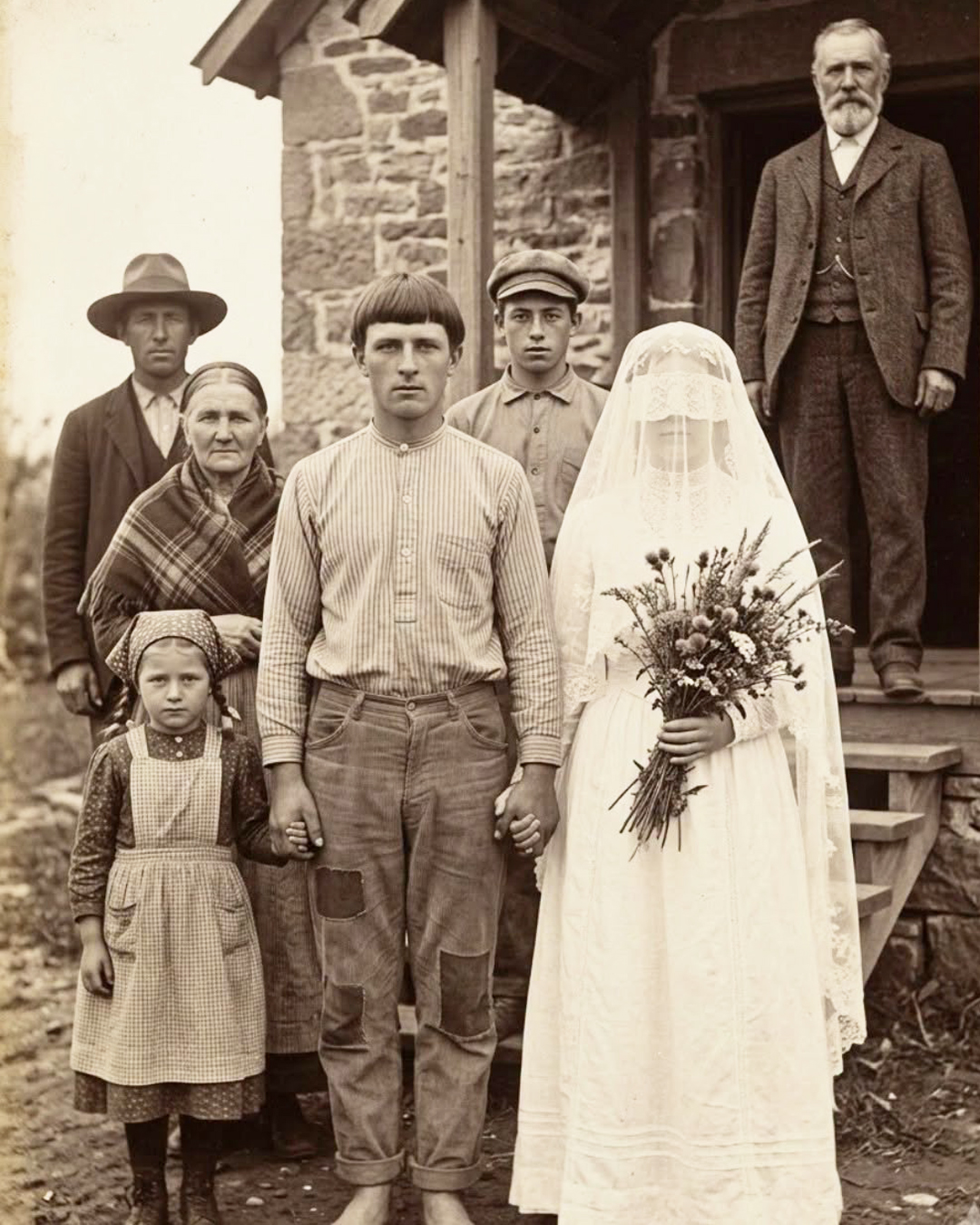
The gathering was modest by the valley’s own measure and still large enough to make her feel displayed. An imam spoke the words. Men signed the paper. Women ululated because that was what women did. Zainab kept her eyes on the pattern of the carpet and felt less like a bride than like an offering being passed from one set of hands to another. When someone told her to smile, she arranged her mouth into the shape they required and let the day continue without her.
Yusha stood a little apart from the congratulations. He was taller than she remembered, and the lines at the corners of his eyes were the kind that come from weather rather than from cruelty. When it was time to leave, he did not take her arm as if he owned it. He waited until she stepped first.
The house below the two apricot trees was smaller than Malik’s and cleaner in a way that suggested care rather than display. A photograph of a woman sat on a low shelf — not large, not theatrical. Dark hair. A mouth that had known how to laugh. Zainab understood at once that this was Noor, the wife the valley still mentioned in the same breath as drought and late frost.
Yusha saw her looking.
“She was my wife,” he said. “She remains part of this house. That does not mean you are expected to become her.”
Zainab did not know what to do with a sentence that left her room. She stood with her small wooden chest at her feet and waited for the instruction that always followed a man’s kindness in her father’s house — the correction, the price, the reminder of who decided. It did not come.
He showed her a room at the back, facing the mint and the slope. The bolt on the inside of the door was new. The wood still smelled of shavings.
“This is yours,” he said. “The bolt is yours as well. I will not open it. No one from this house will open it. If you wish to eat alone, you may. If you wish to speak, I will listen. If you wish to be silent for a long time, that is also a kind of speaking.”
She searched his face for the trick. Men in her experience did not give doors. They gave rules and called them protection.
“Why?” she asked, and then regretted the question, because questions had always cost her.
Yusha looked at the photograph, then at the floor, then at her, as if measuring how much truth a frightened person could carry on the first night.
“Because Noor made me promise,” he said. “She said if I ever married again I was not to take a woman’s fear and call it a wedding gift. I told her I would not marry again. She told me not to make promises I could not keep in a valley like this one. So I kept the part I could keep.”
He left her with water, a lamp, and the key to a chest that already stood empty for her things. He slept on the other side of the house. She bolted the door and sat on the edge of the bed until the lamp burned low, listening for footsteps that did not come.
The first week she moved through the rooms like a guest who expected to be sent back. She cooked because cooking was the language she knew. He ate what she made and washed the pots without comment, as if work were not a test she had to pass. When she spilled tea on the cloth, she braced for the silence that used to follow such a thing in Malik’s kitchen. Yusha only fetched another cloth and said, “It is only tea.”
Only tea. In her father’s house, nothing had ever been only anything. Everything had been evidence.
She began to notice the shape of his days. He rose before light and walked the orchard rows with a patience that did not advertise itself. He spoke to the trees the way some men speak to children they are trying not to frighten. He mended a fence without asking her to watch. He left the good chair near the window for her sewing and took the stool himself. When she mentioned, almost by accident, that the well rope burned her palms, the next morning there was a wrap of old cotton on the handle.
None of it was grand. That was what undid her. She had been raised to recognize authority by its volume. Yusha’s authority, if it could be called that, arrived as space.
The women at the spring were less spacious.
“Has he come to you yet?” one asked, not unkindly, which made it worse.
Zainab looked at the water and said she did not discuss her husband’s house.
“A marriage that is not made real is not a marriage,” another said. “The elders will say so if anyone asks. Your father will say so first.”
She walked home with the jar biting her hip and a new fear walking beside the old one. She had begun, against her training, to feel safe in the bolted room. Safety, she was learning, was a thing other people could still take away with a sentence.
That night she did not bolt the door at once. She sat at the table while Yusha repaired a hinge and said, as evenly as she could, “They are talking.”
He did not pretend not to know.
“They will talk whether we give them a story or not,” he said. “I will not turn their talk into a reason to enter a room you have not opened.”
“My father will come.”
“Then he will come,” Yusha said. “That does not decide what happens inside this house.”
She slept that night with the bolt drawn after all, not because she feared him, but because she needed one place in the world whose lock answered only to her hand.
Malik came on the twelfth day, in the hour when the shadows under the apricot trees were longest. He did not wait to be invited past the gate. He stood in the courtyard as if courtyards were still his by nature, and he looked at Zainab first, then at Yusha, with the particular disappointment of a man who believes a bargain has been only half completed.
“I did not give you my daughter so she could play at being a guest,” he said.
Zainab felt the old shrinking start in her shoulders. She had spent twenty-two years learning the exact angle at which a daughter should stand when a father was angry. Her body remembered even when her mind tried not to.
Yusha did not raise his voice. He set down the basket he had been carrying and placed himself not in front of her like a shield in a story, but slightly to the side, so that she remained visible. It was a small choice. She would remember it longer than many larger ones.
“You gave her,” Yusha said. “I accepted the paper. I did not accept the right to treat her as payment.”
Malik’s mouth tightened. “There is a debt. There is water. The lower fields will not wait while you practice patience. A marriage that is not consummated can be questioned. You know this. The elders know this. I did not send her here to be stored.”
Zainab heard the word stored and felt something in her go very still, the way an animal goes still when it finally understands the shape of the trap.
“I was not told about water,” she said.
Both men looked at her. It was the first time she had spoken in a courtyard without first being asked.
Malik recovered faster. “You were told what you needed. A daughter does not sit at the book. A daughter keeps the house and does not make a spectacle of refusal.”
“She is not refusing the house,” Yusha said. “She is living in it. That is more than some men give their wives in a lifetime.”
“Do not lecture me about wives,” Malik said. “Yours is in the ground. Mine is in the ground. We do what remains.”
The photograph on the shelf could not be seen from the courtyard, but Zainab felt it all the same, as if Noor were another listener who had earned the right to hear her name used as a weapon and to have it refused.
Yusha’s hands stayed open at his sides.
“Noor asked me not to take fear as a gift,” he said. “I will not break that for a spring, and I will not break it for you. If the water is the matter, we will take the water to the elders as water. We will not take this woman to them as proof.”
Malik laughed once, without pleasure. “You think the elders care how gently a widower speaks? They care what holds. They care who yields.”
Zainab stepped forward then. Later she would not be able to say what made the step possible — only that the bolted room had taught her the difference between a door she chose and a door that was chosen for her, and that the courtyard suddenly felt like a third kind of door.
“I will not go back with you,” she said to her father. Her voice did not rise. It did not need to. “You may speak of debt. You may speak of water. You may not speak of my body as if it were a seal on your paper. I am in this house. I will remain in this house. What happens in it will not be decided in the lane.”
Malik stared at her as if a piece of furniture had spoken. For a moment the old power almost worked — the cup set down, the waiting, the demand that she take the words back and become small again. She did not take them back.
He left without blessing and without curse, which in that valley was its own kind of weather. The gate closed. The apricot leaves made their dry sound. Yusha did not praise her. He asked if she wanted tea. She said yes, and then she sat down in the good chair by the window and noticed that her hands were shaking only a little.
Two days later the elders sat under the plane tree with the water book open. Zainab was not required to attend, and she did not. She learned the outcome the way women in the valley often learned outcomes: from the change in the way men walked home. The spring would be shared on a written schedule. Malik’s upper rows would receive their hours. Yusha’s lower orchards would not be held hostage to a marriage bed. The debt in the neighbor’s book was recast as a matter of irrigation, not of daughters. No one called it justice. It was merely a settlement that did not require a young woman to be used as ink.
After that, the house grew quieter in a different way. Not the quiet of Malik’s rooms, which had been a held breath. This was the quiet of two people learning the same work.
Zainab stopped waiting for the correction that did not come. She began to speak of small things first — the mint that wanted cutting, the hen that had stopped laying, the way the evening light made the photograph look almost kind. Yusha answered as if her sentences were not interruptions. When she disagreed about the timing of the harvest, he did not treat disagreement as disrespect. He said, “Then we will look again tomorrow,” and they did.
One afternoon she found, in a drawer he had not hidden, a folded paper in a woman’s hand. It was not long. Noor had written that pain had taught her the difference between a house that held a person and a house that used one. She had written that if Yusha ever sat across from another woman at that table, he was to remember that love, if it came, would come slowly, and that slowness was not a failure. At the bottom she had added a line that Zainab read twice: Do not make her earn the right to be unafraid.
Zainab folded the paper the way it had been folded and put it back. She did not feel replaced by the dead. She felt accompanied by a woman who had understood the valley’s bargains and had tried, from the far side of them, to leave a different instruction.
Her own memories of Malik did not vanish. They did not need to vanish to lose some of their authority. On certain evenings the old shrinking still visited her shoulders when a cup was set down too firmly, or when a man’s shadow crossed the doorway without warning. Yusha learned those evenings without being told in full. He learned to announce himself. He learned not to stand in a threshold. He learned that patience is not the same as waiting for a person to become convenient.
For the first time she understood that strength did not always have to be loud or forceful. It could be a bolt left in a woman’s control. It could be a father refused in a courtyard without a blow. It could be a man washing pots because the pots were dirty, not because he wished to be praised for humility.
What had begun as a marriage forced upon her became, by increments too ordinary to impress the lane, an unexpected partnership. She discovered that she could still hope for happiness without calling hope a betrayal of the girl who had learned to sit still. He learned that trust could not be demanded, collected, or written into an elders’ book. It had to be earned in the same small denominations every day — a listened-to sentence, a door left in her control, a cup set down without a demand.
When, much later, she came to his room of her own accord, it was not because a father had sold a night, and not because a valley required proof. It was because fear had finally run out of arguments, and regard had taken its place. She left the bolt undrawn that morning not as a surrender, but as a choice she could take back if she needed to. He understood the difference. That understanding was the marriage the paper had only guessed at.
Malik did not apologize. Men like Malik rarely do. He continued to speak of duty when he passed her at market. She continued to greet him with the courtesy the old rules required and then walk home to a place where courtesy was not the same thing as surrender. The water rights remained in the elders’ book. Her body did not.
In spring the mint came back thicker. Zainab finished the square of embroidery she had packed in the wooden chest — a border her mother had begun and never lived to close — and set it on the table under the photograph. It was not a grand gesture. It was a woman putting something of her own in a room and discovering that the room could hold it.
She had spent her life under a roof where authority arrived with anger and control. She had been married off as if her future were a tool. What happened next did not unwrite that. It did something more useful. It taught her that a life can be forced at the threshold and still be chosen, piece by piece, on the other side of the door. It taught Yusha that a promise made to the dying can become a shelter for the living. It taught the valley, which did not like to be taught, that a quiet house is not an empty one.
Zainab’s story was never only about an arranged marriage. It was about dignity kept in a place that did not offer it freely. It was about resilience that did not need an audience. It was about the slow work of healing, and about a woman discovering that her feelings were not an inconvenience to be managed but a fact that belonged to her.
Even when people cannot choose the circumstances that deliver them, kindness and respect can still give them the courage to build a different kind of life. In a small house below two apricot trees, with a bolted door that no longer needed its bolt, that is what they did.