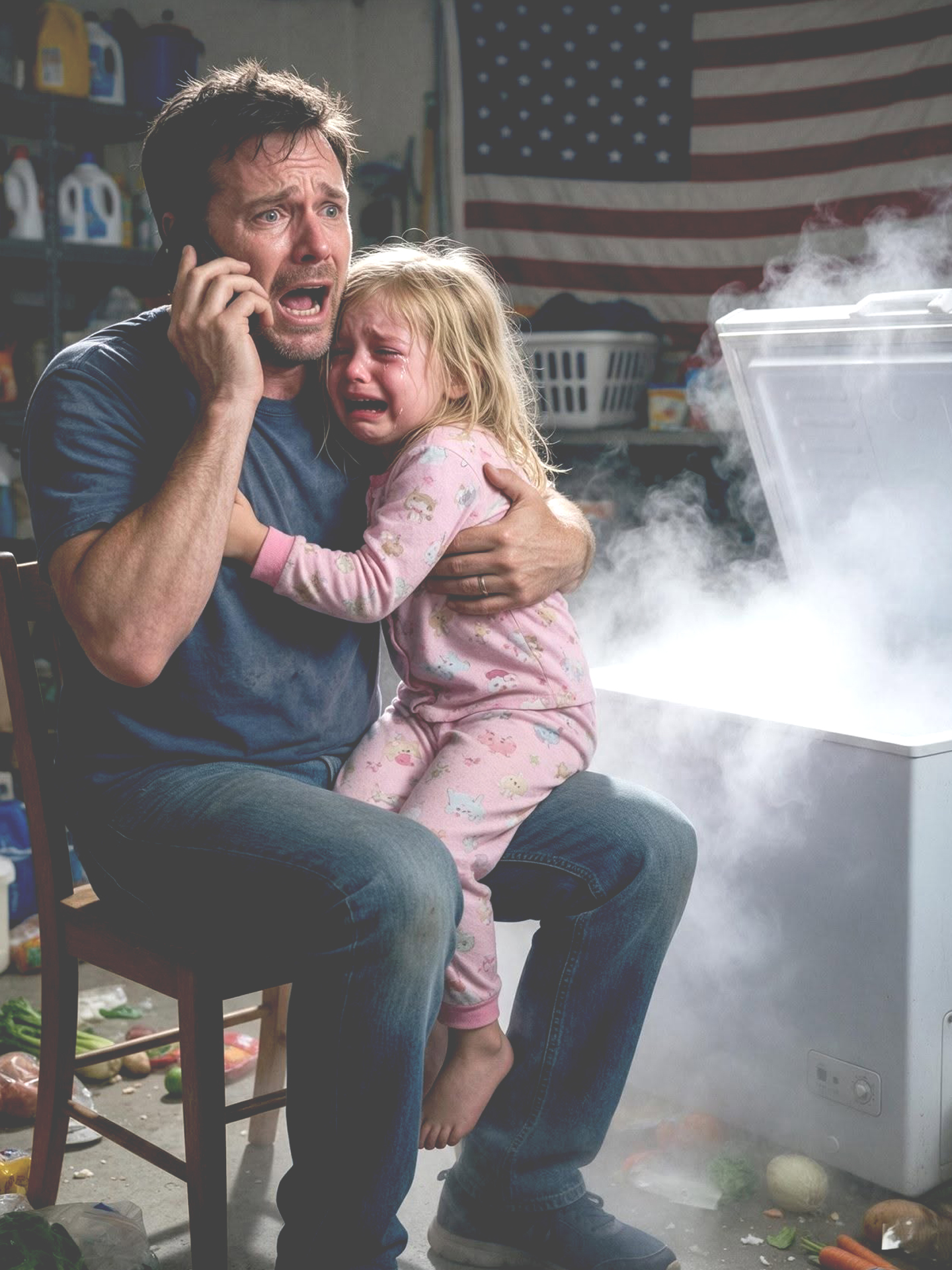
As I wrapped her in my coat, she whispered, “Grandma puts me in here when I’m bad.” Then she pointed at a second freezer secured with a heavy padlock. “Daddy, please don’t open that one…” PART 1: The sound coming from inside the freezer was weak and distorted, almost as though it had fought its way through layers of ice before reaching me. For several seconds, my mind refused to understand what I was hearing because accepting the truth would mean confronting something unimaginable. I was standing inside the garage of the house that had once been mine. It was
9:47 on a bitter October night in Colorado, only three weeks after my divorce from Whitney had become final. Whitney had kept the house on Juniper Ridge Lane while I moved into a small apartment in Thornton. What remained for me was an empty apartment, a broken marriage, and far less time with my daughter Piper than I’d ever wanted. Earlier that day, Whitney had sent me a brief message. “Pick up your stuff by Friday.” There was no greeting or explanation, only another deadline. Instead of waiting, I decided to come Thursday night and collect whatever remained of
my belongings. When I arrived, the garage door was wide open, spilling yellow light into the darkness. Whitney’s car was nowhere in sight, but another vehicle immediately caught my attention. It belonged to Dolores, my former mother-in-law. I stepped into the garage, surrounded by cardboard boxes, abandoned furniture, and scattered pieces of the life I’d once shared with Whitney. Then I heard something that made every thought disappear.
A scream.
It was faint but unmistakably terrified, and it was coming from the chest freezer against the wall. I stood frozen for a heartbeat, desperately trying to convince myself I’d misunderstood.
Then the voice came again.
“Daddy! Help!”
My body reacted before my mind could catch up. I sprinted across the garage, seized the freezer handle with both hands, and ripped the lid open.
A wave of freezing air struck my face. Inside was Piper.
My daughter was curled tightly between packages of frozen food, her lips blue and her entire body trembling uncontrollably. I immediately reached inside, lifted her out, and pressed her against my chest.
“I’ve got you… I’ve got you.”
I kept repeating those words while wrapping her as tightly as possible in my arms. Her little body continued shaking against me as I tried to understand how long she’d been trapped inside.
“How long were you in there?”
“I don’t know…”
Then Piper whispered something that made the cold suddenly feel insignificant.
“Grandma put me in.”
I stared at her, barely able to process what she’d said.
“What?”
“She puts me in when I’m bad… she says it helps me think…”
I immediately looked toward the entrance leading into the house. Dolores’s car was outside, and rage collided with fear as I realized my daughter wasn’t describing an accident.
Before I could move, Piper grabbed tightly at my jacket.
“Daddy… wait…”
I turned toward her, and she pointed across the garage. Another freezer stood against the opposite wall. This one was different. It was smaller, older, disconnected from power, and secured with a thick padlock around the lid.
A terrible feeling settled over me as I stared at it.
“Don’t open that one.”
I looked back at Piper.
“Why?”
Her voice became barely audible.
“That’s where the bad ones go…”
My heart began pounding.
“The ones who don’t come back.”
I didn’t touch the second freezer. I carried Piper outside instead, placed her inside my truck, turned the heater to maximum, and wrapped every blanket I could find around her trembling body.
“Lock the doors. Don’t open them for anyone.”
Piper nodded.
I closed the truck door and stood there for a moment, trying to control my breathing. Then I turned back toward the illuminated garage and stared at the padlocked freezer waiting inside.
I had come to Juniper Ridge Lane that night expecting to collect the last pieces of my old life.
Instead, I’d found my daughter trapped inside one freezer.
And now I had no idea what was waiting inside the other one…
PART 2
I called 911 with my back against the truck door, where I could see Piper through the glass and the garage through the windshield.
“My six-year-old daughter was locked in a chest freezer,” I told the dispatcher. My voice sounded like someone else’s. “She’s conscious, but she’s freezing and her lips are blue. I need an ambulance at 4418 Juniper Ridge Lane, in Thornton.”
The dispatcher kept me talking. She told me to get Piper out of her damp clothes and wrap her in dry layers, skin to skin if I could manage it. I climbed into the back seat, peeled off Piper’s wet pajama top, and zipped her inside my coat against my bare chest. She was so cold it hurt to hold her.
“Daddy, am I in trouble?”
“No, baby. You’re not in trouble. You never were.”
“Grandma says I’m always in trouble.”
I pressed my cheek against her hair and made myself breathe. “Grandma is wrong.”
I heard the front door of the house open.
Through the window, I saw Dolores step onto the porch in her quilted vest, a dish towel in one hand. She looked toward the open garage, then toward my truck. She didn’t hurry. She didn’t look frightened. She looked annoyed, like a woman who’d found a stranger in her kitchen.
I laid Piper across the seat, tucked the blankets around her, and told her to stay down. Then I got out and shut the door behind me.
“Grant,” Dolores said, because that was my name, and she’d always said it like a verdict. “You’re early. Whitney said Friday.”
“Where is she?”
“At work. Night shift.” She looked past me at the truck. “Why is Piper in your vehicle?”
“Why was she in your freezer?”
She didn’t flinch. That was what I remember most, that she didn’t flinch.
“Don’t be dramatic. It was a few minutes. The child’s been impossible all week. Lying, hitting, screaming at bedtime. Someone has to teach her to settle down.”
“A few minutes.”
“The freezer wasn’t even running that high.” She folded the towel over her wrist. “Your generation doesn’t understand discipline. That girl needs a firm hand, and her mother is too soft to give her one. I’m trying to help.”
I took one step toward her, and she stepped back onto the porch. I stopped, because I didn’t trust what my hands would do if I kept going.
“You’re not going to touch her again,” I said. “You’re not going to go near her. The police are on their way.”
For the first time, something moved across her face. It wasn’t guilt. It was calculation.
“Whitney will tell them it was a game,” she said. “Piper climbs into things. You know she does.”
“Piper was locked in. The lid was latched from the outside.”
“You can’t prove that.”
“I don’t have to.” I could hear sirens now, distant but climbing. “I only have to stand here.”
She went back inside and shut the door. I heard the deadbolt turn. I didn’t follow her. I stayed between the house, the garage, and my daughter until the first patrol car swung onto the street, followed a minute later by an ambulance, red and blue light washing over the snow-crusted lawns.
PART 3
Piper’s core temperature was 94.1 degrees when the paramedics got her into the ambulance.
“That’s mild hypothermia,” the paramedic told me, wrapping a heated blanket around her. “She’s lucky you came when you did. Another hour in there, and we’d be talking about a very different night.”
I rode in the back with her. She held my thumb the whole way and watched the ceiling lights slide past.
At Children’s Hospital Colorado, they warmed her gradually and checked her skin, her heart rhythm, and her lungs. A pediatrician named Dr. Okafor examined her with the patience of someone who had learned to talk to frightened kids. Afterward, a hospital social worker named Ms. Reyes asked if she could speak to me in the hallway.
“Mr. Halvorsen, I’m required to call Adams County child protective services, and the police have already asked to interview Piper. We’ll do it gently, with a forensic interviewer, and you can stay close by.”
“Do whatever you need to do.”
Detective Maribel Cruz arrived just after midnight. She was in her forties, with her hair pulled back and a steady, unhurried way of speaking. She told me they had secured the house and the garage, and that Dolores Whitaker was being questioned.
“There’s something else,” she said. “The second freezer. I’d like to explain what we found before you hear it from anyone else.”
My stomach dropped. “Tell me.”
“Officers opened it under a warrant about an hour ago.” She paused. “It wasn’t what your daughter led you to believe. But it’s still significant.”
She showed me photographs on her tablet. The old freezer was lined with towels, and stacked inside were stuffed animals, a pink plastic tea set, a doll with a missing arm, and a child’s scooter folded in half. In the corner sat a battered green notebook sealed in a gallon bag.
“Those are Piper’s things,” I said slowly. “Her toys.”
“Your daughter has been told that toys that are ‘bad’ go in there, along with children who misbehave,” Detective Cruz said. “We believe Mrs. Whitaker confiscated the items as punishments and told Piper they were gone for good. The padlock may have been part of the story, a way to make the threat seem real.”
“The ones who don’t come back,” I said.
“Yes.”
I pressed the heel of my hand against my eyes. I’d spent three weeks imagining the worst thing a person could find inside a freezer, and the truth wasn’t that. But it told me exactly what kind of mind had built the rest of it: a woman who had turned a six-year-old’s fear into a system.
“What about the notebook?”
Cruz turned the tablet. The pages were lined, filled with neat cursive in blue ink. Dates ran down the left margin. Beside each one were short entries.
Sept. 4. Screamed at bedtime. Freezer, 8 min.
Sept. 11. Refused vegetables. Freezer, 12 min.
Sept. 19. Hit Whitney’s phone out of my hand. Freezer, 15 min. Cried less. Progress.
There were more than forty entries. The last one was dated that night: Oct. 17. Told lies about Grant. Freezer, 20 min.
“She kept records,” Cruz said quietly. “She thought of it as a program.”
I read the final line three times. Told lies about Grant. My daughter hadn’t lied. She had probably said she missed me.
“The times are short,” I said. My voice shook. “She says eight minutes, twelve minutes.”
“Mrs. Whitaker’s account of the timing doesn’t match what we’ve observed. The freezer was unplugged, which she may have believed made it safe, but the lid seals and the interior is rigid plastic. Your daughter’s temperature suggests she’d been inside much longer than twenty minutes.” Cruz set the tablet down. “The medical team will document that.”
At 1:15, Whitney walked into the pediatric wing.
She was still in her scrubs, her face stripped of color. A uniformed officer had met her at the hospital entrance, and she looked like someone who had been told only half a sentence and filled in the rest.
“Grant.” She stopped five feet from me. “Where is she?”
“She’s asleep. She’s okay.”
Whitney’s knees gave, and I caught her elbow before she could hit the floor. She stood there shaking, clutching my arm, and I realized this was the closest we’d stood in months.
“I didn’t know,” she whispered. “I swear to God, I didn’t know about the freezer.”
“Did you know about the punishments?”
She closed her eyes.
“She told me she was using time-outs. She said Piper was acting out because of the divorce, that she’d handle it. I was working doubles. I was so tired, and I wanted to believe her.” She wiped her face with both hands. “Piper started flinching when I put her in the car. She stopped sleeping. I thought it was us. I thought it was the divorce.”
I didn’t answer. I didn’t know how to hold her guilt and my anger in the same hand.
“I should have asked more questions,” she said.
“Yes,” I said. “You should have.”
She nodded, tears running down her face, and didn’t defend herself. That was the first thing she’d done in a year that made me think she might be able to fix any of it.
FINAL PART
Dolores Whitaker was arrested at 2:40 that morning.
She was charged with child abuse resulting in injury, false imprisonment, and reckless endangerment. Her attorney argued that she was an elderly woman from a different era whose methods had been misunderstood. The prosecutor in Adams County put the green notebook into evidence, and then read the entries aloud, one after another, until the argument stopped sounding like a defense.
Dolores accepted a plea agreement four months later. She was sentenced to prison, with a permanent protection order forbidding any contact with Piper.
Whitney’s case was handled separately. Child protective services found no evidence that she’d known about the freezer, but they documented her failure to act on warning signs, and a judge awarded me temporary primary custody while the family court evaluated the situation.
I braced for a fight. Whitney didn’t give me one.
“I don’t want to take her from you,” she told me at the first mediation, her hands twisted in her lap. “I want her safe. I want to deserve her back. Tell me what to do.”
I had been angry at her for a long time, long before the garage. But anger was a luxury I couldn’t afford when Piper needed us both to be better than we had been.
We agreed on a plan: Whitney would complete a parenting course and begin her own therapy, and she would see Piper in supervised visits that would loosen over time as the counselors judged it safe. It wasn’t forgiveness, and it wasn’t a reconciliation. It was a path.
Piper started trauma therapy in November with a play therapist named Dr. Linden, who kept a basket of puppets in the corner of her office and never once told my daughter to hurry.
The early months were hard. Piper wouldn’t go near our apartment’s freezer. She asked me to check the closets before bed, and then the closets again. She woke at night with her hands pressed over her mouth, silent, as if even crying were something that could get her punished.
“Is Grandma coming back?” she asked one evening.
“No, sweetheart. Grandma isn’t allowed near you ever again.”
“What if she tells me I’m bad?”
I knelt in front of her.
“Then you’ll remember what Daddy says. You’re not bad. You were never bad. What Grandma did was wrong, and it was never your fault.”
She studied my face for a long time.
“Okay,” she said.
It wasn’t belief yet. But it was the first step toward it.
Dr. Linden suggested something small. We brought Piper’s confiscated toys home from the evidence room once the case closed, and I let her decide what to do with them. She laid them on the living room rug in a row: the stuffed rabbit, the tea set, the doll with the missing arm.
“They didn’t come back,” she said.
“They did,” I said. “You brought them back.”
She hugged the rabbit for an hour.
By spring, she was sleeping through most nights. By summer, she was laughing again, the loud, unguarded laugh I’d feared I would never hear after that October. She took swim lessons at the community pool, and I stood at the edge with a towel while she screamed with delight and splashed me, and I thought, this is what I almost lost.
Whitney’s visits went well. She showed up on time, every time. She brought coloring books, and she listened. Piper was wary at first, then curious, then, slowly, glad. At one session, I watched through the observation window as Whitney knelt down and said something quietly. Piper threw her arms around her mother’s neck.
By the following autumn, the court granted shared custody with a gradual schedule. Whitney and I didn’t become friends, exactly. But we spoke to each other with a careful respect we’d never managed during the marriage, and we both knew why.
On the one-year anniversary of that night, I drove past the house on Juniper Ridge Lane. It had been sold the previous spring. The garage door was closed, a swing set stood in the yard, and a different family’s minivan sat in the driveway.
I didn’t stop. I just looked, the way you look at a place where something terrible happened and then stopped happening.
When I got back to the apartment, Piper was at the kitchen table, drawing.
“What’s that?” I asked.
She held it up. It was a picture of the two of us standing outside a house with a bright yellow door, holding hands under a huge sun.
“That’s our new house,” she said.
“We don’t have a new house, bug.”
“We will.” She said it with total certainty. “It’ll have a big garage, and no freezer, and the door will always be open.”
I knelt down and wrapped my arms around her, and she patted my back like I was the one who needed comforting.
Maybe I was.
I still think about the sound that reached me through the freezer lid, that thin, desperate Daddy, help. I think about how close I came to arriving an hour later, or on Friday as instructed, or not at all.
But I don’t let myself stay there long. Piper taught me that, in her small, stubborn way. You can remember the worst night of your life without living inside it.
So I turn the memory over, put it away, and get on with the business of being her father: checking the closets, answering the questions, and showing up when she calls.
Every single time.