The Messages on the Old Phone Twenty-eight days away, then twenty-eight days home—that was the rotation I had accepted when I took a job maintaining electrical substations across the wide, windy stretches of West Texas. The work paid better than anything I could find near our house outside Little Rock, Arkansas, and the money covered the mortgage, our son’s speech therapy, and the small wooden fort I had built beneath the porch for him. I told myself the long stretches away were temporary, a sacrifice we were making for the family we wanted. My son, Eli, was eight.
He was a small, thoughtful white American boy who took his time with strangers but could talk to me for an hour about the lizard in his aquarium, a book he had read at school, or the secret fort he was improving one board at a time. When I was away, I called him every evening at seven. He would show me whatever he had made that day, and I would ask about his spelling list or the little green lizard he had named Pickle. Lately, though, our calls had been getting shorter. “He’s worn out,” my wife, Paige, would say, holding the phone at arm’s length while Eli sat somewhere just
out of view. “He’s already in bed.” I would glance at the time on my screen. “It’s only seven.” “Kids change, Nolan. He’s fine. You don’t need to worry about every little thing.” I wanted to believe her. From my temporary work site, believing her was easier than wondering what was happening in the home I had left behind. I kept working, finished my shifts, and counted the days until my scheduled trip back. Then a severe weather warning moved across the region, and the project supervisors shut down the site early. A crew flight was arranged, and I arrived home two weeks before my rotation was supposed to end. I did not call ahead. I wanted to surprise Eli, the way he used to surprise me by waiting beside the garage with a drawing held behind his back.
I turned into our driveway at 9:58 that night and saw a pickup parked where my truck usually went. It was lifted high above the pavement, with dried mud along the tires and a plastic cooler in the back. The front door was unlocked.
The television was loud enough to hear from the entryway, with a football game playing beneath the steady commentary of two announcers. Two boys I had never met sat across the couch, one with a bowl of chips balanced on his stomach and the other leaning forward to watch the screen. Both looked somewhere around ten or twelve, and both were white American boys with restless, careless energy. A large, bare-chested man was asleep in my recliner, his work boots planted on the rug and a half-empty beer resting in his hand.
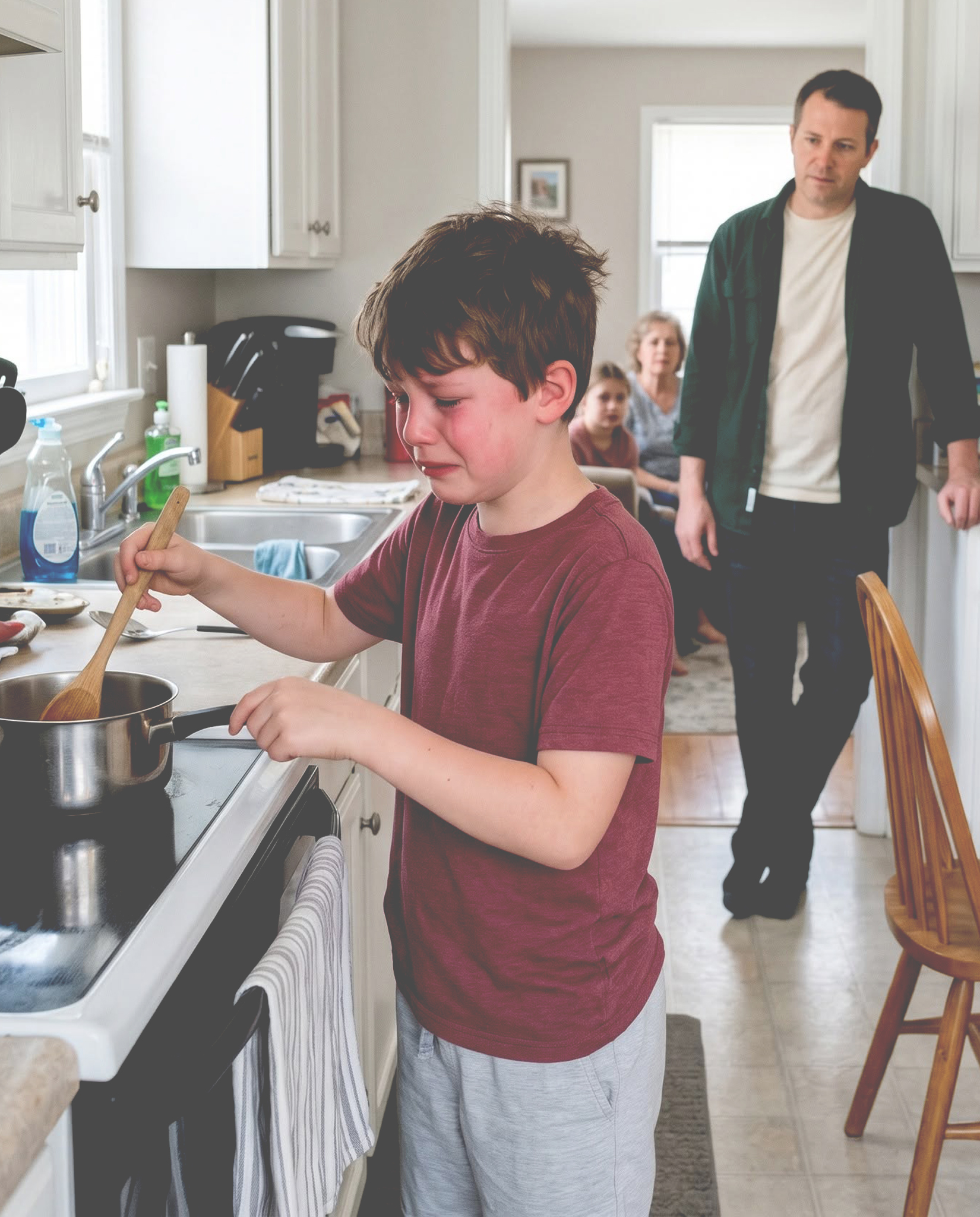
In the kitchen, my son stood on a chair so he could reach the stove.
He was stirring boxed macaroni in a saucepan, still wearing his school uniform, though it was wrinkled and stained. His hair had grown long enough to fall into his eyes, and he looked thinner than I remembered. A strip of silver duct tape covered his left forearm from wrist to elbow.
“Eli.”
He spun around so quickly that one foot slipped near the edge of the chair. For a moment, his whole face brightened; then the smile vanished, replaced by a look of fear I had never seen directed at me.
“Dad, you’re not supposed to be home.”
I lifted him off the chair and held him against my chest. He felt too light, as though the boy I had hugged before leaving had somehow become smaller while I was gone.
“What happened to your arm, buddy?”
His eyes shifted over my shoulder toward the man in the recliner.
“I got burned,” he whispered. “It’s okay. I put tape on it.”
“Who hurt your arm?”
He did not answer. Instead, he spoke quickly, as if he had been practicing the words and needed to get them out before someone heard.
“Please don’t be mad, Dad. Travis says if dinner’s late, I have to sleep in the shed.”
The shed was the narrow wooden building behind the house, the one I had put up to keep the mower and garden tools out of the weather. It had no windows and no proper lighting.
The man in the recliner opened his eyes. He looked at me, then at Eli in my arms, and rose to his feet without hurrying. He was broad through the shoulders, with a tattoo climbing the side of his neck.
“You must be Nolan,” he said. “I’m Travis. Paige’s friend.”
“Where is my wife?”
“Out with friends in Tunica. Somebody’s got to keep an eye on the kids while she gets a night off.” He glanced at Eli. “Your boy could use a little discipline. He gets worked up over everything.”
The boys on the couch laughed.
“He cried when Dad made him sleep in the shed Tuesday,” the older one said.
Travis gave an easy shrug, as though the matter were too ordinary to discuss.
“Builds character. My dad was tougher than I am.”
I set Eli down behind me and felt every part of my body tense. I wanted to grab Travis by the front of his shirt and demand every answer he owed me, but my son was shaking beside the kitchen counter, and I knew that whatever I did next would become another thing he had to remember.
The loudest man in a room is not always the one who has the most control. I had learned that on job sites, where a careless move could put several people at risk.
So I kept my voice level.
“Thanks for watching him.”
Travis smiled as if I had confirmed what he already thought about me. He believed I was the kind of man who would complain a little, then leave again.
Paige came home at one in the morning, smelling of perfume and cigarettes. She stopped when she saw me at the kitchen table.
“Nolan. You’re early.”
“Who is Travis?”
She lifted her chin, already bracing for a fight.
“Someone who’s actually here. You’re gone half the year, and you don’t get to come home and judge me.”
Then she noticed the tape around Eli’s arm and rolled her eyes.
“He grabbed the pan handle. He’s clumsy. He’s always been clumsy.”
The next morning, while Paige slept, I searched the closet in my old office for a bandage. Beneath a stack of folders, I found the phone I had stopped using when I bought a new one for work. It had no SIM card and could not make calls or send messages, but the battery still held a charge.
One note had been saved in the Notes app. The heading read: FOR DAD.
There were twenty-six entries beneath it, each written on a different night. None had been sent because the old phone had no way to send anything.
The first one said:
Day 1. Hi Dad. I’m writing to you every night like you said. I’m okay.
I scrolled to the last entry, dated two nights before I came home. I read it standing in the closet, with one shoulder pressed against a shelf, and by the time I reached the final line my hands were trembling.
Twenty-Six Nights
Day 26. Dad, Travis pressed my arm on the stove because the noodles burned. A man left a paper on our door. Mom cried. Travis said the bank is taking our house and it’s your fault for not sending enough money. Mom said I can’t tell you because you’ll find out where the money went. Please come home. I’m not okay.
I read it four times.
Then I lowered myself to the closet floor and cried for the first time since my father’s funeral. Eli had been writing to me every night on a phone that could not reach me, while I had been listening to Paige say he was already asleep.
I kept reading.
Day 9. Travis’s boys took Pickle. They said he got out.
Day 14. I slept in the shed. It was dark. I counted to one thousand.
Day 19. Mom said if I tell you anything, you’ll stop sending money and we’ll lose the house.
Day 22. I miss you. I put your work sweatshirt on my pillow.
I took a screenshot of every entry and saved a copy to my current phone. Then I went looking for the paper Eli had mentioned.
I found it folded inside Paige’s purse on the kitchen counter: a notice from the mortgage company saying we were four months behind. I had sent money for the mortgage every month. Beneath the notice was a stack of casino markers from the Tunica casino, totaling more than thirty thousand dollars, along with a cashier’s check made out to Travis for eight thousand. The note beside it read, “Truck payment.”
My paychecks had been keeping our house afloat, and some of that money had been diverted to gambling and to the man sleeping in my recliner.
I went outside before calling anyone. I did not want Eli to overhear more arguments in the kitchen, and I needed a moment to make sure that anger did not make decisions for me. From the driveway, I called the local sheriff’s office. Then I called Paige’s mother, Marlene, who lived in Fayetteville, Arkansas.
She began crying as soon as I told her what I had found.
“She asked me for money twice this summer,” Marlene said. “She told me you’d lost your job. Nolan, I had no idea.”
Two deputies came to the house at nine the next morning. Travis was asleep in the recliner again. One deputy spoke with him while the other came to the kitchen and asked Eli if he could look at his arm. The deputy peeled back the duct tape gently, stopping whenever Eli tensed.
Beneath it was a serious burn, swollen and irritated around the edges, with a shape that matched the rim of a pan. The deputy’s expression changed.
“Who did this, son?”
Eli looked at me.
I knelt beside him so our eyes were level.
“You can tell the truth now, buddy. I’m home, and I’m staying.”
Eli pointed at Travis.
The deputies placed Travis under arrest in the living room while his sons watched from the couch. Paige came downstairs in her robe and began shouting before she was fully awake.
“You’re ruining my life! You’re never here! You don’t get to come in and—”
One of the deputies lifted the purse from the counter, where the mortgage notice and casino markers were still visible.
“Ma’am, you should stop here and speak with a lawyer.”
Travis faced charges related to his treatment of Eli. Paige faced charges connected to neglect and failing to report what had happened. That afternoon, a judge granted me emergency custody. My lawyer and I brought the mortgage current within nine days, and the house remained ours.
Marlene drove down from Fayetteville the next morning, bringing a new lizard in a shoebox with small holes in the lid. Eli held the box as if it were something precious, though he did not open it until we got home.
I left the traveling job and accepted a position at a local power facility, where I worked the day shift and could be home by five. The pay was lower, but I had begun to understand that the numbers on a paycheck could not measure what it meant for my son to see me walk through the door.
Eli’s arm healed, leaving a pale crescent-shaped scar. He decided it looked like a shark had taken a very small bite, and told that version of the story to anyone who asked. I did not correct him.
On our first night alone in the house, Eli climbed into my bed with the new lizard and the old phone.
“Can I still write to you?”
“You don’t have to anymore, buddy. I’m right here.”
He considered that for a moment.
“I want to. So you never miss a day again.”
After that, he typed an entry each night before bed. I read it the next morning over cereal.
The first one said:
Day 1. Dad made pancakes. The lizard’s name is Rig. I’m okay. For real this time.
What Came After
People talk about the moment the deputies take someone away as if that is when a difficult story ends. For us, it was only the point at which the hardest parts became visible.
The next morning, I took Eli to a pediatric burn clinic in Little Rock, where a nurse named Mrs. Keene cleaned and dressed his arm while he stared at the ceiling and counted aloud.
“Four hundred twelve. Four hundred thirteen.”
“You can stop counting, buddy,” I told him.
“I’m not scared,” he said. “I just like numbers when it hurts.”
I had to step into the hallway. The doctor explained that the burn would leave a scar, but the irritation around it had been caught in time. Another week without care could have made the situation far more serious. She spoke gently, but she also recorded every detail in Eli’s medical chart, which later became part of the court record.
Two days later, Eli went to a Children’s Advocacy Center for an interview. I was not allowed in the room, so I sat on a couch beneath a painting of a cartoon whale, holding a cup of coffee that grew cold in my hands while a counselor named Mrs. Weller talked with my son behind a closed door.
When she came out, she sat beside me.
“He’s very brave,” she said. “And he’s worried about you.”
“About me?”
“He asked three times whether you were mad at him.”
I looked at the painted whale until my eyes stopped stinging.
“I’m not mad at him,” I said. “I’m mad at myself.”
She did not tell me there was no reason to feel that way. Instead, she said, “Then let’s make sure he hears the first part more often than the second.”
I called the speech therapist who had worked with Eli for two years. I had stopped the sessions in the spring after Paige told me he no longer needed them. She had said it with such confidence that I accepted it, because accepting it was easier than wondering what I might find if I came home.
The therapist, Mrs. Carter, listened while I explained what had happened. Her voice softened, and for a moment neither of us spoke.
“Bring him Thursday,” she said. “Don’t worry about the bill.”
“I can pay it.”
“I know. Bring him anyway.”
The legal case moved slowly. The prosecutor, a careful woman named Ms. Merritt, warned me that everyone would examine the evidence, including the notes on Eli’s phone.
“People want a simple story,” she said. “The defense will try to make this confusing. We need to be prepared for every detail.”
“The notes are real.”
“I believe you. The court will need more than my belief.”
A forensic specialist at the sheriff’s office made a complete copy of the phone’s data and examined the entries. He confirmed that they had been created on the nights Eli had listed, in the order he had written them, on a phone with no SIM card and no ability to send messages. He also noticed that the last entry had been edited several times.
“He started it, stopped, came back, and rewrote part of it,” the specialist said. “It looks like he removed a few lines.”
“Can you recover them?”
He shook his head. “Not from this phone. I’m sorry.”
I sat in the parking lot afterward, thinking about what an eight-year-old boy had decided not to tell me, even in a note he believed I would never receive.
Travis’s lawyer argued that Eli had been coached, that the injury came from an accident, and that Travis had only been staying at the house as a guest. The last claim created a problem for Paige’s legal team, because it placed all responsibility on a man she had described as someone she trusted to care for her child.
Within days, the two legal teams stopped presenting a united front. Paige’s lawyer called mine.
“My client wants to cooperate,” he said.
My lawyer asked, “With what?”
“Everything.”
The Hearing
I did not sit across from Paige until the custody hearing. She had lost weight, and her hair was pulled back without much care. She wore a plain gray blazer and little makeup. When she entered the courtroom, she looked both younger and older than I remembered. She glanced at me once, then turned toward the table.
The judge was a gray-haired woman who wore reading glasses on a chain. She reviewed the deputy’s report, the clinic’s records, the phone data, the mortgage notice, the casino markers, and the check written to Travis.
Then she looked over her glasses at Paige.
“Mrs. Larkin, do you dispute that Eli was left in Mr. Cole’s care while you were away from the home?”
Paige’s lawyer leaned toward her, but she answered before he could speak.
“No, Your Honor.”
“Do you dispute that Eli was made to sleep in an outbuilding?”
Paige paused for a long time.
“I didn’t know about it at first,” she said. Then she lowered her eyes. “That’s not true. I knew about it on Tuesday. I told myself it was only one night.”
The room went quiet.
For a month, I had hated her. In my mind I had practiced what I would say in the truck, on the drive to work, and alone in the shower. In none of those rehearsals had I imagined that she would admit something plainly.
The judge granted me full temporary custody and ordered Paige to undergo an evaluation, including treatment for her gambling. Any time with Eli would be supervised until the court decided otherwise.
In the hallway after the hearing, Paige reached for my sleeve. I looked at her hand until she let go.
“I’m not asking you to forgive me,” she said.
“Good.”
She swallowed and looked down at the floor.
“I read the notes. My lawyer gave me copies. Day 22, the one about your sweatshirt—I read that one a lot.”
I had cruel words ready. I could have used them, and perhaps some part of me wanted to. Instead, I told her the one thing I knew she needed to hear.
“He was saying good night to me every night, Paige. You knew what was happening, and you let him keep believing I couldn’t hear him.”
She nodded, tears in her eyes, and followed the deputy down the hall.
Travis eventually accepted a plea agreement. There was no speech or apology, only paperwork and a sentence of several years for his treatment of Eli. His sons were placed with their aunt in a nearby town. The older boy, the one who had mentioned the shed, sent Eli a letter through the caseworker.
It was a single page written in pencil, with erased marks still visible.
I’m sorry about your lizard. It didn’t get out by itself. My dad let it out the back door. I knew, and I didn’t tell you. I should have.
I let Eli decide whether to read it. He held the letter for two days, then took it onto the porch and read it by himself. When he came back inside, he placed it on the table.
“He’s a kid too, Dad.”
“Yeah, buddy. He is.”
“I’m not mad at him anymore. Is that okay?”
I crouched so we were eye to eye.
“It’s okay to be mad, and it’s okay not to be. You get to decide how you feel.”
He nodded, then asked if we could have pancakes, even though it was dinnertime. We ate pancakes for dinner more than once that fall.
A Place to Put the Day
Paige did the work that was asked of her. I want to say that plainly, because this is not a story I tell simply to make her the villain. She entered a treatment program in Little Rock, sold the SUV my paychecks had purchased, and put the money toward the overdue mortgage. She made a full statement about the missing money, which helped the lender agree to a new payment plan that allowed us to keep the house.
She attended every session the court ordered and some that had not been ordered. Each week, she wrote Eli a letter. I read each one before handing it to him, and none asked him to comfort her or promise that things would go back to the way they had been. Most were about ordinary details: a bird outside the treatment center window, a book she was reading, or a joke she thought he might like.
For the first four months, Eli would not open the letters. I did not push him.
Then one afternoon in February, he came into the kitchen holding an envelope.
“Can you read this one first?” he asked. “I want to know if it’s mean.”
It was not mean. Paige said she was sorry, that none of what had happened was his fault, and that she did not expect him to feel anything he did not feel.
Eli listened until I finished.
“Okay,” he said, then went back to his room.
Their first supervised visit took place in April in a family room at the courthouse. A caseworker brought board games, and I waited in the hall outside the glass door. Eli walked into the room and stopped a few feet from Paige. Neither of them moved for a while.
Then he said something I could not hear. Paige covered her mouth with both hands.
The caseworker told me afterward what he had said.
“I don’t know if I’m ready to hug you. But I brought Rig. You can say hi to him.”
He had carried the lizard in a shoebox with holes in the lid. They sat together on the floor for forty minutes, a mother who had hurt him and a boy who was learning that he could decide for himself what forgiveness might mean.
I do not know whether Paige and I will ever be friends. I do not know whether she will ever have the house again or what her relationship with Eli will look like years from now. The court reviews those questions one step at a time. What I know is that Eli gets to set the pace, and the adults around him have agreed to follow it.
I still work at the local power facility. I am home by five. The swing set remains in the backyard, and the fort is still beneath the porch. Last spring, Eli and I rebuilt it together, this time with a real door, a window, and a latch that opens only from the inside.
He chose the latch. I did not ask why.
On the three-hundred-and-sixty-fifth night after he first began writing, I found him sitting on the back steps with my old phone, tapping slowly at the screen. In the porch light, the scar on his arm looked like a pale crescent moon.
I sat beside him.
“You don’t have to keep writing, you know. You can stop whenever you want.”
“I know.”
“Then why do you?”
He thought for a while before answering.
“The first twenty-six were for you to find. These ones are just for me. I like having a place to put the day.”
I put my arm around his shoulders. He leaned toward me the way he used to when he was small enough to fall asleep in the truck.
“Can I read it?”
He turned the screen toward me.
Day 365. Dad picked me up from school and was early. He’s always early now. I’m taller than the doorknob on the shed. I don’t think about the shed much anymore. Rig is fat. Mom’s visit was good. I laughed at something she said and then felt weird, but then it was okay. I’m learning that you can feel two things. Dad says that’s normal. I’m okay. I’m better than okay. I’m home.
I read it twice. Then I did something I had done only once before in my adult life, on a closet floor with that old phone in my hand.
I cried.
This time, my son placed his hand on my back.
“It’s okay, Dad. You can write one too.”
I took the phone and typed beneath the twenty-six notes that had never reached me and the hundreds that had followed.
Day 1, for real this time. I’m here. I’m not leaving. I love you.
I handed the phone back. Eli read the words and nodded.
“Send.”
“It can’t send, buddy. There’s no SIM.”
He smiled, the lopsided smile I had missed during all those calls from faraway work sites.
“I know,” he said. “But it got there.”