The Empty Chairs I was sitting in the small chapel at St. Matthew’s Hospital when I called my father. My hands were still shaking, and the paper cup of water beside me had gone untouched. Through the chapel windows, the afternoon light fell across the floor in pale rectangles, the kind of ordinary detail that stays with you when everything else has stopped making sense. My husband, Samuel, had been driving our two children along Interstate 81 outside Roanoke that morning. A commercial truck crossed into their lane, and there had been no time for Samuel to steer away.
By the time I reached the hospital, the doctors had told me there was nothing more they could do. My daughter, Annie, was eight. My son, Owen, had just turned five. Samuel was thirty-nine, and he had been the person who made even a routine Tuesday feel like a day worth remembering. I was the only one in our little family who had not been in the car. That fact settled over me with a terrible weight. I was still here, still able to breathe and make phone calls, while the three people I loved most were gone. I knew there was no reason to blame myself for not being in the car, but
grief does not always wait for reason before it begins asking questions. My father answered on the fourth ring. Behind him I heard music, laughter, and the soft clatter of dishes. My younger sister, Brooke, was celebrating her birthday. I could picture my parents’ dining room, the table set for guests, and the cake my mother would have ordered from the bakery near their house. “Dad,” I whispered. “There’s been an accident.” The sounds behind him grew quieter. “What happened?”
I tried to speak, but my throat tightened. When I managed to get the words out, I told him Samuel was gone. I told him Annie and Owen were gone, too. My mother took the phone from him, asking me to repeat what I had said, and I did, though each word felt harder than the last.
Then I asked them to come to the funeral on Friday.
My father paused. I heard him take a breath.
“Friday?”
“Yes. Please, Dad. I need you there.”
He was silent long enough for me to imagine he was trying to find the right words. Then he said the dinner reservation for Brooke’s birthday had been booked weeks earlier.
“We can’t leave her alone on her birthday,” he said. “We’ll be with you another time.”
For a moment, I thought I had misunderstood him. My husband and children had just been lost in a single morning, and my father was explaining why he could not attend their funeral.
“Dad, I’m burying my family.”
“I know, sweetheart. But we’ve already made plans.”
He ended the call before I could answer.
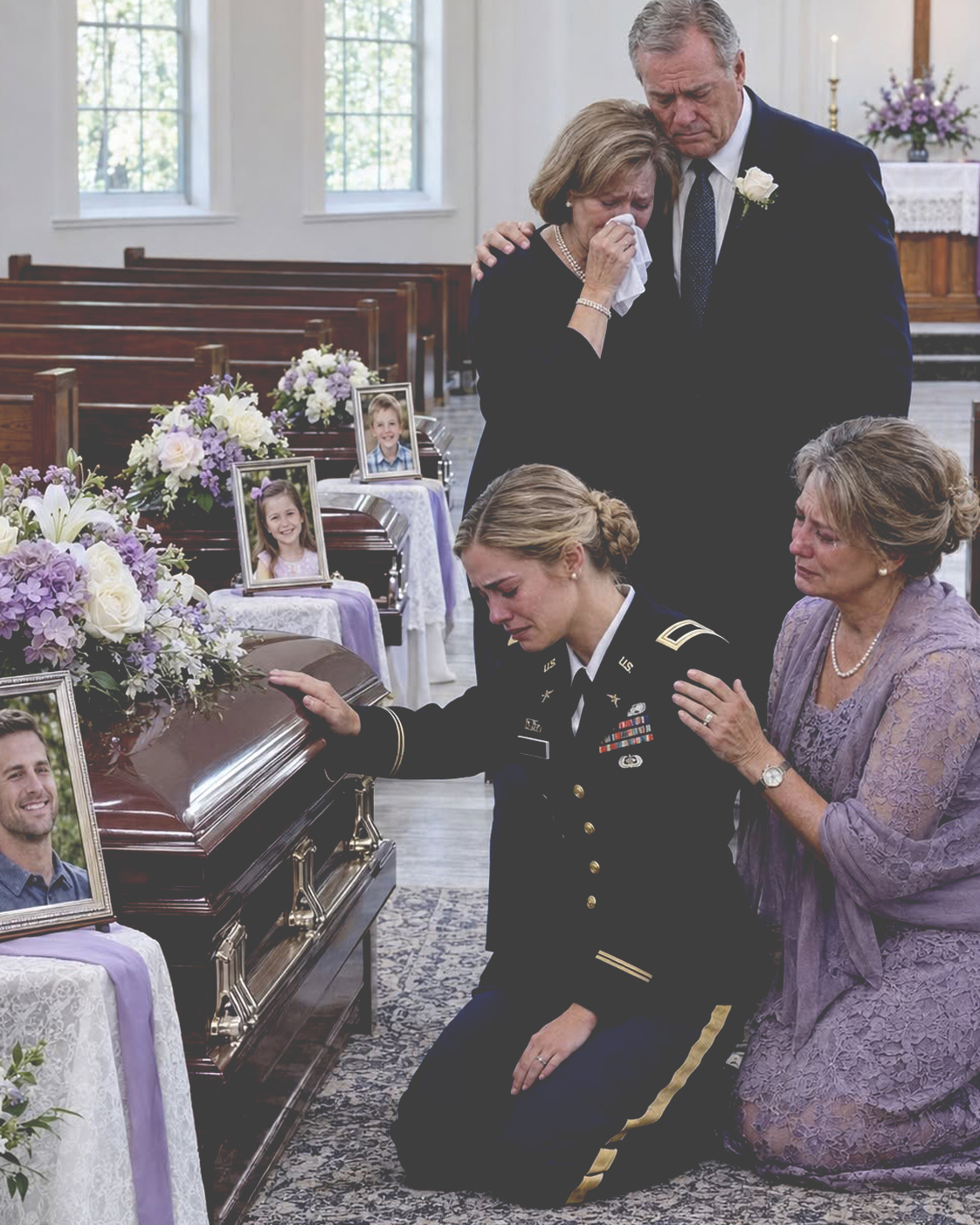
At the funeral, Samuel’s parents stayed close enough to hold me upright when my knees weakened. His mother, Joan, cried quietly beside me, her hand wrapped around mine. His father, Peter, stood at my other side, one steady palm resting on my shoulder as if he could keep me from being swept away by the moment.
The chairs reserved for my family were nearly empty.
My parents were not there. Brooke was not there. Neither were my cousins. My aunt Vivian was the one person from my side of the family who came. She had driven nearly five hours after hearing about the accident from a neighbor, because my parents had not even thought to tell her.
Three days later, my mother sent me a text. I remember the hope that rose in me when I saw her name on the screen. It lasted only until I read the message.
“I hope you’re managing. Brooke felt hurt that you didn’t call her on her birthday.”
I read it again and again, until the words blurred. Something in me seemed to go quiet. It was not peace, and it was not forgiveness. It was the moment I understood that I could no longer pretend my family would show up simply because I needed them.
For the next six months, I stopped answering their calls. There were not many, and most of the messages they sent were cheerful in a way that made them feel even farther away. They shared holiday photographs in the family group chat and sent casual invitations to Brooke’s engagement party, as though I had merely been too busy to attend.
My days were full of things no one asked about. There were legal forms, insurance calls, medical records, and boxes of belongings I could not bring myself to sort. Samuel’s coffee mug stayed beside the kitchen sink. Annie’s school jacket hung by the front door, and Owen’s small sneakers sat crooked beneath the bench where he always left them. I could not move those things, but I could not look at them for long, either.
No one in my family asked what I needed. No one asked how it felt to wake in a house that still seemed to expect the sound of children coming down the hall. I was left to learn, one day at a time, that the people I had counted on were not coming.
What the Settlement Could Not Buy
The legal process continued through the winter. It meant sitting in conference rooms while attorneys and insurance representatives discussed my family in the language of reports and numbers. Each meeting left me tired, but I understood why the work mattered. The evidence showed that the truck driver had fallen asleep at the wheel, and the company accepted responsibility for what had happened.
At one meeting, my attorney, Martin Hale, placed a folder in front of me.
“The settlement is finalized,” he said. “The total is eighteen million, seven hundred thousand dollars.”
I looked at the figure on the page. It was so large that, for a moment, it seemed to belong to someone else’s life.
I did not feel wealthy. I did not feel lucky. I felt the familiar ache of knowing that no number could buy another morning with Samuel, another drawing from Annie, or one more of Owen’s elaborate explanations about why every passing truck deserved a wave.
Martin explained how the funds would be handled and what steps I needed to take to protect them. I listened, then looked down at the folder.
“Could some of this help other families?” I asked.
He leaned forward.
“Certainly. We’d need to set it up carefully, but you could establish a foundation.”
The idea had been forming in me for weeks. I could not change what had happened to my family, but perhaps I could help another parent learn about child passenger safety or support someone left with the same kind of bewildering paperwork and grief. I wanted Samuel, Annie, and Owen to be remembered as people who had mattered, not as names attached to a headline.
“I want to do something for children,” I said. “Road safety, education, and help for families after serious accidents. I don’t want my children remembered only for how we lost them.”
The foundation began as a name written in a notebook: the Annie and Owen Child Safety Foundation. It was not grand at first. It was a purpose, and a reason to get out of bed on mornings when the quiet felt too heavy.
Samuel had always been careful behind the wheel. He checked the children’s seat belts, even when they insisted they had already done it themselves. If Owen tried to unbuckle before the car had stopped, Samuel would remind him to wait. He used to tell Annie that looking after people was a kind of courage.
I wrote that down, too.
The foundation took shape slowly, with help from Martin and a financial adviser. We discussed child passenger safety programs, community education, and assistance for families facing the practical burdens that follow a serious road accident.
Then, on a freezing Tuesday in January, my name appeared in a local news headline: WIDOW OF I-81 CRASH VICTIMS RECEIVES $18.7 MILLION SETTLEMENT, ANNOUNCES CHILD SAFETY FOUNDATION.
The article included a photograph of me beside a picture of Samuel, Annie, and Owen. I had agreed to speak because I wanted other people to understand why the foundation mattered. I had not expected the headline to travel as far as it did.
By noon, my phone had begun to ring. Some calls came from reporters, and some came from people offering condolences or asking about the foundation. Then my father’s name appeared on the screen.
He had not called in nearly six months.
I let it ring. My mother called next, then Brooke. My father tried again. When I still did not answer, a message appeared.
“We just saw the wonderful news. We’re so proud of you. Please call us, sweetheart.”
A second message followed.
“Your father and I would love to see you. We should get together as a family.”
Brooke sent her own.
“I can’t believe the settlement is eighteen million! We have so much to catch up on.”
I stared at the screen, trying to understand how they could have been absent for half a year and suddenly sound so eager to see me.
My aunt Vivian called that afternoon.
“Have your parents contacted you?”
“Yes.”
She let out a slow breath.
“I thought they might. Be careful, honey. You don’t owe anyone access to your life just because you share a last name.”
I looked at the family photograph on the mantel, the one taken at a summer picnic. Samuel was sitting in the grass with Annie leaning against his shoulder, while Owen held a toy airplane over his head.
“I know,” I said, although I was not sure I did.
At 6:18 that evening, someone knocked hard on my front door. I looked through the curtain and saw my parents’ car in the driveway. My father was on the porch, with my mother and Brooke beside him. Brooke held a bouquet of white roses.
My phone buzzed again.
“Open the door,” she had written. “We have so much to talk about.”
The roses were the same kind I had chosen for Samuel’s funeral. I stood behind the curtain longer than I meant to, then finally opened the door.
My father stepped forward with his arms raised, ready to hug me.
“There’s our girl.”
I moved back. His arms remained in the air for a moment before he lowered them.
My mother looked past me into the hall.
“You look tired, sweetheart.”
I could have told her I had been tired since the day she chose a birthday dinner over her grandchildren’s funeral. Instead I asked the one question I could manage.
“Why are you here?”
Brooke lifted the flowers.
“We came to see you.”
I looked at my father.
“After six months?”
He cleared his throat.
“Family should stick together.”
I stepped aside, just enough to let them enter. My father glanced at the photographs on the mantel, but he did not mention Samuel or the children. My mother set her handbag on the living-room table. Brooke placed the roses beside it.
Then my father turned to me.
“You’ve been through a lot.”
“Yes.”
“We’ve been worried.”
I looked at him.
“Really?”
My mother intervened before he could answer.
“We’re here because we want to reconnect.”
“You didn’t come to the funeral.”
She lowered her eyes.
“We were overwhelmed.”
“You didn’t call afterward.”
“We thought you needed space.”
“You texted me to say Brooke was hurt that I didn’t call her on her birthday.”
My mother glanced toward my sister. Brooke looked down at her purse.
My father sighed.
“We didn’t come here to argue about the past.”
That was convenient, because the past was where all the evidence of their choices lived.
I picked up the photograph from the mantel. Samuel was sitting on the lawn with Annie and Owen, taken only a few weeks before the accident. Annie had an arm around her father’s neck, and Owen held his toy airplane.
“They were your grandchildren,” I said.
My mother looked at the picture.
“They were beautiful children.”
“They were your grandchildren,” I repeated.
My father shifted in his chair.
“We heard about the settlement and wanted to make sure you’re handling everything properly.”
There it was: the first honest thing he had said since walking in.
“Why wouldn’t I be?”
He hesitated.
“It’s a lot of money.”
Brooke sat forward.
“That’s actually what we wanted to talk about.”
The Visit They Had Been Waiting For
Brooke explained that she had been thinking about starting an event-planning business. She had a proposal in mind, she said, and needed an investor. My parents had financial concerns of their own, including repairs to their house and the cost of refinancing.
I listened without interrupting. They had not asked whether I was sleeping or eating. They had not asked what it was like to live among the belongings of the people I had lost. They had come to talk about what I could do for them.
“How much are you asking for?” I said.
Brooke seemed surprised that I had asked.
“About two hundred thousand to get the business started.”
My mother added that help with the house would make a real difference. My father suggested three hundred thousand.
I nodded slowly.
“So you came here to ask me for money.”
My mother stiffened.
“Don’t make it sound ugly. Family helps family.”
“Would you have come if there hadn’t been an $18.7 million settlement?”
My father shifted in his seat.
“That’s an unfair question. We’re your parents.”
“It doesn’t answer the question.”
My mother reached toward my hand. I moved it away.
“We know we made mistakes,” she said. “The birthday dinner was already planned. There were guests coming, and we didn’t know what to do.”
I looked at her.
“My husband and children were being buried.”
Her eyes filled with tears.
“I know.”
“No, Mom. You don’t know what it was like to stand beside three caskets and look at the empty seats where my family should have been.”
Brooke crossed her arms.
“You can’t blame us forever.”
“I’m not asking you to carry my grief. I’m asking you to understand what you chose.”
She looked away.
My father stood, saying they had come to rebuild the family, not be attacked. I asked whether rebuilding meant investing in Brooke’s business and paying for their house. My mother began to cry, the way she often had when someone challenged her. For years, that sound had ended difficult conversations. My father would step in, and I would be the one to apologize.
I was no longer willing to do that.
“I’ve spent six months learning how to live without the four people I saw every morning,” I said. “You spent six months acting as if I didn’t exist. Please don’t come into my home and tell me what’s reasonable.”
My mother wiped her cheeks.
“We’re still your family.”
“Then you should have acted like it.”
They left without another word. Through the window, I watched Brooke climb into the car. My father stood by the driver’s door and looked back at the house before he drove away.
The next morning, my mother called again. I let it go to voicemail.
“Yesterday was emotional for everyone,” she said. “We need to sit down and discuss how we can help each other.”
A little later, Brooke sent a message saying Mom was crying because of what I had said. I set the phone aside and returned to the foundation’s paperwork.
Martin called to discuss its structure. Several local organizations had already contacted us: one wanted to help with child passenger safety workshops, and another was interested in supporting families after serious road accidents. For the first time in months, I felt something besides sorrow. It was small, but it was real: the sense that something useful might grow from what had happened.
I opened my notebook and wrote, Annie and Owen deserve a legacy built on love, not money.
Then I added, No one gets to turn their names into an opportunity.
That evening, Aunt Vivian came over. She listened as I told her about the visit.
“Do you think they really believe they did nothing wrong?” I asked.
“I think they’ve spent a long time protecting themselves from uncomfortable truths,” she said. “That doesn’t mean you have to pretend.”
I told her I did not want to hate my parents, but I could not go back to how things had been.
“You don’t have to,” she said. “Forgiveness, if you ever choose it, doesn’t mean giving someone your money or letting them back into your life before you’re ready.”
Two days later, my mother invited me to a family reconciliation dinner. She said Brooke wanted everyone together and that they were ready to apologize. I nearly declined, but I wanted to hear what they had to say. I also asked Aunt Vivian to come with me.
The dinner was scheduled for Saturday at the same restaurant where my family had celebrated Brooke’s birthday. I recognized the entrance and the polished floor. Six months earlier, my father had used that reservation as his reason for missing the funeral. Now I was walking through those doors to meet my family.
My mother greeted me with a broad smile.
“You came!”
Brooke stood beside her in a new dress. My father was already seated at the head of the table. There were six chairs, including one for Aunt Vivian.
Dinner began with careful, ordinary conversation. My mother asked about the foundation. Brooke asked whether the settlement had been paid. My father wanted to know how I planned to manage the funds. I answered briefly: Martin and a financial adviser were helping me establish the foundation’s structure, and its charitable funds would be kept separate from my personal finances.
My father nodded.
“Good. That’s sensible.”
Then he set down his fork.
“Now, about Brooke’s business.”
She opened a folder and slid a proposal across the table. She wanted to start an event-planning company and had researched a location, suppliers, and projected costs. I glanced at the first page, then put it back.
“Have you asked a bank?”
“They want more collateral,” she said.
“Other investors?”
“No one has committed.”
“Then keep looking.”
Her smile disappeared.
“You won’t even hear me out?”
“I’ve heard you.”
My mother leaned closer.
“Your sister has worked hard on this.”
“I believe that. She can pursue it without using my settlement.”
My father said they were not asking me to give away all my money. He suggested two hundred thousand for Brooke and three hundred thousand to help them with the house.
I looked from one to the other.
“Five hundred thousand dollars?”
My mother nodded.
“You have eighteen million.”
For a moment I could not believe she had said it so casually, as if the money had arrived without a reason.
“Do you know what that money represents to me?”
She sighed.
“Claire, please don’t start crying again.”
Aunt Vivian set down her glass. I kept my eyes on my mother.
“It represents the legal acknowledgment of what happened to my family. It represents the work I’m trying to do so another parent doesn’t receive the same phone call. Why are we sitting here discussing how much of it you can have?”
Brooke looked down at the table, then spoke in a tight voice.
“Because you’re not the only person who matters. Everything has been about you for six months—your grief, your tragedy, your foundation, your money. Everyone has to worry about what might upset you.”
I stared at her. She had said it in the same ordinary tone she might have used to complain about the weather.
“When I asked you to come to the funeral, you didn’t even answer.”
“I didn’t know what to say.”
“You could have said you were sorry.”
“I was overwhelmed.”
“So was I. I was standing beside three caskets.”
My mother picked up her napkin.
“Everyone grieves differently.”
I turned toward her.
“Did you grieve them at all? Did you miss Annie? Did you think about Owen? Did you ever wonder what Samuel’s parents were going through?”
My father stood.
“That’s enough.”
“I’m asking you to remember that you had grandchildren.”
Aunt Vivian finally spoke.
“She doesn’t need to explain herself anymore.”
Everyone turned to her. She looked steadily at my parents.
“I drove nearly five hours to attend that funeral. I saw Claire standing beside those three caskets, and I saw Joan holding her because she could barely stand. I remember the empty seats. I remember the message you sent afterward, saying Brooke was hurt because Claire hadn’t called on her birthday.”
Brooke’s face tightened.
“That was a private family matter.”
“It was a choice,” Aunt Vivian replied. “And everyone here should be honest about it.”
My father sat down. He looked older than he had at the start of dinner.
“We made a mistake,” he said. “We should have come. We should have called. We should have been there for you. I’m sorry.”
It was the first apology I had heard from him.
My mother reached across the table.
“Me too, sweetheart.”
I looked at her hand but did not take it.
“I appreciate the apology,” I said. “But it doesn’t mean I can give you money.”
My father nodded, though my mother seemed surprised.
“Then maybe we can start again,” she said.
“We can start by being honest. I don’t know whether our relationship can be what it was before, but it can’t depend on what I can give you.”
Brooke leaned back.
“So you’re saying no?”
“Yes.”
She pushed her chair away from the table. My mother gathered her handbag, and my father stared down at his plate.
“I hope you understand what you’re doing,” he said.
“I do. I’m choosing not to let money become another reason to lose myself.”
Aunt Vivian left with me. Outside, the night air felt cold against my face. For a moment, I wanted to call Samuel and tell him how the dinner had gone. The wish came so naturally that it hurt all over again. I could not call him, or Annie, or Owen. But I could decide what happened next.
The following Monday, I met with Martin. We reviewed the foundation’s plans, its governance, and the separation between charitable and personal funds. I wanted the organization to be transparent and professionally managed.
“Then let’s build something that lasts,” I told him.
For the first time since the accident, I was not only reacting to what had happened. I was making a decision about the future.
A Door Left Open
A few days later, a handwritten letter arrived from my father. I recognized his writing before I opened it. I stood at the kitchen counter for several minutes, then unfolded the single page.
He wrote that he had been thinking about the day I called. He remembered hearing my voice while Brooke’s birthday celebration continued around him, and he remembered telling himself he would call me later. He admitted he had never called. He wrote that he should have been at the hospital and beside me at the funeral, and that he had failed me.
He was not asking for money, the letter said. He was asking whether I would meet him.
I read it more than once, then called Aunt Vivian.
“What do you think?” I asked.
“Meet him only if you want to,” she said. “If he’s sorry, he can show you.”
I did not want to spend the rest of my life angry, but I also did not want to pretend the hurt had disappeared. In the end, I agreed to meet him at a public park where Samuel used to take the children on weekends.
It was a cold afternoon. The trees were bare, and the walking paths were almost empty. My father was waiting on a bench. He stood when he saw me, then gestured for me to sit. For a few minutes, neither of us said anything.
A couple walked past with a little girl in a bright pink jacket. My father watched them.
“I keep thinking about Annie,” he said.
I waited.
“She used to send me drawings. She made me a birthday card once. I still have it.”
I nodded.
“She loved drawing.”
He rubbed his hands together.
“She wrote that I was the best grandfather in the world. I don’t know how I became someone who couldn’t even attend her funeral.”
I looked at the ground. It was the first time I had heard him speak about Annie without trying to change the subject.
“I don’t know either,” I said.
He nodded.
“Your mother and I kept telling ourselves that giving you space was the right thing. The longer we waited, the harder it got to call. Then we saw the headline, and I realized how much time had passed.”
I looked at him.
“Why did you ask about the money?”
He lowered his eyes.
“We were thinking about ourselves. Brooke had been talking about her business, and your mother and I were worried about our finances. We convinced ourselves it was reasonable to ask. We forgot what the money represented.”
“You forgot what happened to my family.”
He nodded.
“Yes.”
We watched a boy run down the path, trying to catch a leaf that had come loose from a tree. For a moment, I could almost imagine Owen doing the same. The ache arrived so quickly that I pressed my lips together.
When I looked back at my father, I asked the question I had been carrying since the funeral.
“Did you know I was alone afterward?”
He frowned.
“What do you mean?”
“Did you know I couldn’t sleep? That I kept walking into the children’s rooms because I didn’t know where else to go? Did you ever wonder whether I was eating, or how it felt to sit in the car because I couldn’t bring myself to walk into the house?”
His eyes filled.
“No. I didn’t know.”
“That was the problem. You didn’t ask.”
He covered his face for a moment.
“I should have known.”
“Yes.”
He reached toward my hand but stopped before touching it.
“I want to do better.”
I looked toward the path.
“Then don’t ask me to forget. Don’t ask me for money. And don’t expect everything to return to normal.”
“I understand.”
I was not sure he understood all of it, but for once he did not argue. When he asked whether he could visit sometime, I said not yet. Maybe later. He accepted that answer without pressing me.
That evening I went to see Joan and Peter. They had become the people I called when the world felt too heavy. Joan was making tea in the kitchen, and Peter was reading in the living room. I told them about the meeting.
Joan listened, then put her arms around me.
“I’m glad you had the conversation,” she said. “You don’t have to decide today whether you can forgive them.”
Peter brought over a small box. He and Joan had found it while sorting some of Samuel’s belongings. Inside were photographs: Samuel at the beach with Annie, Owen asleep against his father’s shoulder, and a folded note in Samuel’s handwriting.
It was addressed to me.
He had written that I made our house feel like home, that the children were lucky to have me, and that he hoped they would always know how deeply they were loved. I held the note against my chest and let myself cry. Joan stayed beside me while Peter quietly looked away.
I might never be the person I was before the accident. But I could still carry the love Samuel and the children had given me.
Over the next few months, the foundation began its work. We partnered with local organizations on child passenger safety education and began planning assistance for families facing the practical burdens that follow serious accidents. I wanted the foundation to be useful, not simply a monument to my sadness.
At our first public event, I stood beside a photograph of Samuel, Annie, and Owen. Annie was laughing, and Owen was making a silly face while Samuel smiled behind them.
“My name is Claire Bennett,” I began. “My husband and two children were lost in a road accident that could have been prevented.”
I told the audience their names and a little about who they were. Annie loved drawing flowers on anything she could find. Owen believed every passing truck deserved a wave. Samuel took care of the people around him as naturally as he breathed.
“I can’t give them another birthday or hear their laughter again,” I said. “But I can help make sure their names are connected to something that protects other children. This foundation exists because their lives mattered, and because the love they gave us still matters.”
Afterward, a woman approached me with her young son. Her husband drove long distances for work, she said, and she wanted to learn more about keeping their children safe.
“That’s why we’re here,” I told her.
A few weeks later, my mother asked if she could visit the foundation. I did not answer right away. Then I wrote that she was welcome to attend a public event, but I was not ready for private visits. She replied that she understood.
Brooke later sent an apology for making the dinner about her business. I read her message carefully before answering. I told her I needed her to remember Annie and Owen as people, not as the reason money had entered my life. Several days later, she wrote that she understood and was sorry.
I did not know what the future would hold with my parents or my sister. Perhaps we would rebuild something slowly. Perhaps we would not. I had stopped believing that being related to someone meant I had to accept whatever they offered.
One Sunday morning, I drove to the cemetery with three bouquets: white roses for Samuel, purple flowers for Annie, and small yellow daisies for Owen. The grass was damp from the night’s rain. I placed each bouquet carefully, then sat beside them and told them about the foundation.
I told Annie her name was helping other children. I told Owen that people were learning how to keep little passengers safer. I told Samuel that I was trying to live, and that I was trying to stop blaming myself for surviving.
“I miss you,” I whispered. “Every single day.”
When I returned home, the house was still quiet, but it no longer felt quite as frightening. Samuel’s coffee mug remained in the kitchen. Annie’s jacket still hung near the front door, and Owen’s shoes were still tucked beneath the bench. I was not ready to move them. Maybe I never would be. But now they reminded me that our home had once been full of love.
My father sent one more message that evening, saying he was sorry they had not been there when I needed them and that he hoped one day they could earn another chance.
I read it twice, then set my phone beside Samuel’s old coffee mug. I did not reply—not to punish him, but because I had learned that an apology can open a door without requiring me to walk through it before I am ready.
The settlement gave me financial security. The foundation gave me a purpose. Samuel, Annie, and Owen had given me a love I would carry for the rest of my life.
I had once believed that losing my husband and children meant losing my entire family. Now I understood that family was also Joan holding my hand beside three graves, Peter standing near me when I could not stand alone, and Aunt Vivian driving across the state because she believed I should not have to face the worst day of my life by myself.
I would always miss the people I had lost. Nothing could change that. But I was no longer waiting for the people who had abandoned me to give me permission to heal.
I had spent six months wondering why my family had not come to the funeral. Now I had a different question: What could I build with the love that remained?
I knew the answer. I would help children travel more safely. I would tell their stories. I would protect the names of the people I loved.
And I would never again confuse being wanted for what I had with being loved for who I was.